

Technical expertise helps keep sterile processing work aligned with established procedures, but it doesn’t automatically prepare a manager to lead people through staffing gaps, shifting priorities, and operational setbacks. Developing leadership skills for SPD managers means turning technical standards into consistent team behaviors, especially when pressure makes communication and accountability harder to maintain.
Knowing the workflow isn’t always enough to resolve a team or department challenge. SPD managers also need to communicate clearly, coach staff, make informed decisions, and coordinate with partners across the facility.
This guide outlines leadership capabilities that matter in SPD management and gives you a practical way to strengthen them through everyday department work. It also explains how specialized education can support your development, and how consulting or interim management can address department needs that extend beyond an individual learning plan.
An SPD manager’s technical knowledge is essential, but reliable department performance also depends on how that knowledge is communicated, coordinated, and applied by the team. Leadership means translating department priorities, technical processes, and staff needs into clear daily practices, then using operational judgment when conditions change. Developing leadership skills for SPD managers bridges the gap between knowing how work should proceed and guiding people through the demands of carrying it out.
Technical competence supports sound decisions about sterile processing work. People leadership adds the ability to clarify expectations, listen to staff concerns, address performance issues, and coordinate with other departments. Operational judgment helps managers weigh competing priorities without losing sight of established processes. These responsibilities are related, but they call for different behaviors. Expertise in a workflow alone doesn’t guarantee clear handoffs or consistent follow-through.
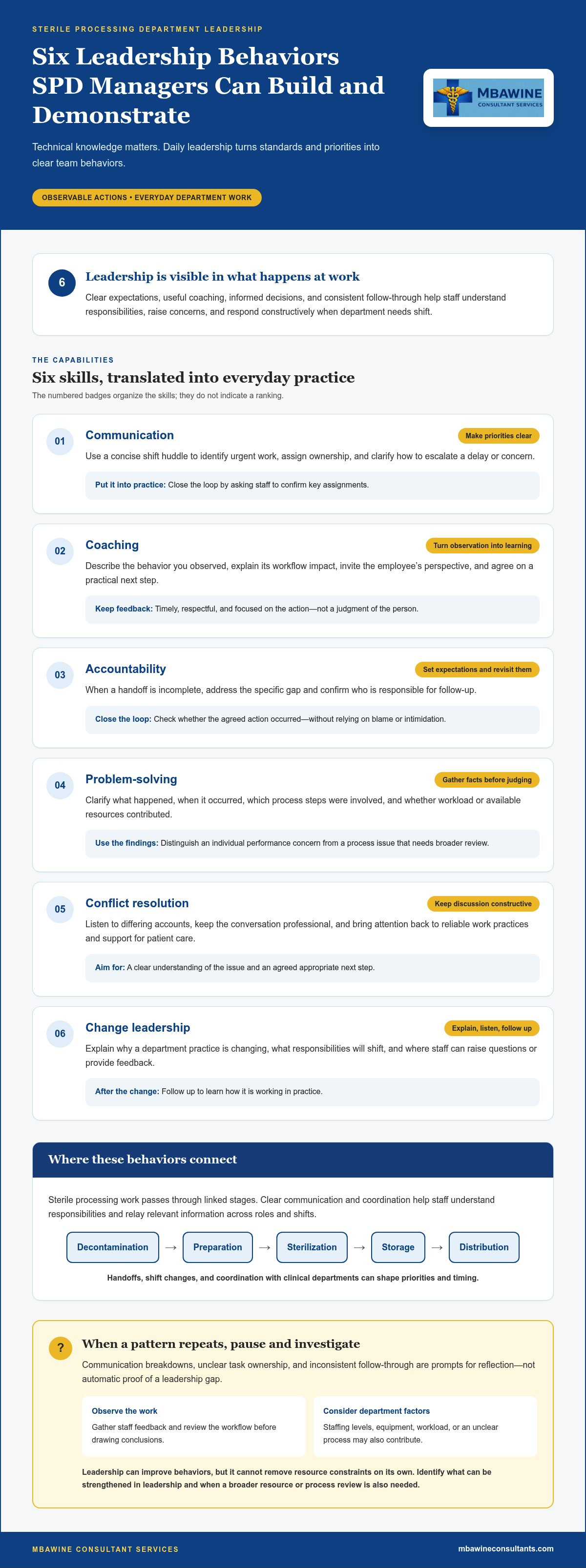
Sterile processing involves linked stages, from decontamination and preparation through sterilization, storage, and distribution. Work passes between roles and shifts, and coordination with clinical departments can shape priorities and timing. A manager’s communication helps staff understand responsibilities, relay relevant information, and raise concerns when a handoff or workload changes. Clear leadership supports quality-minded practice, though it can’t guarantee that errors will never occur.
Leadership development can strengthen individual capability and the way people work together. The broader distinction described in Leadership development approaches is relevant to SPD: a manager may build personal skills while also fostering shared understanding and coordination across the team. Both matter when each stage depends on effective transitions to the next.
Repeated communication breakdowns, unclear task ownership, and inconsistent follow-through are useful prompts for reflection. If staff regularly receive conflicting direction during a shift change, for example, examine how priorities and responsibilities are being communicated. If a concern is raised but no one knows who will address it, clarify who owns the follow-up and when it should happen.
These patterns don’t automatically point to a leadership skills gap. Staffing levels, equipment, workload, or an unclear process may also contribute, and leadership alone can’t remove resource constraints. Gather staff feedback and observe the workflow before drawing conclusions. The aim is to identify leadership behaviors that can improve, while recognizing when a department-level resource or process review is also needed.
Effective SPD leadership is visible in daily actions, not simply in a manager’s confidence or technical background. The qualities of effective sterile processing leadership include operational knowledge and the ability to guide a team. Developing leadership skills for SPD managers means practicing behaviors that help staff understand expectations, raise concerns, and respond constructively as department needs shift.
Communication means sharing priorities and responsibilities clearly. A concise shift huddle can identify urgent work, assign ownership, and clarify how staff should escalate a delay or concern. Close the loop by asking staff to confirm key assignments instead of assuming the message reached everyone.
Coaching turns an observed behavior into a useful learning conversation. Describe what you saw, explain its impact on the workflow, invite the employee’s perspective, and agree on a practical next step. Keep feedback timely and respectful, and focus on the action rather than judging the person.
Accountability means setting clear expectations and returning to them consistently. If a handoff is incomplete, address the specific gap, confirm who is responsible for follow-up, and check whether the agreed action occurred. This supports responsibility without relying on blame or intimidation.
Problem-solving starts with gathering relevant facts. When a workflow concern arises, clarify what happened, when it occurred, which process steps were involved, and whether workload or available resources contributed. This helps distinguish an individual performance concern from a process issue that needs broader review.
Conflict resolution requires listening to differing accounts, keeping discussion professional, and bringing attention back to reliable work practices and support for patient care. Clarify the issue and agree on an appropriate next step instead of allowing disagreement to remain unresolved or become personal.
Change leadership means explaining why a department practice is changing, what responsibilities will shift, and where staff can raise questions or provide feedback. Make expectations clear, then follow up to learn how the change is working in practice. Deliberate workplace practice and feedback can strengthen these behaviors alongside relevant sterile processing education. For structured foundational learning, explore sterile processing classes as one component of ongoing professional development.
Developing leadership skills for SPD managers works best when structured learning is paired with deliberate workplace application. A course can introduce management concepts and strengthen sterile processing knowledge, but applying those concepts consistently under operational pressure takes practice, feedback, and reflection.
Formal education offers a planned way to study relevant concepts and relate them to sterile processing responsibilities. The AONL Nurse Leader Core Competencies provides a healthcare leadership framework to reference when considering areas such as communication and knowledge of the healthcare environment. Choose learning objectives based on your role and observed needs, rather than starting with only a broad goal to “be a better leader.”
Sterile processing classes can also strengthen the technical context for leadership decisions. Education builds knowledge; application and feedback help translate that knowledge into workplace behavior.
Choose one behavior to practice in a routine setting, such as clarifying ownership during a huddle or using a consistent structure for a coaching conversation. A mentor can help you review a decision, consider what information informed it, and discuss alternative responses. Peer learning brings perspectives from colleagues facing comparable department challenges. Reflective practice helps you record what happened, what evidence suggests progress, and what barriers may call for an adjustment.
| Approach | Best use and strength | Consideration |
|---|---|---|
| Formal education | Builds organized concepts and relevant knowledge. | Learning needs workplace application. |
| Mentoring | Provides perspective on decisions and possible responses. | Depends on regular, candid discussion. |
| Peer learning | Exposes managers to approaches used by colleagues. | Ideas must be adapted to local workflows. |
| Reflective practice | Helps identify patterns, progress, and barriers. | Reflection is more useful when tied to specific observations. |
| Coaching | Focuses attention on a target behavior and feedback. | Requires follow-up to assess application. |
Individual development and department-level support address different needs. When operational challenges extend beyond one manager’s learning goals, consulting or interim leadership can support broader improvement. The sterile processing interim leadership guide explores that distinction and can help clarify whether the priority is an individual skill or a wider department need.
A useful development plan connects a specific leadership behavior to a real department responsibility. Instead of trying to improve every management skill at once, choose one or two priorities, practice them during routine work, and review what changes. This keeps developing leadership skills for SPD managers grounded in observable actions rather than broad intentions.
Start with evidence: recurring workflow challenges, staff feedback, and your own responses to difficult situations. Look for patterns such as handoffs that regularly need clarification or follow-up that gets missed when priorities compete. Then consider whether the cause is a knowledge gap, process design, staffing, equipment, or limited decision-making authority. Leadership practice can address some needs, but it can’t resolve every operational constraint.
Write a goal that names both the behavior and the setting. For example: “During shift huddles, I’ll confirm task ownership and ask whether staff have unresolved concerns.” A defined action is easier to practice and review than a goal such as “improve communication.”
Use an existing department routine as the practice setting, then follow this sequence:
Keep reflection brief and tied to existing routines rather than creating extensive paperwork. Look for practical indicators, such as clearer handoffs, staff who know whom to approach with a concern, or more consistent follow-through. If the behavior isn’t helping, refine the goal or consider whether an underlying resource or process issue is getting in the way.
Structured education can complement workplace practice by strengthening relevant sterile processing knowledge. Explore sterile processing classes as part of a broader development plan. If your assessment points to a department-wide process or leadership need, Mbawine Consultant Services provides sterile processing consulting to support broader operational needs.
Developing leadership skills for SPD managers involves more than refining communication or team-management behaviors. Managers also need role-relevant sterile processing knowledge to assess workflows and guide staff appropriately. Education can strengthen that foundation, while practice and feedback help translate learning into decisions and behaviors suited to the manager’s responsibilities and facility processes.
Structured learning can help when a manager identifies a knowledge area connected to current responsibilities or a specific development priority. If you need to strengthen your understanding of sterile processing concepts to explain procedures clearly or evaluate a workflow concern, education offers a focused way to build that knowledge. Mbawine Consultant Services provides specialized sterile processing education in person and online, including classes designed to prepare professionals for certification.
Education complements workplace practice; it doesn’t replace feedback, experience, or facility-specific processes. Connect learning to a practical goal, then reflect on how you apply it in team discussions, workflow reviews, or staff support. For broader context on learning pathways, read the sterile processing education and certification guide.
Some challenges extend beyond one manager’s skills plan. Persistent workflow concerns, repeated gaps in leadership coverage, or operational needs that require broader assessment may call for department-level support. Mbawine Consultant Services provides sterile processing consulting to address organizational needs and interim management to provide leadership support for healthcare facilities. These options support department-level needs while still requiring attention to the underlying issue.
Ask whether the primary need centers on a manager’s capability or on department operations and leadership coverage. Individual learning can strengthen a manager’s knowledge and practice; organizational support can address needs involving wider department conditions. Both can have a role, depending on the situation.
Managers ready to build their sterile processing knowledge can explore sterile processing enrollment options and consider how structured education may complement ongoing leadership development.
Effective SPD leadership grows when managers turn technical knowledge into clear expectations, thoughtful decisions, and consistent team practices. Developing leadership skills for SPD managers is an ongoing process: identify a priority, practice a specific behavior, seek feedback, and adjust as department needs evolve.
Specialized sterile processing education and certification preparation can strengthen the knowledge that supports leadership practice. In-person and online classes provide learning options, while consulting and interim management support healthcare facilities when department needs extend beyond an individual manager’s development plan. Each form of support serves a different purpose, and applying learning in the workplace remains essential.
Choose a next step that aligns with your professional goals. Explore sterile processing enrollment options to see how further education can complement your growth. Build your leadership plan with Mbawine Consultant Services’ sterile processing classes, and take the next step toward guiding your team with clarity and purpose.
Communication, coaching, accountability, decision-making, and adaptability are central to effective SPD management. Managers need to clarify priorities across shifts, provide respectful feedback, and follow up on agreed responsibilities. They also need to assess workflow concerns before responding and adjust plans when workload or department needs change. These behaviors help teams coordinate their work while keeping established processes in view, though leadership can’t remove every staffing or resource constraint.
An SPD manager can develop leadership skills through a focused cycle integrated into routine work. Assess a recurring challenge using staff feedback and workflow observations, then choose one behavior to practice, such as confirming task ownership during a handoff. Seek feedback from a trusted colleague or team member, and briefly reflect on what happened, what helped, and what to adjust. Keeping the focus narrow makes development more manageable alongside daily responsibilities.
Yes. Technicians can practice leadership behaviors without holding formal authority. Clear communication, reliable follow-through, and initiative on assigned responsibilities build habits that support effective teamwork. A technician might help a colleague understand a workflow step, raise a process concern through appropriate channels, or share relevant information during a handoff. These actions should remain within the person’s role and facility procedures; they demonstrate professional contribution, not authority to direct others.
Technical expertise helps a manager understand sterile processing work, but managing a department also requires guiding people and coordinating priorities. Managers communicate expectations, clarify responsibilities, address concerns, and follow up on agreed actions. They must also use operational judgment when workload changes or competing needs arise. Developing leadership skills for SPD managers connects process knowledge with the communication and accountability needed to support consistent team practice.
Relevant sterile processing education can strengthen the technical knowledge managers draw on, while leadership learning can help them examine communication, coaching, and decision-making. Choose learning objectives that relate to actual responsibilities and identified development needs. Mbawine Consultant Services provides specialized sterile processing classes and certification preparation in person and online. A course can introduce concepts, but managers still need workplace practice, feedback, and reflection to apply learning within facility-specific processes.
Look for observable changes tied to a specific development goal. Examples include clearer handoffs, staff who understand task ownership, more timely feedback, or consistent follow-through on agreed actions. Ask colleagues or team members whether communication is clearer, and compare their feedback with your workflow observations. Brief, recurring reflection can help identify progress and barriers. Use these indicators to guide adjustment rather than relying on unsupported numerical targets or assumptions.
Consider department-level support when persistent operational or leadership coverage needs extend beyond one manager’s development priorities. Recurring workflow challenges may call for broader assessment, while a leadership coverage gap may make interim management relevant. Mbawine Consultant Services provides healthcare sterile processing consulting and interim management as organizational support. Clarifying whether the need is individual skill development or a wider department issue helps identify the appropriate direction.

Article by
Mba Akuribila
Mba‑Akuribila is a healthcare leader, educator, and founder of Mbawine Consultants, a Bronx‑based institution recognized nationwide for advancing excellence in sterile processing and allied health workforce development. Born in Bongo in Ghana’s Upper East Region, his journey from rural beginnings to national impact reflects a lifelong commitment to service, empowerment, and community advancement.
For over two decades, he has trained sterile processing employees, mentored, and placed thousands of healthcare professionals across the United States. Through Mbawine Consultants, he established one of the country’s most trusted Sterile Processing Certification Test Prep Programs, preparing new Americans and career‑changers for successful entry into the field. The organization, as at 2026, has graduated more than 15,000 sterile processing technicians who now serve in hospitals, ambulatory centers, dental practices, and reprocessing facilities nationwide.
Under his leadership, Mbawine Consultants has expanded into a full Healthcare Staffing Agency, connecting nurses and allied health professionals to meaningful employment opportunities. His team also provides Interim Management Services, supporting hospitals and surgical centers with experienced leaders who stabilize operations, strengthen compliance, and improve workflow efficiency.
As a former surgical technician, sterile processing manager, educator, and system‑wide director, Mba‑Akuribila brings deep expertise to Sterile Processing Consulting, helping healthcare facilities elevate quality, safety, and regulatory readiness.
His work in the United States and Ghana continues to reflect his core philosophy: service above self, opportunity for all, and excellence without compromise.


