

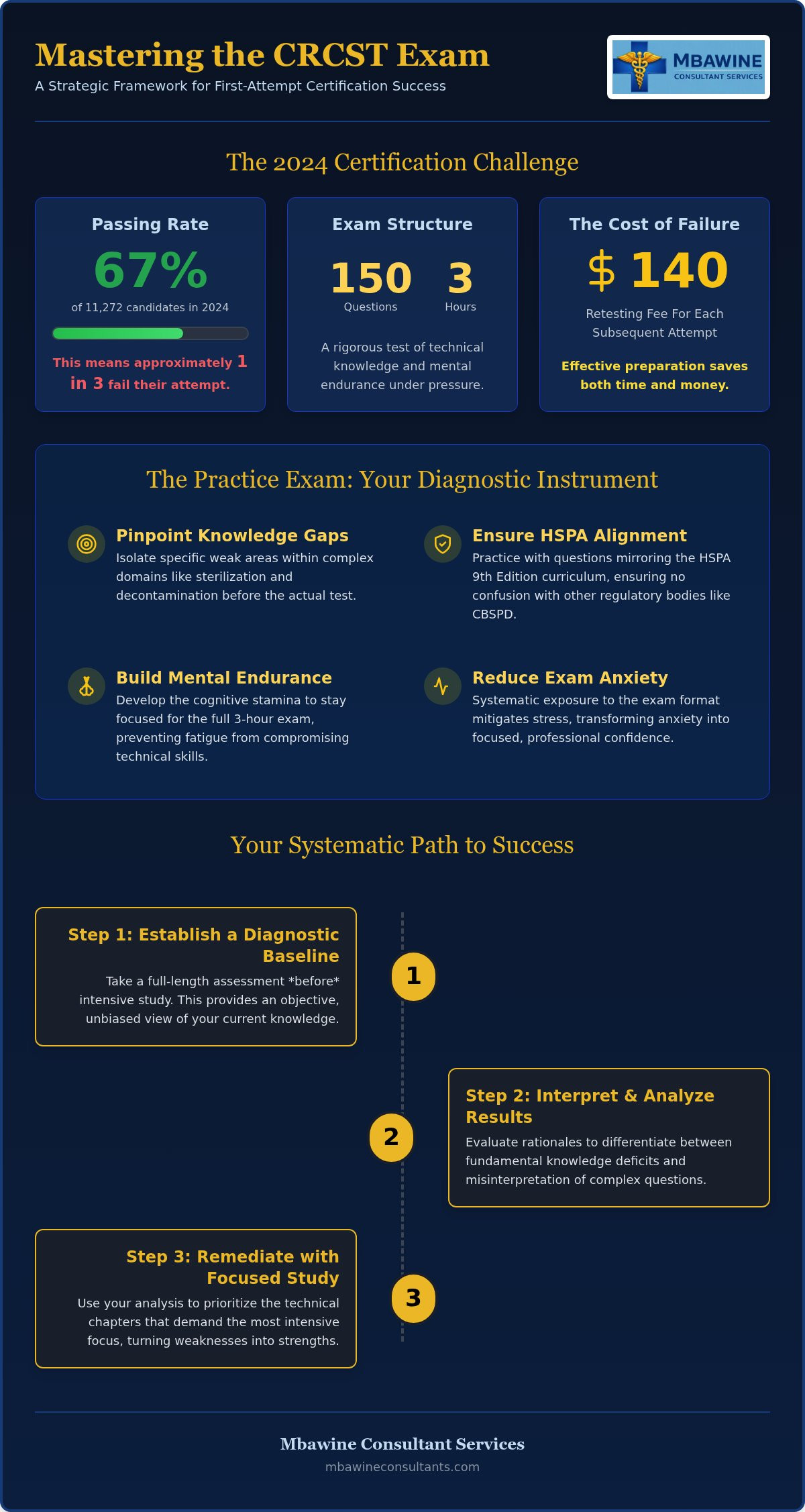
In 2024, approximately 67% of the 11,272 candidates who attempted the Healthcare Sterile Processing Association certification exam achieved a passing score, a statistic that underscores the rigorous nature of this professional benchmark. For many aspiring technicians, the prospect of failing this critical assessment is not merely a matter of professional delay but also a significant financial concern, as each subsequent attempt requires an additional $140 retesting fee. You likely recognize that the breadth of the Ninth Edition Technical Manual presents a daunting challenge, particularly when attempting to differentiate between HSPA requirements and those of the CBSPD. Utilizing a professional crcst practice exam serves as more than a simple rehearsal; it functions as a sophisticated diagnostic instrument designed to isolate specific knowledge gaps within complex technical domains such as sterilization and decontamination.
This guide provides a comprehensive framework for leveraging these practice assessments to build the clinical confidence necessary for first-attempt success. By following a structured roadmap, you will learn to interpret exam rationales and prioritize the technical chapters that demand the most intensive focus. We will examine how to transform your study sessions into a systematic preparation process, ensuring you meet the institutional standards required for professional certification and the maintenance of public safety.
The Certified Registered Central Service Technician (CRCST) designation represents more than a mere professional credential; it signifies a technician's comprehensive understanding of the complex biological and mechanical processes required to safeguard patient health. Within this framework, a professional crcst practice exam serves as a formalized diagnostic tool that allows candidates to measure their current knowledge against the high-stakes requirements of the Healthcare Sterile Processing Association (HSPA). Standardized testing in this field isn't designed to reward rote memorization but rather to ensure that every practitioner can apply the fundamental principles of sterilization within a high-pressure clinical environment. This systematic approach to assessment acts as a necessary bridge, transitioning the student from entry-level education to the advanced technical mastery required to maintain institutional standards and protect public safety.
Professional study materials must maintain strict academic reliability to be effective. A high-quality practice assessment is meticulously engineered to mirror the HSPA 9th Edition curriculum, ensuring that the technical vocabulary and procedural logic align with current industry regulations. These standardized questions don't exist in a vacuum; they reflect real-world clinical scenarios that technicians encounter daily in the decontamination and sterile storage areas. By engaging with these simulated environments, candidates ensure their preparation is grounded in the same regulatory rigor that governs modern healthcare facilities. This alignment ensures that there's no confusion between HSPA standards and other regulatory bodies, providing a clear path toward successful certification.
Success on the certification hurdle requires more than technical knowledge; it demands significant mental endurance and a disciplined professional mindset. The actual examination consists of 150 multiple-choice questions that must be completed within a three-hour window, a task that often induces high levels of anxiety in even the most prepared candidates. Systematic exposure to the exam format through professional assessments helps mitigate this stress by familiarizing the student with the rhythmic demands of the testing center. This process builds the cognitive stamina necessary to remain focused throughout the duration of the test, ensuring that fatigue doesn't compromise the application of technical competencies. Through structured learning, such as the Sterile Processing classes offered by Mbawine Consultant Services, candidates transform their anxiety into a focused commitment to professional excellence, establishing the confidence required to pass on their first attempt.
Achieving professional certification requires more than a casual review of technical manuals; it demands a methodological study regimen that utilizes assessment data to drive improvement. A structured approach ensures that a candidate's progression along the sterile processing technician certification path is both measurable and efficient. By treating every crcst practice exam as a high-fidelity simulation rather than a simple quiz, you establish the mental discipline required for the actual HSPA testing environment. This systematic framework moves beyond the limitations of randomized flashcards, providing a clear roadmap from initial assessment to final readiness.
Don't begin your study journey with intensive review. Instead, establish a diagnostic baseline by taking a full-length assessment before opening your textbooks. This initial attempt provides an objective view of your existing knowledge, allowing you to record specific scores across critical domains such as cleaning, decontamination, and sterile storage. By identifying immediate strengths and weaknesses without the influence of recent review, you can set realistic performance benchmarks for the duration of your study period. This data-driven starting point ensures that your subsequent efforts are focused on the areas of greatest need rather than content you have already mastered.
Once you have identified your technical deficiencies, your study hours should prioritize the lowest-performing chapters from your baseline. This phase connects practice questions back to the primary professional sterile processing education materials, ensuring that you understand the underlying theory behind each procedure. It's essential to incorporate FDA sterilization guidelines into this review to ensure your technical knowledge aligns with federal regulatory standards. Utilizing spaced repetition intervals during this phase facilitates long-term knowledge retention, transforming temporary memorization into professional competency.
The final stage of preparation involves taking full-length exams in a controlled environment to verify readiness in the week preceding the official test. During these simulations, you must master the pace of professional assessment to ensure you can navigate the 150-question hurdle within the three-hour limit. Success in this phase is not just about the final score; it requires analyzing the "why" behind every incorrect answer rationale to bridge any remaining gaps in logic. Candidates should aim for a consistent score of 85% or higher across multiple attempts before scheduling their official HSPA exam. Individuals seeking a structured environment for this rigorous remediation process should consider how to enroll in professional training to ensure every technical domain is fully mastered.
The Certified Registered Central Service Technician examination is meticulously structured around seven core domains that define the professional standards of sterile processing. A high-fidelity crcst practice exam must accurately reflect the weight of these specific domains, particularly the high-priority areas of decontamination and sterilization, which together comprise 42% of the total assessment. Beyond these technical foundations, candidates must demonstrate proficiency in instrumentation identification, inventory management, and the maintenance of clinical supply chain integrity. This comprehensive assessment ensures that technicians possess the analytical skills required to manage complex surgical tools and equipment, identifying potential points of failure before they reach the operating room. Mastery across these domains isn't just about passing a test; it's about ensuring that every medical device processed meets the highest safety standards.
Decontamination serves as the foundational barrier against healthcare-associated infections, making it a critical focus of professional certification. Within a practice environment, questions regarding this domain focus heavily on the selection and use of Personal Protective Equipment (PPE) and the proper handling of biohazardous waste. Candidates must understand the specific chemical properties of enzymatic cleaners and detergents, ensuring that the selected cleaning agents are compatible with both the soil type and the instrument material. Additionally, the critical role of water quality cannot be overlooked, as mineral content and pH levels directly influence the efficacy of the decontamination process. Mastering these technical nuances is essential for any professional seeking to ensure patient safety through rigorous adherence to institutional standards.
The sterilization domain requires a deep understanding of varied modalities, including saturated steam, ethylene oxide (ETO), and low-temperature methods. A robust crcst practice exam challenges the candidate to interpret biological and chemical indicators correctly, ensuring that every cycle meets the physiological parameters required for total microbial destruction. Documentation requirements remain a significant focus, as precise record-keeping is vital for regulatory compliance and audit readiness during healthcare inspections. Troubleshooting common sterilization failures, such as wet packs or indicator changes that don't meet expected results, prepares the technician for the high-stakes environment of the Central Service department. For those who find these technical complexities challenging, engaging with Sterile Processing classes provides the expert-led instruction necessary to transition from theoretical knowledge to professional mastery.
Merely checking for a passing score on a crcst practice exam is a superficial approach that often masks underlying technical vulnerabilities. True preparation requires a candidate to categorize every error with clinical precision, distinguishing between a fundamental lack of knowledge and a simple misinterpretation of the question's phrasing. Professional candidates must commit to reading every rationale provided, even for questions they answered correctly, to confirm that their reasoning aligns with HSPA standards. This level of analytical rigor is an essential component of comprehensive sterile processing technician training, as it ensures that the student isn't just memorizing answers but is instead internalizing the logical framework of the profession.
HSPA examinations are designed to test more than basic memory; they employ sophisticated "distractor" answers that are technically accurate in some contexts but incorrect for the specific scenario presented. Mastering the terminology used by HSPA to describe sterilization stages is paramount, as subtle differences in wording can significantly alter the required response. It's critical to recognize when a question is asking for the "best" long-term solution versus the immediate "first" action required in an emergency or contamination event. By utilizing a high-quality crcst practice exam, candidates learn to navigate these linguistic hurdles, ensuring they can provide the precise technical answers required by the certification board.
Once patterns of error are identified, candidates should develop a formalized deficiency report that tracks performance trends across the seven HSPA domains. This report serves as a roadmap for remediation, indicating where to focus intensive study hours before the official testing date. Creating specific flashcards for technical definitions that were previously missed helps reinforce long-term retention through spaced repetition. For complex sterilization concepts that remain unclear, consulting professional mentors or experienced instructors can provide the specialized insight needed to bridge the competency gap. Re-testing specific domains until a consistent 85% proficiency is achieved is the only way to ensure readiness for the professional environment. To secure your path to success and gain access to expert-led instructional support, you should enroll in professional certification classes to finalize your preparation.
While the individual use of a crcst practice exam is a necessary step in the certification journey, the most reliable pathway to institutional mastery involves a structured educational environment led by industry veterans. Mbawine Consultant Services approaches certification preparation as a mission-driven process, integrating diagnostic assessments into an expert-led instructional syllabus that reflects the most current HSPA standards. This methodology ensures that the transition from student to certified professional is supported by a foundation of academic reliability and clinical accuracy, moving beyond the limitations of isolated self-study. By placing the crcst practice exam within a broader context of professional development, we allow candidates to see the direct correlation between theoretical questions and the practical realities of surgical instrument reprocessing.
Structured learning environments, whether delivered through web-conferencing or in-person instruction, offer a level of pedagogical depth that static study bundles cannot replicate. Participants in our sterile processing classes benefit from a curriculum that is continuously updated to mirror the evolving regulatory landscape of modern healthcare facilities. By engaging with complex technical domains under the guidance of a seasoned mentor, candidates develop the critical thinking skills required to manage the high-stakes demands of a contemporary Sterile Processing Department. This comprehensive approach prepares technicians not just to pass an exam, but to function as authoritative guardians of public safety within their respective institutions. The syllabus is designed to bridge the gap between entry-level education and advanced technical mastery, fostering an environment where technical proficiency and ethical responsibility are prioritized equally.
Professional excellence is a continuous journey that begins with a commitment to rigorous preparation and high-level knowledge. For those ready to advance their careers, the opportunity to enroll in professional certification preparation provides the resources necessary to navigate the HSPA certification hurdle with confidence and precision. Beyond education, Mbawine Consultant Services maintains a significant presence throughout the healthcare sector by providing healthcare temp staffing and interim management expertise, acting as a reliable partner for both individual professionals and complex medical facilities. This breadth of institutional experience informs our instructional methods, providing students with a perspective that is grounded in the operational realities of the field. By choosing a path of structured learning, you don't just prepare for a crcst practice exam; you establish the credentials required to lead and advocate for excellence in the field of sterile processing.
Achieving the Certified Registered Central Service Technician credential requires a disciplined commitment to technical mastery and a systematic approach to study. By utilizing a crcst practice exam as a precise diagnostic instrument, you can isolate technical deficiencies and prioritize the high-stakes domains of decontamination and sterilization. This analytical process ensures that your preparation aligns with the rigorous standards set by the Healthcare Sterile Processing Association, transforming the challenge of certification into a significant milestone of professional achievement. It's a journey that demands focus, but the result is a career defined by expertise and reliability.
Mbawine Consultant Services is dedicated to fostering professional leadership through an expert-led sterile processing training curriculum that is meticulously aligned with current HSPA standards. Our comprehensive syllabus provides the structured environment necessary to move beyond entry-level knowledge toward advanced clinical competency. We invite you to Enroll in Professional CRCST Certification Preparation Today to ensure your first-attempt success and establish a foundation for long-term career excellence. Your dedication to these industry standards remains the primary safeguard of patient safety and institutional integrity.
The official HSPA certification examination consists of exactly 150 multiple-choice questions that must be completed within a three-hour time limit. This computer-based assessment is designed to evaluate a candidate's technical proficiency across seven distinct knowledge domains. Candidates must manage their pace effectively to ensure all items are addressed, as the exam requires sustained cognitive focus to navigate the complex clinical scenarios presented throughout the entire three-hour testing period.
HSPA utilizes a scaled scoring methodology rather than a simple raw percentage to determine a passing result for the certification assessment. While the specific scaled score required for success isn't publicly disclosed, historical data from 2024 indicates that approximately 67% of candidates passed the examination. Professionals are encouraged to achieve a consistent score of 85% or higher on a crcst practice exam to ensure they possess the technical depth necessary to meet these standards.
Candidates should integrate a crcst practice exam into their study regimen at least three times to track professional development effectively. An initial assessment establishes a diagnostic baseline, while a second attempt mid-way through the curriculum identifies remaining technical deficiencies. Finally, a full-length simulation should be conducted in the week preceding the official test to verify readiness. This structured approach ensures that study efforts remain focused on high-priority knowledge gaps rather than redundant review.
Professional practice assessments are designed to simulate the format and technical rigor of the HSPA examination but aren't identical to the official test items. These simulations utilize the HSPA 9th Edition Technical Manual and ANSI/AAMI standards to create questions that mirror the logic and vocabulary required for certification. Using high-quality third-party assessments allows candidates to familiarize themselves with the style of questioning without violating the confidentiality agreements associated with the official process.
Even after completing formal sterile processing classes, utilizing a practice assessment remains a critical step in the certification journey. These exams function as a specialized diagnostic tool that isolates specific technical domains where a student's retention may be insufficient. While classroom instruction provides the theoretical foundation, the practice exam tests the application of that knowledge under timed conditions. This ensures the technician can translate academic concepts into the precise clinical decisions required for professional success.
If a candidate doesn't achieve a passing score on their initial attempt, they're permitted to retake the examination after a mandatory waiting period. Each subsequent attempt requires a full $140 retesting fee, which covers the application processing and the examination seat. To avoid these additional costs and delays, professionals should utilize diagnostic results to remediate technical deficiencies before scheduling a second attempt. This systematic approach ensures that the underlying knowledge gaps are addressed comprehensively.
Candidates are permitted to take the certification exam before completing the 400 hours of hands-on experience in a sterile processing department. If the exam is passed successfully, the individual is granted a provisional certification. This status must be converted to full certification by completing and documenting the required 400 hours within six months of the exam date. Failure to meet this deadline requires the candidate to retake the examination and pay all associated fees again.
Modern practice assessments are meticulously updated to reflect the standards established in the HSPA 9th Edition Technical Manual released in 2023. These exams incorporate the latest ANSI/AAMI ST79 guidelines and AORN perioperative standards, ensuring that candidates aren't studying obsolete protocols. By engaging with these updated questions, technicians ensure their knowledge remains current with federal regulatory requirements. This alignment is essential for maintaining institutional sterilization standards and ensuring the safety of the patients served by the facility.

Article by
Mba Akuribila
Mba‑Akuribila is a healthcare leader, educator, and founder of Mbawine Consultants, a Bronx‑based institution recognized nationwide for advancing excellence in sterile processing and allied health workforce development. Born in Bongo in Ghana’s Upper East Region, his journey from rural beginnings to national impact reflects a lifelong commitment to service, empowerment, and community advancement.
For over two decades, he has trained sterile processing employees, mentored, and placed thousands of healthcare professionals across the United States. Through Mbawine Consultants, he established one of the country’s most trusted Sterile Processing Certification Test Prep Programs, preparing new Americans and career‑changers for successful entry into the field. The organization, as at 2026, has graduated more than 15,000 sterile processing technicians who now serve in hospitals, ambulatory centers, dental practices, and reprocessing facilities nationwide.
Under his leadership, Mbawine Consultants has expanded into a full Healthcare Staffing Agency, connecting nurses and allied health professionals to meaningful employment opportunities. His team also provides Interim Management Services, supporting hospitals and surgical centers with experienced leaders who stabilize operations, strengthen compliance, and improve workflow efficiency.
As a former surgical technician, sterile processing manager, educator, and system‑wide director, Mba‑Akuribila brings deep expertise to Sterile Processing Consulting, helping healthcare facilities elevate quality, safety, and regulatory readiness.
His work in the United States and Ghana continues to reflect his core philosophy: service above self, opportunity for all, and excellence without compromise.


