

Could the most significant vulnerability in your facility's infection control strategy be an uncertified and under-trained sterile processing workforce? The integrity of the surgical suite is inextricably linked to the technical proficiency of the Sterile Processing Department, yet many institutions continue to grapple with high staff turnover and disappointing certification pass rates. It's a shared reality that non-standardized sterilization protocols represent a profound operational risk to patient safety. By implementing professional on-site sterile processing training, healthcare facilities can bridge the gap between entry-level performance and advanced technical mastery, ensuring that every technician operates with the precision required by HSPA and CBSPD standards.
This article demonstrates how specialized on-site training programs enhance department compliance, elevate staff certification rates, and bolster overall patient safety through expert-led clinical education. We'll examine the systematic benefits of a fully certified workforce, the direct impact of standardized training on reducing surgical site infections, and the logistical pathways for integrating these educational resources into existing hospital schedules without disrupting critical workflows.
The Sterile Processing Department (SPD) functions as the central nervous system of modern healthcare facilities, where the margin for error is nonexistent and the stakes involve human lives. Within this high-pressure environment, on-site sterile processing training emerges as a systematic, facility-based educational intervention designed to align technical workflows with rigorous clinical standards. It's not merely a series of lectures. It's a proactive strategy to mitigate the risk of healthcare-associated infections (HAIs) by ensuring that every technician possesses a deep, theoretical understanding of microbial destruction and bioburden removal. By establishing a robust educational foundation within the department's own walls, hospitals can effectively bridge the gap between entry-level orientation and the advanced technical mastery required for complex surgical instrumentation.
A fragmented approach to education often results in operational silos where protocols are misinterpreted or ignored. Professional training programs provide the necessary structure to transform a workforce into a cohesive unit of specialists. This transition is vital. As surgical technology advances, the demand for sophisticated sterilization techniques grows. Without a dedicated, site-specific educational framework, departments risk falling behind current best practices, which directly compromises the safety of the operating room.
Errors in instrument decontamination and sterilization often stem from a lack of uniform, standardized education. When training is inconsistent, the risk of surgical site infections increases, creating significant legal and ethical vulnerabilities for the institution. Mbawine Consultant Services acts as a guardian of these industry standards, advocating for a certified workforce that understands the gravity of their role in public health. Providing clinical education on-site ensures that technicians don't just follow steps; they understand the scientific principles behind every protocol. This deep comprehension is the ultimate safeguard for patient outcomes.
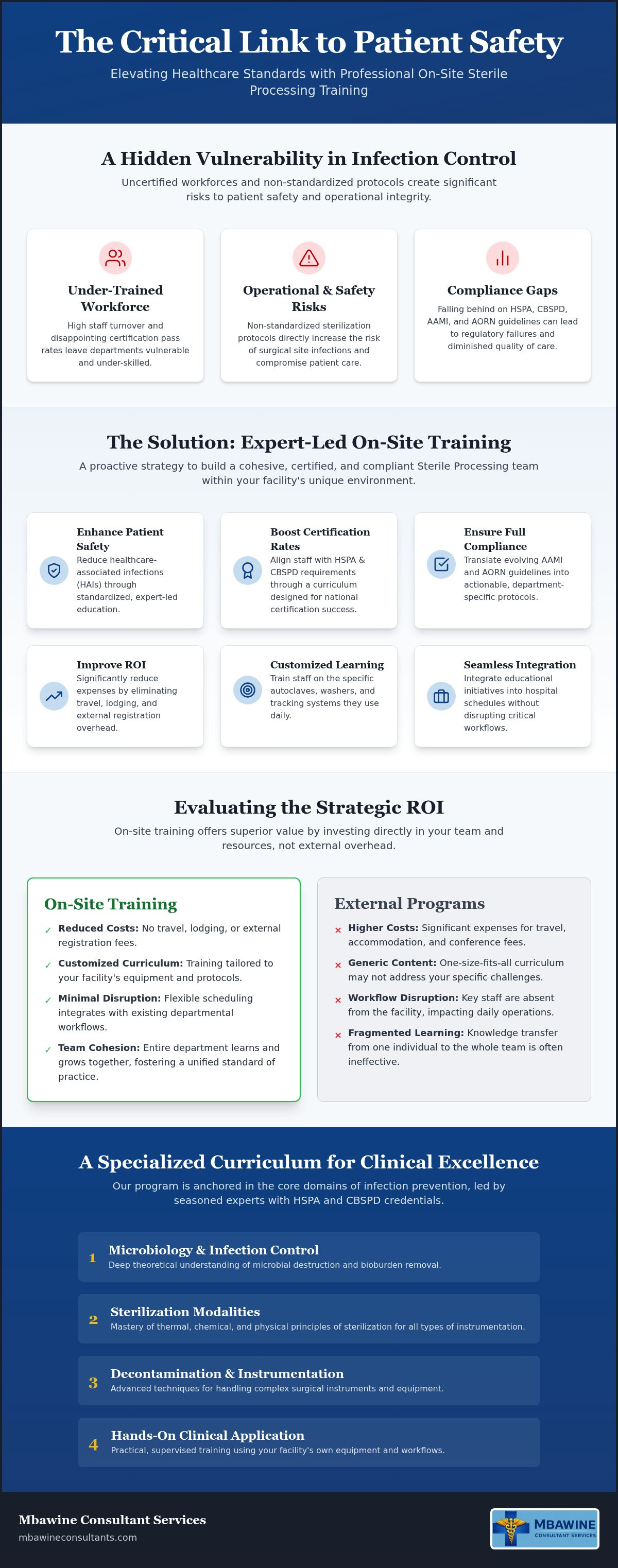
Achieving compliance with HSPA and CBSPD certification requirements is a complex undertaking that demands a structured approach to learning. Professional on-site sterile processing training allows for a unique synergy between theoretical knowledge and practical application. Staff are trained on the specific autoclaves, washers, and tracking systems they use daily. This localized focus ensures that evolving AAMI and AORN guidelines are translated into actionable, department-specific protocols. Maintaining a current, certified team isn't just a regulatory checkbox. It's a commitment to professional excellence that protects both the staff and the patients they serve. Facilities that prioritize these standards often see a marked improvement in their CRCST pass rates and overall operational efficiency.
The transition from a decentralized workforce to a high-performing, certified team requires a pedagogical framework that transcends basic orientation. A comprehensive curriculum for on-site sterile processing training must be anchored in the core domains of infection prevention, including microbiology, thermal and chemical sterilization modalities, and the intricate physics of moisture and heat transfer. These educational sessions are led by seasoned industry experts who hold advanced credentials from HSPA and CBSPD, ensuring that the instruction is grounded in both academic rigor and real-world clinical application. This level of professional mentorship is essential for bridging the gap between simply performing a task and understanding the complex scientific principles that guarantee a sterile outcome. By integrating theoretical lectures with hands-on clinical rotations, facilities can ensure their staff develops the critical thinking skills necessary to handle modern surgical instrumentation.
Preparing an entire department for national certification requires a methodical assessment of each technician's current knowledge base. The pathway to CRCST certification is structured around a multi-phase educational syllabus that includes systematic readiness evaluations. Before any staff member sits for a national exam, they undergo rigorous mock assessments and diagnostic testing designed to identify specific areas of technical weakness. This structured approach ensures that the institution's investment in education translates directly into high pass rates and a fully credentialed workforce. Such thorough preparation is a hallmark of a mission-driven training program that prioritizes the professionalization of the field.
One of the primary advantages of a facility-based educational model is the ability to adapt the curriculum to the specific equipment and workflows of the department. Before training commences, consultants conduct a thorough evaluation of existing sterilization protocols and the unique mechanical systems in place, such as specific steam sterilizers or automated endoscope reprocessors. Training staff within their actual working environment eliminates the disconnect often found in external programs, as technicians learn to apply national standards to the exact tools they use daily. This localized focus not only improves technical proficiency but also fosters a culture of accountability and excellence within the team. For facilities seeking to elevate their departmental standards through this rigorous educational model, it's possible to enroll in professional classes that are tailored to meet these high-stakes institutional goals.
For healthcare administrators, the financial justification for educational programs rests on a rigorous cost-benefit analysis that transcends simple tuition figures. While individual online courses might appear cost-effective on a per-unit basis, they often fail to address the institutional overhead associated with fragmented knowledge and the logistical strain of staff absences. On-site sterile processing training eliminates the external registration fees and travel expenses that quickly accumulate when sending multiple technicians to off-site seminars. More importantly, it fosters a collective competency that individual learning cannot replicate. When an entire department undergoes a unified curriculum, the facility establishes a standardized operational baseline; this ensures that every technician adheres to the same high-level protocols. This approach minimizes operational disruptions, as the educational sessions are integrated into the facility's existing schedule, allowing for a seamless transition between the classroom and the clinical environment.
The strategic value of a unified training model is found in its ability to create a "single source of truth" within the department. When technicians are trained in isolation, they often return with varying interpretations of best practices, which can lead to friction and non-standardized workflows. Collective training sessions allow for real-time clarification of complex sterilization modalities, ensuring that the entire team moves forward with a synchronized understanding of institutional goals. This alignment is a critical factor in maintaining the high-velocity throughput required by modern surgical suites while upholding the most stringent safety standards.
Institutional stability is directly linked to the availability of professional development opportunities. High turnover in the SPD is frequently driven by a lack of clear career progression or inadequate technical support. By providing a structured pathway toward national certification, facilities signal a profound commitment to their workforce, which significantly enhances employee retention. This creates a sustainable internal talent pipeline, reducing the need for expensive, urgent recruitment efforts. In situations where departmental leadership is in transition, interim management and consulting can serve as a critical bridge, providing the authoritative oversight necessary to launch and sustain these educational initiatives.
Similar principles of workforce development apply across the healthcare continuum; for example, Direct Care Training & Resource Center Inc offers specialized training and consulting for long-term care providers to ensure high standards of safety and competency.
The fiscal impact of a certified workforce extends far beyond initial training costs. Technicians who've mastered the complexities of sterilization through a professional syllabus demonstrate higher proficiency, leading to accelerated instrument turnaround times. This efficiency is vital for maintaining the high volume of modern surgical suites. When errors are reduced, the frequency of costly surgical delays and instrument-related complications diminishes. A standardized educational foundation ensures that every employee, from the newest hire to the most seasoned technician, operates under a single, authoritative set of guidelines. This alignment is the cornerstone of institutional excellence and long-term financial health.
Launching a professional educational initiative within a high-volume department requires a methodical approach that respects the critical nature of sterile processing workflows. Successful execution of on-site sterile processing training depends on a structured framework that begins with administrative alignment and ends with long-term technical mastery. Leadership buy-in is the primary prerequisite; it ensures that the necessary time and resources are allocated to the program without compromising the surgical schedule. Hosting a professional consultant involves coordinating clinical space and ensuring that the instruction remains relevant to the specific mechanical systems used within the facility. This deliberate preparation transforms the training from a temporary event into a permanent institutional upgrade that safeguards patient safety and departmental integrity.
Beyond administrative support, the logistical success of the program relies on a clear understanding of the department's operational rhythm. Instruction must be delivered in a way that allows for the continued flow of sterile goods to the operating room. This often involves staggered sessions or small-group rotations that maintain departmental coverage while ensuring every technician receives the necessary attention. The goal is to create a learning environment that feels like a natural extension of the professional workspace rather than an external disruption. When training is integrated into daily operations, the staff can immediately apply theoretical concepts to their practical tasks, reinforcing the learning process through real-world application.
The first phase is a comprehensive needs assessment. This involves a granular evaluation of the current staff's technical skills and certification statuses. It's the moment where departmental policies are scrutinized against national benchmarks to identify specific vulnerabilities in the sterilization chain. By identifying these gaps early, consultants can tailor the curriculum to address the facility's most pressing risks. Facilities can schedule a formal consultation to initiate this diagnostic phase, ensuring the curriculum is built on a foundation of actual data rather than assumptions. This assessment serves as the roadmap for all subsequent educational interventions.
Execution follows a rhythm designed for maximum retention. Blended learning models, which combine direct on-site sterile processing training with online support, allow technicians to reinforce their knowledge during their shifts. Maintaining a rigorous record of these professional credentials is not optional; it's a critical component of audit readiness for regulatory bodies like the Joint Commission or CMS. By fostering a culture of continuous professional development, the department ensures its staff remains at the forefront of sterilization science. This ongoing support ensures that the high standards established during the initial training phase are maintained long after the consultant has departed. To secure this level of expertise for your facility, you can enroll in our professional sterile processing classes today.
Mbawine Consultant Services stands as the premier authority for facilities seeking to institutionalize excellence within their sterile processing departments. Our mission transcends simple service provision; we act as a dedicated partner in the professionalization of the field. By integrating on-site sterile processing training with comprehensive consulting and strategic staffing, we offer a holistic solution that addresses the multifaceted challenges of the modern SPD. This synergistic approach ensures that technical proficiency is not an isolated event but a sustainable institutional standard. Directors can initiate this transformation by engaging with our team to develop a customized roadmap that aligns their technical workflows with national safety benchmarks and institutional goals.
The commitment to industry standards and public safety is the cornerstone of every partnership we establish. We recognize that the Sterile Processing Department is the heart of hospital safety, and its success is predicated on the continuous application of rigorous scientific principles. Our methodology is designed to create a culture of accountability where every technician understands the clinical implications of their work. This is how we bridge the gap between basic compliance and advanced technical mastery, ensuring that your facility remains a leader in infection prevention.
The academic reliability of our curriculum is a direct reflection of our consultants' deep expertise. These professionals serve as seasoned mentors, bringing decades of clinical experience to every facility-based session. This authoritative guidance is a primary factor in the continued success of our staff and alumni, who frequently set the standard for technical mastery in their respective institutions. Our training programs don't just prepare technicians for an exam; they instill a sense of professional purpose and a commitment to the gravity of their role in patient care. This creates a professional environment where excellence is the only acceptable outcome.
Beyond the classroom, Mbawine provides the operational support necessary to maintain department stability during periods of transition or intensive learning. Our interim management and temporary staffing solutions allow facilities to focus on long-term educational goals without compromising immediate surgical needs. For instance, our 24/7 emergency staffing can bridge critical gaps, ensuring that the department remains fully functional while existing staff participate in on-site sterile processing training. This comprehensive approach to department optimization allows healthcare leaders to address both immediate operational risks and long-term strategic objectives simultaneously. To begin the process of elevating your facility's sterilization standards, we invite you to contact us for a professional assessment of your departmental needs.
The technical proficiency of a Sterile Processing Department remains the most reliable predictor of institutional success in the critical field of infection prevention. We've analyzed the strategic necessity of standardized education and the substantial return on investment provided by facility-based instruction. Implementing on-site sterile processing training allows your institution to bridge the gap between entry-level performance and advanced technical mastery, ensuring that every technician operates with scientific precision and adheres to the highest safety protocols. This commitment to excellence protects both the patient and the professional integrity of the healthcare facility.
Mbawine Consultant Services offers specialized preparation for CRCST and other national certifications through expert-led clinical education and consulting. Our nationwide service provides the authoritative mentorship required to transform your department into a model of industry compliance. You can begin this journey toward institutional excellence by securing professional resources for your team today. Request a professional consultation for on-site training to establish a foundation of technical reliability and safety. Your department's transition to a fully certified workforce starts with a dedicated partner committed to the highest standards of public health.
The primary benefits include enhanced regulatory compliance, significantly higher staff certification rates, and a measurable reduction in operational risks. By aligning departmental proficiency with institutional safety goals, this model ensures that every technician operates with the precision required to prevent healthcare-associated infections. It fosters a culture of technical mastery that protects both the patient and the facility's professional reputation.
The duration of a professional program depends on the initial knowledge base of the staff and the specific certification goals of the facility. Most comprehensive initiatives involve several weeks of structured, methodical instruction that balances theoretical lectures with practical clinical application. This deliberate pace ensures that technicians don't just memorize facts but deeply internalize the scientific principles of sterilization science.
Professional curricula are inherently adaptable to the unique surgical specialties served by a facility. Educators conduct a thorough evaluation of the department's specific instrument sets, such as those used in complex orthopedic or cardiovascular procedures. This localized focus ensures that on-site sterile processing training addresses the exact technical challenges and mechanical systems that staff encounter in their daily workflows.
It improves pass rates by replacing fragmented self-study with a rigorous pedagogical framework led by seasoned mentors. Through the use of diagnostic assessments and mock examinations, the program identifies specific knowledge gaps in domains like microbiology or thermal disinfection. This targeted approach ensures that technicians are fully prepared for the academic and technical demands of national certification exams.
Facilities generally need to provide a dedicated space for classroom-style instruction and access to the department's existing sterilization equipment. Utilizing the facility's own autoclaves, washers, and tracking systems is a critical component of the learning process. It allows staff to apply national standards to the specific tools they use every day, which reinforces technical retention and operational consistency.
For institutions with multiple technicians, on-site sterile processing training is often the more economical choice. It eliminates the cumulative costs of external registration fees and staff travel expenses while preventing the operational strain of multiple employee absences. The resulting collective competency creates a standardized baseline of performance that reduces the long-term costs associated with sterilization errors and surgical delays.
Mbawine Consultant Services provides specialized preparation for both HSPA and CBSPD certification pathways. The curriculum is built upon academically reliable standards that meet the requirements of both national governing bodies. This ensures that technicians receive a comprehensive education that is recognized across the professional field, facilitating their transition toward advanced technical mastery.
Facility directors can initiate a partnership by requesting a professional assessment of their current departmental needs. This initial consultation serves as a diagnostic phase to evaluate staff certification gaps and review existing protocols. By establishing this roadmap early, the facility can ensure that the subsequent educational intervention is perfectly aligned with its strategic goals for clinical excellence.

Article by
Mba Akuribila
Mba‑Akuribila is a healthcare leader, educator, and founder of Mbawine Consultants, a Bronx‑based institution recognized nationwide for advancing excellence in sterile processing and allied health workforce development. Born in Bongo in Ghana’s Upper East Region, his journey from rural beginnings to national impact reflects a lifelong commitment to service, empowerment, and community advancement.
For over two decades, he has trained sterile processing employees, mentored, and placed thousands of healthcare professionals across the United States. Through Mbawine Consultants, he established one of the country’s most trusted Sterile Processing Certification Test Prep Programs, preparing new Americans and career‑changers for successful entry into the field. The organization, as at 2026, has graduated more than 15,000 sterile processing technicians who now serve in hospitals, ambulatory centers, dental practices, and reprocessing facilities nationwide.
Under his leadership, Mbawine Consultants has expanded into a full Healthcare Staffing Agency, connecting nurses and allied health professionals to meaningful employment opportunities. His team also provides Interim Management Services, supporting hospitals and surgical centers with experienced leaders who stabilize operations, strengthen compliance, and improve workflow efficiency.
As a former surgical technician, sterile processing manager, educator, and system‑wide director, Mba‑Akuribila brings deep expertise to Sterile Processing Consulting, helping healthcare facilities elevate quality, safety, and regulatory readiness.
His work in the United States and Ghana continues to reflect his core philosophy: service above self, opportunity for all, and excellence without compromise.


