

Last Updated: September 10, 2026
Surgical and ambulatory-surgical facilities are being asked to do more cases with tighter margins and closer regulatory scrutiny than at any point in recent memory. Improved operational support for surgical and ambulatory-surgical facilities for medical education has shifted from a nice-to-have into a survival requirement: departments that document their processes, prove staff competency, and justify every capital request are the ones that pass surveys and keep cases moving. This guide breaks down the workflow, compliance, and budget mechanics that decide whether a sterile processing department (SPD) runs smoothly or becomes the weakest link.
An ambulatory surgery center with eight SPD staff faces the same documentation expectations as a large hospital system with a fraction of the administrative bench. That mismatch is where most operational failures begin, and where a structured assessment pays for itself fastest.
Sterile processing workflow optimization starts with measurement, not equipment. Before proposing a new sterilizer or additional staff, map where instruments stall, where trays queue, and which steps consume time without adding safety. Buying capacity before identifying the actual constraint is a common mistake.
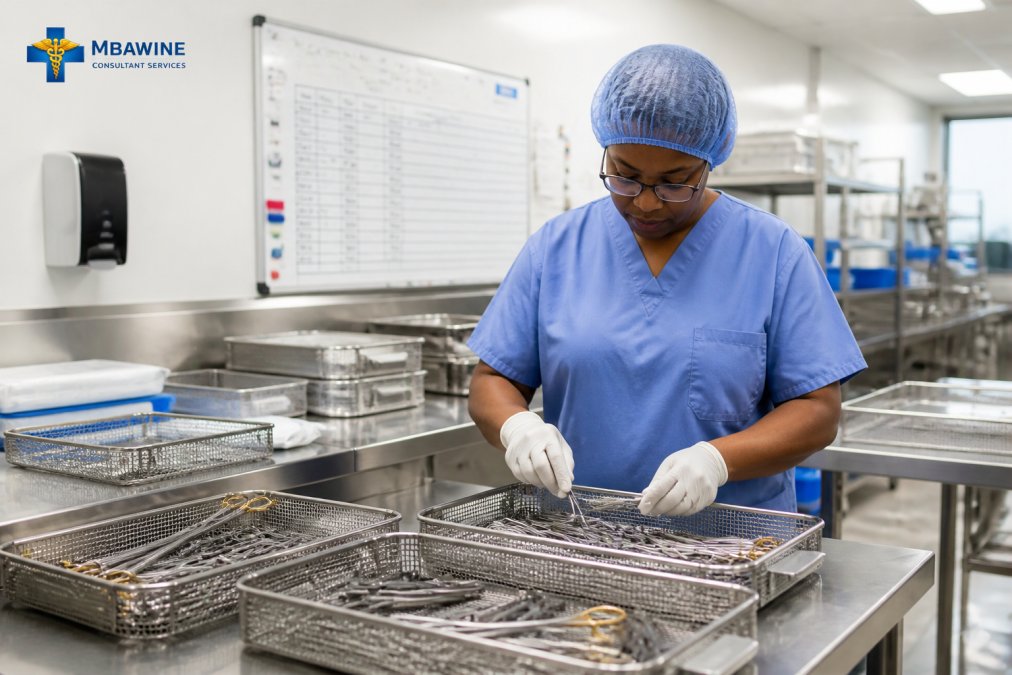
Bottleneck identification means tracing every tray through decontamination, assembly, and sterilization and recording where it waits. The constraint usually sits at one of three points:
Walk the floor during your busiest two hours. The station with trays stacked and staff standing still is your bottleneck.
Tray prioritization means sequencing reprocessing by the next case's start time rather than arrival order. Instrument turnover, the time from used tray to sterile, ready tray, connects SPD performance to the OR schedule. Track it per tray type, not as a department average, because averages hide the trays actually delaying cases.
SPD staff training and certification is the difference between a department that passes an accreditation survey and one that scrambles through it. Surveyors don't just check that certificates exist; they check that staff can explain and demonstrate what they do.
A working program has four parts: initial certification preparation, documented onboarding for facility-specific protocols, annual competency verification, and remediation when gaps appear. Competency files should include direct observation records, not just completion certificates. The technicians who struggle in surveys are usually the ones whose training was never documented beyond a sign-in sheet.
Ambulatory surgery center compliance standards mirror hospital expectations but arrive with less administrative support. The recurring problem isn't ignorance of the rules; it's inconsistent documentation of compliance, and the rules that generate findings are more concrete than most SPD leaders assume.
The regulatory floor is set by the CDC Guideline for Disinfection and Sterilization in Healthcare Facilities and by device-specific reprocessing instructions cleared under FDA premarket notification. On top of that floor sit accreditation surveys, typically The Joint Commission, AAAHC, or AAAASF for an ASC, plus state health department licensure inspections. Each asks a slightly different version of the same question: can you prove, from a written record, that this tray was cleaned, assembled, sterilized, stored, and delivered to the correct patient?
Three areas generate most findings, each with a specific documentation artifact surveyors request:
Three structural features of an ASC make compliance harder than in a hospital, each with a practical countermeasure:
The fix is procedural, not expensive. Standard operating procedures that mirror what surveyors ask for, combined with routine self-audits, close most of the distance. Guidance from The Joint Commission's infection prevention standards reinforces that documentation is treated as evidence of process, not paperwork.
Survey preparation is a separate skill from compliance. Two moves matter most:
A facility that can produce the record, explain the process, and name the owner of each step is very hard to write a finding against, however small the administrative bench.
Gap analysis compares your current SPD practices against required standards; risk assessment ranks those gaps by likelihood and patient impact. A systematic audit method follows five steps:
The scope decision matters more than most teams expect. An assessment that covers decontamination but ignores instrument assembly will miss half the risk.
Documentation protocols determine whether traceability works. Instrument tracking systems only deliver value when every tray is logged at every handoff and records can reconstruct a full chain from patient back to sterilizer load. Many facilities own tracking software but use a fraction of its capability.
Sterilizer performance monitoring is where technical deficiencies surface first. Cycle parameters, temperature, pressure, exposure time, must be recorded for every load, with documented follow-up on deviations. Preventative maintenance keeps that data meaningful; a sterilizer that drifts out of calibration produces records that look fine and prove nothing.
Biological and chemical indicators verify the process but don't replace mechanical monitoring of the sterilizer itself. Facilities that skip preventative maintenance tend to discover problems during a survey rather than a routine check, the worst possible timing.
Budget justification fails when SPD leaders present needs instead of risk. Administration funds requests that reduce measurable exposure: canceled cases, survey findings, staff turnover, and reprocessing errors. Frame every upgrade against one of those four.
A practical ROI case includes:
Where capital is tight, interim staffing and targeted training can deliver returns. The FDA guidance on reprocessing medical devices and CDC sterilization and disinfection guidelines give administrators the regulatory context they need to see the request as risk reduction rather than departmental wishlist.
An assessment without a roadmap is just an expensive report. The differentiator is a sequenced execution plan that survives a busy OR schedule and a skeptical finance office. The framework below is a 30-60-90 day structure with a defined owner, evidence artifact, and exit condition for every item, because a finding without an exit condition never actually closes.
The first 30 days belong to patient-safety gaps and anything that would generate an immediate survey finding. These items are usually cheap and procedural, not capital.
The middle 30 days belong to workflow and competency, items that reduce rework and turnover time but require behavior change to stick.
The final 30 days belong to the items that need money, and the ROI case that funds them. This is where assessment findings become a budget document.
| Phase | Focus | Owner | Exit Condition |
|---|---|---|---|
| Days 0-30 | Patient-safety gaps, documentation backfill, interim coverage | SPD manager / supervisor | Zero open safety gaps; mock reverse-trace passes |
| Days 31-60 | Tray prioritization, competency matrix, tracking utilization | SPD lead / education coordinator | Turnover measured per tray type; no unverified functions |
| Days 61-90 | ROI case, capital sequencing, sustainment cadence | Department director with finance | Cost baseline accepted; requests submitted; monthly review scheduled |
Operational support gives a facility a documented, repeatable process instead of relying on individual memory. That means standard operating procedures for decontamination, instrument assembly, and sterilization validation are written down, staff are trained against them, and results are logged. During an accreditation survey, surveyors ask for evidence, not intentions. Facilities with structured support can show cycle parameters, staff competency records, and traceability data on request. The practical effect is fewer findings, faster survey responses, and a clearer path to correcting technical deficiencies before they become citations.
A workable program covers four things: current certification standards, hands-on competency checks, documentation of each technician's progress, and refresher cycles tied to regulatory requirements. SPD staff training and certification should include CRCST and CIS preparation where relevant, plus facility-specific protocols because every sterilizer and tray system behaves differently. Programs that combine remote learning modules with on-site competency verification tend to hold up better, since technicians can study around shift work and still demonstrate skills on real instrument sets.
Start with baseline numbers before any changes: instrument turnover times, tray error rates, sterilization validation pass rates, and staff vacancy days. Re-measure at 30, 60, and 90 days. A gap analysis using a systematic audit will surface technical deficiencies you can track. If turnover times drop, documentation protocols are being followed without reminders, and survey readiness improves, the support is working. If nothing moves, the assessment was too broad or the implementation plan lacked owners and deadlines.
Sterile processing is where surgical staff learn why instrument care matters. When technicians understand tray prioritization, sterilization validation, and instrument tracking, they communicate better with OR teams about what is available and when. That knowledge flows into medical education through in-service sessions, orientation for new surgical residents, and shared review of infection control data. Facilities that treat SPD as a teaching partner rather than a back-room function see fewer instrument-related delays and stronger clinical safety outcomes across the whole surgical workflow.


