

Survey readiness is demonstrated in everyday work, not assembled in a last-minute binder. For teams preparing for a Joint Commission SPD survey, the challenge is to determine which current requirements apply to the organization and survey scope, then show that staff follow safe, controlled processes consistently across shifts.
Policies and records matter, but documentation alone cannot show whether staff understand a process or whether daily workflows support safe practice. A useful readiness review connects written requirements to observed work, traceable evidence, staff competency, and corrective action. It also helps identify risks that a document-only checklist could miss.
This 2026 checklist offers a structured way to review applicable requirements, records, equipment and process controls, staff knowledge, and improvement plans. It also explains how to prepare teams for survey conversations without rehearsing appearances. Use it as a repeatable review to identify gaps and prioritize improvements to routine practice. Sterile processing classes can reinforce staff understanding, while consulting can help departments assess processes and focus improvement efforts.
Preparing for a Joint Commission SPD survey means showing that staff consistently follow the department’s approved processes, that accurate records support those processes, and that personnel understand the work they perform. Readiness is not a presentation assembled for survey day. It is demonstrated through routine practice, including how staff respond when a process does not go as planned.
Applicable requirements depend on the organization’s facility type, accreditation program, and survey scope. Start by confirming those details through current organizational accreditation records and authoritative Joint Commission resources. Then identify the standards and survey materials that apply. The Joint Commission link provides background on the accrediting organization, but Wikipedia is not a source for current requirements. Use official Joint Commission materials to verify those requirements.
Build the review around the organization’s current accreditation program and applicable standards, not a generic checklist or an older survey file. Keep these categories distinct: accreditation requirements, applicable laws or regulations, professional guidance, manufacturers’ instructions for use, and internal policies. They can inform practice in different ways. Verify the status of a recommendation before describing it as a binding requirement. Avoid copying standards text into local materials unless the current edition and permission to reproduce it have been confirmed.
This distinction matters because a department’s procedures may draw on several sources, while survey applicability depends on the organization’s program and scope. A facility-specific requirements map gives leaders and staff a shared reference for the rest of the readiness review.
Compare written procedures with observed work, then check whether the records reflect what staff did. For example, a policy may describe a process, but stronger evidence comes from staff explaining the relevant steps, observed work following the procedure, and related records being complete and retrievable. Include different shifts in the review so you can see whether practice is consistent across teams.
A polished binder cannot compensate for inconsistent work or explanations that conflict with the documented process. For an internal review, use this practical definition: Survey readiness is the department’s ability to demonstrate, through routine work, consistent processes, knowledgeable staff, and reliable documentation that applicable requirements are being addressed. This is a way to organize an internal review, not a quotation from Joint Commission standards.
Accreditation preparation also differs from certification exam preparation. An exam assesses an individual’s knowledge against its own criteria. Survey readiness concerns how the organization’s systems and daily practices align with applicable requirements. Routine staff education supports shared understanding of procedures and documentation, but education alone does not establish accreditation or replace a facility-specific readiness assessment.
Preparing for a Joint Commission SPD survey involves more than confirming that policies and logs exist. Review the department as a connected system: observe how instruments move through each reprocessing stage, compare actual practice with current local procedures and manufacturer instructions, and check that records and staff explanations match the work. For broader context on evolving professional guidance, see this 2026 healthcare sterilization standards guide. AAMI resources can also inform sterile processing practice, but distinguish professional standards from requirements that apply to your facility.
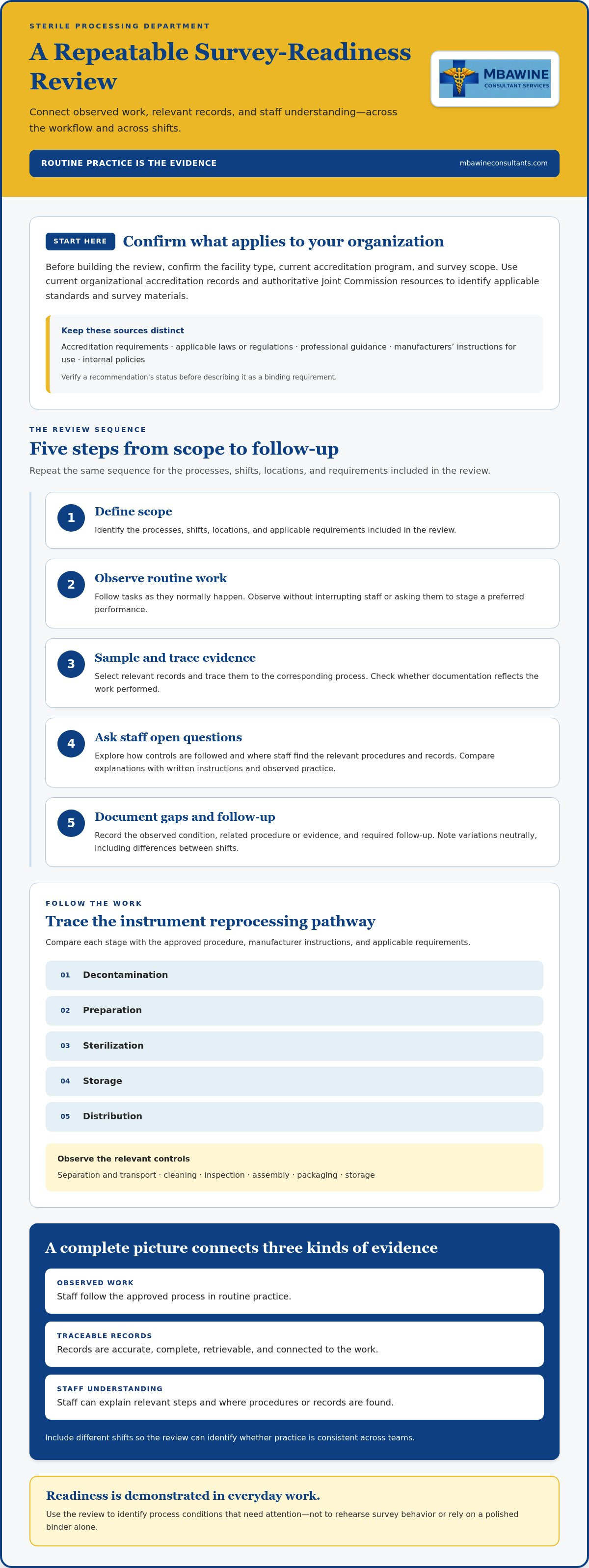
Follow the workflow from decontamination through preparation, sterilization, storage, and distribution. Observe relevant controls for separation and transport, cleaning, inspection, assembly, packaging, and storage. Details vary by process and device, so compare what you observe with the approved procedure, manufacturer instructions, and applicable requirements. AAMI sterile processing resources provide broader professional context, but do not replace verifying which requirements apply to the organization.
Use the same review sequence each time:
Note variations neutrally, including differences between shifts or between written instructions and observed practice. The aim is to identify process conditions that need attention, not to rehearse survey behavior.
Review relevant samples of training and competency records, equipment and maintenance documentation, and process-monitoring records. Check that entries are complete, legible, traceable to the process, and consistent with approved local procedures. If a record is unclear or incomplete, follow the trail to determine whether the issue is a documentation problem, a process variation, or both.
Reliable evidence connects records with observed practice and staff explanations, helping the organization assess whether its processes are performed consistently. Structured sterile processing education can reinforce shared understanding of procedures and documentation. Sterile processing classes can support that learning, while readiness still depends on the facility’s own review and follow-through.
A focused walkthrough connects records and written procedures to the conditions staff encounter during routine work. For teams preparing for a Joint Commission SPD survey, organize observations by risk area. Mark each checklist item as observed, documented, interview-confirmed, or requiring follow-up. These labels show what evidence supports a finding and what still needs review.
Assess work areas and storage conditions against applicable requirements and facility procedures. Verify that clean and contaminated workflows remain appropriately separated, traffic follows local controls, and storage practices align with approved procedures. Review equipment documentation, maintenance records, and monitoring records for processes the department performs. Include sterilization or high-level disinfection only when those activities are within the department’s scope.
Do not assume that a particular environmental parameter or monitoring interval applies universally. Confirm expectations against current authoritative sources, manufacturer instructions, applicable requirements, and facility policy. Record the evidence reviewed and flag discrepancies for further assessment.
Ask open-ended questions that let staff explain their work in their own words. For example: “How do you find the current procedure for this task?” “What would you do if a process result fell outside the expected range?” or “Who do you notify if equipment is unavailable?” Tailor each question to the person’s role and the process being observed.
Compare responses with observed practice and approved procedures. Note where understanding or process execution differs. Do not script identical answers or coach staff to reproduce a preferred response. The goal is to assess accurate understanding and safe judgment, including whether personnel know when to stop, seek guidance, or escalate an issue.
When an item needs follow-up, state what remains uncertain and identify the evidence needed to resolve it. This makes the walkthrough an improvement tool rather than a one-time inspection. It also helps leaders distinguish an isolated documentation gap from a broader process concern.
A finding is useful when it leads to a controlled change and a way to determine whether that change worked. When preparing for a Joint Commission SPD survey, avoid treating every gap as equally urgent or relying on reminders alone to address a recurring problem. Prioritize findings by patient-safety relevance, recurrence, process impact, and applicable requirements. Track each action until improved practice is demonstrated.
Describe each finding objectively, including its location, affected process, what was observed, and the supporting record or procedure. Separate immediate risk controls from longer-term system improvements. For example, address a concern requiring prompt containment through the facility’s established escalation and risk-management processes. Then investigate why the condition occurred and how recurrence can be reduced.
Assign every corrective action an owner and due date. Specify what evidence will demonstrate completion, such as a revised procedure, completed maintenance record, or documented staff competency review, as appropriate to the finding. Define an effectiveness measure before closing the item. This could include reassessing the process in practice and reviewing relevant records over a facility-determined period. The measure should test whether the change is working, not just whether a task was completed.
For recurring findings, investigate contributing conditions such as unclear procedures, workflow design, equipment limitations, inconsistent training, or gaps in oversight. A reminder may communicate expectations, but it will not resolve an underlying system issue by itself. Sterile processing consulting services can support process assessment and help department leaders prioritize improvement work.
When a gap involves staff knowledge or inconsistent technique, provide role-specific education tied to the observed issue and approved procedures. Reinforce the reason for the control, clarify responsibilities, and explain what to do when the expected process cannot be followed. Confirm understanding with an appropriate method, such as discussion, demonstration, or documented competency assessment. Then observe the process again to see whether staff apply the learning during routine work.
Connect follow-up to the corrective-action record. Note who received education, how understanding was assessed, and what a subsequent review showed. This creates a traceable improvement cycle instead of a one-time training event. To strengthen foundational knowledge of sterile processing procedures and documentation, review sterile processing class options.
A facility-specific plan coordinates readiness reviews and corrective actions as ongoing work. Preparing for a Joint Commission SPD survey should follow the organization’s current requirements, survey scope, and identified risks, not an assumed universal calendar or short-term countdown. Set a review cadence that fits facility policy and department operations. Adjust it when requirements, workflows, or findings change.
Assign a lead to coordinate the plan, and make evidence ownership explicit. Identify who maintains current procedures, tracks staff competency records, oversees equipment documentation, and monitors corrective-action follow-up. Schedule walkthroughs across shifts to reflect routine practice. Include relevant SPD, infection prevention, quality, facilities, and leadership stakeholders according to the issues under review.
Maintain a concise index showing where current evidence is stored, who is responsible for it, and how staff can access it. Direct users to approved document and record systems rather than creating competing copies. Confirm that personnel know how to locate current procedures and whom to notify if information is unclear, a record is missing, or a process concern remains unresolved. Coordinate the readiness plan with facility leadership and existing quality and safety processes.
Useful plan elements include:
Structured sterile processing education can support staff knowledge and a consistent understanding of procedures and documentation. Tailor education to identified learning needs and use it alongside, not in place of, facility-specific competency processes. Healthcare sterile processing consulting can support department assessment, workflow review, and prioritization of operational improvements. For additional context, see this sterile processing consultant services guide.
Keep the plan active by reviewing open actions at the established cadence, checking whether changes hold across shifts, and updating responsibilities or evidence locations when processes change. To support ongoing staff development, enroll in sterile processing education.
Preparing for a Joint Commission SPD survey is most effective when the review reflects the work staff perform every day. Confirm which requirements apply to your facility, observe workflows across shifts, and connect records and staff explanations to actual practice. When gaps emerge, prioritize them according to risk, assign clear ownership, and verify that corrective actions improve the process over time.
A coordinated plan helps department leaders sustain this work through defined responsibilities, evidence access, and collaboration with quality and facility stakeholders. Staff education can strengthen shared understanding of procedures and documentation. Sterile processing consulting and interim management can support department assessment and operational improvement. Mbawine Consultant Services provides in-person and online sterile processing classes and supports healthcare organizations nationally.
Build staff knowledge as part of your ongoing readiness effort. Explore sterile processing education and enroll to support continued professional development. With a facility-specific plan and consistent attention to daily practice, your team can approach survey preparation with greater clarity and purpose.
Have current approved procedures, relevant staff training and competency evidence, equipment and process records, and documented follow-up for identified issues. Keep these materials in the facility’s approved systems and maintain a concise index so authorized staff can locate them without creating a separate collection that may become outdated. The exact evidence depends on the organization’s accreditation program, services, applicable standards, and survey scope. Verify expectations through current authoritative facility resources.
Survey activities may include reviewing records, observing work, and speaking with personnel, although the approach depends on the organization, accreditation program, and survey. Prepare by ensuring daily workflows align with approved procedures and staff can explain their responsibilities and how they address concerns. Do not assume there is one universal SPD checklist or interview script. Verify applicable requirements and current survey guidance through official organizational resources.
Set the review cadence through facility policy and risk-based quality processes rather than relying on a universal interval. Reassess after meaningful changes to workflows, equipment, staffing, or policies, and follow corrective actions through an effectiveness review. Include representative shifts and processes, and document the review’s scope and findings. This helps leaders detect recurring patterns, determine whether changes are sustained, and assign accountable follow-up where more action is needed.
Review records relevant to the department’s services and applicable requirements, including staff education and competency evidence, equipment maintenance documentation, process monitoring, and corrective-action follow-up. Check whether records are current, complete, traceable, and consistent with approved procedures. No single list applies to every facility. Validate expectations against current applicable standards, manufacturer instructions, organizational policy, and the department’s actual scope of work.
Staff should answer truthfully, describe the work they actually perform, and explain how they locate procedures or escalate concerns. They should not memorize scripted responses or guess when uncertain. Leaders can review role-specific responsibilities with staff and ensure they know where approved guidance is maintained. The goal is accurate understanding and safe judgment in routine practice, not identical wording rehearsed for survey conversations.
Document the finding objectively, assess its risk and scope, and determine whether immediate controls are needed. Assign an accountable owner, action, due date, completion evidence, and effectiveness measure through the facility’s established processes. For recurring issues, investigate contributing system causes instead of relying only on reminders. Reassess the changed process in practice, retain appropriate follow-up evidence, and escalate concerns through established quality and patient-safety pathways.
Structured education can strengthen staff understanding of sterile processing principles, approved procedures, and role responsibilities, particularly when it addresses observed department needs. Mbawine Consultant Services provides in-person and online sterile processing classes. Training alone does not establish that a facility meets every applicable requirement or guarantee a survey outcome. Pair education with facility-led competency assessment, workflow observation, current procedures, and corrective action to address identified gaps.

Article by
Mba Akuribila
Mba‑Akuribila is a healthcare leader, educator, and founder of Mbawine Consultants, a Bronx‑based institution recognized nationwide for advancing excellence in sterile processing and allied health workforce development. Born in Bongo in Ghana’s Upper East Region, his journey from rural beginnings to national impact reflects a lifelong commitment to service, empowerment, and community advancement.
For over two decades, he has trained sterile processing employees, mentored, and placed thousands of healthcare professionals across the United States. Through Mbawine Consultants, he established one of the country’s most trusted Sterile Processing Certification Test Prep Programs, preparing new Americans and career‑changers for successful entry into the field. The organization, as at 2026, has graduated more than 15,000 sterile processing technicians who now serve in hospitals, ambulatory centers, dental practices, and reprocessing facilities nationwide.
Under his leadership, Mbawine Consultants has expanded into a full Healthcare Staffing Agency, connecting nurses and allied health professionals to meaningful employment opportunities. His team also provides Interim Management Services, supporting hospitals and surgical centers with experienced leaders who stabilize operations, strengthen compliance, and improve workflow efficiency.
As a former surgical technician, sterile processing manager, educator, and system‑wide director, Mba‑Akuribila brings deep expertise to Sterile Processing Consulting, helping healthcare facilities elevate quality, safety, and regulatory readiness.
His work in the United States and Ghana continues to reflect his core philosophy: service above self, opportunity for all, and excellence without compromise.


