

Reducing SPD staff burnout and turnover starts with understanding the conditions behind fatigue and disengagement, not asking technicians to endure more. Persistent vacancies can disrupt department continuity, while heavier workloads may add pressure for the staff who remain. Turnover is not simply a personnel issue; it can signal problems in how work is organized and supported.
Sterile processing requires sustained attention, technical competence, and reliable coordination. When staffing gaps and workload pressures persist, leaders may struggle to distinguish root causes from visible symptoms or decide which changes could make a practical difference.
This article offers a structured approach to identifying department-specific drivers of burnout and attrition, matching interventions to operational problems, and building a retention plan with measurable indicators. It covers how workload, role readiness, professional development, and leadership support can inform that plan, then explains how to track staff experience and workforce trends over time. The goal is a deliberate response grounded in department conditions rather than assumptions about individual resilience.
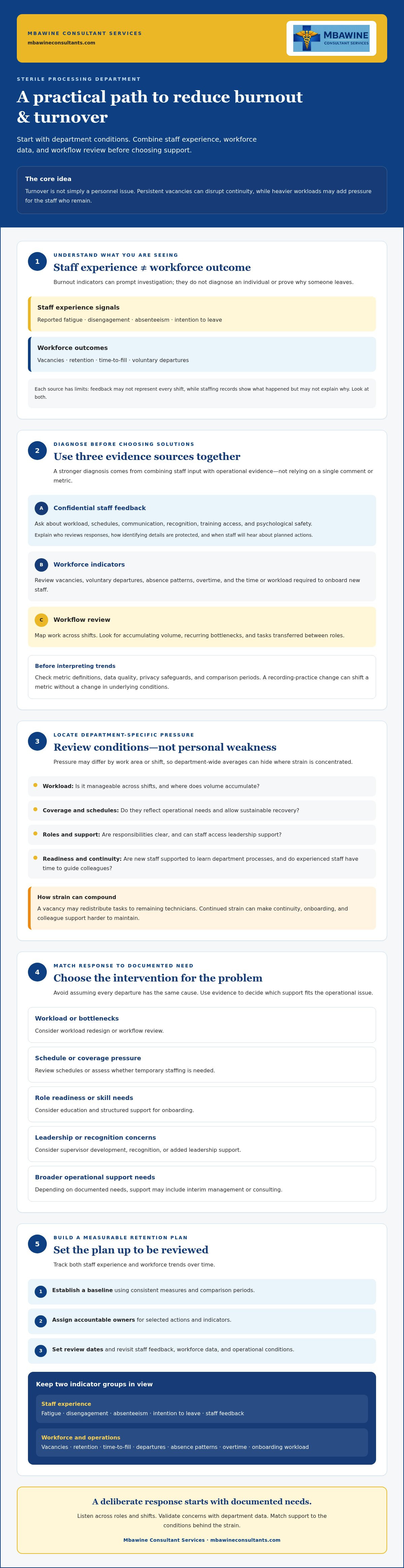
In sterile processing, staff experience and workforce outcomes are related, but they are not interchangeable. Occupational burnout describes a response to chronic workplace stress, commonly associated with exhaustion, increased mental distance from work, and reduced professional efficacy. Turnover, by contrast, is a workforce outcome measured through departures and retention over time. Burnout indicators can prompt investigation, but they don’t diagnose an individual or prove why someone leaves.
Leaders can assess reported fatigue, disengagement, absenteeism, and intention to leave as signals of staff experience. Compare these observations with workforce indicators such as vacancies, retention, and time-to-fill. Each source has limitations: feedback may not represent every shift, while staffing records show what happened but may not explain why. Looking at both helps avoid treating one concerning comment or one departure as a complete diagnosis.
Burnout should prompt a review of working conditions, not be treated as evidence of personal weakness. Check whether workload is manageable across shifts, staffing coverage reflects operational needs, schedules allow sustainable recovery, responsibilities are clear, and staff can access leadership support. Conditions may differ by work area or shift, so department-wide averages can hide where pressure is concentrated.
When capacity strain persists, its effects can compound. A vacancy may redistribute tasks to remaining technicians. Continued strain can make it harder to maintain continuity, support onboarding, and give experienced staff time to guide colleagues. New staff also need structured support to learn department processes, which can add demands for a team already managing coverage pressures. These are reasons to examine the operational context, not to assume every departure has the same cause.
For leaders focused on reducing SPD staff burnout and turnover, begin by identifying where workload, coverage, scheduling, role clarity, or leadership support may contribute to strain. Then validate those observations with staff and department data. For related operational context, review sterile processing staffing solutions and assess whether available support aligns with documented department needs.
Before selecting an intervention, establish what staff are experiencing and where department conditions may be contributing. Confidential feedback can reveal pressures that staffing records don’t explain, while operational data can show whether concerns align with patterns in coverage, absence, or workload. Combining staff and operational evidence gives leaders a stronger basis for diagnosis than either source alone, though neither proves a cause by itself.
Use a brief confidential survey, structured listening sessions, and follow-up conversations where appropriate. Ask specifically about workload, schedules, communication, recognition, access to training, and psychological safety. Explain who will review responses, how identifying details will be protected, and when staff will hear what actions leaders plan to take. Feedback is more useful when employees can see that it is considered and answered, even when every request can’t be accommodated.
Track vacancies, voluntary departures, absence patterns, overtime, and the time or workload required to onboard new staff. Map how work moves across shifts, noting where volume accumulates or tasks routinely transfer between roles. Before interpreting trends, check metric definitions, data quality, privacy safeguards, and comparison periods. A change in recording practices, for example, can make a metric appear to shift even when underlying conditions have not.
Use this sequence to turn observations into testable priorities:
Where privacy and sample size permit, examine findings by role, shift, tenure, and workload. Small groups can make individuals identifiable, so combine categories or report themes rather than detailed counts when needed. Staff comments may be affected by whether people feel safe responding, while operational measures may reflect inconsistent documentation or omit context. Treat mismatches as questions to investigate, not reasons to dismiss either source.
A practical reference point is Cleveland Clinic's approach to reducing turnover, which describes using task forces to examine turnover concerns. If assessment points to a gap in role readiness or professional development, leaders can also review sterile processing class enrollment options and confirm that the available training fits the department’s identified needs. This diagnostic sequence creates a disciplined starting point for reducing SPD staff burnout and turnover.
Interventions are most useful when they address a documented department condition rather than a general assumption about morale. Workload redesign and coverage planning change how work is organized. Supervisor development, recognition, and education can strengthen staff support, but depend on consistent implementation and participation. None should be treated as a guaranteed way to prevent burnout or retain every employee.
If assessment identifies recurring workload imbalances, review task distribution, coverage plans, and workflow bottlenecks before adding another initiative. Cross-training may improve flexibility when staff have appropriate preparation and clearly defined responsibilities. Establish an escalation path so employees know how to raise concerns when coverage or workload exceeds department capacity. These changes require leadership coordination and follow-up, and may not resolve broader constraints such as persistent vacancies or insufficient resources.
Temporary staffing may help address a short-term coverage gap, but it shouldn’t replace investigating why the gap developed or how work is distributed. Consider onboarding, role expectations, and coordination with the existing team when assessing whether temporary support fits the need. For urgent coverage planning, facilities can review emergency staffing options and confirm scope and deployment arrangements directly with a provider.
When staff report unclear expectations or inconsistent communication, supervisor development can help leaders provide clearer direction, regular coaching, and reliable follow-through. Schedule review may address fatigue linked to difficult shift patterns, though changes must account for coverage needs and staff preferences. Recognition can reinforce the value of skilled work, but it won’t compensate for unresolved workload or scheduling problems.
Professional education may be appropriate when role readiness, confidence, or access to development emerges as a concern. Identify specific competencies or learning needs, provide a practical opportunity to participate, and avoid treating training as a substitute for adequate staffing or support. Mbawine Consultant Services offers sterile processing classes in person and online. Facilities can review sterile processing class options and verify current formats and curriculum.
For leaders focused on reducing SPD staff burnout and turnover, the priority is to match evidence with intervention. Select changes based on the cause they are intended to address, define what implementation requires, and monitor whether staff experience and department conditions change.
A retention plan turns assessment findings into assigned work and a review process. Establish a baseline for current workforce indicators and staff experience, then select a manageable number of priorities supported by the evidence. Trying to address every concern at once can dilute ownership and make it harder to tell whether particular changes are useful.
Pair confidential staff feedback with operational measures such as vacancy trends, retention, absence patterns, and overtime. Define each measure consistently, document the comparison period, and protect privacy when reporting feedback. Small groups and limited responses may not represent the wider department, so don’t treat a few comments or short-term metric changes as definitive evidence.
Monitoring an intervention shows whether conditions changed after implementation, but it does not prove that the intervention caused the change. Review unintended effects too, such as workload moving from one role or shift to another. If staff feedback improves while overtime rises, for example, investigate the tension rather than relying on a single favorable indicator.
Assign an executive sponsor to address barriers beyond the department’s authority, a department lead to coordinate implementation, and a staff input channel to capture experience during the process. Set review dates in advance and use short improvement cycles: test a defined change, collect feedback and operational measures, then continue, revise, pause, or seek additional resources. Communicate progress and unresolved barriers so employees know how their input is being handled.
If leadership continuity is a documented barrier, review the scope of sterile processing interim management as one potential support and confirm its fit with department needs. This structure makes reducing SPD staff burnout and turnover a measurable operational effort without assuming that any one intervention will produce a guaranteed outcome.
If the action plan identifies a role-readiness or professional-development need, review sterile processing class enrollment options and verify current formats and curriculum before selecting training as part of the plan.
External support is most useful when it addresses a documented department need and fits within a broader retention plan. A class won’t resolve an unmanageable workload, and temporary coverage won’t correct unclear responsibilities by itself. Support can help address a defined gap, but it can’t guarantee lower turnover or replace ongoing attention to staff feedback and working conditions.
Consider the purpose and limits of each option before selecting a provider:
These options serve different purposes. A department may need more than one form of support, but selecting several at once can make it harder to determine which need each is intended to address. Match the scope to assessment findings and coordinate external support with department leaders and staff.
Before proceeding, clarify the provider’s scope, relevant qualifications, responsibilities, timing, and how progress will be reviewed. Confirm what the facility must supply, how the work will fit existing processes, and who will be accountable for follow-up. These details help leaders assess whether proposed support is appropriate without assuming a particular result.
Keep current employees involved. External support should not replace listening to technicians, supervisors, and other staff who understand how department conditions affect their work. Share the reason for bringing in support, invite relevant input, and explain how recommendations or learning opportunities connect to the retention plan.
For leaders focused on reducing SPD staff burnout and turnover, a measured next step is to compare documented needs with the available scope of support. Mbawine Consultant Services offers sterile processing classes in person and online. Interested readers can review sterile processing enrollment options and verify current formats and curriculum before deciding whether a class aligns with department priorities.
Reducing SPD staff burnout and turnover begins with treating workforce strain as an operational signal, then checking staff feedback against staffing and workflow conditions before choosing a response. A practical plan sets a baseline, focuses on a manageable number of priorities, assigns clear ownership, and reviews staff experience alongside workforce indicators. This gives leaders a disciplined way to adjust interventions as department needs become clearer.
External support may also fit a documented gap. Mbawine Consultant Services offers sterile processing classes in person and online, along with temporary staffing, interim management, and consulting services. These resources may support defined education, capacity, or leadership needs, but should complement, not replace, listening to staff who understand daily department conditions. Verify the scope and fit of any support before proceeding.
If professional development is a priority in your retention plan, review sterile processing enrollment options and confirm current course formats and curriculum. For training that aligns with an identified need, explore Mbawine Consultant Services’ in-person and online sterile processing classes.
Causes vary by facility and should be assessed rather than assumed. Leaders can investigate workload, staffing coverage, scheduling, role clarity, communication, leadership support, and access to training. Confidential staff feedback can reveal how these conditions are experienced, while operational data may show related patterns such as recurring overtime or vacancies. Validate emerging themes with employees, and avoid diagnosing individuals or treating one factor as the explanation for every department.
Changes in staff feedback, engagement, attendance, overtime, vacancies, or stated intent to leave are signals worth reviewing, not standalone proof of burnout. Use consistent measures and confidential listening opportunities, then look for patterns across roles and shifts where privacy allows. Explain how feedback will be handled and communicate what actions follow. Short-term variation can occur, so assess trends over time rather than drawing conclusions from an isolated change.
Appropriate staffing may ease capacity pressure when assessment shows that understaffing contributes to strain. For reducing SPD staff burnout and turnover, leaders should also examine workload distribution and staff feedback, because staffing changes alone may not resolve scheduling, communication, leadership, or workflow problems. Temporary coverage may address an immediate need, but it isn’t a guaranteed retention solution. Review how conditions change over time and whether added capacity shifts pressure elsewhere.
Hospitals should match retention strategies to the causes staff and operational data identify. Options may include workload review, fair scheduling, clearer communication, supportive supervision, recognition, and relevant professional development. Involve staff in selecting a manageable set of priorities rather than applying a generic package. Track staff experience and workforce indicators, and check whether an intervention creates unintended effects, such as shifting workload between roles. Don’t promise a specific turnover reduction without evidence.
Establish a baseline before implementation, then track consistently defined measures such as vacancies, retention, absence, overtime, and confidential staff feedback. Set review dates and document operational changes that may affect results, including shifts in coverage or workload. Trends can help leaders decide whether to continue, adjust, or pause an intervention, but they don’t automatically prove it caused an outcome. Protect privacy when reporting findings and share progress and next steps with staff.
Training may support role readiness, confidence, and professional development when staff and leaders identify education as a need. It isn’t a stand-alone answer to excessive workload, difficult scheduling, or inadequate leadership support. Define learning goals, provide appropriate access, and gather participant feedback. Facilities should verify current course formats and curriculum, then assess feedback alongside broader workforce indicators before drawing conclusions about retention effects.
Consider temporary staffing when the facility has a defined short-term coverage need, and interim management when leadership continuity or operational oversight is the concern. Before engaging support, clarify responsibilities, scope, qualifications, timing, and how the arrangement will be reviewed. External assistance can address a specific need, but it shouldn’t replace listening to current employees or investigating persistent working-condition issues. Assess provider fit against documented department priorities and continue monitoring staff experience and operational measures.

Article by
Mba Akuribila
Mba‑Akuribila is a healthcare leader, educator, and founder of Mbawine Consultants, a Bronx‑based institution recognized nationwide for advancing excellence in sterile processing and allied health workforce development. Born in Bongo in Ghana’s Upper East Region, his journey from rural beginnings to national impact reflects a lifelong commitment to service, empowerment, and community advancement.
For over two decades, he has trained sterile processing employees, mentored, and placed thousands of healthcare professionals across the United States. Through Mbawine Consultants, he established one of the country’s most trusted Sterile Processing Certification Test Prep Programs, preparing new Americans and career‑changers for successful entry into the field. The organization, as at 2026, has graduated more than 15,000 sterile processing technicians who now serve in hospitals, ambulatory centers, dental practices, and reprocessing facilities nationwide.
Under his leadership, Mbawine Consultants has expanded into a full Healthcare Staffing Agency, connecting nurses and allied health professionals to meaningful employment opportunities. His team also provides Interim Management Services, supporting hospitals and surgical centers with experienced leaders who stabilize operations, strengthen compliance, and improve workflow efficiency.
As a former surgical technician, sterile processing manager, educator, and system‑wide director, Mba‑Akuribila brings deep expertise to Sterile Processing Consulting, helping healthcare facilities elevate quality, safety, and regulatory readiness.
His work in the United States and Ghana continues to reflect his core philosophy: service above self, opportunity for all, and excellence without compromise.


