

What if the right response to a missing instrument set isn’t simply to add more trays or ask the team to work faster? Reducing surgeon complaints about instrument availability starts with tracing each failure to its source. A set that arrives late, lacks a required instrument, or cannot be located may point to different issues in workflow, staffing, tracking, or inventory. Each calls for a response proportionate to the evidence.
Recurring reports put pressure on both the sterile processing department (SPD) and the operating room (OR), especially when case readiness is at stake. Acting before the cause is clear can add work without resolving the problem. A structured review helps teams address concerns objectively while maintaining the collaboration needed to improve handoffs.
This guide explains how to identify where availability breaks down, distinguish process and capacity gaps from inventory or tracking issues, and choose interventions that fit the findings. It also shows how to build an improvement plan around shared performance measures and surgeon feedback, with education, operational support, or staffing matched to the needs identified.
A report that an instrument was “unavailable” describes the surgical team’s experience, but it does not explain what failed. For a case to proceed as planned, the correct instruments must be present, the set must be complete, and the instruments must be ready where and when the team needs them. The Central Sterile Services Department (SPD) supports this readiness by processing and preparing reusable devices. Coordination with perioperative teams connects that work to case requirements.
Instrument availability is the operational readiness of the correct, complete, usable instruments at the required location and time; instrument inventory is the quantity of instruments or sets recorded as being on hand. A facility can have substantial inventory and still experience poor availability if the needed set is incomplete, in the wrong location, or not ready for the scheduled case.
Reports that sound alike can describe different problems. An absent instrument may indicate a shortage or a location issue. An incomplete tray suggests a gap between the set’s required contents and what was assembled. A delayed delivery means the instruments may be ready but not in the operating room when needed. An item deemed unserviceable is physically present but cannot be used, which differs from a processing or transport delay.
Timing and procedure-specific expectations also shape perceptions of readiness. A set delivered after the team has begun preparing for a case may be considered unavailable even if it arrives before incision. A substitute may not meet the team’s expectations for a particular procedure. Consistent definitions help SPD and perioperative staff describe each event precisely instead of grouping every concern under a broad label.
Repeated reports can reveal a pattern worth investigating, but complaint counts alone do not establish the root cause or confirm that sets were incomplete. A high count might reflect repeated failures involving one instrument, problems with several different sets, inconsistent reporting, or increased attention to the issue. A low count does not prove readiness is reliable if incidents are not documented consistently.
Keep complaint volume separate from operational measures, such as whether a set was complete at its final check or delivered by the agreed readiness time. For each report, capture enough context to compare similar events:
This disciplined record gives teams a stronger basis for reducing surgeon complaints about instrument availability. First clarify what “unavailable” means, then determine whether reports point to a recurring system pattern or an isolated event.
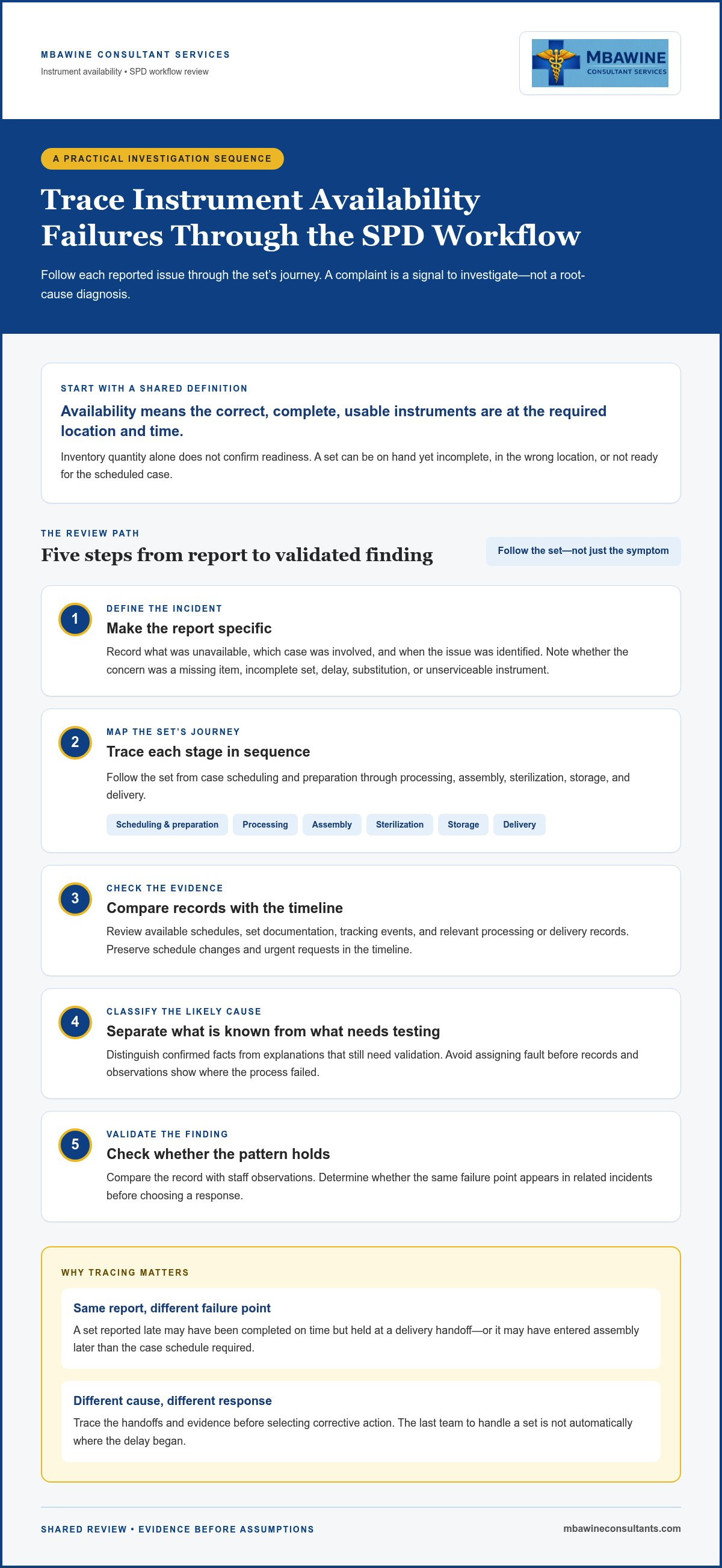
A useful investigation follows the set’s path rather than stopping where someone noticed a problem. Start with the case and reported issue, then trace backward and forward through the connected work. A complaint is a signal to investigate, not a root-cause diagnosis. Treating it this way helps teams avoid assigning fault before records and observations show where the process failed.
Use the same sequence for each report so findings can be compared consistently:
For example, a set reported late may have been completed on time but held at a delivery handoff. Or it may have entered assembly later than the case schedule required. Those situations call for different responses. Preserve the timeline, including schedule changes and urgent requests, instead of assuming the last team to handle the set caused the delay.
Trace who communicates procedure requirements, schedule changes, and urgent requests, and how that information reaches the staff preparing the set. Then follow transport, decontamination, assembly, sterilization, storage, and delivery. At each handoff, note who is responsible, what information should transfer, and what record shows the transfer occurred. Unclear ownership or a missing update can interrupt readiness even when each department completes its assigned task.
Group findings by scheduling, inventory, set configuration, processing, tracking, maintenance, or capacity. Compare incident reports with case schedules, set records, and team observations where available. Interviews can test a workflow explanation, but they should not replace process evidence. Record whether a finding is documented, observed, or still an assumption. This distinction prevents a plausible explanation from being treated as a verified cause.
Consistent execution of established workflows depends on staff understanding both the steps and the handoffs. Focused sterile processing education can support that understanding. A documented trace helps leaders determine whether education is relevant or whether another process issue needs attention. This evidence-based approach makes reducing surgeon complaints about instrument availability a diagnostic effort, not a premature search for someone to blame.
The right intervention depends on what the investigation established, not on which solution is easiest to request. Sourcing equipment through medical device distributors such as Novus Medical or adding staff may be warranted when genuine shortages exist, but neither is automatically the right first response. If the issue comes from an unclear handoff, adding capacity may leave the handoff unchanged. If a recurring shortage reflects insufficient coverage, workflow reminders alone may not resolve it. Match the action to the diagnosed cause, then define what evidence would show progress.
Diagnosed cause: Staff interpret an established task or set-assembly step inconsistently. Possible response: Focused education tied to the workflow and staff roles involved. Evidence of progress: More consistent task execution or documentation in later observations and records.
Diagnosed cause: Information is lost between scheduling, SPD preparation, and OR delivery. Possible response: Clarify handoffs, ownership, and communication steps. Evidence of progress: Fewer documented information gaps and more reliable completion of the defined handoff process.
Diagnosed cause: The set configuration does not match established procedure needs. Possible response: Review the configuration with relevant perioperative and SPD stakeholders. Evidence of progress: Fewer reports tied to the same configuration issue.
Diagnosed cause: Available capacity or coverage is insufficient for the workload pattern. Possible response: Assess staffing or coverage against the demand and timing involved. Evidence of progress: Improved completion or delivery against the facility’s readiness expectations.
Diagnosed cause: An instrument is unserviceable. Possible response: Follow the facility’s established process for taking the item out of use and addressing its condition. Evidence of progress: Clearer visibility of affected items and fewer availability reports attributable to that condition.
Education is relevant when evidence shows recurring variation in established tasks, documentation, or assembly practices, rather than a flawed workflow or inadequate coverage. Instruction should reflect the department’s procedures and the responsibilities of the roles involved. The Sterile Processing Classes: Certification Guide can support staff learning. Link the education need to the performance gap observed.
Consulting can structure an assessment when issues cross departmental boundaries or involve several operational processes. Interim management can provide leadership support during a transition or leadership gap. Temporary staffing is a possible response when evidence points to a capacity or coverage constraint. These options address different needs, so none should replace identifying the cause.
Mbawine Consultant Services provides sterile processing consulting and interim management, as well as temporary staffing solutions for healthcare facilities. The right support depends on the assessment findings. To reduce surgeon complaints about instrument availability, evaluate whether the selected intervention changes the specific process condition behind the reports, without assuming any one response will eliminate them.
Before changing procedures, staffing, or set configurations, establish a baseline using the facility’s existing records. Define what counts as an availability incident, which cases and sets are in scope, and how the observation period will be selected. Without a consistent starting point, changes in reporting or case mix can be mistaken for improvement or deterioration.
A baseline and recurring review turn instrument availability improvement from an impression into a measurable process. Select a focused set of measures that reflects the diagnosed problem and the data the facility can reliably collect. Avoid adopting universal targets without a local basis. Compare results with the department’s baseline and locally approved expectations.
Complaint volume can show whether reports are changing, but it does not establish whether sets were complete or ready. Pair it with measures tied to the failure under review, and define each measure so SPD and perioperative teams count events consistently. For example, agree on what qualifies as an on-time delivery and how an incomplete set is recorded before comparing results.
Keep definitions and data sources stable during review. If the team changes how it records an event, document that change. Otherwise, a shift in the numbers may reflect reporting practice rather than operational performance.
Assign an owner to each corrective action, with responsibility for communicating changes, reviewing evidence, and escalating unresolved barriers. A regular SPD and perioperative forum can examine incidents, track trends, and confirm whether agreed actions were completed. Record decisions, responsible roles, and follow-up findings so teams share the same account of progress.
Before expanding an intervention, reassess whether it addresses the original cause. If reports concern late delivery, review the delivery measure and related handoff records rather than assuming a general drop in complaints proves the change worked. This disciplined review is central to reducing surgeon complaints about instrument availability while keeping attention on case readiness.
When baseline findings point to a staff knowledge or execution gap, sterile processing classes can support consistent execution of established workflows.
Sustainable improvement depends on keeping the response aligned with the evidence. Capture the complaint with its case context, assess where the availability process broke down, select an intervention matched to the cause, and review whether the expected process change is occurring. If the review reveals a different barrier, revise the response rather than continuing an intervention simply because it has already begun. This cause-first sequence supports accountability while keeping case readiness central.
Facility leaders and frontline teams remain responsible for defining local workflows, setting expectations, and reviewing performance. Professional education and operational support can complement that work when an assessment identifies a capability, workflow, leadership, or capacity need. The aim is to select support that corresponds to a defined gap and evaluate it through the facility’s own measures.
When observations point to inconsistent understanding or execution of established tasks, sterile processing education can support staff knowledge and practice. In-person and online classes are available for professionals, and focused learning can be connected to the roles and workflow steps involved in the identified gap. If the concern crosses teams or reflects broader operational issues, healthcare sterile processing consulting can support a structured assessment. Interim management can provide leadership support during a transition or gap, while temporary staffing can help when an assessment identifies a capacity constraint.
These services address different needs and are not interchangeable. Leaders can compare the assessment findings with Mbawine Consultant Services’ sterile processing education, consulting, interim management, and temporary staffing options, then select the support that best fits the department’s improvement work.
Before seeking support, assemble a concise summary of the recurring complaint pattern, the records and observations reviewed, and the process category suggested by the evidence. Note which cases, sets, or handoffs are involved, what the team has already changed, and which questions remain unresolved. This preparation helps clarify whether the priority is staff learning, coordination between departments, leadership support, or capacity, rather than presenting a broad complaint without operational context.
Include the people who understand the affected steps, such as SPD and perioperative stakeholders, and identify who will coordinate assessment, communicate decisions, and review subsequent findings. Keep the facility’s baseline and locally defined measures in view so any support contributes to an improvement process the organization can evaluate.
Reducing surgeon complaints about instrument availability takes disciplined assessment, collaboration, and review, not a promise that one intervention will eliminate reports. For professionals who have identified an education need, review sterile processing class enrollment information as a practical learning option.
Instrument readiness depends on organizational learning: teams need a reliable way to raise concerns, examine the evidence, and carry lessons into daily practice. Leaders can strengthen that learning by clarifying improvement responsibilities and ensuring staff have the knowledge and operational support to follow established processes consistently. This creates a practical foundation for reducing surgeon complaints about instrument availability while supporting coordination and case readiness.
The next step can be modest and focused. Identify where staff would benefit from further sterile processing education, then connect that learning need to the roles and workflows involved. Mbawine Consultant Services offers in-person and online classes, alongside consulting, interim management, and temporary staffing for facilities whose assessments identify broader operational or capacity needs.
Explore sterile processing education and enrollment options to find learning opportunities relevant to your professional goals. With a clear improvement focus and sustained collaboration, your department can continue building stronger practices in support of surgical teams.
Compare readiness results over consistent reporting periods, using the same definitions and data sources each time. For example, monitor whether requested sets pass the department’s final completeness check and reach the designated location by the facility’s agreed readiness time. Review results alongside case volume or schedule changes where available, since workload context can affect interpretation. A downward trend in complaints alone is not enough if set readiness measures remain unchanged.
A useful report identifies the procedure or case, the specific set or instrument, when the issue was discovered, and what happened as a result. Distinguish whether an item was absent, the set was incomplete, delivery was late, or an instrument could not be used. If a substitute was provided, record that and whether it addressed the immediate need. These details help SPD staff investigate the event without relying on memory or broad labels.
Tracking software can make an instrument’s recorded location or status more visible, helping staff investigate where an item may have gone and identify gaps in documented movement. It cannot by itself ensure that a set is correctly assembled, schedule changes reach the right people, or an item is ready for use. To reduce surgeon complaints about instrument availability, treat tracking data as evidence for process review, not as a substitute for it.
Notify the appropriate perioperative contact promptly, confirm exactly what is unavailable, and establish the case timing and the team’s immediate information needs. Then follow facility procedures to determine the set’s status and communicate accurate updates. Handle any alternative set or instrument through the facility’s established clinical and operational decision-making process. After addressing the immediate concern, document the event so the department can examine the cause without delaying communication.
No. Staffing may contribute when documented workload or coverage constraints coincide with repeated late preparation or delivery, but other causes can produce similar reports. An outdated set configuration, unclear schedule-change communication, or incomplete status records may persist even with adequate staffing. Assess the specific failure pattern before changing coverage. If staff knowledge or consistent execution is implicated, targeted education may be more appropriate than adding personnel.
Agree on shared terms for “ready,” “complete,” and “delivered,” then apply them consistently in incident documentation and case communication. When teams disagree about an event, compare the same case timeline and records rather than relying on separate recollections. A brief, recurring review of unresolved examples can clarify expectations and reveal mismatches in handoff practices. Document the agreed interpretation and communicate process changes to the staff responsible for carrying them out.

Article by
Mba Akuribila
Mba‑Akuribila is a healthcare leader, educator, and founder of Mbawine Consultants, a Bronx‑based institution recognized nationwide for advancing excellence in sterile processing and allied health workforce development. Born in Bongo in Ghana’s Upper East Region, his journey from rural beginnings to national impact reflects a lifelong commitment to service, empowerment, and community advancement.
For over two decades, he has trained sterile processing employees, mentored, and placed thousands of healthcare professionals across the United States. Through Mbawine Consultants, he established one of the country’s most trusted Sterile Processing Certification Test Prep Programs, preparing new Americans and career‑changers for successful entry into the field. The organization, as at 2026, has graduated more than 15,000 sterile processing technicians who now serve in hospitals, ambulatory centers, dental practices, and reprocessing facilities nationwide.
Under his leadership, Mbawine Consultants has expanded into a full Healthcare Staffing Agency, connecting nurses and allied health professionals to meaningful employment opportunities. His team also provides Interim Management Services, supporting hospitals and surgical centers with experienced leaders who stabilize operations, strengthen compliance, and improve workflow efficiency.
As a former surgical technician, sterile processing manager, educator, and system‑wide director, Mba‑Akuribila brings deep expertise to Sterile Processing Consulting, helping healthcare facilities elevate quality, safety, and regulatory readiness.
His work in the United States and Ghana continues to reflect his core philosophy: service above self, opportunity for all, and excellence without compromise.


