

The difference between a seamless regulatory survey and a catastrophic institutional failure often rests not on the efforts of a single day, but on the systematic integrity of a department's daily operational framework. Many healthcare leaders understand the profound anxiety that accompanies an unannounced visit from The Joint Commission or DNV, especially when high staff turnover and inconsistent documentation create visible vulnerabilities. Identifying common SPD audit failures is the essential first step toward transforming these systemic weaknesses into pillars of professional reliability. It's a reality that maintaining compliance requires more than reactive preparation; it demands a culture of continuous clinical excellence.
This strategic guide provides a professional framework designed to help you master the rigorous requirements of Sterile Processing Department audits while ensuring institutional compliance through 2026. By implementing a standardized process for daily operations, your facility can move toward the goal of zero findings while fostering professional mastery among technical staff. We'll explore the essential components of audit readiness, including advanced documentation strategies and the role of professional certification in mitigating operational risk, providing a comprehensive roadmap to sustained departmental excellence.
The Sterile Processing Department (SPD) serves as the foundational pillar of institutional infection control, functioning as the critical nexus where surgical safety and technical precision intersect. While often positioned behind the scenes, the department's efficacy directly dictates the viability of every operative procedure performed within the facility. In the current regulatory environment, the transition from reactive, "survey-window" preparation to a permanent state of proactive readiness is no longer optional; it's a professional necessity. The 2026 landscape demands that departments treat documentation accuracy with the same clinical gravity as the physical sterilization process itself, recognizing that an unrecorded task is, in the eyes of an auditor, a task that never occurred. Failure to maintain this level of rigor often results in common SPD audit failures that can jeopardize the entire institution's standing.
The high stakes of these audits involve several critical institutional factors:
Regulatory findings can range from minor citations to "Immediate Jeopardy" (IJ) designations, the latter of which poses a direct threat to a facility's ability to provide patient care and maintain its accreditation status. When common SPD audit failures are identified during a survey, the repercussions extend beyond the department, potentially leading to the suspension of surgical cases and a significant reduction in patient throughput. These disruptions don't just impact revenue; they erode the trust that patients and the community place in the institution's commitment to safety. Audit readiness is the quantifiable alignment of departmental workflows with the objective safety benchmarks established by the 2026 regulatory framework.
Maintaining compliance requires a nuanced understanding of the overlapping requirements set forth by governing bodies such as The Joint Commission (TJC), DNV, and state health departments. These organizations increasingly align their survey methodologies with the rigorous standards of AAMI ST79, which now emphasize the necessity of professional certification for all technical staff to ensure standardized outcomes. Facilities that fail to integrate these standards into their daily operations find themselves vulnerable to citations that could've been prevented through systematic training and expert oversight. To ensure your facility meets these evolving expectations, it's essential to partner with experts who understand the intricacies of healthcare sterile processing consulting and institutional optimization.
Institutional compliance isn't an accidental outcome; it's the result of a deliberate, five-pillared framework designed to withstand the scrutiny of modern regulatory bodies. Standard Operating Procedures (SOPs) represent the first pillar, serving as the validated blueprints for every task performed within the department. These documents must be more than static files; they must be actively utilized, regularly updated, and followed with absolute consistency by every technician. Environmental control and safety constitute the second pillar, requiring the precise monitoring of temperature, humidity, and airflow gradients to prevent cross-contamination. To ensure a fully compliant environment of care, facilities should also explore Fire Extinguisher Maintenance as part of their broader safety protocols. Equipment maintenance and validation form the third pillar, necessitating rigorous testing protocols for autoclaves, washers, and sonic cleaners to ensure that mechanical performance aligns with manufacturer instructions for use (IFU).
The fourth pillar, quality assurance records, operates on the clinical principle that any process not documented is considered unperformed by auditors. Maintaining comprehensive sterilization logs, biological indicator results, and chemical integrator records is essential for institutional defense during a survey. Advanced traceability at the tray level allows for the immediate identification of every instrument processed, creating a transparent chain of custody. This level of detail ensures that staff training records are current and accessible, providing surveyors with the objective evidence they require to verify departmental integrity.
The final pillar is the human element: staff competency and certification. While technical errors are often blamed for citations, many common SPD audit failures actually stem from a lack of standardized education across multiple shifts. There is a direct, documented correlation between CRCST certification and a reduction in common SPD audit failures, as certified technicians possess the specialized knowledge required to navigate complex sterilization protocols. Implementing regular competency assessments for high-risk tasks, such as endoscope reprocessing, ensures that every team member maintains the professional mastery necessary for zero-finding surveys.
Prospective leaders should review our Sterile Processing Classes: Certification Guide to understand the educational requirements for a compliant workforce. To begin building this foundation of expertise within your own team, you can enroll in professional certification training today to ensure your department meets the highest standards of patient safety.
Identifying common SPD audit failures requires a granular examination of the technical processes that occur between the point of surgical use and the sterile storage area. One of the most frequent citations involves the critical gap in point-of-use care, where surgical staff fail to initiate the cleaning process by keeping instruments moist or removing gross soil before transport. This oversight leads to the hardening of bioburden, which complicates the decontamination process and increases the risk of biofilm formation. Auditors in 2026 are increasingly focused on this transition, viewing it as a shared responsibility between the operating room and the sterile processing team. When these departments operate in silos, the resulting inconsistencies create significant regulatory vulnerabilities.
Within the decontamination suite itself, improper usage of Personal Protective Equipment (PPE) remains a prevalent issue. Technicians often fail to adhere to the specific sequence of donning and doffing, or they may utilize compromised equipment that doesn't provide adequate protection against liquid-borne pathogens. This technical lapse is frequently accompanied by the "tribal knowledge" trap, where unwritten, non-compliant shortcuts are passed down through generations of staff, superseding the department's validated SOPs. Breaking this cycle of informal instruction is essential for maintaining institutional integrity and ensuring that every technician operates according to the highest professional standards.
Surveyors prioritize the physical and atmospheric separation of the "dirty" and "clean" environments. Citations often arise from breaches in the dirty-to-clean workflow, such as personnel moving between zones without following proper transition protocols or doors being left open, which disrupts the required negative air pressure in decontamination areas. Clear signage and restricted access protocols must be strictly enforced to minimize cross-contamination risks and ensure that the sterile core remains an isolated, controlled environment. Managing personnel flow isn't just about floor plans; it's about the disciplined movement of staff to minimize bioburden transfer.
The inspection phase serves as the final barrier against surgical site infections, yet it's a frequent site of common SPD audit failures due to inadequate visualization tools. Every instrument, regardless of its perceived cleanliness, must undergo inspection under lighted magnification to identify residual bioburden or structural damage that isn't visible to the naked eye. Auditors in 2026 prioritize manufacturer Instructions for Use (IFU) compliance because these manufacturer-validated protocols serve as the definitive legal and clinical benchmark for ensuring that complex medical devices are rendered safe for patient use. Ensuring that IFUs are current and accessible at every workstation is a fundamental requirement for maintaining institutional compliance and protecting patient outcomes.
The execution of a systematic mock audit represents the transition from theoretical readiness to operational validation. This process must mirror the clinical rigor of a formal survey, utilizing objective checklists to evaluate departmental performance across all shifts and personnel. It's insufficient to assess only the primary day shift; true compliance is verified when night and weekend teams demonstrate the same adherence to validated protocols. By conducting staff interviews, leadership can test knowledge regarding SOPs and emergency sterilization protocols, ensuring that technical mastery isn't confined to a single individual but is a collective departmental trait. Identifying common SPD audit failures during this phase allows for the creation of a robust Corrective Action Plan (CAP) that resolves vulnerabilities before an external surveyor arrives.
To achieve zero findings, managers must learn to "see" the department through the lens of an external auditor. This involves adopting the tracer methodology, where a single surgical instrument is followed from the point of use in the operating room back through decontamination, preparation, and sterile storage. This comprehensive view often reveals common SPD audit failures that are frequently overlooked during routine management walkthroughs, such as dust accumulation on high shelves or expired sterile supplies. By focusing on these often-ignored details, leadership can eliminate the "low-hanging fruit" citations that often signal a lack of departmental oversight to a seasoned auditor.
Maintaining an objective perspective is often difficult for internal teams who've become accustomed to their own environmental norms. This is where interim SPD management provides an essential, unbiased external perspective. Utilizing third-party consulting serves to validate departmental compliance and provides a strategic roadmap for optimization. For a deeper understanding of these professional resources, leaders should consult The 2026 Guide to Sterile Processing Consultant Services to ensure their facility is prepared for the highest level of scrutiny. To build the necessary internal expertise for these assessments, you can enroll in professional certification preparation to ensure your leadership team possesses the clinical knowledge required for audit excellence.
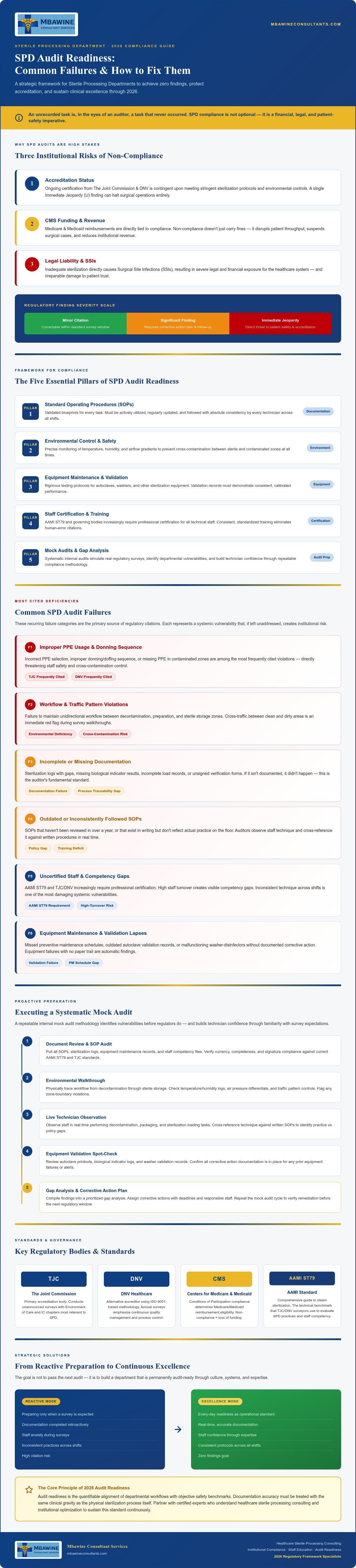
Achieving a permanent state of audit readiness requires a transition from episodic preparation to a deeply ingrained culture of clinical excellence. This transformation is anchored in the integration of comprehensive Sterile Processing Education into the department's foundational operations. By prioritizing professional development, institutional leaders can ensure that every technician possesses the specialized knowledge required to navigate the complexities of 2026 regulatory standards. This proactive approach positions the Sterile Processing Department not merely as a support service, but as a critical center of excellence that safeguards patient safety and institutional integrity. When education is treated as a core operational requirement, the department becomes inherently resilient against the technical lapses that compromise compliance.
Professional certification serves as a primary defense against the technical lapses that lead to common SPD audit failures. Statistical evidence suggests that departments with higher percentages of certified technicians experience significantly lower citation rates, as these individuals are trained to recognize and mitigate risks before they escalate into regulatory findings. Customized training programs, such as specialized CRCST preparation, provide staff with the tools for professional mastery while aligning departmental workflows with current AAMI and TJC requirements. It's a strategic investment that pays dividends in the form of reduced error rates and enhanced technician confidence during high-pressure surveys. Staff who understand the "why" behind a protocol are far more likely to follow it with precision.
Workforce shortages represent a significant threat to departmental standardization, often leading to the inconsistent documentation and workflow violations that characterize common SPD audit failures. To maintain standards during these high-stress periods, facilities must leverage emergency sterile processing staffing solutions that provide experienced, audit-ready personnel. Expert consultants also play a vital role in this ecosystem, acting as the bridge between current operational gaps and industry best practices. These specialists transform struggling departments by implementing validated systems that ensure long-term compliance and efficiency. To initiate this transformation within your own facility, you should enroll in professional sterile processing classes to elevate your team and secure your institution's clinical future.
Transitioning from a reactive survey posture to a state of permanent clinical readiness requires the integration of rigorous technical standards and a commitment to continuous professional education. By establishing a framework based on validated standard operating procedures and executing systematic mock audits, departments can effectively identify and mitigate common SPD audit failures before they impact patient safety or institutional accreditation. This methodical approach ensures that every technician, regardless of shift or tenure, operates with the professional mastery required by 2026 regulatory bodies. It's a standard that demands absolute precision in both physical sterilization and documentation accuracy.
Mbawine Consultant Services stands as a dedicated guardian of these industry standards, offering unparalleled expertise in sterile processing certification preparation, including CBSPD, alongside comprehensive interim management and consulting solutions. Our national reputation for educational excellence provides the bridge between current departmental vulnerabilities and a future of zero-finding surveys. To fortify your facility against regulatory risk and elevate the technical proficiency of your team, you should Enroll in Professional Sterile Processing Classes to Ensure Compliance. Achieving departmental excellence is a deliberate journey; with the right strategic partnership, your institution can set the benchmark for surgical safety and operational integrity.
The most frequent citations identified during regulatory surveys often involve common SPD audit failures such as inconsistent documentation of sterilization cycles and improper Personal Protective Equipment usage in decontamination areas. Auditors also frequently note failures in point-of-use care where bioburden is allowed to dry on instruments before transport. These technical lapses suggest a systemic lack of oversight that can be corrected through rigorous staff training and the implementation of validated standard operating procedures.
Healthcare facilities should ideally conduct internal mock audits on a quarterly basis to ensure continuous departmental readiness and operational integrity. This frequency allows leadership to identify emerging vulnerabilities and correct technical deviations before they manifest as formal survey citations. Regular assessments across all shifts help to eliminate the "tribal knowledge" trap and reinforce a culture where compliance is viewed as a permanent state rather than a temporary reaction to an upcoming audit.
While legal requirements for certification vary by state jurisdiction, the 2026 professional landscape has established professional certification as the de facto institutional standard for patient safety. Accrediting bodies like The Joint Commission increasingly view a certified workforce as a primary indicator of departmental competency and risk mitigation. Facilities that prioritize HSPA or CBSPD certification often report fewer common SPD audit failures because their staff possess the specialized knowledge required to navigate complex manufacturer instructions.
Instructions for Use serve as the definitive clinical and legal benchmark for the cleaning, disinfection, and sterilization of medical devices. During an audit, surveyors expect to see that current IFUs are not only accessible at every workstation but are followed with absolute precision for every cycle. Failure to adhere to these manufacturer-validated protocols is a major source of citations; it directly compromises the efficacy of the sterilization process and endangers patient outcomes in the operating room.
Interim management provides an essential, unbiased external perspective that helps departments identify blind spots in their current workflows and documentation practices. These experienced leaders implement systematic gap analyses and corrective action plans that align departmental operations with national best practices. By providing expert oversight during periods of leadership transition or workforce shortages, interim managers ensure that the facility remains in a state of constant readiness for unannounced regulatory surveys from bodies like the DNV.
The tracer methodology is a survey technique where an auditor follows a single surgical instrument or tray through its entire lifecycle within the facility. This process begins in the operating room and continues through decontamination, preparation, sterilization, and eventually into sterile storage. By observing this journey, surveyors can evaluate the continuity of care and identify breaks in the "dirty-to-clean" workflow that might otherwise go unnoticed during a static inspection of the department's physical environment.
Documentation for immediate-use steam sterilization must be comprehensive and include the specific clinical justification for the cycle to ensure regulatory compliance. Records should capture the patient's identity, the specific item processed, the cycle parameters, and the results of all biological and chemical indicators. Because auditors view IUSS as an exception rather than a standard practice, departments must demonstrate that these cycles are only utilized in urgent situations where no other sterilized alternatives exist for the procedure.
Sterile storage areas must maintain strictly controlled environmental parameters, including temperatures between 68 and 75 degrees Fahrenheit and relative humidity levels not exceeding 60 percent. The area requires positive air pressure relative to surrounding corridors to prevent the infiltration of contaminants from non-sterile zones. Facilities must provide objective evidence of continuous monitoring for these metrics; environmental deviations can compromise the integrity of sterile packaging and lead to significant audit citations during a formal survey.

Article by
Mba Akuribila
Mba‑Akuribila is a healthcare leader, educator, and founder of Mbawine Consultants, a Bronx‑based institution recognized nationwide for advancing excellence in sterile processing and allied health workforce development. Born in Bongo in Ghana’s Upper East Region, his journey from rural beginnings to national impact reflects a lifelong commitment to service, empowerment, and community advancement.
For over two decades, he has trained sterile processing employees, mentored, and placed thousands of healthcare professionals across the United States. Through Mbawine Consultants, he established one of the country’s most trusted Sterile Processing Certification Test Prep Programs, preparing new Americans and career‑changers for successful entry into the field. The organization, as at 2026, has graduated more than 15,000 sterile processing technicians who now serve in hospitals, ambulatory centers, dental practices, and reprocessing facilities nationwide.
Under his leadership, Mbawine Consultants has expanded into a full Healthcare Staffing Agency, connecting nurses and allied health professionals to meaningful employment opportunities. His team also provides Interim Management Services, supporting hospitals and surgical centers with experienced leaders who stabilize operations, strengthen compliance, and improve workflow efficiency.
As a former surgical technician, sterile processing manager, educator, and system‑wide director, Mba‑Akuribila brings deep expertise to Sterile Processing Consulting, helping healthcare facilities elevate quality, safety, and regulatory readiness.
His work in the United States and Ghana continues to reflect his core philosophy: service above self, opportunity for all, and excellence without compromise.


