

A Centers for Disease Control and Prevention study revealed that 67.6% of surveyed ambulatory surgery centers demonstrated at least one infection control deficiency, illustrating how easily procedural variances evade internal notice. If you manage sterile processing operations, you know the quiet anxiety that accompanies an impending survey from The Joint Commission or DNV. When technician turnover and irregular documentation compromise high-level disinfection protocols, rigorous SPD audit preparation isn't merely an administrative exercise; it's the fundamental safeguard protecting institutional accreditation and surgical patient safety.
You can replace the stressful scramble of survey cycles with a dependable, institutional standard that produces zero findings across every shift. This guide delivers a professional framework to master modern regulatory complexities, standardize daily decontamination workflows, and elevate departmental clinical confidence. Ahead, we detail the updated 2026 environmental standards, documentation controls, and leadership strategies essential for enduring compliance.
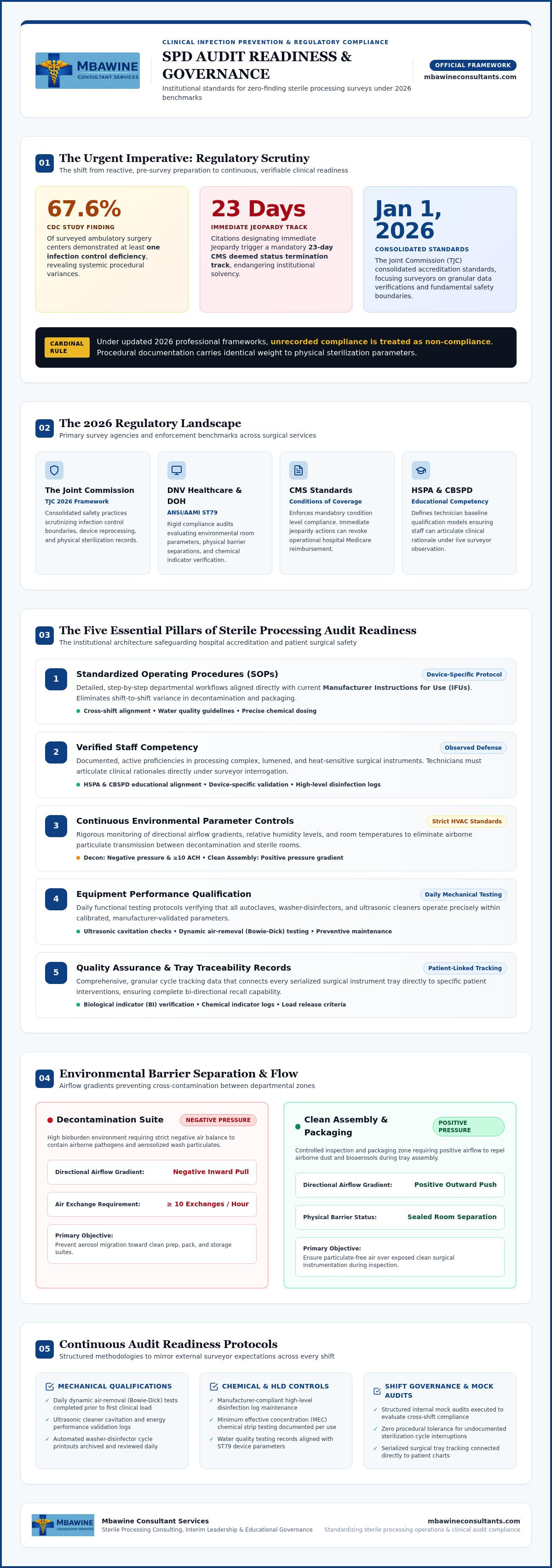
Operating rooms depend entirely on the rigorous execution of decontamination, assembly, and sterilization workflows. Operating as the operational core of hospital-wide infection prevention, the Central Sterile Services Department (CSSD) bears the clinical responsibility of neutralizing surgical site infection risks before instrumentation reaches the sterile field. In recent years, surveyors have shifted their scrutiny from basic structural overviews to granular, data-driven verifications. Institutional leaders now recognize that effective SPD audit preparation demands a cultural transition from reactive, pre-survey panics to a structured state of continuous clinical readiness. Under updated 2026 professional frameworks, unrecorded compliance is treated as non-compliance; procedural documentation carries identical weight to physical sterilization parameters.
Deficiencies identified during clinical surveys produce catastrophic institutional repercussions. Citations designating Immediate Jeopardy trigger mandatory 23-day termination tracks for Centers for Medicare & Medicaid Services (CMS) deemed status, jeopardizing hospital solvency. Beyond federal enforcement, procedural failures compromise operating room throughput. Canceled elective cases cause severe revenue hemorrhaging, erode surgeon trust, and damage institutional reputations across the healthcare sector.
In the context of 2026 clinical standards, audit readiness represents the verifiable capacity of a department to execute and document reproducible, standard-compliant sterilization protocols across every shift without deviation.
Healthcare facilities operate under intense oversight from several accrediting bodies. The Joint Commission (TJC) consolidated its accreditation standards on January 1, 2026, directing surveyors to scrutinize fundamental safety practices and infection control boundaries. Concurrently, DNV Healthcare and state departments of public health enforce strict adherence to ANSI/AAMI ST79 standards, evaluating environmental parameters, physical barrier separations, and precise chemical indicator records.
Passing these rigorous surveys requires certified, highly educated personnel capable of defending departmental practices under direct observation. Technicians must understand the clinical rationale supporting every element of performance, from water quality testing to device-specific instructions for use. Facilities seeking to build institutional resilience often prepare their personnel through dedicated Sterile Processing Classes: Certification Guide pathways, aligning internal competency validations directly with current Healthcare Sterile Processing Association (HSPA) and CBSPD educational standards. This alignment closes dangerous procedural gaps, ensuring departmental practices consistently satisfy both external auditors and internal safety benchmarks.
Operational resilience in sterile processing rests on five interconnected pillars: validated standard operating procedures, verified staff competency, continuous environmental parameter controls, equipment performance qualification, and meticulous quality assurance logs. Effective SPD audit preparation requires healthcare managers to evaluate each pillar with disciplined institutional oversight. Decontamination areas must sustain continuous negative air pressure with at least 10 air exchanges per hour, while clean assembly suites require positive pressure to prevent airborne particulate migration. Daily mechanical verification across all autoclaves and washer-disinfectors ensures equipment functions within validated parameters.
Surveyors operate under an unwavering clinical tenet: undocumented processes represent unperformed processes. Complete traceability requires logging every instrument set as it moves from decontamination to terminal release. Cycle documentation must record physical parameters, biological indicator results, and Type 5 chemical integrator readouts for every autoclave run. Facility leaders must also organize technician training portfolios, ensuring annual skills evaluations and high-level disinfection sign-offs remain immediately accessible for surveyor inspection.
Audit vulnerabilities stem primarily from procedural human variances rather than mechanical failures. Technicians possessing recognized CRCST certification demonstrate lower citation rates during surveys because they understand the microbiological rationale behind chemical contact times and mechanical scrubbing. Maintaining this standard requires periodic reassessments for complex tasks, particularly flexible endoscope reprocessing and automated cleaning verification. Departmental leaders seeking to eliminate cross-shift discrepancies can enroll personnel in professional sterile processing education to establish departmental consistency and safeguard regulatory compliance.
Audit failures rarely stem from sudden operational breakdowns. Instead, they emerge from gradual, unaddressed procedural drift across shifts. When departments rely on unwritten customs rather than standardized manufacturer guidelines, dangerous variances take root. Comprehensive SPD audit preparation requires leadership to confront this reliance on tribal knowledge, systematically auditing the entire instrument lifecycle from initial perioperative use to final storage. Key survey citations frequently reveal simple yet critical breakdowns:
Surveyors scrutinize physical boundaries separating bioburden containment from clean assembly suites. Strict unidirectionality governs instrument movement; items must never flow backward from preparation into decontamination without complete reprocessing. Personnel traffic requires equal vigilance. Technicians must observe clear gowning protocols before entering clean assembly spaces, and facilities must restrict all unauthorized foot traffic through electronic badge access controls and prominent regulatory warning signage.
Visual inspection demands thorough optical support rather than casual observation. Technicians must evaluate every hinged, serrated, and lumened surgical tool under dedicated lighted magnification to detect micro-debris, bioburden residue, or metal fatigue before packaging. Surveyors will observe technicians directly, cross-referencing their manual cleaning and inspection actions against device-specific instructions for use (IFUs).
Strict adherence to manufacturer instructions for use serves as the primary survey focus for 2026 auditors because improper cleaning methodologies directly compromise the efficacy of thermal sterilization.
Departments must maintain an accessible, continuously updated digital repository of IFUs at every assembly station. If technicians can't produce the exact reprocessing parameters for an obscure laparoscopic instrument within seconds, surveyors treat that procedural gap as an active infection risk. Regular departmental assessments ensure clinical compliance matches written manufacturer mandates across every operational shift.
Simulated regulatory surveys provide the most reliable mechanism for identifying latent compliance vulnerabilities before external auditors arrive. Effective SPD audit preparation requires leadership to abandon subjective spot-checks in favor of an objective, scored evaluation matrix administered across all operating shifts. Night and weekend shifts often display divergent workflows that escape daytime oversight. Departmental leaders must systematically test technician comprehension through unannounced scenario interviews, evaluating staff responses to biological indicator failures, wet pack discoveries, and emergency chemical spills.
Auditors identify operational breakdown by inspecting foundational physical parameters that departmental staff frequently overlook. In sterile storage environments, surveyors quickly cite packages stored less than 8 inches from the floor, within 18 inches of sprinkler heads, or less than 2 inches from exterior walls. They inspect upper wire shelving for lint accumulation and scrutinize peel pouches for micro-punctures or compromised heat seals. When surveyors detect these visible lapses, they routinely expand their inquiry into sterilization records and equipment maintenance logs.
Internal personnel often develop operational familiarity that blinds them to gradual compliance drift. Engaging qualified interim management or external healthcare sterile processing consulting introduces unbiased, clinical scrutiny to departmental workflows. Seasoned leaders assess current practices against evolving accreditation frameworks, eliminating procedural vulnerabilities before official surveys commence. To establish systematic operational readiness and empower personnel with standardized compliance strategies, facilities can enroll departmental teams in professional certification and training programs designed to secure permanent regulatory compliance.
Achieving permanent regulatory compliance requires healthcare institutions to recognize that sophisticated equipment alone cannot safeguard sterile processing integrity. Without rigorously trained professionals, automated washer-disinfectors and low-temperature sterilizers can't prevent procedural human errors. Sustainable SPD audit preparation embeds clinical discipline directly into departmental culture, transforming technician perspectives from mechanical task completion to active infection prevention. When facilities invest systematically in their personnel, the department evolves from an overlooked support service into an institutional center of clinical excellence.
Technician credentialing serves as a hospital's strongest defense against survey citations. Certified technicians who have completed formal certification preparation demonstrate significantly lower error rates in chemical concentration testing, packaging integrity, and biological monitoring. Structured curriculum models eliminate the procedural drift caused by informal peer training. Integrating comprehensive sterile processing education ensures that every technician understands not just how to execute manufacturer instructions for use, but why microbiological barriers depend on uncompromising compliance. Tailored facility training standardizes competencies across complex specialties, including flexible endoscopy and robotic instrumentation.
Acute labor shortages present an immediate threat to sterilization standards. When departments operate understaffed, personnel face pressure to accelerate turnaround times, inadvertently compromising enzymatic soak durations or skipping ultrasonic cleaning cycles. Utilizing specialized healthcare temp staffing and 24/7 emergency staffing stabilizes daily operations, preventing dangerous shortcuts during unexpected surgical surges or staffing deficits. Concurrently, interim management provides objective administrative oversight, restructuring daily workflows to align with updated accreditation expectations. To evaluate your facility's current survey readiness and resolve operational vulnerabilities before inspectors arrive, contact Mbawine Consultant Services for a professional assessment.
Transitioning from episodic survey dread to permanent compliance demands systematic operational control across all shifts. Thorough SPD audit preparation aligns daily environmental controls, meticulous cycle logging, and manufacturer instructions for use into an unbroken clinical barrier against surgical site infections. When healthcare leaders replace unwritten tribal customs with objective mock evaluations and verified staff competencies, the sterile processing suite transforms into a resilient pillar of institutional reliability.
Navigating 2026 regulatory scrutiny doesn't have to strain your clinical resources. Drawing on deep expertise in HSPA and CBSPD standards, structured interim management solutions and workforce development pathways bridge the gap between departmental vulnerabilities and inspection excellence. Empower your technicians with the authoritative knowledge necessary to sustain flawless survey outcomes across every surgical discipline. Secure your department's future with professional sterile processing education and consulting to build an enduring foundation of clinical compliance.
The most frequent citations involve failures in point-of-use cleaning, inconsistent documentation of sterilizer printouts, improper personal protective equipment usage in decontamination, and non-compliance with validated device instructions for use. Surveyors regularly identify environmental variances, such as incorrect airflow pressure gradients or out-of-range humidity levels. Addressing these gaps requires systematic SPD audit preparation that focuses on strict adherence to ANSI/AAMI ST79 standards across all operational shifts.
Healthcare facilities should conduct a comprehensive mock audit semi-annually, complemented by targeted monthly audits focused on high-risk processes like flexible endoscope reprocessing. Regular evaluations prevent compliance drift and familiarize technicians with surveyor tracer techniques. Consistent internal assessments ensure continuous survey readiness rather than hurried preparation before triennial Joint Commission or DNV visits. They also reveal cross-shift discrepancies that typically evade routine supervisory observation.
Certification requirements vary by state, but accrediting bodies and healthcare systems increasingly mandate credentials like the CRCST or CSPDT to satisfy CMS Conditions of Participation. Even where legislation doesn't require certification, surveyors evaluate technician competency through direct observation and oral questioning. Facilities employing certified personnel experience significantly fewer procedural citations, as certified technicians possess formal training in microbiological principles and validated reprocessing standards.
Manufacturer instructions for use serve as the definitive clinical benchmark against which surveyors evaluate departmental compliance. Facilities must maintain a centralized, accessible digital repository of current IFUs for every instrument, container, and cleaning chemical utilized. During an audit, surveyors observe manual cleaning and mechanical cycle selections, comparing technician actions directly against written IFU specifications to verify that reprocessing protocols achieve validated sterility assurance levels.
Interim management provides objective, external leadership to identify latent procedural deficiencies that internal personnel often overlook. Experienced interim leaders restructure daily workflows, establish rigorous quality control audits, and align documentation practices with current regulatory frameworks. In complex operational transitions or leadership vacancies, interim managers maintain operational continuity, conduct targeted gap analyses, and execute effective SPD audit preparation to ensure departmental compliance during high-stakes surveys.
Tracer methodology is an evaluation technique where surveyors follow the complete lifecycle of a single surgical instrument set through the facility. The surveyor tracks the tray from point-of-use decontamination in the operating room, through manual cleaning, ultrasonic wash, assembly, terminal packaging, and autoclave cycle documentation, ending at sterile storage. Any procedural deviation or missing documentation along this pathway constitutes an immediate survey citation.
Immediate-use steam sterilization documentation requires exhaustive, real-time logging that justifies the clinical emergency prompting the cycle. Each IUSS log must record the patient identifier, specific instruments processed, cycle parameters, chemical integrator results, cleaning verification, and operator identification. Facilities must routinely audit these records to confirm that IUSS isn't used as an inventory convenience, which constitutes a serious violation under ANSI/AAMI ST79 guidelines.
Under ANSI/AAMI ST79 standards, sterile storage suites must maintain temperatures between 68°F and 73°F and relative humidity between 30% and 60%. The suite requires continuous positive air pressure with at least four total air changes per hour. Additionally, sterile supplies must remain at least 8 inches above the floor, 18 inches below fire sprinkler heads, and 2 inches away from exterior walls to prevent contamination risks.

Article by
Mba Akuribila
Mba‑Akuribila is a healthcare leader, educator, and founder of Mbawine Consultants, a Bronx‑based institution recognized nationwide for advancing excellence in sterile processing and allied health workforce development. Born in Bongo in Ghana’s Upper East Region, his journey from rural beginnings to national impact reflects a lifelong commitment to service, empowerment, and community advancement.
For over two decades, he has trained sterile processing employees, mentored, and placed thousands of healthcare professionals across the United States. Through Mbawine Consultants, he established one of the country’s most trusted Sterile Processing Certification Test Prep Programs, preparing new Americans and career‑changers for successful entry into the field. The organization, as at 2026, has graduated more than 15,000 sterile processing technicians who now serve in hospitals, ambulatory centers, dental practices, and reprocessing facilities nationwide.
Under his leadership, Mbawine Consultants has expanded into a full Healthcare Staffing Agency, connecting nurses and allied health professionals to meaningful employment opportunities. His team also provides Interim Management Services, supporting hospitals and surgical centers with experienced leaders who stabilize operations, strengthen compliance, and improve workflow efficiency.
As a former surgical technician, sterile processing manager, educator, and system‑wide director, Mba‑Akuribila brings deep expertise to Sterile Processing Consulting, helping healthcare facilities elevate quality, safety, and regulatory readiness.
His work in the United States and Ghana continues to reflect his core philosophy: service above self, opportunity for all, and excellence without compromise.


