

The right choice depends on whether your sterile processing department needs focused expertise for a defined project or ongoing leadership woven into daily operations. SPD consulting may suit a specific project or temporary skills gap; hiring a full-time manager is often a better fit for continuous oversight, team development, and sustained organizational knowledge. The decision between SPD consulting and hiring a full-time manager comes down to what the department needs and how long it needs it.
Both options can support department operations, but differ in continuity, availability, benefits, and how closely the leader becomes part of the organization. Weigh predictable staffing and institutional knowledge against access to specialized support without creating a permanent role.
This article explains how project scope, specialist skills, job security, benefits, and organizational familiarity shape the decision. It also considers when consulting, a full-time appointment, or a combination of both may best meet your department’s needs.
Employment status affects job security, supervision, and continuity in a sterile processing department. Before deciding, compare the written arrangement, expected duration, and authority over daily work.
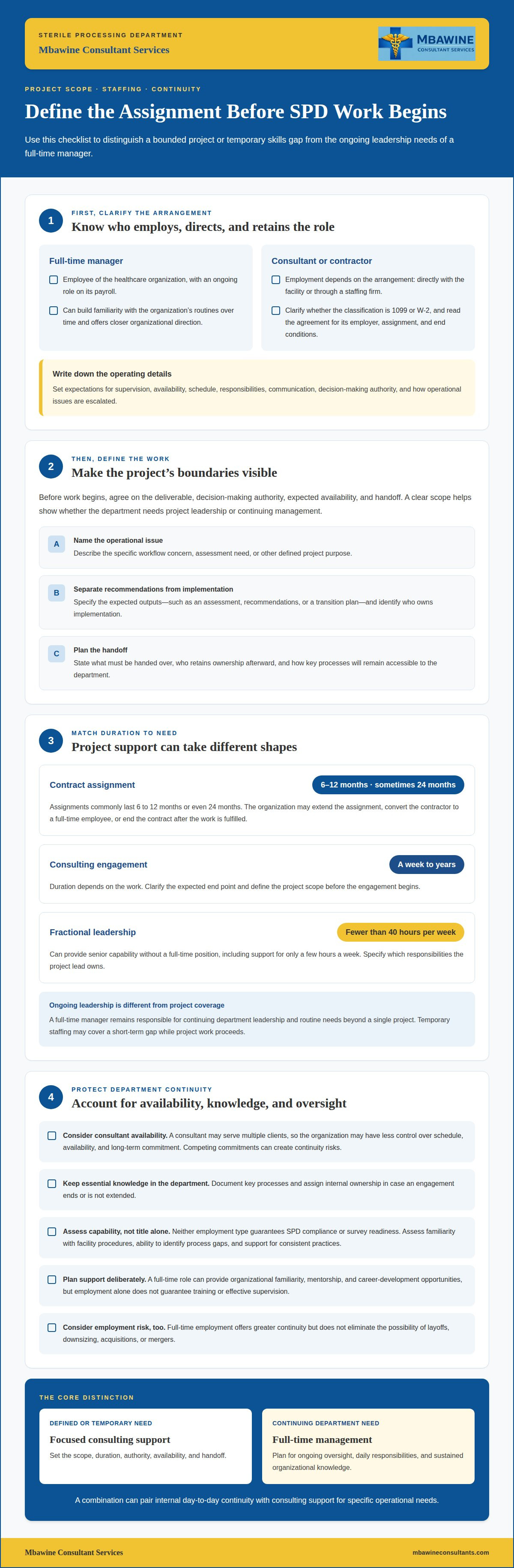
A full-time manager is an employee of the healthcare organization, with an ongoing role on its payroll. A consultant works on a defined assignment, arranged directly or through a staffing firm. In a staffing arrangement, the consultant may be employed by the firm while working at the facility.
Before accepting a consulting or contracting position, clarify whether the arrangement is as a 1099 contractor or a W-2 contractor, as advised by the Internal Revenue Service. These classifications affect who employs the worker and how the engagement is structured. Read the agreement for its employer, assignment, and end conditions.
Contract assignments commonly last 6 to 12 months or even 24 months. The organization may extend an assignment, convert the contractor to a full-time employee, or end the contract after the work is fulfilled. This flexibility can address a defined need, but it doesn’t provide the same continuity as an ongoing position.
| Option | Employment relationship | Continuity and control |
|---|---|---|
| Full-time manager | Employee of the organization | Ongoing role and closer organizational direction |
| Consultant or contractor | Classification depends on the arrangement | Assignment-based, with possible extension or conversion |
Choose according to whether the need is temporary or ongoing, and how much day-to-day direction the role requires.
A full-time manager works for one organization and can learn its routines over time. The organization can provide clear processes, mentorship, and career-development opportunities. These supports take deliberate planning: employment alone does not guarantee training or effective supervision.
A consultant may work with multiple clients, giving the organization less control over availability, schedule, and long-term commitment. Set expectations for responsibilities, communication, and decision-making authority at the outset. This helps staff understand who directs the work and how operational issues are escalated.
Neither employment type guarantees SPD compliance or survey readiness. Assess whether the manager or consultant understands the facility’s procedures, can identify process gaps, and can help the team prepare and maintain consistent practices.
A consulting engagement can create continuity and availability risks if it ends, is not extended, or the consultant has competing commitments. Document key processes and assign internal ownership so essential knowledge remains accessible to the department.
Full-time employment offers greater continuity, but does not eliminate employment risk. Employees generally have limited control over layoffs, downsizing, acquisitions, and mergers, so consider organizational stability as well.
Project-based support can address a specific operational need without creating an ongoing position. SPD consulting can provide focused expertise and project leadership; a full-time manager typically takes on continuing department responsibilities.
Before work begins, define the deliverable, decision-making authority, expected availability, and handoff. These details help determine whether the need is a bounded project or an ongoing leadership role.
A consultant may contribute without extensive onboarding, which can help when a project has a defined start and end. An experienced consultant’s decisions may offset engagement costs if they resolve issues efficiently. Compare the full scope and expected outputs rather than judging value by the fee alone.
For example, a facility addressing a specific workflow concern can define the assessment, recommendations, and transition plan before work starts. That makes it easier to evaluate the consultant’s contribution against the project’s purpose.
Fractional leadership provides senior capability without requiring a full-time position. It can fit a department that needs project direction for fewer than 40 hours per week, including only a few hours a week. This differs from a full-time manager, whose role continues beyond a single project and supports routine department needs.
Temporary staffing can also cover a short-term gap while project work proceeds. Specify which responsibilities need coverage and which belong to the project lead, so the temporary role supports accountability rather than obscuring it.
Consulting engagements can last from a week to years, depending on the work. Clarify the expected end point before the assignment begins. For an SPD project, specify the operational issue, deliverables, and handoff. A full-time manager, by contrast, remains responsible for ongoing leadership after a project closes.
SPD consulting may cover a defined assessment or project direction, while a full-time manager combines continuing oversight with daily department responsibilities. The project plan should distinguish recommendations from implementation and identify who retains ownership afterward.
Use a simple planning sequence: define the need, set the scope, determine the weekly support required, then establish completion and handoff criteria. Temporary needs may suit project-based support; recurring responsibilities may call for a permanent role. This distinction can also guide professionals weighing project assignments against sustained organizational leadership.
For teams considering workforce development alongside project planning, sterile processing learning options can support a longer-term approach to staff capability.
Consultants can bring focused expertise and tailor their work to a defined need. A full-time manager generally offers more consistent availability for routine department operations. The choice of SPD consulting vs hiring a full-time manager depends partly on whether the department needs specialist input or sustained leadership.
For either arrangement, assess practical sterile processing knowledge, communication, and workflow evaluation skills. Ask how the person would identify a process gap and explain next steps to department staff. A useful answer links the concern to a clear approach, rather than relying on a job title alone.
Consultants may choose the work, clients, hours, and location that suit their practice, including work outside a normal 9-to-5 workday. That flexibility can help a facility obtain specialized support for a particular need. However, a consultant may have limited availability when other clients require attention.
Set expectations before work begins. Identify which duties require an on-site presence, what decisions the consultant can make, and how staff can reach them. For example, a workflow review may require scheduled observation, while follow-up recommendations can use an agreed communication method. Clear boundaries help the arrangement fit department operations.
A full-time manager may have less flexibility in work hours but can be a familiar contact for recurring questions. If staff need guidance during routine operations, continuity may matter more than flexibility in work location. For specialized, temporary needs, expertise may matter more than a permanent schedule.
Compare each candidate’s experience with the actual requirement. A facility seeking help with an operational concern should describe the issue, affected workflow, and staff involved, then assess whether the person can explain a suitable approach. A full-time manager may be better suited to ongoing supervision, team communication, and coordination across daily responsibilities.
Use these criteria to assess flexibility and fit:
For SPD consulting vs hiring a full-time manager, flexibility helps only when responsibilities are clear. Match the arrangement to the department’s schedule, specialist skills required, and level of staff support. A consultant’s autonomy can suit targeted work; a manager’s consistent presence can suit responsibilities that recur across the department.
Compensation is only one part of the decision. Compare income consistency, benefits, and total employment costs before choosing a full-time manager or consulting arrangement.
In the United States, companies with 50 or more employees must provide health insurance under the Affordable Care Act and family and medical leave under the Family Medical Leave Act, according to the Internal Revenue Service. This threshold is one factor in assessing a full-time role’s benefits framework. The actual package may also include retirement savings, paid time off, sick days, stock options, or bonuses.
There is no single average salary or total employer cost for every full-time SPD manager. Salary and total cost depend on the compensation package, benefits, employment taxes, and training provided by the organization.
A full-time employee can receive consistent income, supporting financial predictability. The organization also budgets for costs beyond salary, including benefits, taxes, and training. Compare the complete employment package with the position’s responsibilities and continuity needs, rather than evaluating salary alone.
Consultants have a different income and benefits structure. Independent consultants arrange their own healthcare coverage and may experience income fluctuations, so planning between engagements matters. They may deduct business expenses, but their income depends on the work they secure and complete. This is generally less predictable than a steady employee paycheck.
A consultant assigned through a staffing firm may be employed and paid through the firm’s payroll. In this arrangement, the staffing firm provides benefits to its consultants and takes on liability and insurance responsibility for assigned contractors. These terms differ from independent consulting, so identify who employs the worker and which benefits apply before comparing packages.
Benefits can affect retention and workforce continuity. A full-time manager may receive mentorship, training, and career-development opportunities, while an independent consultant manages business responsibilities beyond the assignment. Decide which arrangement best supports the department’s staffing plan, the worker’s needs, and the organization’s expected level of ongoing leadership.
For temporary coverage, staffing support can address a specific workforce gap; for sustained oversight, a permanent position may better support continuity. Compare who pays the worker, which benefits apply, and how reliably the arrangement meets operational needs.
An internal manager can build familiarity with a facility’s people, routines, and decision-making pathways over time. A consultant can bring an outside perspective but first needs to understand how the organization works. Weigh the need for continuity against the value of targeted external input.
During internal recruitment, assess how candidates would work across the sterile processing department and connected teams. For example, ask how they would learn the facility’s communication practices, clarify responsibilities, and raise an operational concern. These questions reveal whether a candidate can integrate into the organization’s culture, rather than relying on technical knowledge alone.
A full-time employee may have opportunities to lead a team, mentor colleagues, and become familiar with established processes. That can support consistent coordination when staff need decisions within usual workflows. The organization still needs to define authority and expectations clearly: a new manager cannot be expected to understand unwritten practices without structured orientation.
Consultants may need a deliberate introduction to staff, reporting relationships, and local procedures. Start by assigning an internal contact who can explain how decisions move through the facility. Then clarify which recommendations the consultant can make independently and which require leadership approval. This helps avoid confusion when outside expertise meets established routines.
Organizational goals can change during an engagement or an employee’s tenure. If priorities shift, an internal manager may carry context forward and help coordinate new responsibilities. A consultant can offer a fresh assessment when leadership wants an outside view of a changed objective. The key question is who will maintain direction as priorities evolve.
Use a practical decision test: if success depends on sustained team leadership and organizational knowledge, internal hiring may be the closer fit. If a defined need calls for an external perspective, consulting may complement the existing structure. Interim Management can also provide leadership continuity during a transition while the organization evaluates its longer-term needs.
For teams strengthening sterile processing capability, explore sterile processing enrollment as a staff-development step alongside clear leadership and integration plans.
Mbawine Consultant Services offers Sterile Processing classes for professionals seeking structured learning, as well as Healthcare Sterile Processing Consulting for facilities addressing department-level needs. Interim Management can provide leadership during a transition, while Healthcare Temp staffing can help address staffing requirements.
These services address different needs, from professional education to operational guidance and temporary workforce support. Decide whether the priority is building staff knowledge, obtaining consulting expertise, maintaining leadership, or supporting staffing. Defining the need clarifies which option fits the decision between consulting and a full-time manager.
Contact Mbawine Consultant Services to discuss which sterile processing support best fits your needs.
The question of SPD consulting vs hiring a full-time manager becomes clearer when you tie the choice to a defined operational outcome. Before proceeding, document what needs to change, who will own the work, and how the department will assess whether the arrangement remains appropriate. This gives leaders a practical basis for adjusting course as staffing needs and organizational priorities evolve.
For an individual professional, the next step may be building knowledge that supports future responsibilities. For a healthcare facility, it may be clarifying the leadership or staffing support required. Keep the decision connected to the work itself, rather than treating either arrangement as a permanent answer to every department need.
To explore the next step in your professional development, review enrollment information. A thoughtful decision can support stronger planning and a more capable sterile processing team.
The price depends on the case and is provided after a quote request. Relevant cost factors include project scope, engagement duration, specialist expertise, required availability, and whether the work involves consulting or interim leadership. To compare options, define the deliverables and time commitment first, then assess the proposed engagement against the full costs and responsibilities of a permanent role.
Consider an SPD consultant when the facility needs specialized input for a defined operational issue, temporary project, or short-term leadership gap. For example, a team facing a specific workflow challenge may need a focused assessment rather than ongoing department oversight. A full-time manager is generally a better fit when the facility needs continuing supervision, staff development, and leadership integrated into routine operations.
Consulting can provide targeted expertise and adaptable support, but a consultant may work with multiple clients and may not offer a continuous presence in the organization. A full-time manager can build greater familiarity with the facility and support ongoing team leadership, but employment carries continuing costs and responsibilities. Compare the options against the work required, expected continuity, and who will retain operational knowledge.
Consultancy engagements can last from a week to years; contractor assignments commonly last 6 to 12 or even 24 months. Onboarding should establish the project objective, relevant workflows, access to appropriate staff, decision authority, communication arrangements, and deliverables. Before work starts, identify who will receive recommendations and own follow-up tasks, so the engagement has a clear operational handoff.
Compare total engagement or employment costs with documented operational outcomes linked to the work. Set a baseline, define measurable deliverables, and track changes in the targeted process, staff capacity, or project completion. Include benefits, taxes, and training in the employment comparison, and account for the consultant’s scope and duration. Evaluate outcomes the facility can observe, not assumed savings.

Article by
Mba Akuribila
Mba‑Akuribila is a healthcare leader, educator, and founder of Mbawine Consultants, a Bronx‑based institution recognized nationwide for advancing excellence in sterile processing and allied health workforce development. Born in Bongo in Ghana’s Upper East Region, his journey from rural beginnings to national impact reflects a lifelong commitment to service, empowerment, and community advancement.
For over two decades, he has trained sterile processing employees, mentored, and placed thousands of healthcare professionals across the United States. Through Mbawine Consultants, he established one of the country’s most trusted Sterile Processing Certification Test Prep Programs, preparing new Americans and career‑changers for successful entry into the field. The organization, as at 2026, has graduated more than 15,000 sterile processing technicians who now serve in hospitals, ambulatory centers, dental practices, and reprocessing facilities nationwide.
Under his leadership, Mbawine Consultants has expanded into a full Healthcare Staffing Agency, connecting nurses and allied health professionals to meaningful employment opportunities. His team also provides Interim Management Services, supporting hospitals and surgical centers with experienced leaders who stabilize operations, strengthen compliance, and improve workflow efficiency.
As a former surgical technician, sterile processing manager, educator, and system‑wide director, Mba‑Akuribila brings deep expertise to Sterile Processing Consulting, helping healthcare facilities elevate quality, safety, and regulatory readiness.
His work in the United States and Ghana continues to reflect his core philosophy: service above self, opportunity for all, and excellence without compromise.


