

The most persistent SPD leadership and management challenges call for consistent communication, deliberate staff development, and reliable operational processes. Leaders who set clear expectations, invite concerns, and connect daily work to departmental standards can build trust while keeping performance and compliance in focus. The goal is not just to keep work moving, but to maintain established processes under pressure.
That balance can be difficult when staffing constraints, changing demands, and communication gaps strain coordination between sterile processing and the operating room. This article covers practical ways to build trust, develop future leaders, improve coordination, and foster a culture of learning and accountability.
You’ll also learn how process reviews and thoughtful delegation can help teams identify waste and support consistent work while meeting applicable requirements. These strategies address both the leadership practices that shape team relationships and the operational decisions that affect sterile processing performance.
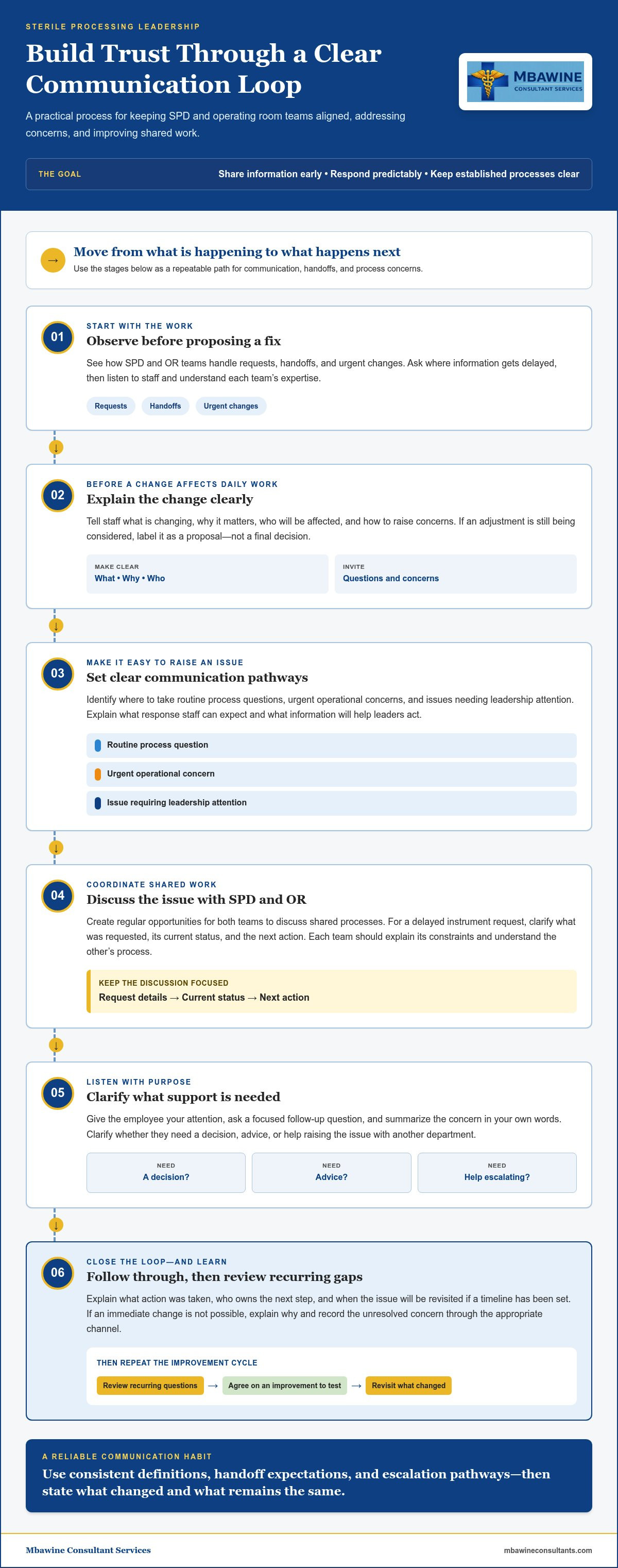
Trust grows when SPD leaders are visible, accessible, and willing to understand work beyond their department. Observe how sterile processing and operating room teams handle requests, handoffs, and urgent changes. Ask staff where information gets delayed, and listen before proposing a fix. This shows respect for each team’s expertise and helps leaders address causes rather than assumptions.
Communicate plans before changes affect daily work. Explain what is changing, why it matters, who will be affected, and how staff can raise concerns. If a workflow adjustment is still under consideration, distinguish the proposal from a final decision. Clear communication reduces speculation and gives employees time to prepare, ask questions, and understand the purpose of the change.
Make communication channels easy to use. Identify the right contact for routine process questions, urgent operational concerns, and issues that require leadership attention. Explain how employees can expect a response and what information will help leaders act. Clear pathways bring problems to light early, set realistic expectations, and keep important details from getting lost between shifts or departments.
For SPD and OR communication, set regular opportunities to discuss shared work. A conversation about a delayed instrument request, for example, should clarify what was requested, its current status, and the next action. Both teams should explain their constraints and understand each other’s processes. A shared view helps resolve the immediate issue without turning a process gap into personal blame.
Consistency matters as much as frequency. Use agreed definitions, handoff expectations, and escalation pathways in conversations and written updates. When information changes, state what is different and what remains the same. Staff can then distinguish new direction from established practice. This is especially important during workflow or technology changes, when unclear messages can cause avoidable confusion.
Make active listening a regular practice. Give the employee your attention, ask a focused follow-up question, and summarize the concern in your own words. For instance, clarify whether the issue is an unclear priority or a missing handoff detail. Ask whether the employee needs a decision, advice, or help raising the issue with another department. This keeps the conversation purposeful.
Close the loop after staff raise concerns. Explain what action was taken, who owns the next step, and when the issue will be revisited, if a timeline has been set. If an immediate change is not possible, explain why and record the unresolved concern through the appropriate channel. Follow-through shows that communication leads to action rather than serving as a formality.
Trust grows when staff can share information early and leaders respond predictably. Review recurring questions and handoff problems with SPD and OR representatives, then agree on a practical improvement to test. Revisit whether it clarified responsibilities or revealed another gap. This cycle makes communication a working management tool and strengthens coordination around shared processes.
Future SPD leaders often come from employees who understand daily workflows, instrument handling, and team pressures. Their technical experience is a foundation, but supervising colleagues requires additional skills. A deliberate development plan lets employees practise decision-making before taking full responsibility for staff, priorities, and departmental performance.
How do SPD leadership challenges compare across industries and organization sizes? Developing people and coordinating work matter across industries, while sterile processing adds specialized workflows and close ties to operating room activity. In organizations of any size, leadership development should reflect the department’s responsibilities, available support, and operational complexity.
Identify candidates through reliability, sound judgment, and willingness to learn, not technical performance alone. Agree on a development goal with each employee. One aspiring supervisor might practise shift planning, while another takes responsibility for reviewing a recurring workflow issue. Defined opportunities let staff build leadership skills step by step.
Make feedback specific, timely, and tied to observable actions. Instead of saying “show more leadership,” explain how an employee handled a priority change, identify what worked, and discuss a different response for next time. Ask the employee to reflect, then set a follow-up opportunity to apply the learning. This builds confidence while making room for improvement.
Mentors and sponsors play different roles in workforce development. A mentor advises an aspiring leader and helps them examine decisions; a sponsor actively supports their advancement within the organization. Together, they can offer guidance and visibility. For example, a sponsor might invite a developing leader to contribute to an improvement discussion, then help them prepare for greater responsibility.
What training and skills do SPD leaders need? They need role-relevant technical knowledge, communication, delegation, problem-solving, and the ability to develop staff. Training should also reflect the actual duties of the role, such as coordinating work, applying departmental procedures, and responding to operational issues.
The ILM Level 5 Certificate in Leadership and Management is presented for supervisors, managers, and aspiring leaders seeking practical leadership skills. It offers one example of structured management learning; development plans should still connect training to the employee’s responsibilities and workplace practice. Pair coursework with supervised assignments, such as leading a team discussion or mapping a process, so learning transfers into daily work.
Review progress through observed work, employee reflection, and agreed development goals. If a participant struggles with delegation, provide a bounded responsibility and discuss the result afterward. If they excel, broaden their contribution gradually. For employees seeking a structured learning pathway, enrollment in sterile processing classes can support continued professional development.
Operational performance depends on how reliably instruments move through each processing step. Map the workflow from receipt and decontamination through preparation, sterilization, storage, and delivery. At each handoff, identify the responsible role, required documentation, and where delays or rework occur. A clear process map helps leaders distinguish workload pressure from avoidable variation.
Complex inventory makes standard work essential. Healthcare organizations may use hundreds or thousands of instrument types, each with specific sterilization and packaging processes. Ensure staff can find the applicable procedure for each device and know how to escalate uncertainty. Training on new technology, along with collaboration with manufacturers, can help teams address challenges with complex devices.
Review instrument utilization alongside processing effort. Up to 87% of instruments may go unused during surgical procedures, and assessment and optimization procedures reduced instrument tray load by up to 39% in a cited study. These findings support reviewing tray contents with clinical stakeholders, removing items that are not needed, and preserving instruments required for the procedure. Fewer unnecessary items can reduce avoidable handling and processing work.
How can SPD organizations address staffing shortages and workload pressure? Compare scheduled coverage with demand, then prioritize tasks according to clinical need, process requirements, and staff skills. Cross-training and clear task assignments can help teams respond to changing workloads without bypassing established procedures.
Track measures that show both workflow and quality, rather than relying on a single productivity figure. Useful indicators include incomplete or delayed sets, rework, errors, instrument availability, and recurring bottlenecks. Review patterns with frontline staff, identify the process step contributing to the issue, and assign a follow-up action. This turns operational data into practical improvements.
Standards and local procedures should guide process decisions. SPD managers should know their organization’s procedures and relevant AAMI and AORN standards. The Association for the Advancement of Medical Instrumentation advises testing devices for cleanliness before returning them to the OR. A study cited by BMJ Quality and Safety found SPD errors affected 5% of surgical cases, underscoring the importance of reliable checks.
What metrics can measure SPD leadership and management effectiveness? Consider whether teams complete work reliably, identify errors and rework, and follow through on corrective actions. Pair operational measures with staff feedback and workflow reviews to see whether leaders are improving performance without compromising established processes.
When proposing an improvement, connect it to organizational goals and assess its effect on quality, workload, and instrument availability. Test the revised workflow, document the results, and adjust based on staff observations. This disciplined cycle can reduce waste while maintaining the processing controls that support safe, dependable outcomes.
Proactive SPD leaders shape department culture through everyday decisions, not slogans. At the start of each shift, clarify priorities, identify coverage concerns, and invite staff to flag barriers. If workload changes affect a handoff, explain the adjustment and why it is needed. Predictable leadership helps employees understand how decisions are made and where their responsibilities begin.
What risks come with ineffective SPD leadership and management? Unclear direction, weak follow-through, or blame can discourage staff from raising concerns and leave process problems unresolved. In sterile processing, breakdowns can affect workflow and patient safety, so leaders need systems that make issues visible and support timely corrective action.
Build error tracking around learning and prevention. Record what happened, where it occurred in the workflow, and which conditions contributed, such as unclear instructions or a missed handoff. Review reports with those involved, identify a practical correction, and assign responsibility for follow-up. Focus the discussion on understanding the process, not assigning personal blame.
A positive safety culture depends on staff seeing that speaking up leads to a considered response. Leaders can model this by acknowledging their own mistakes, asking for help when needed, and thanking employees who identify risks. If a staff member notices a recurring documentation gap, for example, discuss how to clarify the step and assess the change.
Teamwork also requires clear ownership. Leaders who solve every problem themselves can limit others’ growth and create dependence. Instead, delegate a defined task, explain its boundaries, and let the employee make appropriate decisions. A team member reviewing a handoff process, for instance, can gather observations and present improvement options for discussion.
Balance immediate demands with longer-term planning. During a high-workload shift, leaders may need to prioritize essential tasks. Afterward, they can examine whether staffing, training, or workflow design contributed to the pressure. This keeps urgent action from becoming a permanent substitute for addressing root causes and helps managers align practical changes with department goals.
Constructive feedback strengthens accountability when it describes observable behavior and its effect. A manager might explain that an incomplete handoff delayed the next task, then agree with the employee on a clearer transfer point. Follow up by recognizing progress and addressing remaining obstacles. This sets expectations without defining a person by a single error.
To assess culture, review recurring concerns, staff participation in improvement discussions, and whether agreed actions are completed. Use those observations to adjust meetings, delegation, or workflow support. A department becomes more resilient when employees can contribute ideas, take responsibility within clear limits, and work toward shared standards.
Establish a shared operating rhythm between sterile processing and the operating room. Hold regular meetings to review quality initiatives, recurring workflow problems, and unresolved handoff issues. Give each meeting a defined purpose, such as tracing a delayed instrument request from its origin to delivery. Record decisions, assign owners, and revisit actions at the next meeting.
Shared governance gives SPD and OR staff a practical role in shaping solutions. Bring representatives from both departments together to examine a specific problem, compare its effects, and agree on a change to evaluate. If requests arrive with incomplete details, for example, map what information each team needs and where it should be communicated. Review the revised approach against actual handoffs.
A designated coordinator or liaison can reduce miscommunication between departments. The role should connect teams, clarify requests, and direct unresolved issues to the appropriate decision-maker. For instance, a liaison can distinguish an urgent request from a routine question, then track it through the agreed communication pathway. This supports coordination without shifting responsibility for each department’s work.
The Center for Creative Leadership recommends boundary spanning and building high-performing teams to address work across an organization. SPD leaders can apply this by involving OR partners in discussions about shared processes, rather than treating departmental priorities as separate. Ask both groups to identify their desired outcome, constraints, and decisions that require joint ownership.
Use one-on-one meetings to connect individual concerns with team objectives. Ask what is working, where a task becomes difficult, and what support would help. Give the conversation your full attention, remove distractions, and summarize the concern before agreeing on an action. If an employee raises a handoff issue, clarify the specific step and who can help resolve it.
Make communication two-way. After explaining a process change, ask staff to describe their understanding and invite questions about its effect on daily work. This checks comprehension better than simply distributing a written update. Tell employees which communication methods you monitor for routine concerns and which channel handles urgent operational issues.
Listening also means responding to the need behind the message. Ask whether an employee wants advice, practical support, or help escalating a concern. Restate the key point in plain language, then agree on a next step. This prevents managers from preparing a rebuttal while staff are still explaining the issue.
Build these practices into leadership development, so staff can strengthen communication and coordination skills alongside technical knowledge. Enroll in structured sterile processing learning to support continued professional development and stronger team practice.
Mbawine Consultant Services offers Sterile Processing classes for professionals who want to strengthen their knowledge and prepare for certification. These classes can support staff development and help build internal leadership capacity. For broader operational needs, the company also provides Healthcare Sterile Processing Consulting, Interim Management, and Healthcare Temp staffing.
Classes can complement workplace development by giving employees structured learning alongside supervised responsibilities and practical feedback. Facilities can also use consulting or interim management for leadership and process support.
To discuss professional development or departmental support, contact Mbawine Consultant Services or visit mbawineconsultants.com.
Progress depends on turning leadership intent into consistent practice. Choose an improvement that matters to staff, define who will carry it forward, and decide how the team will review its effect. This creates a manageable starting point and lets leaders adapt as operational needs change. Addressing SPD leadership and management challenges takes sustained attention to how people work together, not a single intervention.
As a next step, identify where your team would benefit most from professional development, then choose a learning pathway that supports that need. A deliberate commitment to developing knowledge and leadership skills can lay the groundwork for future improvements.
Explore enrollment options and take a constructive step toward continued growth. Each thoughtful improvement can help your team build stronger practices over time.
Recurring barriers include competing people-management demands, limited time, and pressure to respond to changing organizational conditions. The Center for Creative Leadership reports that frustrations with people and time are the most common challenge for frontline managers, and have increased in frequency since the pandemic. For executives, working in a dynamic business environment is the top challenge. Its research examined anonymized global 360-assessment data from over 48,000 leaders over the past several years.
The most persistent SPD leadership and management challenges include aligning departmental decisions with organizational priorities, preparing employees for greater responsibility, and sustaining accountability under operational pressure. A manager, for example, may need to resolve a recurring workflow concern while helping the team understand why a proposed change matters. Make trade-offs clear, involve the appropriate staff, and ensure short-term decisions do not undermine consistent practice.
SPD managers coordinate specialized work while responding to competing demands, shifting priorities, and communication across departments. An urgent request may interrupt planned work, so staff need to know who can reprioritize tasks and how the change should be documented. Unannounced surveyor visits can also test whether department policies are understood in practice, making staff familiarity with procedures an important management focus.
Unclear expectations, inconsistent decisions, and few development opportunities can leave employees feeling that their effort has little impact. If staff repeatedly raise a workflow concern without hearing what happened next, for example, they may become less willing to contribute ideas. Managers can monitor morale through regular conversations about workload, support, and growth, then follow up on specific concerns. Visible follow-through helps employees see how they can contribute.
SPD means sterile processing department.

Article by
Mba Akuribila
Mba‑Akuribila is a healthcare leader, educator, and founder of Mbawine Consultants, a Bronx‑based institution recognized nationwide for advancing excellence in sterile processing and allied health workforce development. Born in Bongo in Ghana’s Upper East Region, his journey from rural beginnings to national impact reflects a lifelong commitment to service, empowerment, and community advancement.
For over two decades, he has trained sterile processing employees, mentored, and placed thousands of healthcare professionals across the United States. Through Mbawine Consultants, he established one of the country’s most trusted Sterile Processing Certification Test Prep Programs, preparing new Americans and career‑changers for successful entry into the field. The organization, as at 2026, has graduated more than 15,000 sterile processing technicians who now serve in hospitals, ambulatory centers, dental practices, and reprocessing facilities nationwide.
Under his leadership, Mbawine Consultants has expanded into a full Healthcare Staffing Agency, connecting nurses and allied health professionals to meaningful employment opportunities. His team also provides Interim Management Services, supporting hospitals and surgical centers with experienced leaders who stabilize operations, strengthen compliance, and improve workflow efficiency.
As a former surgical technician, sterile processing manager, educator, and system‑wide director, Mba‑Akuribila brings deep expertise to Sterile Processing Consulting, helping healthcare facilities elevate quality, safety, and regulatory readiness.
His work in the United States and Ghana continues to reflect his core philosophy: service above self, opportunity for all, and excellence without compromise.


