

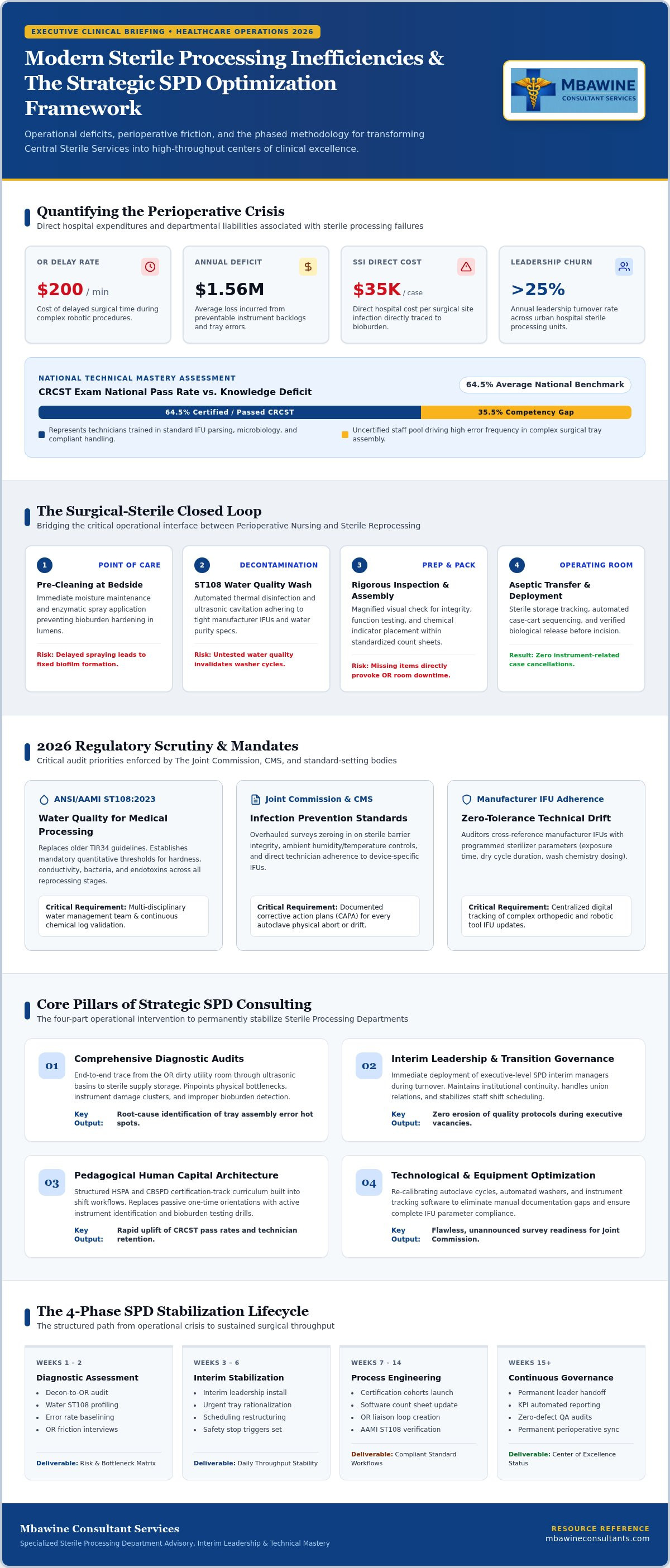
With surgical suites operating at costs reaching $200 per minute for complex procedures, can your facility truly afford the $1.56 million annual deficit associated with preventable instrument backlogs and tray errors? Hospital administrators frequently struggle with the friction between the Operating Room and Sterile Processing leadership, especially when chronic understaffing leads to non-standardized workflows that jeopardize patient safety. Utilizing specialized SPD management consulting serves as a critical intervention, providing the technical mastery and institutional oversight necessary to transform a reactive department into a center of excellence.
It's understood that maintaining compliance with the latest ANSI/AAMI ST108 water quality mandates and the overhauled Joint Commission infection control standards requires more than just temporary staffing; it demands a fundamental shift toward professionalized education and interim leadership. This article outlines a strategic framework for achieving a standardized, compliant workflow that significantly reduces surgical delays and mitigates the risk of costly surgical site infections. We'll explore how integrating interim management with industry-leading certification programs creates a highly trained workforce capable of sustaining long-term operational integrity and perioperative synergy.
The healthcare industry in 2026 faces a precarious intersection of escalating surgical volumes and a persistent sterile processing workforce crisis. As facilities strive to maximize operating room throughput, the chronic instability within the central sterile services department has become a primary bottleneck that threatens institutional revenue and patient safety. High rates of departmental leadership turnover, which currently exceed 25% in many urban health systems, correlate directly with an increased incidence of surgical site infections (SSIs). These infections carry a staggering direct hospital cost of $30,000 to $35,000 per occurrence. When leadership is transient, standardized protocols erode, leading to the contamination events that trigger these clinical failures.
Hospitals don't often realize that the financial implications of instrument backlogs are equally profound. With operating room time valued at upwards of $200 per minute for complex robotic procedures, even a brief delay caused by a missing or improperly sterilized instrument can result in thousands of dollars in lost opportunity costs. These inefficiencies are often exacerbated by a reliance on uncertified personnel. Since national pass rates for the CRCST exam remain approximately 64.5%, the presence of uncertified staff members often indicates a lack of technical mastery that manifests as assembly errors and reprocessing failures.
The historical silos separating perioperative nursing from sterile processing technicians create a climate of friction that compromises surgical outcomes. Professional SPD management consulting acts as a bridge between these critical areas, fostering a culture of mutual accountability and transparent communication. By aligning the priorities of the surgical suite with the technical realities of the decontamination room, consultants ensure that both teams understand their role in the broader ecosystem. The surgical-sterile loop is a critical safety mechanism that relies on the continuous, error-free exchange of sterile goods and data between the reprocessing area and the point of care. To optimize these information streams, Momentum Data Labs provides innovative data solutions that enhance operational transparency and decision-making.
Preparing for unannounced Joint Commission and CMS surveys in 2026 requires more than a cursory review of existing policies. Regulatory bodies have increased their scrutiny of environmental factors, such as the ANSI/AAMI ST108:2023 water quality standards, necessitating rigorous documentation and multidisciplinary risk assessments. Effective SPD management consulting provides the framework for these standardized quality assurance protocols, ensuring that every cycle is logged and every deviation is addressed through a documented corrective action plan. For a deeper analysis of these evolving requirements, practitioners should consult The 2026 Guide to Sterile Processing Consultant Services to understand the nuances of departmental optimization.
Excellence in sterile processing isn't a byproduct of high-end equipment alone; it's the result of a structured methodology that prioritizes institutional standards over mere operational speed. Comprehensive SPD management consulting begins with a rigorous operational assessment that audits every stage of instrument throughput, from the initial decontamination phase to final sterile storage. This diagnostic process identifies the root causes of tray errors and missing components, ensuring that the department's workflow aligns with the most current clinical requirements. Effective SPD management consulting also necessitates technological optimization, ensuring that existing autoclaves and washers are utilized in strict compliance with manufacturer instructions for use (IFU).
Beyond hardware, the most critical pillar of departmental stability is human capital development. Many facilities fail because they neglect the pedagogical needs of their staff, viewing training as a one-time event rather than a continuous professional pathway. By integrating certification-track education into daily management, institutions can bridge the gap between entry-level tasks and technical mastery. This focus on professional credentials ensures that every technician possesses the expertise to navigate complex CDC guidelines for disinfection and sterilization, which are essential for maintaining a safe surgical environment.
Applying lean principles to the sterile processing environment involves more than just speed; it requires the systematic elimination of waste in instrument set assembly. Reducing unnecessary movements and optimizing the ergonomic design of the department layout can significantly decrease technician fatigue and assembly errors. These improvements don't just speed up surgical turnover times; they ensure that the instruments arriving in the operating room are processed with the highest degree of precision. By focusing on the flow of goods, consultants help departments eliminate the bottlenecks that lead to surgical delays.
Sustainable excellence requires a clear reporting structure where accountability is maintained through data-driven decision making. Effective governance ensures that departmental budgets aren't just spent on new tools but are allocated toward initiatives that improve clinical outcomes. By adhering to Healthcare Sterilization: 2026 Professional Standards, leadership can establish a Quality Management System that reflects institutional safety as a core metric. For departments seeking to implement these rigorous standards, it's often beneficial to enroll in professional development programs that cultivate the next generation of sterile processing leaders.
While many institutions view the departure of a department head as a crisis requiring a reactive stop-gap, professional SPD management consulting reframes this transition as a strategic opportunity for systemic overhaul. An external interim manager provides an objective lens through which to evaluate existing workflows against FDA standards for reprocessing reusable medical devices, a level of scrutiny that internal temporary appointments often struggle to maintain due to existing departmental biases. This specialized leadership doesn't merely fulfill administrative duties but serves as a guardian of professional standards, ensuring that every reprocessing cycle meets the rigorous validation requirements necessary for patient safety. By acting as a mentor-model, the interim leader demonstrates advanced technical mastery and institutional leadership, setting a high-register precedent for the permanent staff to follow throughout the stabilization process.
The primary objective of an interim leader is the rapid identification and neutralization of departmental friction points that impede surgical throughput. Within the first 30 days of an engagement, these experts implement immediate corrective actions for high-risk compliance gaps, particularly those related to documentation and biological monitoring. By addressing these vulnerabilities early, the interim manager stabilizes the environment, allowing the facility to move from a state of crisis management to one of proactive optimization. For a comprehensive analysis of this transition, administrators should review The Strategic Role of Sterile Processing Interim Leadership to understand the impact of professionalized oversight on long-term outcomes.
Long-term stabilization is only achievable when the interim engagement includes a robust framework for developing internal talent through structured sterile processing classes. Succession planning must be a deliberate component of the SPD management consulting strategy, ensuring that permanent staff members are equipped with the technical and managerial competencies required to maintain excellence after the external expert departs. This pedagogical approach transforms the department from a collection of individual technicians into a cohesive unit of certified professionals who are prepared for the rigors of modern perioperative demands. Interim-to-Permanent Excellence represents the ultimate strategic institutional goal, where the foundations laid during a period of transition become the permanent standard for the facility.
Achieving departmental excellence requires a methodical, multi-phased approach that transcends reactive troubleshooting. Professional SPD management consulting provides a structured framework designed to move a facility from operational instability toward institutional mastery. This journey is divided into five critical stages:
This sequential progression ensures that every structural deficiency is addressed before new protocols are implemented. It's not enough to simply change a policy; the underlying culture must shift to embrace these professional standards as the foundation of departmental safety.
The diagnostic audit serves as the foundation of the entire optimization framework. Unlike surface-level reviews, this phase involves direct observation of technician competency and a thorough knowledge assessment to identify technical deficiencies that lead to tray errors. Consultants evaluate the accessibility and adherence to Instructions for Use (IFU) across all surgical specialties, ensuring that specialized instrumentation, such as complex robotic or orthopedic sets, is reprocessed according to manufacturer mandates. Additionally, the physical environment is assessed for strict compliance with AAMI ST79 standards, addressing critical factors such as air exchange rates, temperature controls, and traffic flow patterns that prevent cross-contamination. While some competitors rely heavily on software to drive optimization, it's the technician's foundational knowledge that prevents clinical failures.
A robust SPD management consulting strategy must prioritize the professionalization of the workforce, specifically by providing a clear pathway to CRCST certification. National data suggests that certified technicians contribute to significantly lower departmental error rates, as their technical mastery allows for greater precision in set assembly and sterilization monitoring. Measuring the impact of these credentials provides institutional leadership with tangible evidence of improved safety and efficiency. To maintain these gains, facilities must schedule ongoing education that encourages professional mastery and ensures that staff members remain current with evolving industry regulations. Institutional leaders ready to transform their reprocessing operations should enroll in professional training programs to build a foundation of certified expertise.
Mbawine Consultant Services occupies a unique position within the healthcare industry, serving as a specialized bridge between the rigid demands of institutional compliance and the high-level technical mastery required for modern instrument reprocessing. While many firms offer generalized workforce solutions, Mbawine's approach to SPD management consulting is built upon the foundational belief that departmental excellence is inseparable from professional education. By integrating comprehensive operational audits with elite certification preparation, the firm ensures that every strategic recommendation is supported by a workforce capable of executing it with clinical precision. This commitment to the professionalization of the field transforms the sterile processing department from a support service into a primary guardian of public safety.
The firm's customized staffing solutions provide health systems with more than just temporary personnel; they offer access to a network of certified experts prepared for interim leadership and emergency operational needs. Whether a facility is navigating a sudden leadership transition or preparing for a rigorous accreditation survey, Mbawine provides the specialized oversight necessary to maintain institutional integrity. This advocacy for the profession fosters a culture where academic reliability and technical expertise are prioritized, ensuring that the department remains resilient in the face of evolving regulatory standards. Through this lens, SPD management consulting becomes a mission-driven partnership focused on the absolute elimination of reprocessing errors.
Maintaining this level of operational excellence is a key factor in the overall market value of a healthcare organization. For owners considering a sale or merger, you can discover Healthcare Biz Brokers, Inc. to learn more about professional healthcare business brokerage and valuation services.
Mbawine’s sterile processing classes are designed to empower departmental leadership by providing the pedagogical tools needed to cultivate an expert workforce. These programs aren't generic training sessions; they're customized educational pathways that address the specific procedural needs and instrumentation complexities of each facility. By leveraging an extensive network of staff and alumni, Mbawine maintains industry-leading standards that reflect the latest evidence-based practices in sterilization. This synergy between management consulting and direct education ensures that leadership and front-line technicians are aligned in their pursuit of operational excellence and safety.
Partnering with Mbawine allows healthcare organizations to build a foundation for long-term strategic growth and operational resilience. In an environment where surgical volumes continue to rise and regulatory scrutiny intensifies, having a dedicated partner to guide departmental evolution is essential for patient safety. Mbawine ensures that your sterile processing department doesn't just meet the minimum requirements but sets a national benchmark for excellence. To begin your journey toward a standardized and compliant workflow, enroll in professional development or request a consultation today to secure the future of your perioperative services.
The path to departmental excellence in 2026 demands a departure from reactive crisis management in favor of a structured, pedagogical approach. By prioritizing the integration of interim leadership with rigorous educational standards, healthcare institutions can effectively resolve operational bottlenecks while ensuring unwavering patient safety. Specialized SPD management consulting provides the necessary expertise to bridge the gap between complex regulatory requirements and technical mastery, transforming the sterile processing department into a proactive center of clinical excellence. This systemic shift ensures that every reprocessing cycle is governed by professional accountability rather than operational convenience.
As an authoritative expert in sterile processing education and a dedicated advocate for national certification standards, Mbawine Consultant Services offers the comprehensive interim leadership and staffing solutions required to stabilize underperforming departments. This commitment to professionalization ensures that your facility remains a guardian of industry standards and public safety in an increasingly complex medical landscape. It's time to transition from basic compliance to advanced technical mastery. Secure Your Department’s Future: Enroll in Mbawine Consultant Services today to begin your departmental transformation. We look forward to partnering with your team to achieve sustainable excellence.
The primary role of an SPD management consultant is to conduct comprehensive operational audits and implement standardized reprocessing workflows that align with national safety benchmarks. Unlike general administrators, these specialists focus on the technical nuances of decontamination, sterilization, and sterile storage to eliminate bottlenecks that delay surgical starts. They act as a bridge between institutional requirements and technical mastery, ensuring that every instrument set is processed according to the most current manufacturer instructions for use.
Traditional staffing agencies primarily focus on filling labor gaps with temporary technicians, whereas interim leadership provides high-level managerial expertise and structural stabilization. Professional SPD management consulting through interim leaders involves root-cause analysis of departmental failures and the implementation of sustainable leadership pipelines. These experts don't just perform the work; they mentor existing staff and establish the accountability structures necessary to maintain excellence long after their engagement concludes.
Yes, specialized consulting is a critical tool for ensuring your department meets the rigorous standards required to pass a Joint Commission or CMS audit. Consultants conduct thorough gap analyses to identify vulnerabilities in documentation, biological monitoring, and environmental controls. By aligning your facility's protocols with ANSI/AAMI ST79 and ST108 standards, they help establish the evidence-based quality management systems that accrediting bodies prioritize during unannounced surveys.
You should prioritize consultants who hold advanced professional credentials from the Healthcare Sterile Processing Association (HSPA) or the Certification Board for Sterile Processing and Distribution (CBSPD). A qualified expert must demonstrate deep familiarity with CDC guidelines and AAMI standards while possessing a proven record of institutional leadership. Look for a partner like Mbawine Consultant Services that advocates for professional certification as the fundamental baseline for departmental safety and operational integrity.
The duration of a sterile processing department optimization project depends on the initial diagnostic findings and the complexity of the facility's surgical specialties. A typical engagement follows a phased approach, beginning with a comprehensive audit and moving through strategic planning, process execution, and final validation. While immediate corrective actions are implemented within the first 30 days, achieving long-term stabilization and staff certification usually requires a commitment of several months to ensure sustainable gains.
While not all firms offer it, Mbawine Consultant Services considers staff certification a mandatory component of the SPD management consulting process. Professionalizing the workforce through structured classes is the only way to ensure that technicians possess the technical mastery required for high-stakes reprocessing. By integrating CRCST or CIS preparation into the consulting framework, facilities reduce error rates and build a culture of academic reliability that supports long-term clinical safety.
Mbawine Consultant Services integrates education with interim management by pairing experienced leaders with specialized sterile processing classes for the existing workforce. This dual-action approach ensures that as workflows are optimized, the technicians responsible for executing them are simultaneously earning their professional credentials. This synergy creates a sustainable internal talent pipeline, reducing the institution's dependency on costly temporary staffing while reinforcing the department's role as a guardian of patient safety.
Hiring a consulting firm yields measurable benefits such as a significant reduction in surgical instrument backlogs and a decrease in the direct costs associated with surgical site infections. Facilities often report improved first-case on-time starts and higher surgeon satisfaction scores due to the elimination of missing or contaminated instruments. Additionally, the focus on professional development and certification leads to lower staff turnover rates and a more resilient, compliant operational environment.

Article by
Mba Akuribila
Mba‑Akuribila is a healthcare leader, educator, and founder of Mbawine Consultants, a Bronx‑based institution recognized nationwide for advancing excellence in sterile processing and allied health workforce development. Born in Bongo in Ghana’s Upper East Region, his journey from rural beginnings to national impact reflects a lifelong commitment to service, empowerment, and community advancement.
For over two decades, he has trained sterile processing employees, mentored, and placed thousands of healthcare professionals across the United States. Through Mbawine Consultants, he established one of the country’s most trusted Sterile Processing Certification Test Prep Programs, preparing new Americans and career‑changers for successful entry into the field. The organization, as at 2026, has graduated more than 15,000 sterile processing technicians who now serve in hospitals, ambulatory centers, dental practices, and reprocessing facilities nationwide.
Under his leadership, Mbawine Consultants has expanded into a full Healthcare Staffing Agency, connecting nurses and allied health professionals to meaningful employment opportunities. His team also provides Interim Management Services, supporting hospitals and surgical centers with experienced leaders who stabilize operations, strengthen compliance, and improve workflow efficiency.
As a former surgical technician, sterile processing manager, educator, and system‑wide director, Mba‑Akuribila brings deep expertise to Sterile Processing Consulting, helping healthcare facilities elevate quality, safety, and regulatory readiness.
His work in the United States and Ghana continues to reflect his core philosophy: service above self, opportunity for all, and excellence without compromise.


