

Strong SPD manager candidates connect technical judgment to department performance. The SPD manager interview questions and answers you prepare should show more than familiarity with sterile processing procedures. They should demonstrate how you lead people, protect quality, and respond when workflow or compliance concerns arise.
If you’ve built your experience through hands-on work, translating it into clear evidence of leadership can be challenging. You may be weighing how to discuss standards, staffing pressures, conflict, and performance without overstating your authority or expertise. Thoughtful preparation helps you answer with precision and confidence.
This guide offers role-specific sample answers, leadership scenarios, and a practical framework for presenting your experience credibly. You’ll learn how to structure examples around the situation, your actions, and the results, while explaining your technical reasoning and acknowledging when to consult applicable guidance or escalate an issue. It also highlights knowledge areas to strengthen before an interview. For professionals developing their technical foundation, in-person and online sterile processing classes and certification preparation can support continued learning.
The examples in this guide are for candidates interviewing for sterile processing department manager roles. Strong SPD manager interview questions and answers connect safe processing decisions with accountability for staff performance, workflow, and department outcomes. Interviewers want to know not only whether you understand a task, but also how you help staff understand, support, and follow reliable practices.
Expect questions about technical judgment, communication, prioritization, and readiness to lead. An interviewer may listen for how you recognize a concern, determine what falls within your authority, communicate with the appropriate people, and ensure follow-through. A clear understanding of the work performed in a Sterile Processing Department (SPD) provides useful context, but your examples should make your own role and reasoning clear.
A technician-focused answer often explains how to complete a task correctly. A manager-level answer adds how you support consistent practice: how you communicate expectations, coach staff, decide when to escalate an issue, and ensure actions are documented and followed through. Managers still need technical knowledge, but they must connect it to team and department accountability.
For example, instead of describing only how you handled a workflow concern, explain how you clarified responsibilities, communicated priorities, and checked that the agreed process was followed. Speak from your actual scope and experience. If you supported a decision rather than making it, say so and describe your contribution.
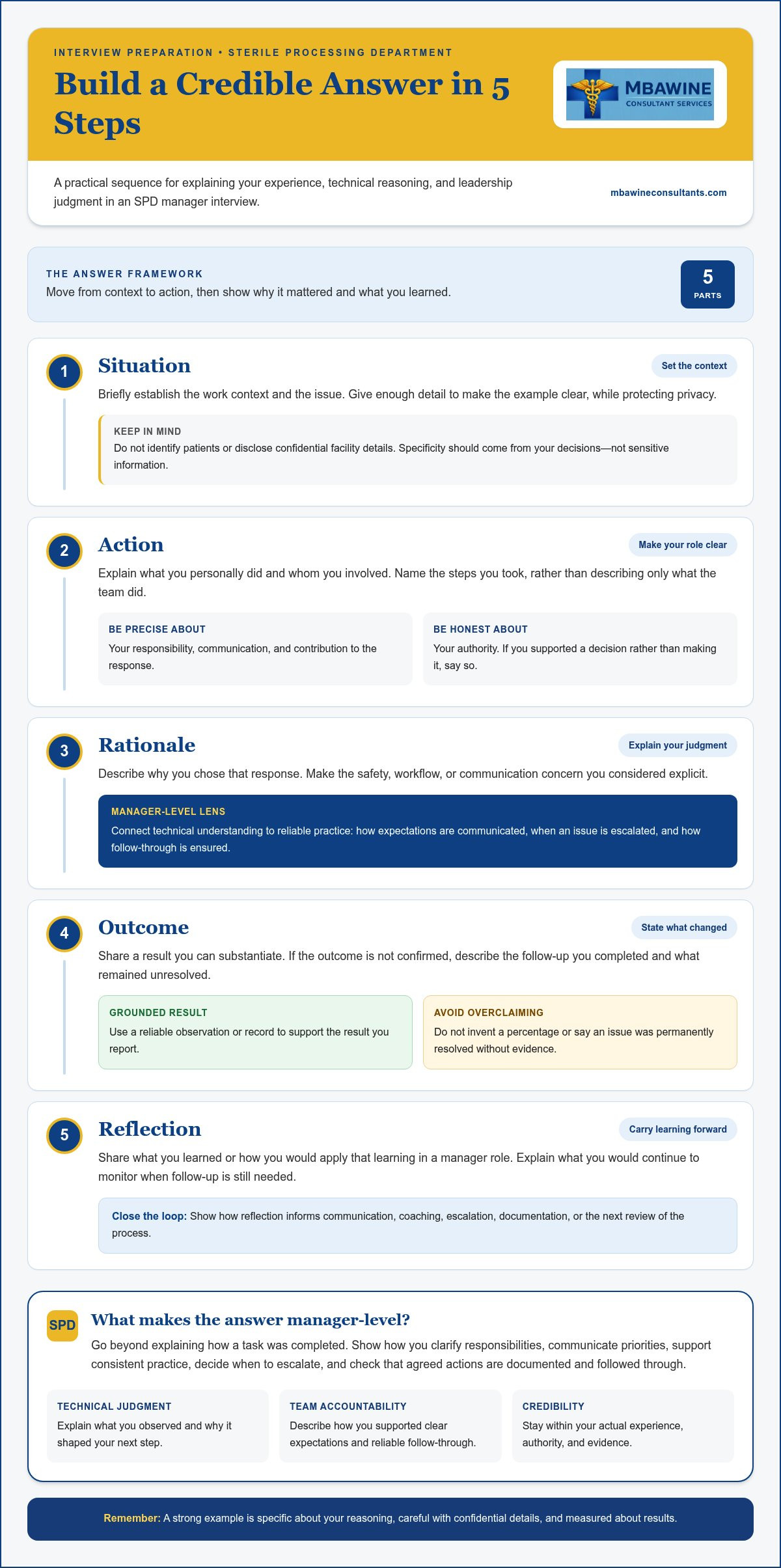
Use this five-part sequence to keep your response focused without making it sound memorized:
Choose a specific workplace example, then remove names, dates, and other details that could identify a patient, colleague, or facility. Specificity comes from your decisions, not from revealing sensitive information. Explain what you observed, how you determined the next step, and why communication, escalation, or documentation mattered.
Be measured when describing outcomes. If a result is supported by a reliable observation or record, state it plainly. If it isn’t, don’t invent a percentage or claim the issue was permanently resolved. You can still show sound judgment by explaining the follow-up you completed, what remained unresolved, and what you would monitor. This combination of technical understanding, honest scope, and reflective leadership makes an answer credible.
Technical questions for an SPD manager assess more than procedural recall. Interviewers want to hear how you verify that work follows facility procedures and applicable manufacturer instructions, recognize potential risk, communicate concerns, and ensure follow-up. The examples below are models to adapt to your responsibilities, not universal protocols.
A strong technical answer demonstrates evidence-based judgment within policy. Explain what you would establish before deciding how to proceed, which people or resources you would involve, and how you would document the response. Foundational learning, such as the responsibilities outlined in this Sterile Processing Technician Course Overview, can help you describe the technical context clearly while keeping decisions grounded in local requirements.
Sample answer: “I would clarify what was observed and identify the affected work or process, using department procedures to determine the appropriate immediate response. I’d gather relevant records and speak with the staff involved before drawing conclusions. Then I’d notify the appropriate stakeholders and escalate according to policy. I’d document the facts and actions taken, confirm who is responsible for follow-up, and review whether additional assessment or coaching is needed.”
Sample answer: “I’d communicate current procedures, support staff education, and use observation and routine review to understand how work is being performed. If I noticed a recurring variation, I’d look for contributing factors before deciding whether targeted coaching, clarification, or further review is appropriate. I’d also verify that the response aligns with facility policy and applicable guidance, including relevant AAMI or CDC recommendations.”
Sample answer: “I’d establish which records are affected and verify available information through the systems and procedures the facility uses. I would avoid assuming that a missing entry proves a particular event occurred. I’d bring the concern to the appropriate lead or department partner, document the review and decisions, and follow the established process for resolving the gap and preventing recurrence.”
Sample answer: “I’d assess competing requests against established priorities, the information available, and department procedures. Then I’d communicate what can be addressed and what requires escalation. I’d coordinate with the relevant clinical and operational stakeholders rather than bypass required steps. After the immediate demand, I’d review the workflow and document any unresolved issue or resource concern for follow-up.”
Adapt the wording to your experience and authority. Be precise about what you personally did and what you would do as the manager. To reinforce your technical foundation as you prepare, explore sterile processing classes.
Leadership questions reveal how you make decisions when staffing, workload, communication, and quality intersect. In SPD manager interview questions and answers, a manager-level response explains what you did, how you assessed the situation, whom you involved, and how you checked that the department could continue operating safely. Use examples from your experience and be clear about the limits of your authority.
Leadership evidence is a specific account of decisions, communication, and follow-through, not simply a claim that you are a strong leader. The contrast below can help you move from describing activity to demonstrating accountability.
| Task-only answer | Manager-level evidence |
|---|---|
| “I assigned staff to the busiest area.” | Explains how current demand, staff capabilities, and operational constraints informed priorities, then describes how assignments and changes were communicated. |
| “I asked the team to work together.” | Shows how expectations were clarified, concerns heard, and responsibilities coordinated to maintain continuity. |
| “I spoke to the employee about the issue.” | Describes fact-finding, respectful feedback, consistent expectations, and any appropriate follow-up or escalation. |
Sample answer: “I’d review the work in front of the department, identify immediate priorities using established procedures, and consider which staff members are qualified and available for each responsibility. I’d communicate assignments and changes clearly, monitor whether the plan remains workable, and use the appropriate escalation pathway if capacity or competing demands could affect operations. In a prior example, I helped reorganize assignments during a demand shift and kept relevant team members informed as priorities changed.”
Adapt the example to a real situation you can describe. Don’t assert a staffing ratio or promise that every request was met unless you have facility-specific evidence. Explain how you balanced urgency with staff capability, communicated constraints, and revisited the plan as conditions changed.
Sample answer: “I’d listen first to understand the concern and establish what happened, rather than assuming the cause. I’d explain the applicable expectation, invite questions, and agree on the next step with the staff member. If the issue continued or raised a concern beyond my authority, I’d document and escalate it through the appropriate process. In my example, I helped resolve a disagreement by clarifying responsibilities and following up on the agreed approach.”
Keep your own contribution at the center: what you asked, clarified, or communicated, and how you checked progress. Coaching may address a knowledge or communication gap. Repeated concerns or matters requiring formal review call for appropriate escalation. This distinction demonstrates accountability without overstating your role.
Interview examples are most persuasive when they reflect work you actually performed and make your decision-making clear. Use the SPD manager interview questions and answers in this guide as prompts, not scripts. Adapt each response to the role, your responsibilities, and the evidence you can discuss confidently. If you haven’t held a formal manager title, examples from training, shift coordination, peer support, or process improvement can still demonstrate leadership, as long as you describe your authority accurately.
Prepare examples that show different capabilities instead of relying on one successful story for every question. A useful example identifies the situation, your personal action, the reason for your approach, and a result you can verify. Include what you learned. An unresolved challenge can also demonstrate sound judgment if you explain what you would change, what you escalated, and how you followed through.
Use this five-step process to shape your preparation:
Leadership doesn’t require overstating your title. If you helped orient a colleague or coordinate a handoff, explain your specific responsibility, how you communicated expectations, and what you did to support consistency. Then distinguish that experience from decisions reserved for a supervisor or manager. This candor helps an interviewer assess your readiness and your understanding of when to escalate.
Interviewers may ask what you would do differently, how you confirmed an improvement, or when you would involve another leader. Prepare to reflect without undermining your example: identify one lesson and explain how it informs your current approach. You can also ask how the department defines its immediate priorities, supports staff development, and evaluates success in the role.
Credentials and continued learning can also strengthen your foundation. If you’re reviewing CRCST certification preparation, connect your study to the technical knowledge you hope to apply in leadership. For structured foundational learning, explore sterile processing classes as part of your professional development plan.
Preparing for an SPD manager interview can reveal where your experience is strong and where you would benefit from further study. Credible answers bring together technical judgment, leadership, and evidence. They show how you reached a decision, communicated it, and learned from the outcome. Continuing education can reinforce the sterile processing foundations that support professional responsibility, but it doesn’t replace practical management experience or demonstrate leadership on its own.
As you review technical examples, notice where you struggle to explain the reasoning behind a process, describe how you would verify an issue, or identify which procedures and guidance inform a decision. Use those gaps to set focused learning goals. Structured study may strengthen your knowledge base and help you discuss technical topics more clearly, while your interview examples must still accurately represent the responsibilities you’ve held.
Education is most useful when it addresses a specific development need. If interview practice highlights uncertainty about a technical concept, revisit the relevant learning material and consider how the knowledge applies within your facility’s procedures. Mbawine Consultant Services offers in-person and online sterile processing classes for professionals seeking continued education. Treat learning as one part of a broader development plan that also includes appropriate workplace responsibilities, feedback, and opportunities to build leadership experience.
Turn reflection into an action you can complete and assess. Review your preparation notes, select one technical area to strengthen, and identify one leadership capability you want to demonstrate more clearly. You might revisit a process, seek feedback on how you communicate, or practice describing a situation in which you contributed to a team decision. Keep your goals specific enough to guide your next study session or workplace conversation.
Then review your interview examples for accuracy. Distinguish what you did from what the team did, avoid implying authority you didn’t hold, and be ready to explain what you would do differently. If a question concerns a knowledge area you’re still developing, answer honestly and explain how you would consult facility procedures, seek appropriate guidance, and follow through. That approach communicates sound judgment without overstating expertise.
Professional development continues whether or not an interview is imminent. If structured study fits your goals, review enrollment information for sterile processing classes and use what you learn to strengthen the technical foundation you bring to future responsibilities.
Make interview preparation an ongoing professional practice, not an exercise you set aside once the interview ends. Keep refining how you explain your decisions, seek opportunities to develop your leadership skills, and identify technical areas where further study would strengthen your confidence. The goal isn’t to deliver a memorized script. It’s to speak accurately about your experience and show how you’re preparing for greater responsibility.
Use the SPD manager interview questions and answers in this guide as a starting point for that development. Mbawine Consultant Services offers in-person and online sterile processing classes and certification preparation for sterile processing professionals, alongside sterile processing consulting and interim management services. Education can reinforce technical foundations, while practical experience remains essential to building leadership capability. Neither a class nor a credential guarantees an interview outcome or substitutes for evidence of your judgment and contributions.
If structured learning is a useful next step, explore sterile processing class enrollment. Continue preparing with purpose: each area of knowledge you strengthen and each responsibility you take on can help you present a clearer account of your readiness.
SPD manager interview questions and answers commonly cover technical oversight, workflow, team leadership, communication, and decision-making. A panel may ask how you would respond to a concern, allocate work during a disruption, or support consistent practice. Priorities vary by facility, so prepare examples you can adapt. Before each interview, review the job description, identify the responsibilities it emphasizes, and choose evidence that matches those duties without assuming local policies.
Give a concise professional introduction that connects your sterile processing background to the position’s responsibilities. Describe areas of department work you know well, a relevant contribution such as supporting staff training, and the leadership skills you’re developing. End by explaining why the role fits your next career step. Focus on qualifications that help the panel assess your readiness rather than recounting every position or task in your work history.
Be direct about your experience while identifying responsibilities that demonstrate leadership potential. For example, explain how you helped orient a colleague, coordinated a handoff, or raised a process concern through the proper channel. State what you personally contributed and what you learned about communication or accountability. Then explain how you would handle broader authority responsibly, including seeking guidance and following established procedures when a decision exceeds your experience.
Start with the technical responsibilities named in the job description, then review how they connect to quality oversight, equipment, workflow, staff education, and communication with other departments. Make a short study list of topics you can explain confidently and questions that need further review. For each topic, practice explaining how you would verify current information, refer to applicable facility procedures, and recognize when to raise a concern with an appropriate leader.
Explain how you would clarify immediate demands, identify available staff capabilities, and communicate constraints to the relevant people. For a real example, describe what changed during the shift, how you helped coordinate work, and what you did when priorities competed. Don’t promise that every request can be met or cite a staffing formula without facility-specific support. If the outcome wasn’t measurable, describe follow-up or communication you can accurately verify.
Yes, if a credential is relevant to the position, describe it accurately and distinguish a current certification from one you’re pursuing. Explain how your learning informs your work, such as helping you discuss processing principles or identify topics that need further review. Don’t suggest that certification alone establishes management readiness. Pair credential information with examples of responsibility, collaboration, or sound judgment, and be ready to describe how you continue developing your professional knowledge.
Ask questions that clarify the role’s immediate priorities and how the department expects its manager to contribute. For example, ask what the panel would like the successful candidate to address first, how staff development is supported, or what measures are used to assess progress. These questions invite useful detail without presuming a problem exists. Listen to the response, then connect it to relevant experience or ask a thoughtful follow-up.

Article by
Mba Akuribila
Mba‑Akuribila is a healthcare leader, educator, and founder of Mbawine Consultants, a Bronx‑based institution recognized nationwide for advancing excellence in sterile processing and allied health workforce development. Born in Bongo in Ghana’s Upper East Region, his journey from rural beginnings to national impact reflects a lifelong commitment to service, empowerment, and community advancement.
For over two decades, he has trained sterile processing employees, mentored, and placed thousands of healthcare professionals across the United States. Through Mbawine Consultants, he established one of the country’s most trusted Sterile Processing Certification Test Prep Programs, preparing new Americans and career‑changers for successful entry into the field. The organization, as at 2026, has graduated more than 15,000 sterile processing technicians who now serve in hospitals, ambulatory centers, dental practices, and reprocessing facilities nationwide.
Under his leadership, Mbawine Consultants has expanded into a full Healthcare Staffing Agency, connecting nurses and allied health professionals to meaningful employment opportunities. His team also provides Interim Management Services, supporting hospitals and surgical centers with experienced leaders who stabilize operations, strengthen compliance, and improve workflow efficiency.
As a former surgical technician, sterile processing manager, educator, and system‑wide director, Mba‑Akuribila brings deep expertise to Sterile Processing Consulting, helping healthcare facilities elevate quality, safety, and regulatory readiness.
His work in the United States and Ghana continues to reflect his core philosophy: service above self, opportunity for all, and excellence without compromise.


