

Last Updated: October 9, 2026
Most small clinics do not fail at sterile processing because their staff lack skill. Below, we break down startup versus recurring costs, line-item supply spending, equipment lifecycle math, and how to run a cost analysis your administrator will actually approve.
A sterile processing budget is a documented plan that estimates every cost required to clean, inspect, prepare, sterilize, store, and document reusable medical instruments for a defined period. It covers one-time capital purchases and recurring operational expenses separately, which matters because administrators approve them through different channels.
Three failure patterns show up again and again:
Splitting your sterile processing budget into one-time and ongoing categories is the single fastest way to make it defensible. Administrators approve capital requests differently from operating expenses, and mixing them guarantees you will be asked to justify the same line twice.
Startup spending covers everything you buy once and depreciate over years:
A useful rule: if the item survives more than three years of daily use, it belongs in capital. If you consume it, it belongs in operating.
Recurring costs repeat monthly or per-case and are where small clinics lose control:
A workable sterile processing budget template is nothing more than a spreadsheet with four fixed columns: category, cost type, unit basis, and annualized total. The unit basis is the column most clinics skip, and it is the one that makes the budget defensible.
| Category | Cost Type | Unit Basis | What to Track |
|---|---|---|---|
| Sterilizers and washers | Capital | Per unit, depreciated | Purchase, install, validate |
| Wraps and pouches | Operating | Per tray processed | Size mix, waste rate |
| Cleaning chemistry | Operating | Per wash cycle | Dilution, refill frequency |
| Monitoring supplies | Operating | Per load | Biological, chemical, Bowie-Dick |
| Preventive maintenance | Operating | Per unit, per year | Contract, parts, labor |
| Staff labor | Operating | Per FTE hour | Coverage, overtime, training |
| Documentation | Operating | Per month | Software, storage, audit prep |
Fill the unit basis first, then multiply by realistic volume. If you do not know your monthly tray count, count it for two weeks before you build the budget. Guessing here is what produces the emergency capital request six months later.
Sterile processing supply costs split into consumables every department burns through and instrument-specific items tied to your case mix. Separating them tells you which costs scale with volume and which scale with specialty.
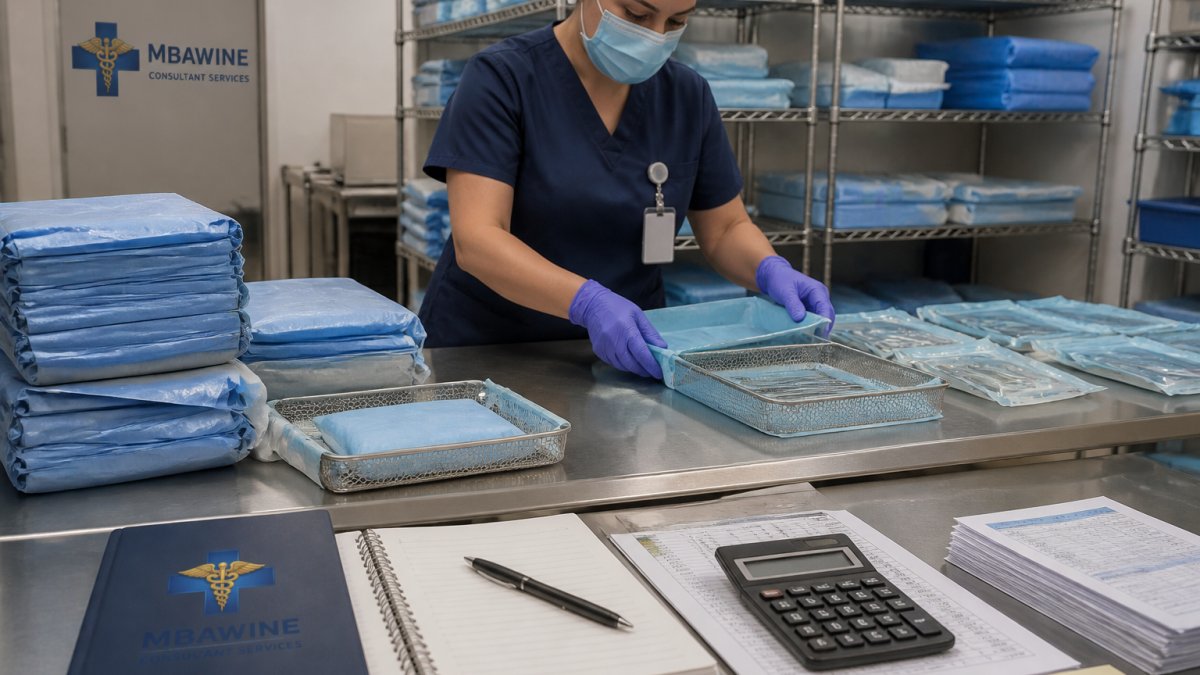
These items are consumed on every load or every tray, regardless of specialty:
Specialty drives cost here. A clinic running mostly basic exams needs far less than one handling ophthalmic or orthopedic sets:
Sterilization equipment maintenance costs are the line small clinics most often underfund, and they are the least optional. A sterilizer that fails a biological monitoring test takes the whole department offline until it is resolved.
Plan maintenance in three tiers:
For lifecycle planning, work backward from expected service life. Steam sterilizers typically see heavy use over a decade or more before major component replacement becomes uneconomical.
A practical approach many departments use: set aside a fixed percentage of the equipment purchase value each year as a replacement reserve. When the unit reaches end of life, the money is already there.
The in-house versus outsourcing decision comes down to volume, case mix, and control, not to a single price comparison. Outsourcing shifts fixed costs to variable costs, which helps low-volume clinics and hurts high-volume ones.
| Factor | In-House Processing | Outsourced Processing |
|---|---|---|
| Cost behavior | High fixed, lower per-tray | Low fixed, higher per-tray |
| Control over turnaround | Direct, same-day possible | Dependent on courier schedule |
| Instrument inventory needed | Full sets plus backup | Reduced, but not eliminated |
| Compliance responsibility | Entirely yours | Shared, contract-defined |
| Best fit | Steady or high volume | Low or unpredictable volume |
| Staffing demand | Requires trained technicians | Minimal internal staffing |
Small clinics with intermittent surgical volume often find outsourcing cheaper on paper. Clinics running consistent daily volume usually find in-house processing cheaper per tray once labor and equipment are fully loaded.
For departments that need coverage during a vacancy or a surge, interim management and staffing support can bridge the gap without committing to a permanent hire.
Compliance and staffing are the two budget lines that never appear in a starter spreadsheet and always appear in the audit. Both are recurring, both are non-negotiable, and both are cheaper when planned.
Sterile processing in the United States operates under standards set by organizations such as the Association for the Advancement of Medical Instrumentation and requirements enforced by The Joint Commission and the Centers for Medicare & Medicaid Services for participating facilities. Budget for:
Documentation is not free. It costs software, storage, staff time, and audit preparation hours.
Labor is typically the largest single line in a sterile processing budget. Certification matters here: CRCST and CIS credentials from the Healthcare Sterile Processing Association demonstrate competency and are frequently required by employers and surveyors.
Budget for:
A sterile processing cost analysis answers one question: what does it actually cost us to produce one sterile tray? Everything else is detail.
Run it in five steps:
Repeat this quarterly. When the number rises, you can trace it to a specific driver: volume drop, supply waste, overtime, or equipment inefficiency.
If your team needs the technical depth to run this analysis confidently, structured CRCST and CIS preparation builds the competency behind it.
Sterile processing budgets fail when they are treated as a supply order instead of a clinical operation with real cost drivers.
A complete sterile processing budget covers personnel wages and benefits, sterilization equipment (autoclaves, washers, dryers), instrument cleaning and sterilization supplies, equipment maintenance contracts and repairs, compliance and validation expenses (biological indicators, documentation, training), and facility utilities. For a small clinic, personnel and supplies typically consume the largest share. Build your budget around actual instrument volume and case mix, not national averages. Review every line item quarterly to catch cost creep before it strains clinic operations.
Start by tracking instrument volume and case types for three months. List all direct costs: staff time, consumables, equipment depreciation, and maintenance. Add indirect costs like utilities and space. Use a sterile processing budget template to organize line items, then compare your projections to actual spending monthly. Adjust for seasonal case volume changes. Involving your sterile processing staff in the process surfaces costs administrators often miss, such as reprocessing supplies for specialty instruments or overtime during high-volume periods.
Count every item used per reprocessing cycle: enzymatic cleaners, detergents, lubricants, sterilization pouches, indicator strips, biological indicators, and gloves. Multiply by your monthly instrument volume. Add 10-15% for waste and spoilage. Track actual consumption for at least two months to refine estimates. Supply costs scale with instrument volume, so a clinic processing 200 trays monthly will spend proportionally more than one processing 50. Review vendor contracts annually to catch price increases that quietly erode your budget.
Set aside 5-10% of your equipment purchase price annually for maintenance. Autoclaves need quarterly preventive service, annual calibration, and occasional part replacements. A service contract typically costs less than emergency repairs and ensures compliance documentation. Track repair history: if a sterilizer needs major repairs more than twice in a year, replacement may cost less over time. Budget for a loaner or backup sterilization capacity during downtime to avoid surgical delays that hurt revenue.
Replace sterilization equipment when repair costs exceed 50% of replacement value, when the unit fails validation tests repeatedly, or when it no longer meets current standards. Most autoclaves last 7-10 years with proper maintenance. Plan replacement in your capital budget two years before expected end-of-life. Upgrading to a larger chamber or faster cycle can reduce overtime and turnaround time, but only if your instrument volume justifies the investment. Calculate total cost of ownership, not just purchase price.
An annual sterile processing operating budget includes personnel (wages, benefits, training, certification), consumables (cleaners, packaging, indicators), equipment maintenance and service contracts, compliance and validation costs, and administrative overhead. For small clinics, staffing often represents 50-60% of the budget. Build in contingency funds for equipment failures and regulatory updates. Review the budget quarterly against actual spending to catch variances early, and adjust staffing or supply orders before year-end shortfalls.


