

The integrity of the modern surgical suite doesn't begin with the first incision; it starts within the decontamination and sterilization bays where the margin for error is non-existent. Every tray processed represents a critical link in the chain of patient safety, yet many institutions continue to struggle with the persistent challenges of wet packs, sterilization failures, and the recurring threat of surgical site infections. You're likely aware that these operational deficiencies aren't merely technical hurdles but are often systemic failures rooted in a lack of standardized protocols and high staff turnover. Implementing comprehensive sterile processing department best practices is no longer an aspirational goal but a fundamental requirement for any healthcare facility committed to clinical excellence and full regulatory compliance.
This institutional framework provides a rigorous methodology for achieving excellence by integrating the latest ANSI/AAMI ST79:2026 updates with advanced professional development strategies. By reading this guide, you'll gain the specific insights necessary to reduce sterilization errors and build a highly trained, certified workforce capable of meeting demanding healthcare standards. We'll explore the tri-fold synergy of standardized clinical protocols, advanced technology integration, and the mandatory certification pathways that transform the department into a dedicated guardian of public safety.
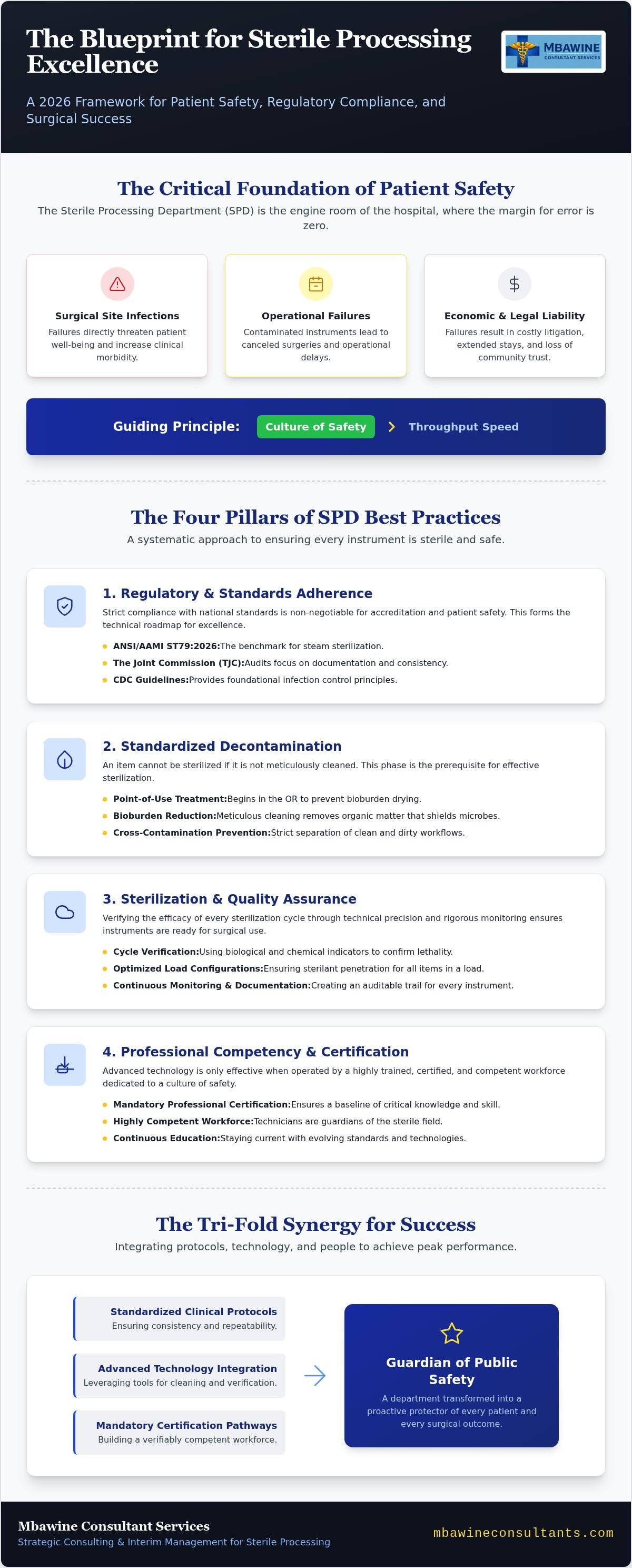
The Sterile Processing Department (SPD) functions as the indispensable nexus where clinical precision intersects with institutional safety protocols. In 2026, the department is no longer viewed as a peripheral support service but as the primary engine driving surgical success and patient protection. It's the engine room of the hospital. Failure to implement sterile processing department best practices creates a cascade of risk that extends from the decontamination sink to the operating table. These failures result in significant clinical morbidity and substantial economic liabilities for healthcare organizations. A true institutional framework for excellence begins with a culture of safety that prioritizes technical accuracy over throughput speed, ensuring that every technician understands their role as a guardian of the sterile field. This foundational mindset serves as the prerequisite for the successful execution of technical protocols and the long-term sustainability of departmental operations. Without this cultural alignment, even the most advanced sterilization technology fails to deliver consistent results.
The economic impact of sterilization failures is profound, often manifesting in canceled surgeries and extended hospital stays. When a single contaminated instrument reaches the sterile field, the cost isn't just measured in immediate reprocessing time but in the potential for multi-million dollar litigation and the erosion of community trust. Modern healthcare leadership must recognize that the SPD is a high-stakes environment where the margin for error is effectively zero. Achieving this level of reliability requires a strategic investment in professional consulting and standardized training to bridge the gap between regulatory requirements and daily operational reality.
The direct correlation between sterile processing quality and surgical site infections (SSIs) remains a cornerstone of modern epidemiology. Operating Room (OR) throughput depends entirely on the timely availability of sterile, functional instrument sets. When bioburden isn't meticulously removed, the resulting delays and potential for patient harm create severe legal and reputational consequences for the institution. Reliable instrument availability is the silent partner in every successful surgical outcome.
Adherence to the ANSI/AAMI ST79:2026 standards provides the technical roadmap for steam sterilization excellence, detailing specific requirements for environmental controls and load monitoring. These standards serve as the benchmark during audits conducted by The Joint Commission (TJC), which focuses on the consistency of departmental documentation. Institutional accountability in 2026 is defined by a comprehensive commitment to meeting these rigorous standards through continuous monitoring and the professionalization of the SPD workforce. Consistent compliance ensures that sterile processing department best practices are woven into the institutional fabric.
The efficacy of any sterilization cycle is fundamentally predicated on the success of the preceding decontamination phase. It's an established clinical axiom that an item can't be sterilized unless it's been thoroughly cleaned. Cleanliness is the precursor to safety. Residual organic matter acts as a physical shield, protecting microorganisms from the lethal effects of the sterilant. Adhering to sterile processing department best practices requires a meticulous approach to bioburden reduction through the application of standardized cleaning agents and mechanical action. This process begins with the physical separation of clean and dirty workflows, a structural mandate designed to prevent the cross-contamination of processed goods. Within the decontamination area, the use of comprehensive Personal Protective Equipment (PPE) is a non-negotiable safety standard, protecting technicians from exposure to bloodborne pathogens and hazardous chemical vapors.
The continuum of care begins in the surgical suite, where immediate point-of-use (POU) treatment is vital for instrument longevity and patient safety. Technicians must perform pre-cleaning immediately following the procedure to remove gross soil and prevent debris from drying in lumens or box locks. The application of enzymatic sprays or gels is a critical step in this phase, as it initiates the breakdown of proteins and prevents the formation of resilient biofilms during the transit period. Standardized transport protocols involve the use of leak-proof, puncture-resistant containers clearly labeled as biohazardous, ensuring that contaminated items reach the decontamination bay without compromising the safety of hospital corridors or personnel.
Modern departments utilize a combination of manual and automated systems to achieve the high levels of cleanliness required by 2026 institutional standards. Ultrasonic cleaners are essential for dislodging fine debris from complex instrument geometries through cavitation, while automated washer-disinfectors provide a validated, repeatable cleaning and thermal disinfection cycle. When automated systems are contraindicated, manual cleaning must be performed using specific brushes and documented protocols to ensure consistency. Monitoring water quality and detergent concentration is equally critical, as mineral content or incorrect dilutions can impede the chemical efficacy of the cleaning process. Maintaining these high standards is a core component of sterile processing department best practices in the modern era. Facilities looking to standardize these complex workflows often find that professional education programs provide the necessary technical foundation for staff to execute these protocols with precision.
The verification of sterilization cycles constitutes the final clinical safeguard before medical devices are returned to the sterile field. It's a process that demands uncompromising adherence to technical specifications to ensure every instrument set is rendered safe for patient use. Establishing sterile processing department best practices in this area involves a multi-modal approach to quality assurance, beginning with the selection of the appropriate sterilization modality. While saturated steam remains the standard for heat-stable items, low-temperature modalities like Ethylene Oxide (ETO) or Vaporized Hydrogen Peroxide are essential for moisture-sensitive or heat-labile complex devices. Once processed, the maintenance of sterility depends on rigorous environmental controls within the sterile storage area. This requires precise monitoring of temperature (68°F to 75°F) and humidity (30% to 60%) to prevent compromised packaging and microbial ingress.
The transition from "shelf-life" to "event-related" sterility paradigms emphasizes that sterility is maintained by the quality of the packaging and the integrity of the storage environment rather than an arbitrary expiration date. Achieving this requires the exclusive use of FDA-cleared packaging materials and chemical indicators that provide immediate visual confirmation of sterilant exposure. Proper load configuration is equally vital; technicians must ensure adequate spacing between items to facilitate air removal and sterilant penetration. This practice is the primary defense against "wet packs", which occur when moisture remains on the instruments or within the wrap after the cooling cycle's complete. Don't underestimate the importance of proper cooling; removing items from the sterilizer before they reach ambient temperature can cause immediate condensation and contamination.
Verification protocols must integrate physical, chemical, and biological monitors to provide a comprehensive assessment of cycle efficacy. Physical monitors record the mechanical parameters of the sterilizer, while chemical indicators verify that specific conditions were met inside the package. However, biological indicators (BIs) remain the gold standard, as they provide actual proof of microbial lethality. BIs don't just suggest success; they provide the empirical evidence required for high-risk procedures. The 2026 standard mandates frequent BI testing, often with every load containing implantables, and meticulous documentation of results. If a cycle failure or positive BI occurs, the department must follow a structured response:
Maintaining these rigorous standards is often best supported by expert consulting services that can audit current verification workflows against national benchmarks.
Technical protocols, regardless of their complexity or regulatory alignment, are only as effective as the professionals tasked with their execution. In the high-stakes environment of the SPD, the human element represents both the greatest strength and the most significant vulnerability in the sterilization chain. Adhering to sterile processing department best practices requires more than just access to modern equipment; it demands a workforce that possesses a deep, theoretical understanding of microbiology, thermal dynamics, and chemical efficacy. By 2026, the national healthcare landscape has shifted decisively toward mandatory certification, recognizing that standardized education is the only reliable method for ensuring departmental consistency. Institutional leadership must prioritize the professionalization of their staff to mitigate the risks associated with technical error and procedural non-compliance. Knowledge is the ultimate safeguard.
Comprehensive Sterile Processing Classes serve as the essential foundation for this professional journey, bridging the gap between entry-level manual labor and advanced technical mastery. These educational pathways ensure that technicians aren't merely following a list of steps but are making informed clinical decisions based on established scientific principles. When staff members understand the "why" behind the "how", the overall safety profile of the institution improves significantly. This intellectual investment transforms the department from a labor-intensive cost center into a specialized clinical partner.
The Certified Registered Central Service Technician (CRCST) designation provides a rigorous framework for validating technical proficiency and institutional safety. The curriculum requires a comprehensive mastery of decontamination, instrument assembly, and sterilization processes, alongside a documented 400 hours of hands-on clinical experience. Obtaining CRCST certification demonstrates that a technician has met the highest national standards for competency and safety. Research within the field consistently indicates that departments staffed by certified professionals exhibit significantly lower rates of sterilization failures and procedural deviations. Certified technicians act as a critical barrier against institutional risk.
The pursuit of excellence doesn't terminate with initial certification; it requires a lifelong commitment to professional development. Annual competency assessments and the accrual of continuing education units (CEUs) are necessary to stay abreast of evolving technologies and updated ANSI/AAMI standards. Investing in advanced healthcare sterilization training not only enhances departmental safety but also serves as a powerful tool for staff retention by providing clear pathways for career advancement. Facilities that foster a culture of learning are better equipped to handle the complexities of modern surgical instrumentation. To elevate your department's technical precision and ensure full regulatory compliance, you're encouraged to enroll in professional classes designed to cultivate the next generation of sterile processing leaders.
Implementing the previously discussed technical and professional standards requires a level of institutional agility that many healthcare facilities find difficult to maintain internally. The gap between theoretical sterile processing department best practices and daily operational reality is often where clinical risk resides. Specialized sterile processing consultant services provide the external perspective necessary to identify hidden inefficiencies that internal teams may overlook. These experts analyze the entire lifecycle of an instrument, from the surgical suite to the decontamination bay, ensuring that every protocol is both compliant and efficient. When a department faces a leadership vacuum or a sudden surge in surgical volume, the institution's ability to remain compliant is tested. Specialized temporary SPD staffing solutions offer a safeguard against the workforce crisis, ensuring that clinical operations don't suffer during periods of transition or high turnover. Mbawine Consultant Services acts as a strategic partner, providing the leadership and technical expertise required to sustain a culture of excellence.
The process of sterile processing department optimization involves a systematic redesign of physical spaces and digital tracking systems to enhance throughput without sacrificing safety. Through sterile processing workflow consulting, facilities can eliminate the bottlenecks that lead to surgical delays and instrument shortages. A thorough sterile processing compliance audit serves as the diagnostic tool for this transformation, benchmarking current practices against the 2026 ANSI/AAMI and CDC standards. These audits provide a clear roadmap for remediating deficiencies before they result in adverse patient outcomes or regulatory citations.
Leadership continuity is the bedrock of departmental stability. Interim SPD management provides a bridge during leadership transitions, preventing the erosion of standards that often occurs when a department is left without expert oversight. This stabilization is critical for maintaining the high-stakes synergy between the SPD and the surgical suite. Additionally, access to 24/7 emergency staffing ensures that unexpected absences or equipment failures don't lead to the cancellation of critical procedures. Maintaining sterile processing department best practices requires a resilient infrastructure that can adapt to institutional challenges in real time. Facility leaders seeking to fortify their operations and achieve long-term clinical excellence should contact Mbawine for a comprehensive service assessment and a tailored optimization strategy.
The path toward institutional excellence requires a steadfast commitment to the tri-fold synergy of clinical precision, regulatory adherence, and professional development. The successful implementation of sterile processing department best practices is not merely a matter of technical compliance; it's a mission-driven endeavor that protects the integrity of the sterile field and the safety of every patient. By standardizing decontamination workflows, maintaining rigorous sterilization verification, and prioritizing the certification of the workforce, healthcare facilities can effectively mitigate the risks of surgical site infections and operational inefficiencies. Institutional reliability is built upon these foundational pillars.
Mbawine Consultant Services remains dedicated to this professionalization, offering specialized healthcare sterilization consulting alongside expert interim management and staffing to stabilize departments during critical transitions. Our comprehensive CRCST exam preparation ensures that your technicians possess the mastery required to navigate the high-stakes environment of modern surgery. Achieving departmental excellence is a continuous journey that demands both strategic oversight and technical expertise. Elevate your department’s standards—enroll in Mbawine’s professional classes or request consulting today. Together, we can establish a robust framework for patient safety that withstands the complexities of the evolving healthcare landscape.
The most critical sterile processing department best practices for infection control include the strict physical separation of clean and dirty workflows, the meticulous execution of point-of-use pre-cleaning, and the mandatory use of biological indicators. These practices ensure that bioburden is effectively reduced before sterilization and that every cycle is validated for microbial lethality. Additionally, maintaining a certified workforce provides the necessary technical oversight to prevent human error during complex instrument assembly and decontamination processes.
In 2026, institutional standards dictate that biological indicators (BIs) should be used at least daily for each sterilizer and with every load containing implantable devices. This frequency ensures that the most rigorous level of microbial verification is applied to the highest-risk surgical items. Documentation of these results is essential for regulatory compliance and provides the empirical evidence required to validate that sterilization parameters were successfully achieved throughout the entire load configuration.
Professional certification, specifically the CRCST designation, has become a mandatory requirement for sterile processing technicians in many jurisdictions and healthcare systems by 2026. This shift reflects a national commitment to elevating technical competency and reducing institutional error rates. Certification ensures that all personnel possess a standardized understanding of microbiology and sterilization science. Facilities that prioritize a certified workforce demonstrate a higher level of adherence to sterile processing department best practices and improved patient safety outcomes.
Point-of-use treatment involves the immediate pre-cleaning of instruments in the surgical suite to prevent the drying of organic matter and the formation of resilient biofilms. Technicians use enzymatic sprays to initiate the breakdown of proteins while instruments await transport to the decontamination area. This proactive step is essential because once biofilms mature, they become significantly more difficult to remove through standard cleaning processes, potentially compromising the efficacy of the entire sterilization cycle.
A sterile processing consultant identifies systemic bottlenecks and operational inefficiencies through comprehensive workflow audits and compliance assessments. By analyzing the physical movement of instruments and the allocation of staff resources, consultants can redesign departmental layouts to optimize throughput. This objective oversight helps institutions align their daily operations with current ANSI/AAMI standards, ensuring that productivity increases don't come at the expense of clinical safety or regulatory adherence.
Maintaining a sterile storage environment requires precise control over environmental parameters, including temperature ranges between 68°F and 75°F and humidity levels maintained between 30% and 60%. These conditions prevent the degradation of packaging materials and the growth of opportunistic microorganisms. Additionally, the storage area must be restricted to authorized personnel and designed with positive pressure airflow to ensure that processed goods remain protected from environmental contaminants until they're needed in surgery.
Interim management provides essential leadership continuity during transitions, preventing the erosion of technical standards and staff morale that often occurs when a department lacks expert oversight. These specialized leaders implement stabilizing protocols and ensure that sterile processing department best practices remain the priority during the search for permanent management. By maintaining a steady operational rhythm, interim managers safeguard the institution against the regulatory lapses and safety risks associated with leadership gaps.
Common mistakes in sterile processing include the overloading of sterilizer racks, which prevents adequate steam penetration, and the premature removal of items before the cooling cycle is complete. These errors often lead to "wet packs" and compromised sterility. Additionally, failing to perform adequate point-of-use treatment or relying on uncertified staff for complex instrument assembly can introduce significant clinical risks. Avoiding these pitfalls requires a combination of rigorous technical training and a robust institutional culture of safety.

Article by
Mba Akuribila
Mba‑Akuribila is a healthcare leader, educator, and founder of Mbawine Consultants, a Bronx‑based institution recognized nationwide for advancing excellence in sterile processing and allied health workforce development. Born in Bongo in Ghana’s Upper East Region, his journey from rural beginnings to national impact reflects a lifelong commitment to service, empowerment, and community advancement.
For over two decades, he has trained sterile processing employees, mentored, and placed thousands of healthcare professionals across the United States. Through Mbawine Consultants, he established one of the country’s most trusted Sterile Processing Certification Test Prep Programs, preparing new Americans and career‑changers for successful entry into the field. The organization, as at 2026, has graduated more than 15,000 sterile processing technicians who now serve in hospitals, ambulatory centers, dental practices, and reprocessing facilities nationwide.
Under his leadership, Mbawine Consultants has expanded into a full Healthcare Staffing Agency, connecting nurses and allied health professionals to meaningful employment opportunities. His team also provides Interim Management Services, supporting hospitals and surgical centers with experienced leaders who stabilize operations, strengthen compliance, and improve workflow efficiency.
As a former surgical technician, sterile processing manager, educator, and system‑wide director, Mba‑Akuribila brings deep expertise to Sterile Processing Consulting, helping healthcare facilities elevate quality, safety, and regulatory readiness.
His work in the United States and Ghana continues to reflect his core philosophy: service above self, opportunity for all, and excellence without compromise.


