

Last Updated: August 14, 2026
A sterile processing department efficiency audit is a systematic evaluation of how your SPD operates across decontamination, sterilization, instrument assembly, and sterile storage workflows. The goal is to identify where time and resources leak away and where quality control gaps exist.
Before you begin, you need a clear plan. At Mbawine Consultants, we've guided healthcare facilities through audits, and the ones that generate actionable results share one common trait: they start with defined scope and the right team assembled beforehand.
Your audit scope determines what you're measuring. Are you auditing the entire department or focusing on a specific workflow like instrument assembly? Are you examining turnaround time, quality metrics, compliance, or all three?
Start by listing what's driving the audit: persistent case delays, recurring quality issues, staff complaints about bottlenecks, or regulatory concerns. These become your audit objectives. Next, set boundaries. A full department audit typically takes 3-5 days for a facility with 8-15 staff members; larger departments may require a week or more. Define your success metrics upfront, is it reducing case turnaround time by 15%, eliminating missed biological indicators, or cutting staff overtime? Be specific.
Include at least one person who works in the SPD daily to spot systemic blind spots, a supervisor or manager who understands big-picture workflow, and ideally someone from the OR who receives sterilized instruments. External auditors like Mbawine Consultants bring expertise in process improvement and regulatory compliance, plus objective perspective. Assign clear roles: who leads the audit, documents findings, conducts interviews, and observes workflows.
Decontamination and sterilization represent the foundation of your SPD operation. If these workflows contain inefficiencies or quality gaps, everything downstream suffers.
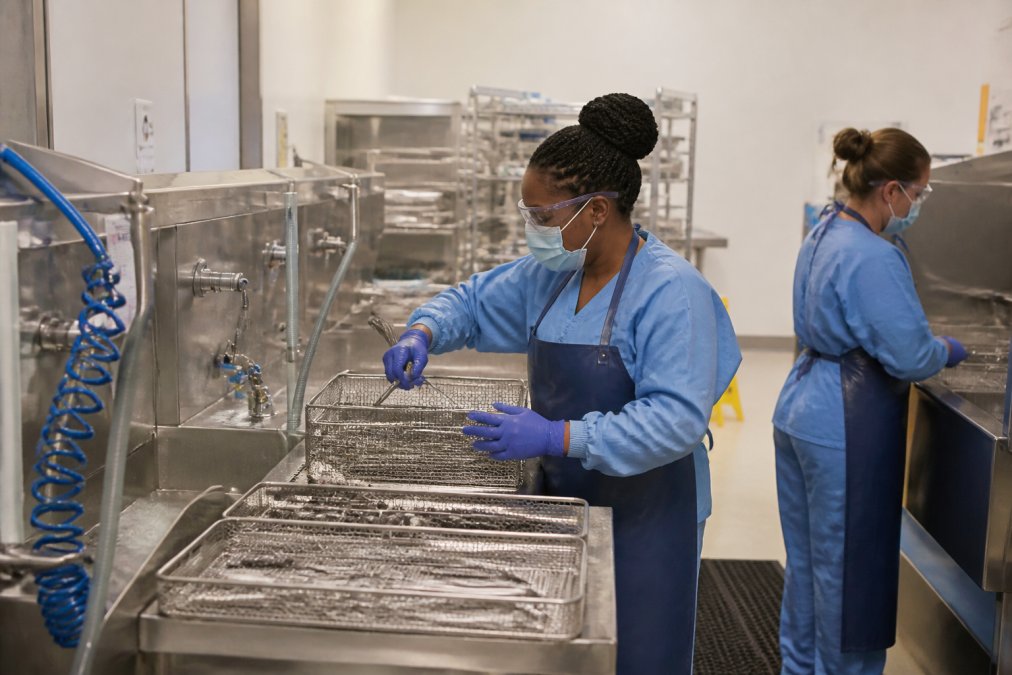
Observe the decontamination process from start to finish. Do staff pre-rinse instruments immediately, or do they sit in holding areas? Do they follow the correct sequence: initial rinse, enzymatic cleaning, ultrasonic or manual scrubbing, rinsing, drying?
Common bottlenecks include unpredictable instrument arrival intervals, inadequate holding areas, poorly ergonomic manual scrubbing stations, and slow drying procedures. Document the actual time instruments take through each stage and compare it to your standard operating procedures. Check whether staff are trained on bioburden removal, the process of reducing contamination to levels acceptable for sterilization. Many efficiency problems trace back to inadequate decontamination.
Observe how instruments are loaded into sterilizers. Are trays positioned to allow steam or gas penetration? Are sterilizers being overloaded? Review your biological indicator protocols, are they running with required frequency and results properly documented?
Check sterilizer maintenance logs. Preventive maintenance directly impacts cycle time and reliability. Document actual sterilization cycle times and compare it to manufacturer specifications and your facility's validated parameters. If cycles consistently exceed validated times, sterilizer performance may be degrading.
A comprehensive SPD audit checklist template becomes your working document, ensuring consistency and capturing specific observations.
Your checklist should cover:
Decontamination workflow: pre-rinsing procedures and timing, enzymatic cleaning concentration and contact time, ultrasonic cleaning parameters, manual scrubbing techniques, drying methods, and holding area conditions.
Sterilization and testing: sterilizer loading procedures, steam or gas sterilization cycle parameters, biological indicator placement and frequency, indicator result documentation, sterilizer maintenance schedule adherence, and equipment calibration records.
Instrument assembly and inspection: staff competency in identifying damaged instruments, assembly procedures and tray configuration, sterile barrier system integrity checks, traceability labeling, and case readiness verification.
Physical workflow: movement patterns between areas, bottleneck points, staff ergonomics, equipment placement, and cross-contamination prevention.
Your checklist must capture how well your facility maintains traceability, tracking instruments from receipt through decontamination, sterilization, assembly, and delivery to the OR. Document what information is recorded at each stage. Are lot numbers tracked? Are biological indicator results linked to specific sterilization runs? Can staff retrieve records if needed?
Check whether your facility uses digital audit tools or manual logging. Digital systems provide faster data retrieval and trend analysis; manual systems are prone to transcription errors. Verify that staff understand why traceability matters.
Key performance indicators transform observation into measurable data.
Turnaround time is the interval from when soiled instruments arrive until sterilized, assembled trays are ready for delivery. Measure this for different instrument types and case complexities.
Track case readiness, the percentage of cases prepared and available when needed. A rate below 95% signals workflow problems. Document average case turnaround time by day of week and time of day to identify predictable surges. Measure first-pass quality rate: the percentage of instruments passing inspection without reprocessing. A rate below 98% indicates quality control gaps.
Track sterilization failure rates and document reasons for each failure. Measure staff competency through observation and competency assessments. Monitor compliance with standard operating procedures and regulatory requirements. Document instances where staff deviate from procedures, as deviations often represent workarounds compensating for workflow problems.
The physical design of your SPD either facilitates efficiency or creates constant friction.
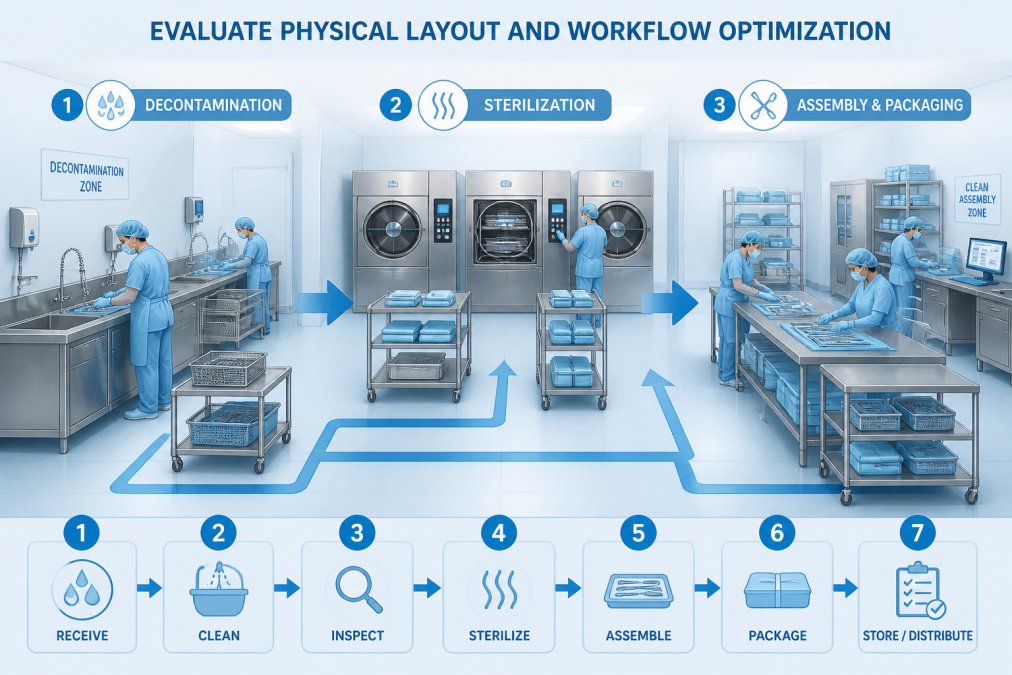
Walk the physical space and trace the path instruments follow. Do they move logically, or do they require backtracking? Are decontamination, sterilization, assembly, and storage areas positioned to minimize unnecessary movement?
Look for equipment creating bottlenecks. If you have only one ultrasonic cleaner or one sterilizer serving multiple specialties, these become constraints. Identify systemic blind spots, workflow problems staff have learned to work around but remain unaddressed. Ask staff where they lose time; they'll often point out problems management doesn't see.
Observe how well staff execute each procedure. Note which procedures show consistency and which show variation. Review your training documentation, do all staff have current competency assessments? Identify training gaps. Check whether your facility conducts periodic competency refresher training, as staff often revert to old habits without it.
The audit findings only matter if they lead to action.
For each significant finding, conduct root cause analysis. Don't stop at surface problems. If turnaround time is slow, the root cause might be "sterilizers are overloaded because decontamination workflow doesn't match sterilizer capacity," not simply "sterilization takes too long."
Develop corrective action plans addressing root causes, not symptoms. Assign accountability for each corrective action with clear deadlines and success measures. Prioritize by impact and feasibility, implementing high-impact, low-cost changes first.
Manual audits provide a snapshot; digital audit tools provide continuous monitoring and trend analysis. Digital systems track sterilization parameters, biological indicator results, staff competency, and case turnaround metrics, enabling you to identify trends before they become crises.
Integration with your facility's existing systems creates a unified view of SPD operations, reducing manual data entry and enabling real-time decision-making. When selecting a tool, prioritize systems capturing the KPIs most important for your facility.
Quality management systems create the framework for sustained improvement.
Preventive maintenance on sterilization equipment prevents unexpected failures and maintains validated performance. Document a maintenance schedule and hold staff accountable.
Biological indicator protocols ensure your sterilization process works. Establish required frequency and document results systematically. Implement internal controls catching quality problems before they reach patients: pre-sterilization checks verifying correct loading, post-sterilization verification of indicator results, inspection procedures catching instrument damage, and documentation reviews flagging missing records.
Your standard operating procedures should reflect your actual validated processes. If your SOP differs from how staff consistently perform a procedure, update the SOP to match validated practice.
Verify which regulatory bodies govern your facility and which standards apply. Common requirements include sterilizer validation and maintenance documentation, staff competency assessments, biological indicator testing, instrument traceability, and quality assurance monitoring. Conduct periodic internal compliance audits to verify procedures are followed and documentation is complete.
Last Updated: August 14, 2026
Conducting a sterile processing department efficiency audit requires systematic planning, careful observation, and disciplined follow-up. Start with clear objectives and the right team. Assess your decontamination and sterilization workflows with specific attention to where time and quality slip away. Develop a comprehensive checklist capturing procedural compliance and efficiency metrics. Measure key performance indicators revealing where your department excels and where improvement is needed. Examine your physical layout and staff competency to identify bottlenecks and training gaps. Implement corrective actions addressing root causes. Finally, establish quality management systems and internal controls sustaining improvement over time.
The facilities seeing the most dramatic efficiency gains treat the audit as the beginning of continuous improvement, not a one-time event. If you're managing a sterile processing department and need expert guidance, Mbawine Consultants provides comprehensive support including interim management, staff training on process improvement methodologies, and competency assessment for CRCST and CIS certification preparation. Our team brings real clinical expertise to help you transform audit findings into measurable operational improvements.
A comprehensive SPD audit checklist template should cover decontamination procedures, sterilization and testing protocols, instrument assembly and inspection, sterile storage and case readiness, staff competency assessment, preventive maintenance, biological indicator documentation, and compliance with regulatory standards. Include sections on internal controls, traceability systems, and standard operating procedures. Document findings for each area and identify systemic blind spots that could affect surgical safety and infection control.
Most facilities benefit from conducting comprehensive sterile processing efficiency audits annually, with quarterly reviews of key performance indicators and turnaround time metrics. High-volume surgical centers may require more frequent assessments. After identifying deficiencies, implement corrective actions and monitor progress monthly. Digital audit tool integration enables continuous tracking between formal audits, allowing you to catch workflow bottlenecks and quality issues before they impact case readiness or regulatory compliance.
Common pitfalls include inadequate staff training and competency assessment, poor traceability of instruments through the decontamination and sterilization process, insufficient preventive maintenance schedules, inadequate documentation of biological indicators and sterilizer loading procedures, and failure to identify workflow bottlenecks that delay case readiness. Many departments also overlook the importance of post-audit remediation workflows and root cause analysis. Addressing these gaps through systematic audit procedures and lean methodology principles significantly improves infection control and surgical safety outcomes.
The FDA, CDC, and AAMI standards require comprehensive documentation of sterilization processes, including biological indicator results, sterilizer maintenance records, and instrument traceability systems. Facilities must maintain standard operating procedures, staff competency records, and quality management system documentation. Internal controls and audit documentation should demonstrate compliance with infection control standards. State licensing boards and accreditation bodies (such as The Joint Commission) require evidence of ongoing process improvement and corrective action implementation based on audit findings.
This article was written using GrandRanker


