

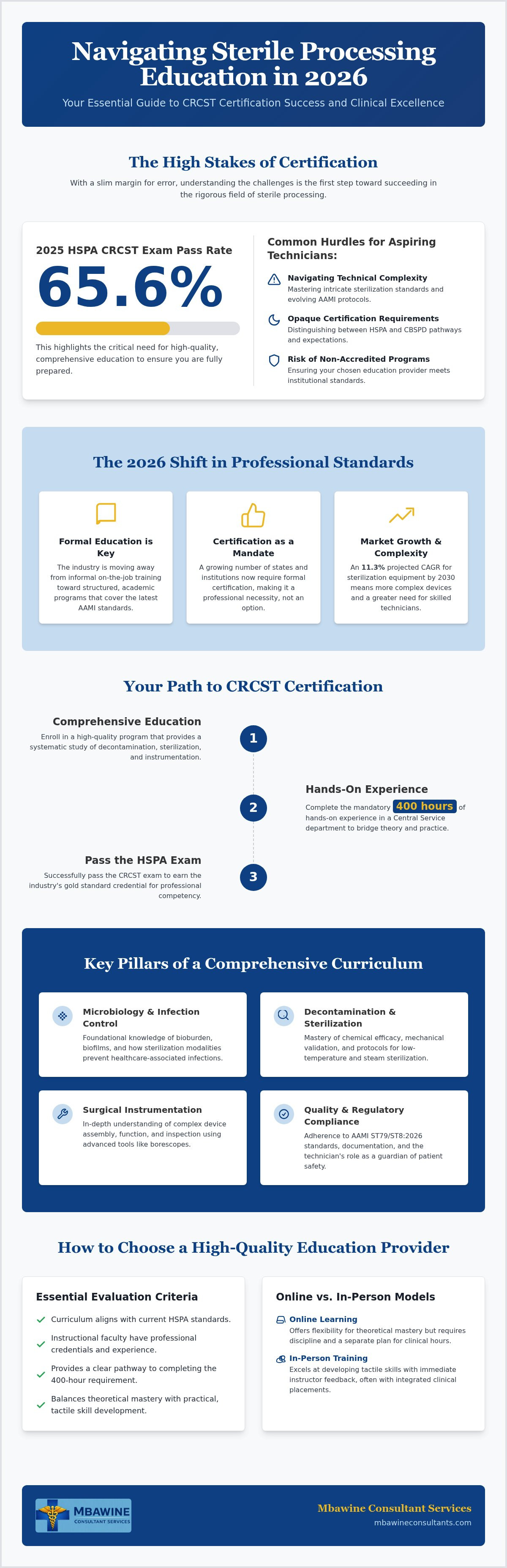
With a 2025 HSPA CRCST exam pass rate of only 65.6 percent, the margin for professional error in your preparatory phase is remarkably slim. You're likely navigating a landscape of technical complexity where the distinction between HSPA and CBSPD requirements feels opaque and the fear of selecting a non-accredited program remains a constant concern. It's understandable to feel a sense of gravity when your career trajectory depends on mastering intricate sterilization standards and evolving AAMI protocols. Choosing among various sterile processing education programs requires more than a casual assessment; it demands a systematic evaluation of institutional standards and clinical relevance.
This 2026 guide provides the essential criteria for selecting an educational pathway that ensures both certification success and long-term clinical excellence. You'll gain a clear understanding of the mandatory 400-hour experience requirements and the latest AAMI ST8:2026 updates regarding steam sterilization. By the end of this analysis, you'll have a definitive framework for identifying high-quality training that bridges the gap between entry-level knowledge and technical mastery. We'll explore the specific nuances of certification bodies and the methodical steps necessary to secure your professional future in this vital healthcare sector.
Sterile processing education is defined as the rigorous, systematic study of decontamination, sterilization, and distribution protocols that govern the lifecycle of surgical instrumentation within the Central sterile services department (CSSD). This discipline transcends simple mechanical cleaning; it encompasses a comprehensive understanding of microbiological barriers, chemical efficacy, and mechanical validation. As of 2026, the regulatory landscape has undergone a significant transformation, with an increasing number of states adopting legislative mandates that require formal certification for all practicing technicians. This shift reflects a growing institutional recognition that standardized sterile processing education programs serve as the primary defense against surgical site infections (SSIs), which remain a critical concern for patient safety and hospital liability. By establishing a baseline of professional competency, these educational frameworks ensure that every technician operates with an acute awareness of their role as a guardian of public health.
The traditional reliance on informal, on-the-job training has proven insufficient to meet the demands of modern medical environments, leading to a necessary adoption of formal academic and institutional training models. Modern healthcare facilities increasingly seek candidates who have completed structured curricula that integrate the latest AAMI ST8:2026 standards for steam sterilization and the environmental parameters defined by AAMI ST79. Professional consulting services now play a pivotal role in shaping these curricula, ensuring they reflect the technical mastery required to manage AI-powered tracking systems and advanced borescope inspections. This transition from vocational apprenticeship to academic rigor is driven by the escalating complexity of surgical devices and the 11.3 percent compound annual growth rate projected for the sterilization equipment market through 2030. It's clear that the depth of knowledge required today can't be acquired through observation alone.
The Certified Registered Central Service Technician (CRCST) designation is the industry gold standard for professional competency, verifying that an individual possesses the specialized knowledge required to navigate the high-stakes environment of an operating room's supply chain. There's a profound distinction between basic vocational instruction and the comprehensive certification preparation required to achieve a passing score on the HSPA exam. Aspiring professionals must pursue high-level sterile processing education programs that address the technical nuances of low-temperature sterilization and complex instrumentation assembly. To understand the specific requirements and milestones of this journey, professionals should consult The Definitive Sterile Processing Technician Certification Path for 2026. This educational foundation doesn't just prepare a student for an exam; it instills a lifelong commitment to the rigorous standards of healthcare sterilization.
A robust curriculum for sterile processing education programs must go beyond superficial vocational training to address the complex scientific principles that ensure patient safety. It requires a multifaceted approach that integrates biological science with mechanical precision. This educational foundation prepares technicians to manage the high-stakes environment of a modern surgical suite by establishing a deep understanding of the entire reprocessing cycle. Every pillar of the curriculum serves as a critical checkpoint in the prevention of healthcare-associated infections.
Understanding bioburden and the resilient nature of biofilms is critical for any aspiring technician. High-level programs teach students how different sterilization modalities, such as Ethylene Oxide (EtO) or Vaporized Hydrogen Peroxide (VHP), interact with specific medical device materials. It's not just about operating machinery; it's about understanding the specific lethal parameters required to achieve a Sterility Assurance Level (SAL) of 10^-6. Thermal and chemical disinfection standards are taught as academic disciplines, ensuring students grasp the scientific rationale behind every exposure time and chemical concentration level.
The sheer volume of surgical instruments, often numbering in the thousands within a single facility, necessitates a curriculum focused on rigorous identification and classification. Students must master inspection protocols, such as checking for insulation integrity in laparoscopic tools or testing the sharpness of osteotomes and scissors. A systematic approach to assembly prevents perioperative errors that can lead to surgical delays or instrument failure during critical moments. Professionals who seek this level of technical mastery often enroll in specialized certification courses to solidify their expertise and ensure they're prepared for the clinical demands of the field.
The decontamination process represents the most critical phase of instrument reprocessing. It involves a systematic methodology for manual and mechanical cleaning followed by high-level disinfection (HLD) where required. Quality assurance doesn't end with a successful sterilization cycle; it extends to meticulous documentation and validation. Every cycle, biological indicator result, and environmental parameter must be recorded with clinical precision. This creates a transparent audit trail that serves as both a legal safeguard and a benchmark for institutional excellence in a professional SPD. By adhering to these rigorous standards, technicians act as the final line of defense for patients undergoing invasive procedures.
The selection of a pedagogical delivery model represents a pivotal decision for aspiring technicians, as the efficacy of sterile processing education programs often hinges on the balance between theoretical comprehension and clinical application. Digital platforms have matured significantly by 2026, offering sophisticated environments for mastering the complex microbiology and regulatory standards essential for patient safety. However, the high-stakes nature of surgical instrument reprocessing demands a level of tactile proficiency that digital interfaces alone cannot replicate. Professionals must evaluate these models not merely through the lens of convenience, but through the objective assessment of how each pathway facilitates the transition from academic student to competent clinical practitioner.
Online curricula have proven exceptionally effective for the theoretical mastery required to secure professional certification, utilizing high-fidelity virtual simulations to guide students through the multi-step decontamination process. These digital environments allow for repetitive, risk-free engagement with complex workflows, which is instrumental in preparing for the technical rigors of the CRCST exam. Self-paced study modules provide the flexibility necessary for working professionals to synthesize dense technical information without the constraints of a rigid classroom schedule. For a detailed analysis of these digital offerings, professionals should review Sterile Processing Technician Training Online: A Comparison. This resource serves as a critical benchmark for evaluating the instructional quality of remote learning environments.
Despite the advancements in virtual training, the 400-hour hands-on experience requirement remains an immutable cornerstone of professional education, ensuring that technicians possess the manual dexterity required for intricate instrumentation handling. In-person sterile processing education programs provide an environment where instructors offer immediate, corrective feedback on sterilization techniques and assembly precision. This direct supervision is vital for mastering the nuances of tactile inspection, such as identifying the subtle tension in a surgical scissor or the minute bioburden remaining in a complex lumen. Peer interaction within a physical laboratory setting fosters a culture of collaborative accountability and professional advocacy, mirroring the interdisciplinary communication found in high-functioning hospital departments. The hybrid model, which integrates digital flexibility with these essential clinical intensives, has emerged as the preferred standard for institutional excellence in 2026.
Selecting among various sterile processing education programs requires a level of scrutiny that transcends typical consumer decision-making. Given the 2025 HSPA CRCST exam pass rate of 65.6 percent, it's evident that not all preparatory pathways provide the technical depth necessary for professional success. A provider must be evaluated as an institutional partner in your career, assessed by their adherence to rigorous industry standards and their ability to translate academic theory into clinical proficiency. This evaluation framework ensures that your investment leads to a dually recognized credential rather than a non-accredited certificate of completion.
The primary criterion for any professional program is its explicit alignment with the certification domains established by the Healthcare Sterile Processing Association (HSPA) or the Certification Board for Sterile Processing and Distribution (CBSPD). A legitimate curriculum must integrate the latest regulatory updates, specifically the AAMI ST8:2026 standards regarding immediate-use steam sterilization (IUSS) and the environmental parameters defined in ST79. Prospective students should verify program legitimacy through a rigorous checklist:
The value of an educational provider is fundamentally tied to the professional credentials of its faculty. It's vital to learn from dually certified professionals who possess extensive management experience within a high-volume sterile processing department. These mentors act as a bridge between abstract microbiology and the high-pressure reality of an operating room's supply chain. Mentorship should extend beyond the classroom, providing students with the critical thinking skills required to navigate complex manufacturers' instructions for use (IFUs) and evolving safety regulations. Programs that offer continuous professional development and robust post-graduation support demonstrate a commitment to the long-term professionalization of the field. To secure your place in a program that meets these exacting standards, you should enroll in our upcoming certification classes to begin your path toward technical mastery.
Mbawine Consultant Services operates at the intersection of educational advocacy and technical mastery, positioning itself as a premier provider for those entering the high-stakes field of medical device reprocessing. Unlike generic vocational courses, our mission-driven approach focuses on the professionalization of the industry, treating each student as a future guardian of patient safety. We offer both in-person and online sterile processing classes, ensuring that the rigorous demands of the modern Central Sterile Services Department (CSSD) are met with academic and clinical reliability. Our role extends beyond instruction; we act as a bridge between foundational knowledge and the advanced technical expertise required to lead in a professional SPD environment.
Our specialized training programs are built upon a systematic indoctrination into 2026 healthcare sterilization standards. We prioritize adherence to the latest ANSI/AAMI ST79 and ST8:2026 updates, ensuring that every participant understands the lethal parameters of sterilization cycles and the necessity of documentation accuracy. This clinical rigor is designed to eliminate the anxiety associated with technical complexity by breaking down complex sterilization modalities into manageable, evidence-based modules. By focusing on compliance and systematic processes, we prepare students to navigate the evolving regulatory landscape with confidence. To secure your position within our next cohort, you may register for specialized sterile processing education programs through our enrollment portal.
The primary objective of our education model is the successful attainment of professional certification, specifically the CRCST designation. Students benefit from an environment where staffing and consulting insights are integrated into the curriculum, providing a realistic perspective on the leadership requirements within a professional SPD. This holistic approach prepares individuals not just to pass an exam, but to excel in high-pressure clinical environments where precision is non-negotiable. Our focus on certification preparation directly addresses the 65.6 percent pass rate seen in 2025 by providing targeted, high-level mentorship from seasoned industry experts. We invite you to schedule a professional consultation to discuss your specific career trajectory and how our educational framework supports your long-term advancement in the healthcare field.
The 2026 landscape of medical device reprocessing demands a commitment to technical mastery that transcends basic vocational training. The transition toward mandatory certification and the implementation of rigorous AAMI ST8:2026 standards necessitate a systematic approach to professional development. Selecting among various sterile processing education programs is a decision that impacts not only your individual career trajectory but also the broader standards of public safety and institutional reliability. By prioritizing curricula aligned with HSPA standards and dually certified mentorship, you'll position yourself at the forefront of this high-stakes field.
Mbawine Consultant Services offers a national pathway to professional success, providing a curriculum designed by industry consultants that bridges the gap between theory and clinical reality. We invite you to Enroll in Professional Sterile Processing Classes Today to begin your comprehensive preparation for HSPA/CRCST certification. Your dedication to excellence starts with an educational foundation built on clinical rigor and professional advocacy. It's time to transform your potential into specialized mastery.
Online sterile processing education programs are recognized for national certification eligibility if their curriculum explicitly aligns with the standards established by the Healthcare Sterile Processing Association (HSPA) or the Certification Board for Sterile Processing and Distribution (CBSPD). While the education provider itself may hold institutional accreditation, the critical factor is that the coursework prepares students to meet the rigorous examination requirements and the 400-hour clinical experience mandate necessary for professional credentialing.
The duration of a typical sterile processing curriculum in 2026 generally ranges from four to twelve months, depending on the instructional model and the student's ability to fulfill clinical requirements. Accelerated programs may conclude theoretical instruction within ten to sixteen weeks, but the total time to full certification is often extended by the necessity of completing 400 hours of hands-on experience, which serves as a mandatory validation of technical proficiency.
The primary distinction lies in the certification bodies and their specific eligibility requirements. The HSPA offers the Certified Registered Central Service Technician (CRCST) credential, which mandates 400 hours of hands-on experience. Conversely, the CBSPD provides the Certified Sterile Processing and Distribution Technician (CSPDT) designation, which offers multiple eligibility pathways, including the completion of a certificate program or specific employment duration. Both are nationally recognized and dually accredited by the National Commission for Certifying Agencies.
Completing a theoretical education program doesn't inherently guarantee a clinical internship, as these placements are often subject to the availability and specific requirements of partner healthcare facilities. However, high-quality sterile processing education programs frequently establish formal agreements with hospitals to facilitate these essential rotations. Students must often pass background checks and meet health immunization standards before they're permitted to enter a clinical Central Sterile Services Department (CSSD) for their practical training.
Standard prerequisites for enrollment typically include a high school diploma or an equivalent General Education Development (GED) credential. Prospective students must generally be at least 18 years of age and possess the physical stamina required for long periods of standing and lifting heavy instrument trays. Additionally, many institutions require a clean criminal background check and updated immunization records to ensure compliance with the safety protocols of the clinical environments where hands-on training occurs.
The financial investment required for these programs varies significantly based on the institution type and the delivery model selected. Community colleges often charge tuition based on credit hours, while private technical schools or specialized consulting services may offer flat-rate fees that include study materials and exam preparation resources. Prospective technicians should evaluate these costs against the potential for career advancement and the comprehensive nature of the curriculum provided by the educational institution.
It's technically possible to sit for the CRCST examination without formal schooling, provided the candidate can verify 400 hours of hands-on experience within a sterile processing department. However, the high technical complexity of the 2026 standards and the 65.6 percent pass rate recorded in 2025 suggest that independent study is often insufficient. Most successful candidates find that a structured education program is essential for mastering the microbiology and instrumentation knowledge required for the exam.
Many reputable sterile processing education programs offer professional support services, including resume development and interview preparation, to assist graduates in securing employment. While a program can't guarantee a specific job, those with strong institutional reputations often maintain networks with healthcare recruiters and staffing agencies. This professional advocacy serves as a bridge between the attainment of a certification and the commencement of a career within a high-volume surgical environment. Similarly, for individuals exploring adjacent clinical pathways and allied health credentials, vocational centers like Progressive Medical Institute provide focused training to help aspiring professionals enter the medical workforce.

Article by
Mba Akuribila
Mba‑Akuribila is a healthcare leader, educator, and founder of Mbawine Consultants, a Bronx‑based institution recognized nationwide for advancing excellence in sterile processing and allied health workforce development. Born in Bongo in Ghana’s Upper East Region, his journey from rural beginnings to national impact reflects a lifelong commitment to service, empowerment, and community advancement.
For over two decades, he has trained sterile processing employees, mentored, and placed thousands of healthcare professionals across the United States. Through Mbawine Consultants, he established one of the country’s most trusted Sterile Processing Certification Test Prep Programs, preparing new Americans and career‑changers for successful entry into the field. The organization, as at 2026, has graduated more than 15,000 sterile processing technicians who now serve in hospitals, ambulatory centers, dental practices, and reprocessing facilities nationwide.
Under his leadership, Mbawine Consultants has expanded into a full Healthcare Staffing Agency, connecting nurses and allied health professionals to meaningful employment opportunities. His team also provides Interim Management Services, supporting hospitals and surgical centers with experienced leaders who stabilize operations, strengthen compliance, and improve workflow efficiency.
As a former surgical technician, sterile processing manager, educator, and system‑wide director, Mba‑Akuribila brings deep expertise to Sterile Processing Consulting, helping healthcare facilities elevate quality, safety, and regulatory readiness.
His work in the United States and Ghana continues to reflect his core philosophy: service above self, opportunity for all, and excellence without compromise.


