

When a multi-facility review of 200 hospitals reveals that 18.7% of defective trays intercepted before surgery contain residual bioburden, the gravity of sterile processing failures becomes impossible to ignore. These figures represent more than just technical errors; they indicate a systemic breakdown that necessitates expert sterile processing leadership consulting to safeguard patient safety and institutional integrity. You likely understand the profound frustration of managing recurring wet loads and the persistent friction between the department and the operating room. It's clear that high attrition rates among technicians often stem from a lack of professional development and technical leadership support.
Discover how specialized consulting bridges the gap between these deficiencies and perioperative excellence through clinical rigor and educational mastery. By prioritizing HSPA and CBSPD certification as the foundation for departmental success, institutions can foster a culture of technical precision and accountability. This article provides a comprehensive analysis of the institutional transformation required to achieve sustained regulatory compliance and optimized surgical throughput. We'll explore how a structured, mentor-driven approach creates a highly skilled workforce prepared for the rigorous standards and water quality requirements of 2026.
The modern surgical environment relies on the precision of the Central Sterile Services Department (CSSD) more than ever before. Historically viewed as a back-of-house support function, the Sterile Processing Department (SPD) is now a central driver of clinical outcomes and institutional financial viability. This shift requires a level of oversight that transcends basic administrative management. Engaging in sterile processing leadership consulting provides the specialized expertise necessary to align technical operations with the high-stakes requirements of the operating room. Without this alignment, hospitals risk significant surgical delays and compromised patient safety.
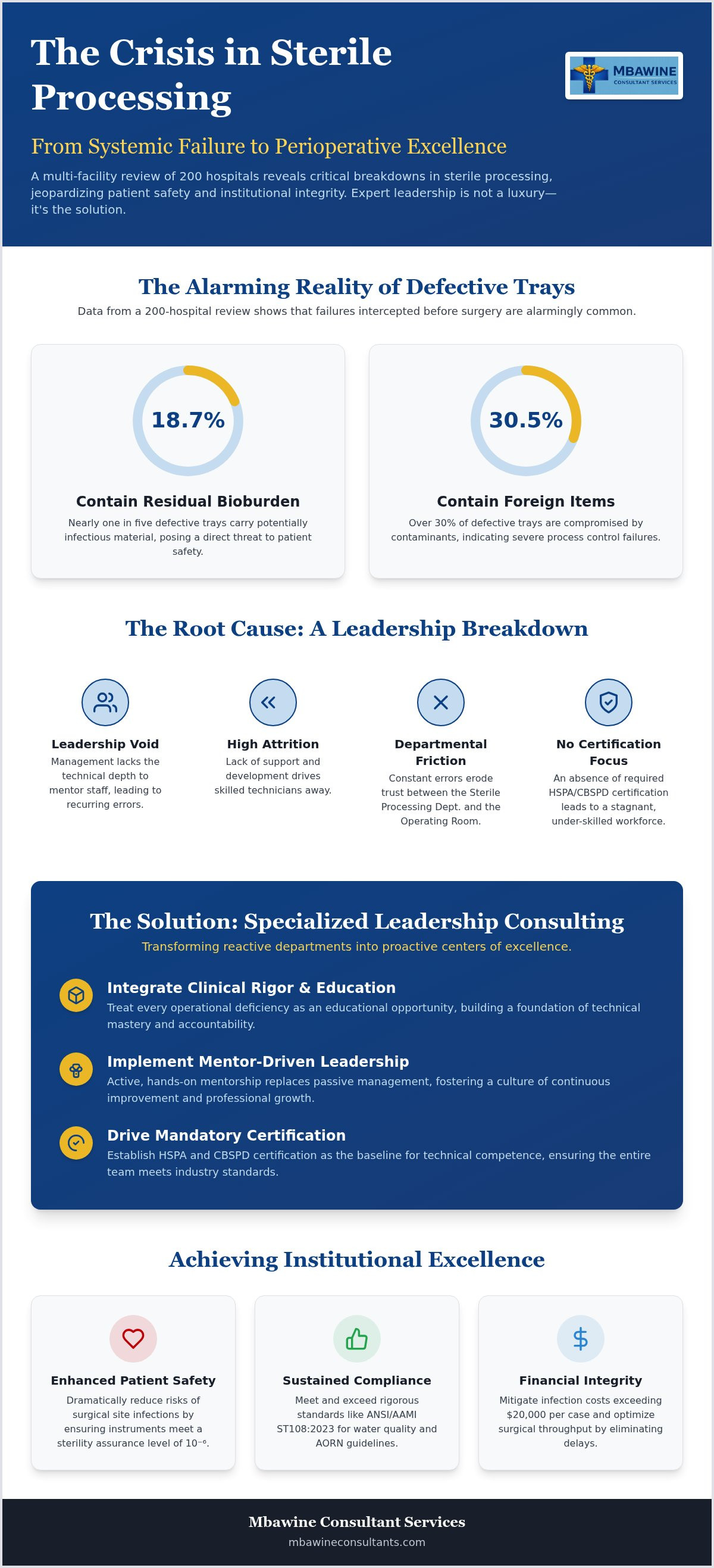
Institutional stagnation often begins with a leadership void. When management lacks the technical depth to mentor staff, departments experience high attrition and recurring errors. A multi-facility review of 200 hospitals found that 18.7% of defective trays intercepted before reaching the OR contained residual bioburden, while 30.5% contained foreign items. These failures aren't just technical; they're leadership failures. A lack of certified, expert guidance often results in an "undervalued" status for the SPD within the hospital hierarchy. This perception creates a cycle of low morale and professional friction.
Recognizing institutional decline is the first step toward recovery. High staff turnover and instrument contamination are often symptoms of ineffective management rather than technician incompetence. When leaders don't prioritize educational rigor or certification, the workforce remains stagnant. This gap exacerbates friction with the Operating Room, as surgeons lose confidence in the equipment provided. Professional sterile processing leadership consulting identifies these fractures, providing a roadmap to restore technical authority and departmental pride.
Effective leaders act as the ultimate guardians of industry standards. They ensure adherence to current regulations, such as the ANSI/AAMI ST108:2023 water quality standards and AORN guidelines for endoscope reprocessing. This responsibility is clinical. Leaders must position the SPD as a critical component of infection control. By fostering accountability through specialized consulting services, management transforms the department into a pillar of public safety. This commitment ensures instruments meet the sterility assurance level of 10⁻⁶, mitigating surgical site infections that can increase costs by over $20,000 per occurrence.
Leadership in sterile processing isn't merely a matter of scheduling and logistics; it's a commitment to technical mastery. The Mbawine methodology posits that operational excellence is impossible without foundational education. By implementing specialized sterile processing leadership consulting, institutions can move beyond reactive problem-solving. This approach treats every departmental deficiency as an educational intervention, ensuring that leaders don't just manage staff but actively mentor them toward professional certification. This symbiotic relationship between education and management creates a resilient workforce capable of meeting the rigorous demands of modern perioperative services.
Professional certification serves as the baseline for technical competence in a modern department. The Mbawine methodology emphasizes that sterile processing classes are the cornerstone of this institutional transformation. As of 2026, many states have moved to mandate certification for technicians within two years of hire, making proactive education a regulatory necessity. Preparing a workforce to pass the CRCST exam on their first attempt reduces the institutional burden of failed audits and minimizes the costs associated with high staff turnover. When technicians understand the scientific principles behind sterilization, they become invested in maintaining a sterility assurance level of 10⁻⁶.
Leadership transitions often leave departments vulnerable to process drift and regulatory non-compliance. Expert interim SPD management stabilizes these environments by implementing systematic protocols for instrument tracking and decontamination. These interim leaders act as catalysts for cultural change, bridging the gap between entry-level skill sets and advanced technical mastery. They ensure that all department activities align with CDC Sterilizing Practices, protecting the facility from the legal and clinical risks of improper reprocessing.
A comprehensive assessment is the first step in this methodology. It involves a clinical audit of existing workflows to identify where educational gaps lead to operational failures. By integrating this diagnostic phase with sterile processing leadership consulting, hospitals can build a culture of accountability and professional pride. This proactive stance is essential for those seeking to professionalize their workforce and optimize surgical throughput. If you're ready to elevate your department's standards, consider exploring our certification preparation pathways to build a foundation of excellence.
The efficacy of sterile processing leadership consulting is best demonstrated through the lens of institutional recovery in high-volume surgical environments. In a representative transformation, a facility initially presented with a 2.0% tray failure rate, where audits revealed that 30.5% of defective trays contained foreign objects. This state of operational liability wasn't merely a technical issue; it was a reflection of a leadership void that failed to prioritize professional certification and clinical oversight. By integrating strategic consulting with intensive educational pathways, the facility began a transition toward becoming a center of perioperative excellence. This change required a shift from reactive crisis management to a structured, mentor-driven environment.
The transformation began with a rigorous assessment of the department's existing workflows and cultural dynamics. Consultants conducted comprehensive interviews with perioperative stakeholders to quantify the impact of leadership gaps on surgical throughput. The assessment revealed that the department's failure to adhere to FDA guidance on Sterilization for Medical Devices was primarily due to a lack of technical mastery among the uncertified staff. By evaluating current processes against 2026 professional standards, the diagnostic team identified specific educational deficiencies that were preventing the department from achieving a consistent sterility assurance level of 10⁻⁶.
Strategic intervention focused on stabilizing the department through the deployment of sterile processing manager training. This program empowered leaders to act as technical mentors, fostering a culture where precision is a point of professional pride rather than an administrative burden. The results of this methodology were measurable and profound. Within twelve months, the facility achieved a 95% staff certification rate through targeted classes, effectively professionalizing the workforce. This shift in expertise led to a reduction in case cart errors and surgical delays by over 40%, directly mitigating the financial risks associated with surgical site infections. By the end of 2026, the department had shifted from a clinical liability to a proactive partner in perioperative success, proving that sterile processing leadership consulting is an essential investment for modern healthcare institutions.
Selecting a partner for institutional transformation requires a rigorous evaluation of professional credentials and operational capabilities. General healthcare consultants often lack the technical depth required to address the specific complexities of the decontamination and sterilization process. Effective sterile processing leadership consulting must be rooted in a comprehensive understanding of clinical standards, including the latest AORN 2026 guidelines and ANSI/AAMI ST108:2023 water quality requirements. A consultant's value is measured by their ability to stabilize a department while simultaneously cultivating a culture of technical excellence. This requires a track record of improving workforce retention through structured mentorship rather than temporary fixes.
National coverage and flexible staffing are critical components of a robust consulting engagement. In 2026, the demand for certified technicians remains high, making it essential for consultants to offer 24/7 support and emergency solutions. This ensures that facility operations remain uninterrupted during leadership transitions or unexpected volume surges. It's vital that consultants act as guardians of industry standards, ensuring every process aligns with the goal of zero patient harm.
Generalist firms often overlook the granular details of surgical logistics and instrument care. True expertise requires a commitment to CRCST certification standards as a baseline for all personnel. Consultants must demonstrate proficiency in the scientific principles of sterilization to ensure a sterility assurance level of 10⁻⁶ is consistently met. Without this specialized knowledge, recommendations remain surface-level and fail to address the root causes of bioburden issues or wet loads. Professional sterile processing leadership consulting provides the technical authority needed to gain the trust of both the SPD staff and the surgical team.
The ultimate goal of any engagement is to establish a self-sustaining department. This is achieved through sterile processing management solutions that prioritize detailed, implementable recommendations over vague strategy. ROI is calculated not just through immediate error reduction, but through the long-term decrease in technician overtime and the prevention of surgical site infections. Each infection avoided saves an institution more than $20,000 in hospitalization costs. By professionalizing the workforce, specialized consultants convert the SPD from a cost center into a driver of perioperative throughput. To begin building this foundation of excellence within your facility, we invite you to enroll in our professional development programs today.
The transition from reactive crisis management to proactive clinical excellence represents the pinnacle of institutional transformation. While interim solutions stabilize immediate threats, long-term sterile processing leadership consulting ensures that these improvements are woven into the facility's permanent operational fabric. This evolution requires a shift in how the Sterile Processing Department perceives its role within the hospital. When technicians see themselves as clinical professionals rather than manual laborers, the entire perioperative ecosystem benefits from increased precision and reduced risk. This cultural shift is essential for navigating the intensified regulatory scrutiny expected throughout 2026, including the rigorous water quality standards and enhanced bioburden control protocols.
Mbawine Consultant Services acts as a mission-driven partner, positioning itself as a guardian of industry standards. By focusing on the professionalization of the field, the consulting engagement moves beyond simple compliance audits. It builds a foundation of trust and technical authority that bridges the gap between entry-level requirements and advanced mastery. This proactive stance future-proofs the department against shifting CMS regulations and evolving AORN guidelines, ensuring that sterility assurance remains a constant rather than a variable. Specialized sterile processing leadership consulting provides the framework for this stability, allowing management to focus on long-term strategic goals rather than daily operational fires.
Effective leadership consulting empowers staff and alumni to lead from within, creating a sustainable internal hierarchy. The psychological impact of obtaining professional certification can't be overstated; it transforms technician morale by validating their technical expertise. When a department prioritizes education, it naturally creates a pipeline of future leaders who are prepared to uphold clinical rigor. This internal development reduces the institutional reliance on external temp staffing and fosters a deep sense of professional pride and accountability. It's this commitment to professional development that ensures the department remains a center of excellence long after the initial consulting phase ends.
Initiating a comprehensive leadership assessment is the first step toward achieving this high-level institutional standard. Every facility possesses unique challenges, from specific instrument volume issues to localized friction between the SPD and the Operating Room. Customizing consulting services ensures that these unique needs are met with precision and clinical expertise. The process involves a methodical evaluation of current workflows followed by the implementation of structured, mentor-driven leadership. To begin your journey toward technical mastery and sustained regulatory compliance, Contact Mbawine Consultant Services to schedule your leadership consultation. We're dedicated to acting as your partner in excellence, ensuring your department becomes a pillar of public safety and perioperative success.
The transformation of a Sterile Processing Department from a regulatory liability into a center of clinical excellence requires more than administrative oversight; it demands a dedicated commitment to technical mastery and educational rigor. By implementing specialized sterile processing leadership consulting, healthcare institutions can effectively bridge the gap between persistent operational deficiencies and the high standards of modern perioperative care. This methodology prioritizes expert preparation for CRCST certification as a non-negotiable foundation for every technician. It also leverages comprehensive national interim management services to stabilize departments during critical transitions.
Maintaining a sterility assurance level of 10⁻⁶ and adhering to 2026 water quality standards isn't just a goal; it's a professional mandate that protects public safety. A formal, mission-driven approach ensures that every tray reaching the operating room is a testament to institutional integrity. You have the opportunity to redefine your department's culture and future-proof your operations against evolving regulatory demands. We invite you to take the first step toward professionalizing your workforce and optimizing your surgical throughput.
Schedule a Sterile Processing Leadership Consultation
Your commitment to institutional excellence and patient safety begins with a foundation of technical mastery.
It involves a comprehensive assessment of departmental workflows, educational gaps, and regulatory compliance. Consultants provide a roadmap for institutional transformation by aligning technical operations with perioperative requirements. This process includes mentoring existing management, refining decontamination protocols, and ensuring adherence to current standards like ANSI/AAMI ST108:2023. It's a strategic partnership designed to shift the Sterile Processing Department from a support function to a central driver of clinical excellence.
Interim management focuses on technical leadership and process stabilization rather than merely filling a labor void. While traditional staffing provides front-line technicians, interim leaders implement systematic changes and mentor the existing workforce toward technical mastery. These professionals act as catalysts for cultural change, ensuring that departmental activities remain compliant with CDC guidelines during leadership transitions. This approach prioritizes long-term institutional stability and professional development over short-term personnel coverage.
Yes, specialized consulting identifies and rectifies the most common compliance failures cited during surveys. These often include issues with sterilizer cycle documentation, deviations from manufacturer instructions for use, and improper environmental monitoring. By conducting proactive audits and implementing rigorous sterility assurance protocols, consultants ensure the department's prepared for unannounced inspections. This preparation transforms the audit from a source of institutional anxiety into a validation of established clinical excellence.
Hiring a specialized agency ensures access to experts who possess deep technical knowledge of surgical logistics and sterilization science. These agencies provide a level of oversight that general healthcare consulting firms can't match. Benefits include reduced surgical delays, improved instrument tray accuracy, and enhanced technician retention through structured certification preparation. By professionalizing the department, a specialized sterile processing leadership consulting engagement mitigates clinical risks and optimizes the facility's overall surgical throughput.
The cost of a consulting engagement is determined by the specific scope of the institutional assessment and the duration of the required intervention. Factors such as the current state of departmental compliance, the size of the surgical volume, and the depth of educational needs influence the total investment. While industry rates for regulatory consulting vary, facilities should focus on the long-term ROI achieved through reduced overtime and the prevention of costly surgical site infections.
Measurable improvements in technical accuracy and tray readiness are often observed within the first ninety days of a structured intervention. However, achieving a full institutional transformation and a certified workforce typically requires a commitment of twelve months or longer. This timeline allows for the implementation of systematic educational programs and the stabilization of departmental culture. Sustained excellence is a methodical process that rewards consistency and a disciplined adherence to professional standards.
Mbawine Consultant Services provides comprehensive sterile processing leadership consulting and staffing solutions on a national scale. Our methodology is designed to support healthcare facilities across various jurisdictions, ensuring that all operations align with federal standards and national industry guidelines. By offering 24/7 emergency staffing and interim management, we provide the flexible support necessary to maintain perioperative excellence regardless of a facility's geographic location or local labor market challenges.
Professional certification serves as the definitive benchmark for technical competence and professional accountability in the sterilization field. For leaders, CRCST status validates their ability to mentor staff and oversee complex decontamination processes with clinical authority. It ensures that management understands the scientific principles required to achieve a sterility assurance level of 10⁻⁶. As regulatory bodies increasingly mandate certification, leaders must possess these credentials to maintain institutional compliance and uphold the highest standards of public safety.

Article by
Mba Akuribila
Mba‑Akuribila is a healthcare leader, educator, and founder of Mbawine Consultants, a Bronx‑based institution recognized nationwide for advancing excellence in sterile processing and allied health workforce development. Born in Bongo in Ghana’s Upper East Region, his journey from rural beginnings to national impact reflects a lifelong commitment to service, empowerment, and community advancement.
For over two decades, he has trained sterile processing employees, mentored, and placed thousands of healthcare professionals across the United States. Through Mbawine Consultants, he established one of the country’s most trusted Sterile Processing Certification Test Prep Programs, preparing new Americans and career‑changers for successful entry into the field. The organization, as at 2026, has graduated more than 15,000 sterile processing technicians who now serve in hospitals, ambulatory centers, dental practices, and reprocessing facilities nationwide.
Under his leadership, Mbawine Consultants has expanded into a full Healthcare Staffing Agency, connecting nurses and allied health professionals to meaningful employment opportunities. His team also provides Interim Management Services, supporting hospitals and surgical centers with experienced leaders who stabilize operations, strengthen compliance, and improve workflow efficiency.
As a former surgical technician, sterile processing manager, educator, and system‑wide director, Mba‑Akuribila brings deep expertise to Sterile Processing Consulting, helping healthcare facilities elevate quality, safety, and regulatory readiness.
His work in the United States and Ghana continues to reflect his core philosophy: service above self, opportunity for all, and excellence without compromise.


