

The transition from a high-performing technician to a department leader is not merely a promotion; it is a fundamental shift in professional identity that requires a completely different set of competencies. While technical mastery ensures that surgical instruments are safe for patient use, it does not inherently prepare an individual for the complexities of sterile processing manager training or the administrative burdens of departmental oversight. As regulatory bodies like The Joint Commission increase their focus on the practical application of standards rather than just documentation, the need for structured leadership development has never been more critical.
You likely recognize the immense pressure of maintaining AAMI ST79 environmental standards while simultaneously managing personnel, budgets, and inter-departmental communication. It's common to feel overwhelmed by the choice between various leading certification programs, including the CBSPD Certified Sterile Processing and Distribution Management (CSPDM) credential. This guide, presented by Mbawine Consultant Services, provides a systematic pathway to bridge the gap between technical expertise and administrative excellence. We will examine the core competencies required for modern SPD leadership, provide a comparative analysis of the most recognized certification programs, and outline a comprehensive professional development roadmap that aligns with the rigorous industry standards established for 2026.
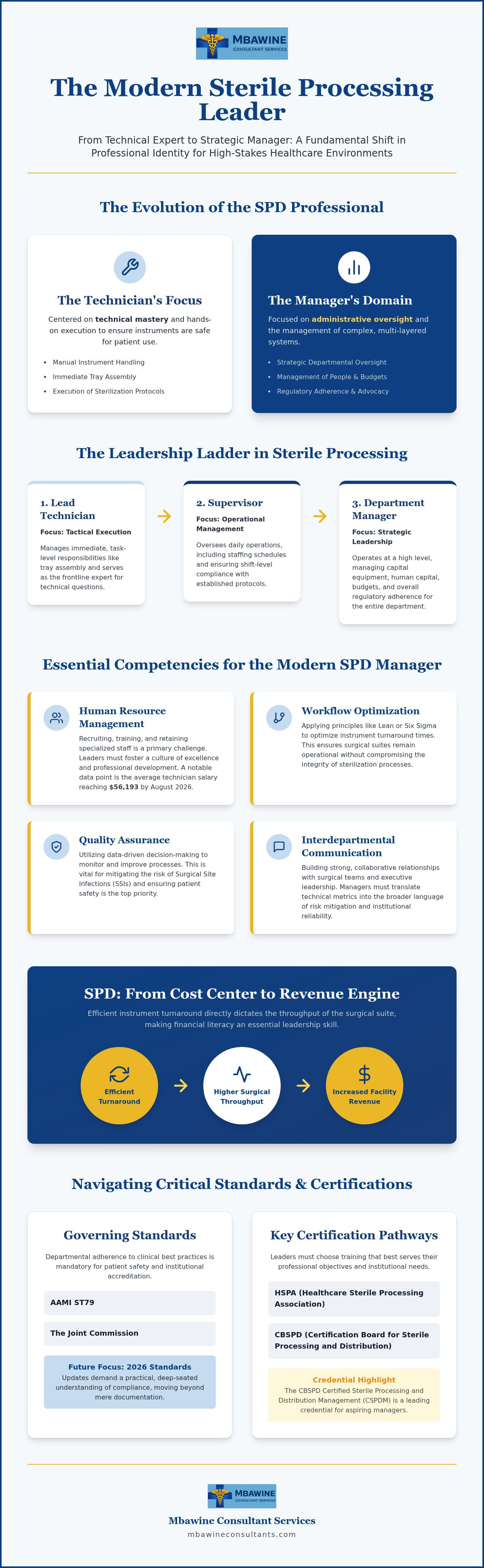
The landscape of surgical support has undergone a profound transformation, moving away from the historical view of the sterilization unit as a subordinate utility. By 2026, the sterile processing department is recognized as a sophisticated clinical environment where technical skill serves only as the baseline requirement. Modern sterile processing manager training now emphasizes the transition from manual instrument handling to the oversight of complex, multi-layered systems. This evolution is driven by the January 1, 2026, Joint Commission standards updates, which demand that leadership demonstrates a practical, deep-seated understanding of compliance rather than mere documentation. Managers must now advocate for their departments as central pillars of patient safety, ensuring that the gravity of their mission is understood by executive hospital leadership. This advocacy requires a shift in communication, translating technical metrics into the broader language of risk mitigation and institutional reliability.
Roles within the department are increasingly specialized to meet these rising expectations. While a Lead Technician focuses on immediate tray assembly and a Supervisor manages daily staffing and shift-level compliance, the Department Manager operates at a strategic level. This role requires a total shift from hands-on processing to the high-level management of capital equipment, human capital, and regulatory adherence. It's no longer enough to know how to sterilize a robotic instrument; the manager must know how to justify the purchase of the sterilizer itself. The manager's primary responsibility is to serve as the professional guardian of patient safety through the rigorous enforcement of process compliance and institutional standards.
The Central Sterile Services Department (CSSD) is no longer a cost center; it is a vital revenue engine. Efficient instrument turnaround directly dictates the throughput of the surgical suite, making financial literacy and budget management essential skills for the modern leader. By implementing strategic sterile processing management solutions, leaders can minimize delays and reduce the risk of surgical site infections (SSIs), which carry heavy financial penalties and reputational damage. Effective sterile processing manager training ensures that leaders can speak the language of hospital administrators, connecting technical KPIs to the facility's overall financial health and operational stability. This includes understanding the impact of AAMI ST79 compliance on accreditation and the long-term fiscal benefits of a highly trained, certified workforce.
Transitioning into a leadership role requires a departure from technical execution in favor of systemic oversight. Comprehensive sterile processing manager training focuses on the synthesis of clinical knowledge and administrative strategy. This shift is essential for managing the high-stakes environment of instrument reprocessing, where the margin for error is nonexistent. Modern leaders must master several core competencies to ensure the department functions as a reliable component of the healthcare continuum.
Mastery of ANSI/AAMI ST79 remains the foundation of departmental safety. Managers are responsible for maintaining environmental controls, such as ensuring decontamination areas stay between 60°F and 65°F with at least 10 air exchanges per hour. Preparing for Joint Commission surveys requires continuous readiness and the ability to implement evidence-based practice changes. Many professionals seek a CBSPD management certification to demonstrate their proficiency in these rigorous regulatory requirements.
A manager must balance the business requirements of the facility with the clinical needs of the surgical team. This involves managing complex inventory levels for surgical instrumentation and justifying equipment upgrades through productivity analysis. Analyzing these metrics allows leaders to present a compelling case for staff expansion or new technology. Leveraging consulting services for departmental optimization can provide the objective data needed to secure institutional support. Professionals ready to advance their administrative capabilities should consider specialized sterile processing manager training to refine these critical leadership skills.
Professional advancement within the sterile processing field is increasingly predicated on the acquisition of formal leadership credentials. By 2026, healthcare facilities have intensified their focus on specialized sterile processing manager training to ensure that department heads possess the administrative acumen required to navigate complex regulatory environments. The two primary certification bodies, the Healthcare Sterile Processing Association (HSPA) and the Certification Board for Sterile Processing and Distribution (CBSPD), offer distinct pathways for those seeking to validate their management expertise. While technical skill is the foundation, these advanced certifications provide the institutional authority necessary to lead a department effectively.
The HSPA Certified Healthcare Leader (CHL) and the CBSPD Certified Sterile Processing and Distribution Management (CSPDM) credentials focus on high-level oversight. These certifications correlate directly with professional standing and financial compensation. With the average annual salary for technicians at $56,193 as of August 2026, those who achieve management-level status often see significant increases in both responsibility and remuneration. Maintaining these credentials requires a steadfast commitment to continuing education, particularly as standards like AAMI ST8:2026 introduce new terminology such as 'immediate-use steam sterilization' (IUSS) and revised biological performance testing protocols.
The HSPA CHL exam is a rigorous assessment designed for those who have already mastered the technical aspects of the field. To be eligible, candidates must hold a current Certified Registered Central Service Technician (CRCST) certification. The examination focuses on critical domains including strategic management, operational efficiency, and human resources. Given the complexity of these subjects, many professionals utilize specialized CRCST and CHL prep classes to ensure they are prepared for the 2026 exam requirements. Successful candidates must demonstrate a comprehensive understanding of how to manage staff, budgets, and the high-stakes logistics of the sterilization cycle.
While the CHL and CSPDM are the most recognized management-specific certifications, other pathways exist for professional growth. The Certified Instrument Specialist (CIS) serves as an excellent technical leadership stepping stone, focusing on the intricate details of complex surgical sets. For those aiming for executive roles, a Project Management Professional (PMP) certification or a degree in healthcare administration can provide a competitive edge. Choosing the right path involves a careful assessment of your facility's specific requirements and your long-term career goals. Effective sterile processing manager training should ultimately align with the specific operational challenges of your clinical environment.
Developing a strategic approach to leadership requires more than professional ambition; it demands a structured methodology that aligns with the rigorous expectations of modern healthcare administration. Aspiring managers should initiate this process by conducting a comprehensive self-assessment using the Healthcare Sterile Processing Association (HSPA) competency framework. This systematic evaluation identifies specific deficiencies that a comprehensive sterile processing manager training program can address, such as financial management, human resources, and strategic planning, which are often overlooked during technical training. Identifying a mentor, whether an established department director or a seasoned leader within a professional organization, provides the clinical and administrative perspective necessary for high-stakes decision-making. It's also vital to document all leadership experiences, including periods spent as an 'acting manager', as these hours are foundational for advanced certification eligibility.
Success in the administrative landscape is built upon a robust academic and professional foundation. Enrolling in professional sterile processing classes provides the theoretical framework required to navigate the complexities of 2026 regulatory standards. Professionals must choose between the flexibility of online learning and the networking advantages of in-person training, both of which offer distinct benefits for career advancement. A disciplined study schedule is essential to master the administrative domains of the field, ensuring a deep understanding of the revised AAMI ST8 and Joint Commission protocols. This formal sterile processing manager training serves as the bridge between technical skill and executive leadership.
A manager's influence must extend beyond the physical boundaries of the decontamination and sterilization areas. Gaining cross-functional exposure is a critical component of professional development. Requesting shadow opportunities with Operating Room (OR) managers and Infection Control practitioners provides invaluable insight into the entire perioperative cycle. Volunteering for hospital committees focused on safety, quality, or supply chain management further demonstrates leadership initiative and institutional commitment. This broader perspective allows a leader to advocate for the department more effectively, positioning the sterile processing unit as a strategic partner in patient safety. For those ready to formalize their leadership journey, you should enroll in our management-focused classes to secure your professional future.
Mbawine Consultant Services functions as a specialized conduit between foundational technical knowledge and the high-level administrative oversight required in the modern surgical environment. Our comprehensive sterile processing manager training is meticulously designed to address the rigors of the 2026 professional standards, ensuring that leaders are fully prepared for the evolving expectations of the Joint Commission and AAMI. Beyond classroom instruction, our interim management services play a critical role in stabilizing departments during leadership transitions, providing a hands-on pedagogical environment where new managers can observe and implement best practices in real-time. This commitment to professionalization ensures that every facility we serve benefits from a culture of expert mentorship and uncompromising adherence to safety protocols. By tailoring our customized employee education programs to the unique needs of individual healthcare facilities, we ensure that departmental goals align with institutional requirements for excellence and public safety.
Accessing professional guidance is particularly vital for those transitioning into management roles where the margin for error is nonexistent. Specialized consulting allows new leaders to bridge the gap between theoretical certification and the daily, often unpredictable, realities of departmental governance. By engaging with our network of experienced staff and alumni, emerging leaders gain access to a reservoir of institutional knowledge and ongoing professional support. Additionally, our external audits provide an objective assessment of current operations, identifying specific opportunities for process improvement and leadership development that internal reviews might overlook. These assessments are essential for maintaining the high standards of institutional reliability that modern healthcare facilities demand. It's through this structured support that a manager can move from a state of reactive troubleshooting to proactive, strategic leadership.
The pathway to leadership excellence requires a deliberate and structured educational strategy that reflects the high-stakes nature of the medical field. We provide direct access to our 2026 course schedule, which is specifically curated for professionals aiming to master the administrative and regulatory domains of the sterile processing field. Our programs support national standards of excellence, ensuring that every participant is equipped to lead with authority and clinical precision. We invite you to take the definitive step in your professional development and begin your leadership journey by enrolling in our specialized training programs today to secure your role as a guardian of patient safety and industry standards. This investment in your professional future ensures that you're not just managing a department, but leading a vital clinical function with the weight of expertise and mission-driven purpose.
The transition into a management role within the sterile processing department represents a deliberate shift toward systemic accountability and institutional advocacy. By mastering core competencies in human resource management and operational financial literacy, you position yourself as a vital strategic partner in the perioperative environment. This professional trajectory requires a steadfast commitment to rigorous standards, including the acquisition of advanced credentials such as the HSPA CHL or CBSPD management certifications. Specialized sterile processing manager training provides the analytical framework necessary to navigate the complexities of 2026 regulatory updates while ensuring uncompromising patient safety.
Mbawine Consultant Services offers authoritative expertise in healthcare sterilization standards through specialized HSPA and CBSPD certification preparation. Our programs provide a national reach with both online and in-person options, ensuring that every aspiring leader has access to high-level mentorship and comprehensive exam preparation. Enroll in Professional Sterile Processing Manager Training today to formalize your leadership trajectory and join a network of dedicated professionals committed to industry excellence. Your dedication to these rigorous standards ensures a safer, more reliable future for the patients and clinical teams you serve.
Becoming a Sterile Processing Manager requires a combination of foundational technical expertise and demonstrated leadership capability. Candidates typically must hold a baseline certification, such as the CRCST, and accumulate documented 'acting manager' hours to qualify for higher-level credentials. Beyond these technical prerequisites, a candidate must demonstrate mastery over the administrative domains of the department, including human resource management and financial oversight. Many facilities now prioritize individuals who have completed formal sterile processing manager training to ensure they can navigate the high-stakes regulatory landscape of 2026.
While a college degree isn't universally mandated for all leadership positions, it's increasingly viewed as a valuable asset for those seeking director-level oversight. Many facilities accept a combination of professional experience and advanced management certifications as a viable alternative to a formal degree. These specialized credentials validate an individual's proficiency in healthcare administration and strategic planning. Pursuing advanced sterile processing manager training often provides the specific business acumen that traditional academic programs may lack in a clinical context.
The duration of leadership development varies significantly based on the candidate's existing experience and the intensity of the chosen curriculum. Specialized management courses often range from several weeks to several months of structured study, focusing on the core competencies required for certification. Candidates must also account for the time necessary to document the leadership hours required by certifying bodies like HSPA or CBSPD. A disciplined approach to this professional development ensures that the transition from technical mastery to administrative oversight is both thorough and sustainable.
The primary distinction lies in the eligibility requirements and the specific focus of the examination domains. The HSPA Certified Healthcare Leader (CHL) credential requires a current CRCST certification and emphasizes strategic management and human resources within the sterile processing environment. Conversely, the CBSPD Certified Sterile Processing and Distribution Management (CSPDM) pathway is an independent management certification that covers a broad spectrum of administrative responsibilities. Both credentials are held in high regard and demonstrate a professional's commitment to the highest standards of departmental governance.
Modern educational platforms provide extensive online flexibility to accommodate the demanding schedules of working sterile processing professionals. Many reputable training programs offer virtual classrooms that combine theoretical lectures with practical, case-based assessments. This digital accessibility allows aspiring leaders to master complex regulatory standards and administrative strategies without compromising their current operational responsibilities. Online training remains a highly effective method for preparing for the rigorous 2026 certification examinations while maintaining continuous employment within a healthcare facility.
In 2026, managers must prioritize data-driven decision-making and a deep understanding of evolving regulatory standards, such as the revised AAMI ST79 and ST8 guidelines. Effective inter-departmental communication is equally vital, as the manager serves as the primary liaison between the sterilization unit and the surgical suite. Proficiency in financial literacy and inventory management has also become essential for maintaining departmental efficiency. These skills ensure that the leader can advocate for the department's role as a critical guardian of patient safety and institutional reliability.
Certification serves as a definitive catalyst for salary advancement by validating the holder's expertise in high-level departmental oversight. As of August 2026, the average annual salary for technicians is $56,193, but those who achieve management-level certification often access significantly higher compensation tiers. Facilities recognize that certified leaders are better equipped to mitigate risks and optimize surgical throughput, which justifies the increased financial investment in their roles. Advanced credentials provide the institutional authority required to negotiate for competitive salary packages and professional recognition.
With increased compensation often comes the opportunity for personal investment; many healthcare leaders choose to diversify their income through real estate, utilizing the expertise of TBM Property Management to ensure their rental properties are managed with the same precision and care they bring to their clinical roles.
A specialized management agency provides the mentorship and interim support necessary to stabilize departments and cultivate new leadership talent. These agencies offer objective external audits and customized educational programs that bridge the gap between technical skill and administrative excellence. By leveraging the expertise of a consulting firm, aspiring managers gain access to a reservoir of institutional knowledge and best practices. This professional partnership accelerates career development by ensuring that the transition into leadership is supported by a foundation of expert guidance and proven operational strategies.

Article by
Mba Akuribila
Mba‑Akuribila is a healthcare leader, educator, and founder of Mbawine Consultants, a Bronx‑based institution recognized nationwide for advancing excellence in sterile processing and allied health workforce development. Born in Bongo in Ghana’s Upper East Region, his journey from rural beginnings to national impact reflects a lifelong commitment to service, empowerment, and community advancement.
For over two decades, he has trained sterile processing employees, mentored, and placed thousands of healthcare professionals across the United States. Through Mbawine Consultants, he established one of the country’s most trusted Sterile Processing Certification Test Prep Programs, preparing new Americans and career‑changers for successful entry into the field. The organization, as at 2026, has graduated more than 15,000 sterile processing technicians who now serve in hospitals, ambulatory centers, dental practices, and reprocessing facilities nationwide.
Under his leadership, Mbawine Consultants has expanded into a full Healthcare Staffing Agency, connecting nurses and allied health professionals to meaningful employment opportunities. His team also provides Interim Management Services, supporting hospitals and surgical centers with experienced leaders who stabilize operations, strengthen compliance, and improve workflow efficiency.
As a former surgical technician, sterile processing manager, educator, and system‑wide director, Mba‑Akuribila brings deep expertise to Sterile Processing Consulting, helping healthcare facilities elevate quality, safety, and regulatory readiness.
His work in the United States and Ghana continues to reflect his core philosophy: service above self, opportunity for all, and excellence without compromise.


