

Choose a sterile processing staffing agency by assessing whether its candidates’ credentials and experience match your facility’s needs, how thoroughly it vets technicians, what recruiter support it provides, and whether its hiring options fit your coverage requirements. Industry standards typically require candidates seeking certified sterile processing technician credentials to complete substantial supervised professional hours before sitting for certification exams. A formal credential matters, but it should be considered alongside relevant experience and the specific operational requirements of the role.
Choosing a sterile processing staffing agency means looking beyond basic access to qualified technicians. You also need candidates who can meet the role’s technical and scheduling demands. This guide explains how to assess credentials, screening, recruiter communication, temporary and permanent hiring options, and the factors that affect candidate fit. You’ll learn how to compare an agency’s process with your facility’s coverage needs, staffing plans, and expectations for sterile processing operations.
The goal is a practical selection framework, not a one-size-fits-all answer: the right staffing arrangement depends on the role, the team, and the duration of the need. The sections that follow walk through each decision point so you can identify what to assess and choose an approach that supports consistent sterile processing operations.
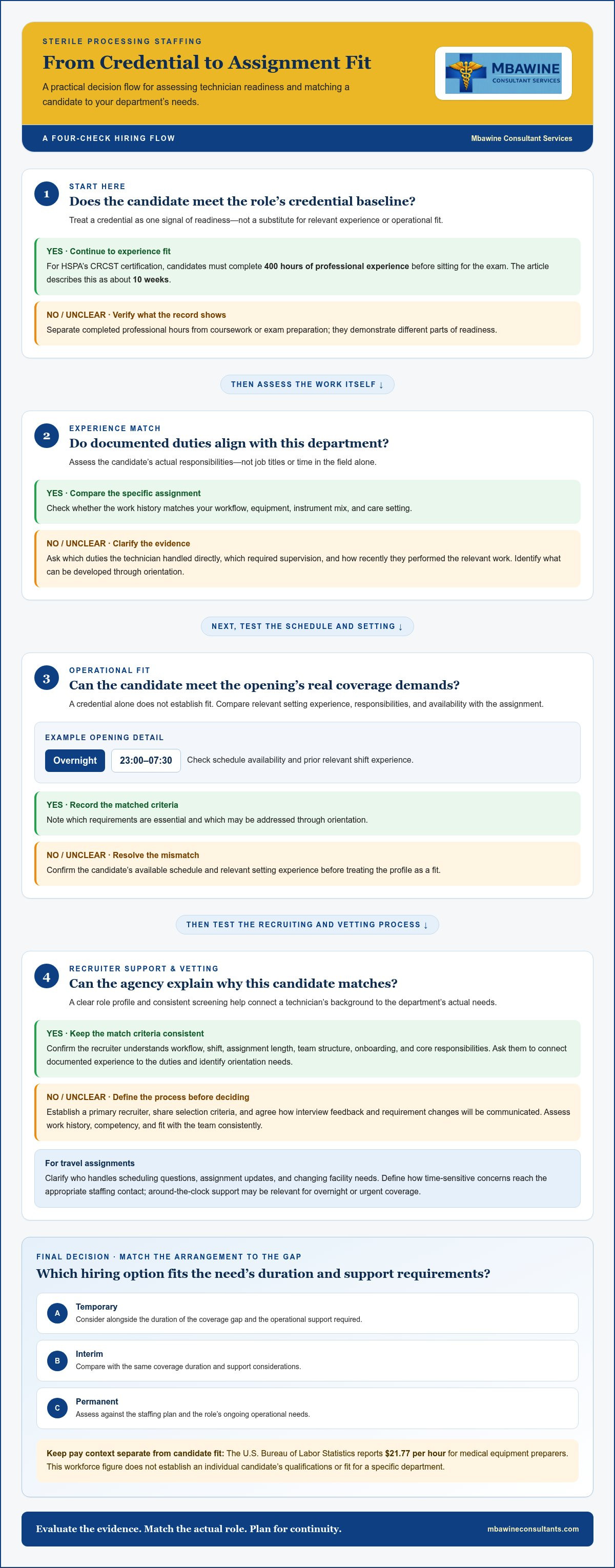
Credentials establish a baseline, but a sterile processing tech’s experience shows how that knowledge applies in a working department. The Healthcare Sterile Processing Association’s CRCST certification requires candidates to complete 400 hours of professional experience before sitting for the exam. That experience is described as about 10 weeks. When reviewing a candidate profile, distinguish completed professional hours from coursework or exam preparation; each demonstrates a different part of readiness.
Match required experience to the assignment, rather than applying one threshold to every opening. A travel sterile processing tech job might require 1 year of experience alongside specific shift demands, such as a five-day, eight-hour overnight schedule from 23:00 to 07:30. These details illustrate why a credential alone may not establish fit: a candidate’s work history should align with the facility’s setting, schedule, and expected responsibilities.
Assess experience by duties, not job titles alone. Ask whether the candidate’s documented background matches your department’s workflow, equipment, and instrument mix. Hospital experience, for example, may differ from experience in another care setting. Clarify which responsibilities the technician handled directly, which required supervision, and how recently they performed the relevant work. This helps you connect experience to the position without treating time in the field as a complete measure of competency.
Compensation context can also inform role planning, though it should not replace credential and experience criteria. The U.S. Bureau of Labor Statistics reports an hourly wage of $21.77 per hour for medical equipment preparers. A facility can use workforce data as context while assessing the requirements of its own opening. Mbawine Consultant Services understands that baseline pay rates do not establish an individual candidate’s qualifications or determine whether that person fits a specific department.
Market expertise means understanding the practical conditions attached to a particular opening. For an overnight assignment, prior overnight experience and reliable shift coverage become important matching considerations. Compare a candidate’s available schedule, relevant setting experience, and documented responsibilities with the opening’s actual demands. Then record which criteria are essential and which can be developed through orientation. This disciplined comparison helps teams evaluate candidates consistently and focus on experience that supports the department and patient care.
Effective recruiter support starts with a clear role profile, not a generic request for a sterile processing technician. Define the department’s workflow, shift, assignment length, and core responsibilities before reviewing candidates. A role covering overnight instrument processing, for example, calls for different availability than a weekday opening. A recruiter can then compare candidates’ backgrounds with your stated needs and explain how closely each profile fits.
Dedicated staffing support also depends on continuity of communication. Identify a primary recruiter who can keep the facility’s priorities, interview feedback, and selection criteria connected throughout the process. Share operational details such as the team structure, onboarding approach, and the tasks the technician will perform. When requirements change, such as a revised shift or expanded instrument responsibilities, timely updates help keep candidate matching aligned with the actual opening.
Traveler support needs clear boundaries and practical coordination. For a travel assignment, establish who handles scheduling questions, assignment updates, and communication when facility needs change. Around-the-clock traveler support is especially relevant when a placement involves overnight work or urgent coverage, but the specific support process should be clearly defined. A facility should know how a traveler can raise a time-sensitive concern and how that information reaches the appropriate staffing contact.
Employment terms can affect whether an opportunity suits a technician’s career plans. Explain assignment terms, benefits information, and how employment questions are handled. Benefits do not replace job fit: the candidate still needs relevant experience, availability, and interest in the work. Someone seeking a short-term travel role, for example, may prefer a different arrangement from a technician pursuing a long-term position in one department.
Use a structured conversation rather than relying on a résumé summary. Ask the recruiter to connect each candidate’s documented experience to the role’s duties, identify orientation needs, and confirm schedule fit. Give consistent interview feedback against the same criteria. This helps hiring teams make clear decisions and gives candidates an accurate view of the position, supporting a stronger fit between career priorities and operational needs.
Technicians preparing for sterile processing roles can also strengthen their career foundation through Sterile Processing class enrollment. For healthcare teams, separating educational preparation from staffing coordination clarifies which support addresses the immediate vacancy and which supports longer-term workforce development.
Specific listings can give recruiters and candidates concrete details to discuss alongside experience and schedule fit. The Portland, Maine, travel sterile processing tech job had a five-day, eight-hour overnight schedule from 23:00 to 07:30, listed as 5x8-Hour.
Recruiters can use these location and pay details to clarify which opportunities merit a closer conversation, while confirming that the role’s actual duties and working hours suit the candidate.
Agency vetting should establish how candidates are screened and how their qualifications match your facility’s expectations. When deciding how to choose a sterile processing staffing agency, review its screening practices, placement experience, and communication about candidate readiness. Temporary staff may need to learn unfamiliar workflows, so facility-specific onboarding and competency review are important ways to address potential gaps.
Ask the agency to identify any accreditation it holds, who issued it, and what it covers. Review the placement process, candidate screening, and approach to facility concerns. If your department needs overnight coverage, for example, discuss the agency’s experience with similar roles and how it responds when assignment expectations change.
Request professional references who can describe the candidate’s sterile processing duties, reliability, and response to feedback. Ask about the work setting and how the technician followed established procedures. Use consistent questions across candidates, such as how they handled workflow changes or communicated concerns. References can also help you assess how clearly the agency communicates during placements.
A temporary technician may not know your equipment, documentation practices, or escalation pathways. Before the first shift, designate a department contact, explain local procedures, and clarify which tasks require supervision or demonstrated competency. A supervisor can observe the technician’s work, provide feedback, and document orientation. These steps help identify and address workflow or training gaps early.
Compare temporary, contract, and permanent hiring based on how long you need staff and how much continuity the role requires. Rates, overtime charges, and conversion terms vary by contract. Compare the written terms and ask how each charge is calculated before signing.
Before agreeing, ask what the rate includes, how overtime is authorized and billed, what conversion conditions apply, and how schedule or assignment changes are handled.
Compare proposals using the same role profile, shift, expected duration, and responsibilities. A standard sterile processing technician travel assignment is 13 weeks, which can serve as a reference when planning temporary coverage. Examine the agreement’s billing basis, included services, cancellation terms, and process for extending or ending an assignment. A lower quoted rate may not represent the same scope or contract conditions as another proposal.
Ask for every rate component in writing. Clarify whether orientation, schedule changes, or additional hours affect billing. The contract should also state who approves changes and how approvals are documented. This makes it easier to compare agreements than looking at the headline rate alone.
Overtime terms should define what counts as overtime, who authorizes it, and how additional hours are recorded. Ask whether the facility must approve extra hours in advance and identify the contact responsible for approval. Clear procedures help prevent unexpected billing and reduce disputes among staffing, payroll, and department teams.
If a temporary employee may later join the facility directly, review conversion conditions before placement. Ask when a fee applies, how the agreement defines eligibility, and whether terms change during the assignment. Record the answers in the contract, and do not assume the same policy applies to every role or arrangement.
Use a consistent set of questions to assess the agreement and its operational fit:
Compare each answer with your department’s staffing plan, including the shift, expected assignment length, and possibility of ongoing employment. Short-term coverage differs from a recurring vacancy that may call for permanent recruitment. Record the agreed terms in the signed contract so facility leaders and staffing contacts share the same expectations.
Staffing availability depends on how well a facility’s needs match technicians prepared to meet them. To decide how to choose a sterile processing staffing agency, assess how it defines a match, communicates candidate availability, and responds when role requirements change. Location matters, but so do shift, assignment length, experience, and candidate interest.
A market snapshot counted 259 sterile processing openings, including 204 unique jobs, eight per diem jobs, and no interim sterile processing technician roles. These figures show that openings differ by employment arrangement; they don’t establish whether a technician is available for a specific facility, shift, or set of responsibilities.
Location affects access to candidates, as do the opening’s requirements. An overnight schedule, specialized workflow, or short assignment may narrow the interested group. Separate essential qualifications from preferences, then explain the role clearly. This helps recruiters search against realistic criteria rather than excluding candidates for details that are not essential to the work.
Give the recruiter a clear position profile that includes:
These details help recruiters assess fit with the actual opening instead of relying on a job title alone. A facility seeking overnight coverage, for example, needs candidates available for that schedule. A timely interview process also helps maintain communication with interested candidates and makes the facility’s priorities clear.
Ask the recruiter how candidates are identified and presented. Which criteria guide the search? How is availability for the required shift established? What role-specific details accompany a candidate profile? Clear answers can help you distinguish a focused search from one that presents candidates without regard to the opening’s practical demands.
For workforce planning beyond an immediate vacancy, education can support the development of prospective technicians. A facility or individual can explore Sterile Processing class enrollment as an educational pathway. Training and staffing address different needs, so evaluate each candidate’s qualifications and suitability for the position independently.
Education can also support workforce planning beyond an immediate vacancy. A facility or individual considering training can treat that effort as a longer-term complement to recruitment, while keeping the requirements of the current opening clear. The U.S. median annual wage for pharmacy technicians was $46,620. That figure is for pharmacy technicians, not sterile processing technicians, and should not be presented as a pay benchmark for a sterile processing role.
Keep immediate coverage and future workforce development distinct when discussing a staffing plan. Ask how candidate qualifications are assessed against the position profile and how essential requirements stay clear as facility needs change. For education planning, identify the qualifications your facility expects and how they relate to its workflow. This helps recruitment address the current opening while longer-term development remains focused on future needs.
Mbawine Consultant Services offers Sterile Processing classes for professionals seeking structured education in the field. Healthcare teams can use these classes to support staff development alongside staffing decisions. For immediate workforce needs, Healthcare Temp staffing can help address coverage gaps, while Interim Management and Healthcare Sterile Processing Consulting support broader departmental needs.
Each service addresses a different need: classes support education, staffing addresses workforce coverage, and consulting supports sterile processing operations. Identify whether your priority is professional learning, temporary coverage, management, or operational guidance to determine the right next step.
Contact Mbawine Consultant Services or visit mbawineconsultants.com to discuss the options relevant to your team.
Deciding how to choose a sterile processing staffing agency can also prompt a broader workforce question: what support will help your department stay prepared as needs change? Consider how immediate coverage, operational guidance, and staff development fit into one workforce plan instead of treating each challenge as an isolated vacancy.
Mbawine Consultant Services offers Healthcare Temp staffing for coverage needs, Interim Management for management support, and Sterile Processing classes for professional development. These services address different needs, so identify whether your priority is staffing, leadership continuity, or education. A deliberate plan can connect today’s operational requirements with the capabilities your team will need over time.
If professional education is your next priority, explore Sterile Processing classes. A focused approach to workforce planning gives your team a clear foundation for moving forward.
Hospitals should look for a staffing process that connects technician qualifications with the department’s actual work. Ask how candidate experience is documented, how references are gathered, and what information department leaders receive before placement. Clarify who coordinates facility orientation and communicates concerns during an assignment. A central sterile department and an outpatient unit, for example, may have different workflows, so role-specific matching matters.
Screening should establish a candidate’s identity, employment history, references, and relevant credentials. Competency assessment should evaluate skills against the role’s duties. Ask which screening steps are completed and what records the facility receives. A practical assessment might ask a technician to explain a facility-approved workflow or demonstrate a task under observation. The facility should then provide orientation to its procedures and assess readiness for assigned responsibilities.
Per diem staffing covers individual shifts, travel assignments address time-limited placements away from a technician’s usual location, and temporary roles provide short-term workforce coverage. A standard travel assignment is 13 weeks. Permanent placement supports direct hiring for an ongoing role. Mbawine Consultant Services offers Healthcare Temp staffing and Interim Management, which address temporary coverage and departmental leadership needs rather than serving as interchangeable hiring models.
Map applicable standards and state requirements to the position, then document how each candidate’s credentials and competencies are assessed. AAMI, AORN, and OSHA address distinct professional or workplace considerations, so one credential should not be treated as proof of every requirement. Keep a role-specific record of credentials reviewed, competency results, and facility orientation, with responsibility for each step clearly assigned.

Article by
Mba Akuribila
Mba‑Akuribila is a healthcare leader, educator, and founder of Mbawine Consultants, a Bronx‑based institution recognized nationwide for advancing excellence in sterile processing and allied health workforce development. Born in Bongo in Ghana’s Upper East Region, his journey from rural beginnings to national impact reflects a lifelong commitment to service, empowerment, and community advancement.
For over two decades, he has trained sterile processing employees, mentored, and placed thousands of healthcare professionals across the United States. Through Mbawine Consultants, he established one of the country’s most trusted Sterile Processing Certification Test Prep Programs, preparing new Americans and career‑changers for successful entry into the field. The organization, as at 2026, has graduated more than 15,000 sterile processing technicians who now serve in hospitals, ambulatory centers, dental practices, and reprocessing facilities nationwide.
Under his leadership, Mbawine Consultants has expanded into a full Healthcare Staffing Agency, connecting nurses and allied health professionals to meaningful employment opportunities. His team also provides Interim Management Services, supporting hospitals and surgical centers with experienced leaders who stabilize operations, strengthen compliance, and improve workflow efficiency.
As a former surgical technician, sterile processing manager, educator, and system‑wide director, Mba‑Akuribila brings deep expertise to Sterile Processing Consulting, helping healthcare facilities elevate quality, safety, and regulatory readiness.
His work in the United States and Ghana continues to reflect his core philosophy: service above self, opportunity for all, and excellence without compromise.


