

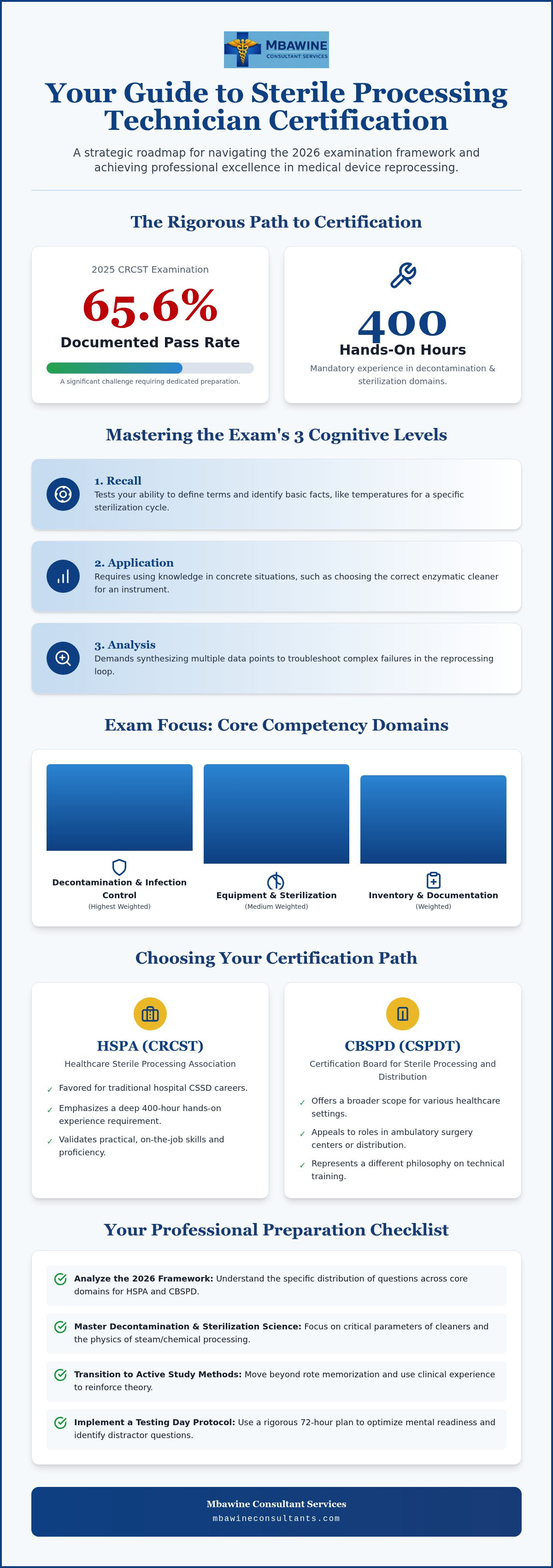
With a documented pass rate of only 65.6% for the CRCST examination in 2025, the path to becoming a certified professional in medical device reprocessing remains a rigorous challenge that demands more than mere rote memorization. Candidates often find themselves submerged in an overwhelming volume of technical specifications while simultaneously attempting to fulfill the mandatory 400 hours of hands-on experience across decontamination and sterilization domains. Achieving success requires a strategic approach to sterile processing technician exam tips that aligns clinical expertise with the high-register academic standards required by certifying bodies like the HSPA and CBSPD.
It's understandable that many practitioners feel a sense of profound anxiety when facing high-stakes testing that serves as the primary barrier to professional advancement. This authoritative guide serves as a comprehensive bridge between entry-level knowledge and technical mastery, offering a structured roadmap designed for the 2026 regulatory environment. You'll gain clarity on the most heavily weighted exam domains, including sterilization and high-level disinfection, while mastering specific techniques to navigate complex multiple-choice questions. By following this professional preparation checklist, you can transform your study habits into a disciplined system that ensures public safety and clinical excellence.
Professional certification in the 2026 healthcare environment has transitioned from a voluntary credential to a fundamental requirement for institutional safety and career longevity. The Healthcare Sterile Processing Association (HSPA) and the Certification Board for Sterile Processing and Distribution (CBSPD) maintain rigorous standards that reflect the increasing complexity of modern surgical instrumentation. Mastery of these standards begins with a methodological understanding of the examination framework, which evaluates a candidate's ability to protect patients from healthcare-associated infections. These examinations aren't merely tests of memory; they're comprehensive assessments of a technician's technical proficiency and professional judgment within a high-stakes clinical setting. Utilizing specific sterile processing technician exam tips can help candidates navigate the transition from classroom theory to the specialized environment of a Central Sterile Services Department (CSSD).
The examination architecture is built upon three distinct cognitive levels. Recall questions test your ability to define terms and identify basic facts, such as the required temperature for a specific sterilization cycle. Application questions require you to use that knowledge in concrete situations, such as determining the correct enzymatic cleaner for a particular lumen. The most challenging are analysis-level questions, which demand that you synthesize multiple data points to troubleshoot complex failures in the reprocessing loop. The foundational text for this entire framework is ANSI/AAMI ST79, a comprehensive document that establishes the national standards for steam sterilization and sterility assurance. Success requires treating this document not as a reference, but as a blueprint for professional conduct.
The distribution of exam questions is weighted heavily toward the technical processes that most directly impact patient outcomes. Candidates must demonstrate deep mastery across several critical pillars of the central service profession:
Choosing between the HSPA CRCST and the CBSPD CSPDT requires an analysis of your long-term professional objectives and current clinical exposure. The HSPA pathway is often favored by those seeking a traditional career trajectory within a hospital's central service department, emphasizing a deep 400-hour hands-on experience requirement that validates practical skill. In contrast, the CBSPD certification offers a broader scope that may appeal to those working in ambulatory surgery centers or specialized distribution roles. Both credentials carry significant weight, yet they represent different organizational philosophies regarding technical training. Understanding your specific sterile processing technician certification path is essential for selecting the exam that aligns with your professional strengths. Regardless of the path you choose, utilizing effective sterile processing technician exam tips will ensure you're prepared for the technical and administrative rigors of the 2026 standards.
The technical foundation required for certification success rests upon four distinct pillars of central service expertise. Decontamination is the primary defense against cross-contamination, requiring technicians to master the selection of Personal Protective Equipment (PPE) to mitigate exposure to bloodborne pathogens. Effective cleaning relies on the chemical efficacy of enzymatic cleaners, which are formulated with specific enzymes like protease, lipase, or amylase to break down organic soils. Ultrasonic cleaners utilize the physics of cavitation to remove microscopic debris from the complex serrations of surgical instruments. One of the most critical sterile processing technician exam tips is to prioritize the science of sterilization, which demands a precise understanding of the lethal parameters of time, temperature, and pressure. Saturated steam remains the gold standard for reprocessing, but technicians must also demonstrate proficiency in low-temperature modalities for heat-sensitive devices.
The assembly and packaging stage serves as the final opportunity for rigorous instrument inspection. Every tray must meet professional standards for integrity, ensuring that chemical indicators are correctly placed and that wrapping techniques facilitate aseptic presentation. Once sterilized, maintaining the clinical environment for storage and distribution is paramount. This involves monitoring temperature and humidity levels to prevent the degradation of sterile barriers and ensuring that the "first-in, first-out" methodology is strictly followed to manage inventory expiration.
Professionalism in the sterile processing department requires a high degree of linguistic precision. Technicians must develop a systematic approach to medical terminology by deconstructing root words, prefixes, and suffixes commonly found in surgical instrumentation. For instance, understanding that "-tome" refers to a cutting instrument or "arthro-" refers to a joint allows for the rapid identification of specialized tools during the assembly process. Precise nomenclature ensures clear communication between the department and the operating suite, reducing errors during high-pressure surgical cases. Bioburden is defined as the number of microorganisms on a contaminated object prior to sterilization, representing the total microbial load that the cleaning and sterilization processes must effectively eliminate to ensure patient safety under 2026 standards.
A technician acts as a primary guardian of patient safety by adhering to the rigorous standards set by The Joint Commission (TJC), the Centers for Medicare & Medicaid Services (CMS), and OSHA. These regulatory bodies mandate strict compliance with a manufacturer's Instructions for Use (IFU), which dictate every aspect of the reprocessing cycle from cleaning chemistry to sterilization parameters. Failure to follow an IFU is a direct violation of the healthcare sterilization training protocols that define modern practice. Professionals who wish to deepen their mastery of these technical requirements often find that structured enrollment in specialized classes provides the necessary clarity for exam success. By internalizing these standards, you transition from a manual laborer to a clinical advocate, ensuring that every instrument delivered to the sterile field is safe for patient use.
Success on the CRCST or CBSPD examination requires a transition from passive consumption of text to active evaluative methodologies. Many candidates mistakenly rely on repetitive reading of manuals, a method that often leads to an illusion of competence without genuine technical retention. To achieve or exceed the 2025 pass rate of 65.6%, you must employ active recall and spaced repetition. These techniques force the brain to retrieve information from memory, which strengthens neural pathways and prepares you for the analysis-level questions discussed previously. Using practice examinations as diagnostic tools allows you to identify specific knowledge deficits rather than simply memorizing answers. This methodical approach ensures that your preparation is targeted and efficient, reflecting the disciplined nature of the sterile processing profession.
One of the most effective sterile processing technician exam tips involves the strategic integration of your mandatory 400-hour hands-on requirement with your academic studies. This clinical experience shouldn't be viewed merely as a prerequisite, but as a practical laboratory where theoretical concepts are validated in real-time. When you're performing the 120 hours required for decontamination, don't just follow the motions; mentally correlate the enzymatic cleaner's pH with the manufacturer's Instructions for Use (IFU) you studied the night before. By treating every instrument tray and sterilization cycle as a live case study, you transform abstract regulatory standards into concrete professional habits. This synthesis of theory and practice is what distinguishes an elite technician from a candidate who merely survives the examination.
While self-study is a path some attempt, the high failure rates associated with unguided preparation highlight the inherent risks of independent study. Enrolling in professional sterile processing classes provides a definitive advantage by offering expert mentorship to resolve technical ambiguities that textbooks often leave unanswered. Peer interaction within a structured environment fosters a collaborative learning culture where complex regulatory updates can be analyzed through multiple clinical perspectives. This professional advocacy ensures that you're not just learning for a test, but preparing for the institutional standards of elite healthcare facilities.
A disciplined 12-week preparation roadmap is essential for compartmentalizing the vast syllabus into manageable technical domains. During the first month, focus exclusively on microbiology and decontamination, ensuring a foundational understanding before moving into complex sterilization physics. It's vital to schedule high-retention study sessions during your active employment, perhaps utilizing break periods to review flashcards on surgical instrumentation nomenclature. You must also remain vigilant against cognitive biases, such as overconfidence in areas where you have the most clinical experience. Rigorous self-assessment through objective testing is the only way to ensure that your technical proficiency is uniform across all examination domains. Utilizing these sterile processing technician exam tips within a structured timeframe will help you maintain the steady, methodical pace required for long-term retention.
The 72 hours preceding the certification examination constitute a critical stabilization period where the focus shifts from intensive acquisition of new data to the optimization of cognitive performance. A professional protocol during this window involves maintaining a consistent circadian rhythm and ensuring nutritional intake that supports sustained mental clarity. You should avoid the temptation of exhaustive "cramming" sessions, which often lead to cognitive fragmentation and increased cortisol levels. Instead, engage in high-level reviews of the foundational ANSI/AAMI ST79 standards to reinforce the systematic logic required for the 150-question assessment. This disciplined preparation ensures that you arrive at the testing center with the mental fortitude necessary to navigate a three-hour evaluative window without succumbng to the fatigue that often compromises decision-making.
During the examination, your primary technical objective is the surgical deconstruction of each question stem to identify critical keywords and qualifying terms. Words such as "always," "never," "only," or "immediately" often serve as indicators of the specific regulatory standard being tested. You must balance your pace to allow approximately 72 seconds per question, a strategy that provides a sufficient buffer for the review of flagged items. Once you've completed the assessment, the score reporting process typically provides immediate preliminary results, followed by a formal verification of your professional credentials. To ensure you have the technical foundation required to meet these rigorous standards, you may enroll in professional certification classes that provide comprehensive training for the 2026 examination cycle.
Approaching complex multiple-choice questions requires a methodological process of elimination to isolate the "most correct" response within a clinical context. In scenarios where multiple options appear plausible, you must evaluate each choice against current manufacturer's Instructions for Use (IFU) and institutional safety protocols. If a question presents a conflict between outdated facility practices and national standards, the professional technician always prioritizes the established national guidelines. This mindset ensures that every answer is filtered through the lens of patient safety advocacy, which remains the primary mission of the sterile processing department.
Maintaining peak focus during the second hour of the examination is essential for preventing the analytical errors that stem from cognitive fatigue. You can implement controlled diaphragmatic breathing and brief mental resets to stabilize your heart rate and maintain neurological alertness in high-stakes environments. It's also important to understand the psychological implications of the "provisional" status for those who haven't yet completed their 400 clinical hours. Recognizing that this status is a legitimate professional pathway can alleviate the perceived pressure of the examination, allowing you to focus on demonstrating your theoretical mastery of the sterilization reprocessing loop. These sterile processing technician exam tips are designed to transform testing anxiety into a disciplined, clinical assessment of your own professional readiness.
Mbawine Consultant Services operates as an authoritative guardian of industry standards, providing the specialized education necessary to navigate the high-stakes environment of 2026 healthcare sterilization. Our institutional philosophy recognizes that certification success is merely the first milestone in a broader professional trajectory. While many resources offer fragmented sterile processing technician exam tips, Mbawine provides a systematic curriculum that aligns directly with the current HSPA and CBSPD requirements. By joining our national network, you're not just preparing for an assessment; you're entering a community of experts dedicated to the highest levels of patient safety and technical proficiency. This mission-driven approach ensures that our graduates are recognized as elite practitioners capable of leading high-performing departments within the nation's most prestigious medical institutions.
The transition from a candidate to a certified professional requires a bridge built on academic reliability and clinical experience. We position our students at the intersection of these two pillars, ensuring they possess the gravity and expertise required for modern surgical support roles. Our commitment to excellence extends beyond the classroom, as we act as a bridge between entry-level requirements and advanced technical mastery, facilitating a steady flow of high-level knowledge to the next generation of central service leaders.
The educational architecture at Mbawine Consultant Services is designed for maximum retention through both in-person and online modalities. Our curriculum deconstructs the complexities of the 2026 standards, transforming technical specifications into actionable clinical habits that endure long after the examination is complete. Beyond the classroom, we provide essential support for the 400-hour hands-on experience verification process, ensuring that provisional status is converted into full certification with methodical efficiency. This comprehensive support system acts as a definitive bridge between academic study and professional mastery. Technicians seeking a structured roadmap to success are encouraged to Enroll in Sterile Processing Classes to secure their professional future.
Professional development within the Mbawine ecosystem extends far beyond the initial certification phase. For the experienced technician, we facilitate pathways into interim management and healthcare sterile processing consulting, roles that demand a sophisticated understanding of regulatory compliance and operational leadership. Our staffing division serves as a critical resource for healthcare facilities, providing healthcare temp staffing and 24/7 emergency staffing to maintain institutional standards during periods of transition or crisis. By leveraging your certification within our network, you gain access to elite healthcare environments that prioritize clinical excellence and leadership proficiency. Those ready to elevate their career trajectory should Contact Mbawine Consultant Services for Professional Development to discuss their long-term objectives.
Achieving professional certification is a transformative milestone that establishes your role as a guardian of patient safety within the healthcare ecosystem. By internalizing a systematic approach to the examination framework and the technical science of sterilization, you move beyond mere preparation into the realm of professional mastery. These sterile processing technician exam tips are designed to ensure that your clinical experience and academic study work in tandem to meet the rigorous benchmarks set for the 2026 cycle. It's essential to recognize that the discipline you apply during your preparation phase determines the standard of care you provide throughout your career.
Your path to leadership in the central service department is best supported by a structured educational environment that prioritizes technical accuracy and institutional reliability. Mbawine Consultant Services offers a comprehensive 2026 curriculum and expert mentorship from industry leaders, all backed by a proven track record in certification preparation. We invite you to enroll in our professional Sterile Processing classes today to secure your certification success. With the right preparation and a dedicated commitment to excellence, you'll be well-positioned to excel in this critical medical field and join a national network of elite professionals.
A disciplined preparation period typically spans approximately twelve weeks of methodological study to ensure comprehensive coverage of the extensive technical syllabus. This timeframe allows candidates to compartmentalize complex domains such as microbiology and sterilization physics while integrating practical insights from their clinical experience. Shorter durations often result in cognitive overload, whereas a structured three-month approach facilitates the deep retention required for analysis-level examination questions and long-term professional proficiency.
The passing threshold for the HSPA CRCST examination is established through a scaled scoring system where a minimum value of 700 is required for successful certification. In contrast, the CBSPD CSPDT examination generally requires a raw score of 70% to achieve a passing status. These benchmarks ensure that only candidates who demonstrate a high degree of technical competence and understanding of the 2026 regulatory standards are granted professional credentials within the field.
Candidates may indeed sit for the HSPA CRCST examination prior to completing the 400-hour hands-on requirement through a provisional certification pathway. Upon successfully passing the assessment, the technician is granted a six-month window to document the necessary clinical hours across decontamination, sterilization, and distribution domains. Failure to verify these hours within the allotted timeframe results in the expiration of the provisional status, necessitating a full retake of the examination to regain standing.
The most heavily weighted technical domains consistently involve decontamination and sterilization processes, which collectively represent a significant portion of the evaluative criteria. These sections prioritize the mastery of cleaning chemistries, PPE protocols, and the physical parameters of steam and low-temperature sterilization modalities. Focusing your sterile processing technician exam tips on these core areas is essential, as they directly impact patient safety and form the foundation of the reprocessing cycle in any clinical environment.
Difficulty is subjective and largely dependent on a candidate's clinical background, though both examinations are recognized for their technical rigor and adherence to ANSI/AAMI standards. The CRCST often emphasizes institutional hospital processes and specific hands-on experience, while the CBSPD may incorporate a broader perspective on distribution and specialized reprocessing environments. Both pathways require an equivalent level of theoretical mastery and disciplined preparation to overcome the documented failure rates within the profession.
The HSPA CRCST examination consists of 150 multiple-choice questions that must be completed within a three-hour testing window, requiring a steady pace of approximately 72 seconds per item. The CBSPD CSPDT examination typically features between 100 and 125 questions, also set within a strictly timed environment. This volume of questioning is designed to comprehensively assess a candidate's knowledge across all seven core domains of the sterile processing technician role.
If a candidate fails to achieve a passing score on their initial attempt, they must adhere to a mandatory waiting period before becoming eligible for a re-examination. For the HSPA pathway, this interval is typically six weeks, during which candidates should utilize diagnostic score reports to refine their study of sterile processing technician exam tips. Each subsequent attempt requires the submission of new examination fees and a formal re-application through the respective certifying body.
External calculators, reference manuals, or personal digital devices are strictly prohibited within the secure testing environment to maintain the integrity of the certification process. If a specific question requires mathematical calculation, an on-screen calculator is typically provided within the testing software interface. Candidates are encouraged to focus their preparation on mental proficiency regarding sterilization parameters and temperature conversions to ensure they can navigate technical questions without relying on external aids.

Article by
Mba Akuribila
Mba‑Akuribila is a healthcare leader, educator, and founder of Mbawine Consultants, a Bronx‑based institution recognized nationwide for advancing excellence in sterile processing and allied health workforce development. Born in Bongo in Ghana’s Upper East Region, his journey from rural beginnings to national impact reflects a lifelong commitment to service, empowerment, and community advancement.
For over two decades, he has trained sterile processing employees, mentored, and placed thousands of healthcare professionals across the United States. Through Mbawine Consultants, he established one of the country’s most trusted Sterile Processing Certification Test Prep Programs, preparing new Americans and career‑changers for successful entry into the field. The organization, as at 2026, has graduated more than 15,000 sterile processing technicians who now serve in hospitals, ambulatory centers, dental practices, and reprocessing facilities nationwide.
Under his leadership, Mbawine Consultants has expanded into a full Healthcare Staffing Agency, connecting nurses and allied health professionals to meaningful employment opportunities. His team also provides Interim Management Services, supporting hospitals and surgical centers with experienced leaders who stabilize operations, strengthen compliance, and improve workflow efficiency.
As a former surgical technician, sterile processing manager, educator, and system‑wide director, Mba‑Akuribila brings deep expertise to Sterile Processing Consulting, helping healthcare facilities elevate quality, safety, and regulatory readiness.
His work in the United States and Ghana continues to reflect his core philosophy: service above self, opportunity for all, and excellence without compromise.


