

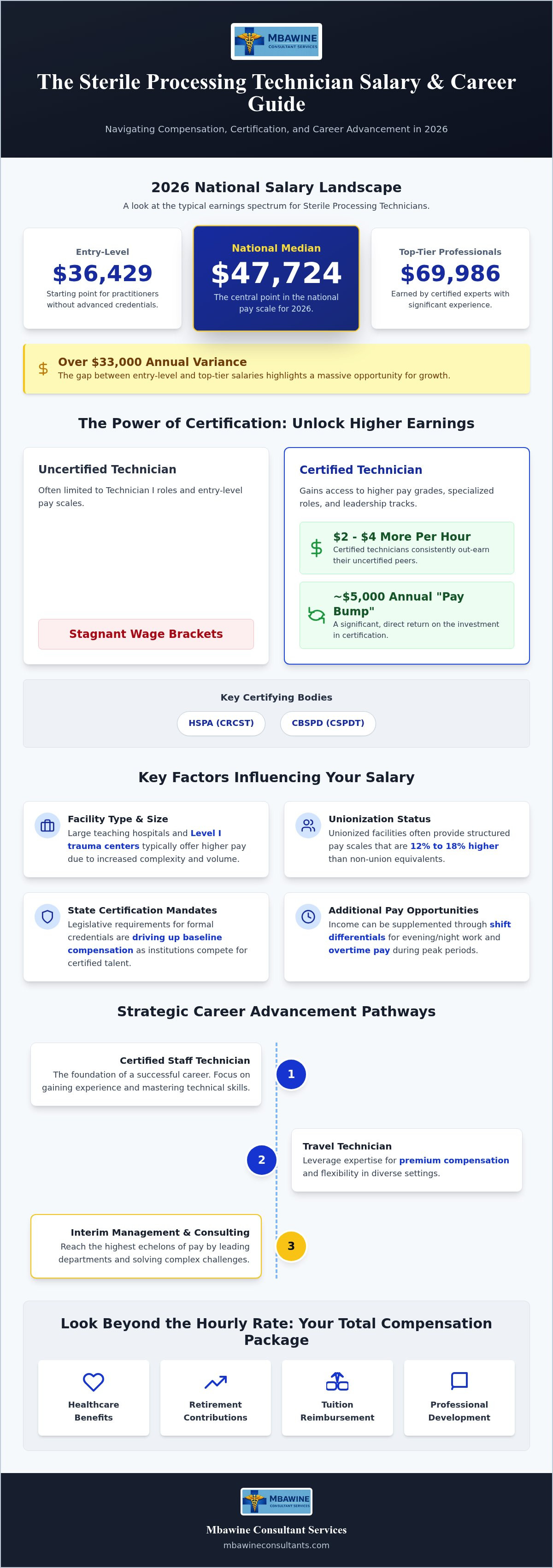
By the year 2026, the national median sterile processing technician salary has reached approximately $47,724, yet the variance between entry-level earnings and the professional ceiling exceeds $33,000 annually. This substantial disparity frequently results in dedicated practitioners remaining within stagnant wage brackets while their certified peers secure significantly higher compensation through specialized expertise and advanced credentials. For the professional who is deeply committed to the standards of clinical excellence, a thorough comprehension of the current economic landscape is an essential component of career stewardship.
You likely understand that although your meticulous work in sterilization is fundamental to institutional safety, your current remuneration may not always align with the high-stakes nature of your duties. This analysis establishes a clear framework for navigating the complexities of the modern labor market to maximize your professional value. We shall explore the quantifiable advantages of obtaining CRCST or CSPDT credentials, the fiscal benefits of transitioning into travel or interim management roles, and the strategic steps required to reach the highest echelons of industry pay.
The standard compensation model for professionals within the Central Sterile Services Department (CSSD) incorporates several distinct variables beyond a simple hourly rate. A competitive sterile processing technician salary typically consists of a base wage supplemented by shift differentials for evening or overnight rotations, as well as opportunities for overtime during peak surgical volumes. In 2026, the national median salary is approximately $47,724, but this figure represents a broad spectrum of experience and institutional settings. Entry-level practitioners often start near the lower end of the $36,429 range, whereas those who have reached professional-grade status through years of technical mastery can command figures approaching $69,986. Unlike generic job boards that often conflate various roles, a precise analysis reveals that certified technicians consistently earn $2 to $4 more per hour than their uncertified counterparts.
Institutional characteristics exert a significant influence on these pay scales. Large, high-volume teaching hospitals and Level I trauma centers generally offer higher compensation than smaller ambulatory surgery centers. This is due to the increased complexity of the instrumentation and the critical nature of the reprocessing workflows required to maintain patient safety in high-acuity environments where surgical throughput is constant. With the Bureau of Labor Statistics projecting a 15% growth rate for this profession through 2033, the 2026 market reflects an environment where demand for expertise is actively driving wage appreciation. Unionized facilities frequently provide a structured pay scale that is 12% to 18% higher than non-union equivalents, offering a predictable roadmap for financial growth.
State-level certification mandates are fundamentally altering the baseline for technician compensation across the industry. Legislative changes in several jurisdictions now require practitioners to hold formal credentials, which has forced many healthcare institutions to re-evaluate their departmental budgets. There's a direct correlation between SPD compliance and institutional reimbursement rates. Consequently, facilities are increasingly willing to allocate higher salary tiers for certified staff to ensure they meet rigorous industry standards. This professionalization isn't just about individual skill; it's a strategic driver for SPD budget increases nationwide.
Evaluating this career requires looking beyond the immediate hourly wage. Comprehensive contracts in 2026 often include healthcare benefits, employer-sponsored retirement contributions, and tuition reimbursement programs that add significant value to the total package. Many modern facilities also provide professional development stipends to help technicians manage the costs of ongoing education. This structure ensures long-term financial stability while encouraging the continuous technical growth necessary for public safety. Investing in human capital remains the only way to maintain the high-level knowledge required for modern surgical support.
The acquisition of professional credentials represents the single most significant variable in determining a sterile processing technician salary. While uncertified practitioners often find themselves restricted to entry-level pay scales, credentialed professionals typically receive a "certification pay bump" that averages approximately $5,000 annually. According to Bureau of Labor Statistics (BLS) data, the distinction between those in the lowest and highest percentiles is frequently defined by the depth of their technical certifications. This financial elevation isn't merely a one-time adjustment but a structural shift in how institutions value a technician's contribution to patient safety and regulatory compliance.
Healthcare facilities utilize certification to categorize personnel into distinct salary grades, often designated as Technician I, II, and III. A Technician I typically lacks formal credentials, whereas a Technician II has achieved the Healthcare Sterile Processing Association (HSPA) Certified Registered Central Service Technician (CRCST) status. The CRCST remains the industry's gold standard for salary negotiation due to its rigorous requirements and widespread institutional recognition. Those who advance to Technician III status often hold specialized certifications, such as the Certified Endoscope Reprocessor (CER) or the Certified Instrument Specialist (CIS), which allow access to the highest available pay tiers within the clinical setting.
In 2026, the marketability of HSPA and Certification Board for Sterile Processing and Distribution (CBSPD) credentials remains high, yet institutional preferences often lean toward the HSPA pathway for leadership roles. Advanced credentials like the Certified in Healthcare Leadership (CHL) are essential for those seeking management-level compensation. Professionals who prepare for your CRCST certification through structured programs often find they're better positioned for these high-paying leadership trajectories. The technical depth required for these exams ensures that practitioners can justify their request for premium compensation through demonstrated mastery of complex sterilization workflows.
Remaining uncertified creates a significant lifetime earnings gap that can exceed $100,000 over a twenty-year career. Without formal credentials, technicians face a rigid wage ceiling that limits their ability to benefit from the 4.22% compound annual growth rate currently observed in the field. The CRCST credential serves as the primary catalyst for professional wage advancement and long-term career viability. To avoid these financial limitations, professionals should consider how enrolling in specialized classes can accelerate their path to a higher salary grade.
Staff technicians provide the operational backbone for surgical services, benefiting from institutional stability and predictable career trajectories. While the base sterile processing technician salary for staff roles remains the industry baseline, these positions offer critical non-monetary value through comprehensive health insurance, retirement vesting, and local community integration. For many entering a career in sterile processing, the staff model serves as the essential period for clinical mastery before transitioning into more lucrative specialized paths. It's the foundational stage where professionals develop the technical rigor required for advanced roles.
The travel technician model represents a significant departure from traditional employment, offering a high-intensity alternative for those willing to relocate. These professionals are frequently deployed to facilities facing acute staffing shortages or operational backlogs. They're expected to maintain peak efficiency from their first shift, commanding premium market rates in exchange for their flexibility and immediate technical contribution.
Travel contracts are characterized by a unique dual-income structure that combines a taxable hourly wage with non-taxable stipends for housing and incidentals. In the 2026 market, travel technicians frequently earn weekly totals ranging from $1,121 to $2,312, representing a 30% to 50% premium over permanent staff positions. Accessing these high-tier contracts requires a high level of clinical proficiency and often necessitates specific certifications that demonstrate a technician's ability to integrate into diverse surgical environments. When evaluating these paths, professionals often compare Sterile Processing Technician Training Online vs In-Person to determine which educational format best facilitates the rapid skill acquisition required for the travel circuit. High-demand regions often offer the most aggressive compensation packages to attract certified talent.
The highest salary echelons within the profession are reserved for those who transition into departmental leadership or specialized consulting roles. Sterile processing managers and directors oversee complex logistics, regulatory compliance, and personnel management, with average annual salaries reaching approximately $86,522 for experienced leaders. Interim management roles offer even greater short-term financial rewards as these leaders are tasked with crisis stabilization and departmental turnaround during periods of transition. Those who have achieved technical mastery may also pivot into institutional advisory roles, providing high-level consulting services that address systemic operational inefficiencies. To navigate these advanced career transitions and maximize your sterile processing technician salary, professionals can explore our interim management and staffing services to identify placements that align with their leadership expertise. This progression from the bench to the boardroom ensures that a professional's earning potential remains uncapped as they assume greater responsibilities for public safety and institutional excellence.
The decision to pursue professional certification involves a calculated assessment of upfront expenditures against long-term financial appreciation. While some practitioners attempt to rely solely on decentralized on-the-job training, this approach often extends the duration of entry-level earnings and increases the risk of examination failure. By contrast, a structured educational investment provides a "speed to certification" advantage that allows technicians to access higher wage tiers months earlier than their self-taught peers. This acceleration is a critical factor when analyzing the total lifetime sterile processing technician salary potential.
Direct costs associated with achieving professional status include tuition, study materials, and examination fees. For instance, the initial fee for the HSPA CRCST exam is approximately $140, with recurring renewal requirements that ensure ongoing clinical competence. Tuition for comprehensive training programs typically ranges from $699 to over $4,000 depending on the institution's depth and format. Securing a passing score on the first attempt is vital for maintaining your financial trajectory. It prevents the accumulation of re-testing fees and avoids the opportunity cost of delayed salary adjustments. To mitigate these risks, professionals should enroll in our comprehensive certification classes, which are designed to maximize first-time success rates.
Professional education serves as a gateway to institutional promotion and enhanced job security. Facilities increasingly prioritize certified staff for lead technician and supervisory roles, which command a higher sterile processing technician salary. Mbawine Consultant Services prepares practitioners for these high-value positions by aligning curriculum with the rigorous standards required by modern surgical departments. For a detailed analysis of the available training pathways, consult our Comprehensive Guide to Sterile Processing Education Programs. It's this commitment to technical mastery that separates high-earning leaders from the general labor pool.
Consider the timeframe for recouping this investment. If a credentialed professional earns an average salary premium of $5,000 annually, even a high-end educational investment is typically fully recovered within the first year of certification. It's a rapid ROI that makes formal training one of the most efficient professional investments available in the 2026 healthcare market. By eliminating the trial-and-error approach of self-study, you're effectively buying back time and securing your financial future within the clinical sterilization field.
Mbawine Consultant Services serves as a comprehensive professional partner, facilitating the progression from baseline technical duties to specialized, high-compensation roles. While the previous sections established the benchmarks for a sterile processing technician salary, achieving the upper percentiles of that range requires more than just clinical experience. It necessitates a strategic alignment with an organization that understands the nuances of institutional standards and the requirements of the modern healthcare market. Our professional classes don't just prepare you for an exam; they provide the technical foundation required to command expert-level compensation in high-volume surgical environments where precision is non-negotiable.
The synergy between our educational curriculum and our staffing division creates a seamless pathway for professionals seeking to maximize their financial potential. Graduates of our programs are uniquely positioned to leverage our extensive network of healthcare partners, gaining access to premium placements that are often unavailable through traditional job boards. Mbawine Consultant Services acts as a guardian of industry standards while fostering professional financial growth by ensuring that every technician we place meets the highest levels of clinical readiness. By maintaining this rigorous standard, we're able to negotiate more competitive rates for our personnel, directly impacting the long-term sterile processing technician salary of those within our network. You can meet our successful alumni and staffing partners to observe the tangible results of this professional ecosystem.
For veteran technicians who've already achieved technical mastery, the next phase of career advancement involves a transition into leadership or specialized consulting. Our interim management and consulting services provide a structured environment for experienced professionals to address systemic operational challenges within a facility's SPD. This transition represents the professional ceiling where expertise in regulatory compliance and departmental efficiency translates into peak earning potential. Navigating these pivots requires a clear roadmap, such as the one detailed in The 2026 Path to Sterile Processing Certification. Mentorship plays a critical role in these pivots. It provides the institutional knowledge necessary to negotiate complex contracts and assume high-stakes leadership responsibilities. If you're ready to define your professional trajectory, you should contact us to schedule your career consultation and begin the process of identifying your next high-value placement.
The 2026 healthcare landscape presents a distinct economic hierarchy where specialized credentials and strategic career pivots serve as the primary determinants of your financial ceiling. As established throughout this guide, while the baseline sterile processing technician salary provides a reliable foundation, the transition into top-tier compensation brackets requires an unwavering commitment to rigorous certification and leadership development. By leveraging our expert-led consulting for departmental leadership and accessing our national staffing network for premium career placement, practitioners can effectively transcend the limitations of entry-level roles. Mbawine Consultant Services maintains a standard of academic and professional reliability in CRCST preparation, ensuring that every professional is equipped to meet the high-stakes demands of modern surgical environments with technical precision. Your progression toward clinical excellence and sustained economic stability is a deliberate undertaking that begins with the right educational foundation. Invest in your future—Enroll in our Sterile Processing Classes today. We remain dedicated to supporting your journey toward technical mastery and look forward to fostering your long-term professional success within this critical medical field.
The national median sterile processing technician salary in 2026 is approximately $47,724 per year, which translates to an hourly rate of about $22.94. This figure represents a broad spectrum of clinical environments, with entry-level practitioners typically starting near $36,429. Professionals who reach the upper percentiles of the field can command annual compensation approaching $69,986. These figures are influenced by institutional volume, trauma level designations, and the specific technical requirements of the department.
Achieving professional certification provides a substantial economic advantage, typically resulting in an annual pay increase of approximately $5,000. Certified practitioners often earn between $2 and $4 more per hour compared to their uncertified colleagues. This "certification pay bump" reflects the institutional value placed on verified technical competence and regulatory compliance. Many healthcare facilities now mandate these credentials for access to higher salary grades, making certification a prerequisite for reaching the top tier of the professional pay scale.
The direct cost for the Certified Registered Central Service Technician (CRCST) examination is approximately $140. Beyond the examination fee, professionals should account for the investment in formal training programs, which varies across the industry based on the instructional format and depth of the curriculum. While self-study remains an option, the investment in a structured sterile processing class often yields a higher return by ensuring first-attempt success and accelerating the timeline for professional wage adjustments through technical mastery.
A travel sterile processing technician salary is significantly higher than that of a permanent staff position, frequently commanding a 30% to 50% premium. Weekly compensation for travel assignments in 2026 typically ranges from $1,121 to $2,312. This total often includes a combination of taxable hourly wages and non-taxable stipends for housing and incidentals. These roles require high levels of clinical flexibility and immediate technical integration into diverse surgical environments facing acute staffing shortages.
The highest compensation tiers are typically reserved for professionals who obtain specialized or leadership-oriented credentials. Certifications such as the Certified Endoscope Reprocessor (CER) and the Certified Instrument Specialist (CIS) allow technicians to access specialized pay grades. For those seeking the professional ceiling, the Certified in Healthcare Leadership (CHL) is essential for transitioning into management and director-level roles. These advanced credentials demonstrate a mastery of complex reprocessing workflows and the ability to manage departmental logistics at an institutional level.
Completing a formal sterile processing class provides a concrete foundation for salary negotiation by demonstrating a commitment to industry standards and clinical excellence. Educational programs aligned with HSPA or CBSPD requirements signal to employers that a candidate possesses the technical rigor necessary for high-volume surgical support. Professionals can leverage this specialized knowledge to justify requests for higher starting wages or accelerated promotion to Technician II or III tiers, particularly in facilities prioritizing departmental compliance and patient safety.
The career ceiling for this profession extends into executive-level departmental leadership and specialized healthcare consulting. Experienced practitioners often progress into roles such as SPD Manager or Director, where annual salaries can reach approximately $86,522 or higher depending on the facility's scale. Those who transition into interim management or institutional advisory roles can command even greater compensation by providing crisis stabilization and operational turnaround services. This progression ensures that the earning potential remains uncapped for those who achieve technical and administrative mastery.
Salaries are generally higher in large, high-volume hospitals and Level I trauma centers than in smaller ambulatory surgery centers or outpatient clinics. This disparity is due to the increased complexity of instrumentation and the critical nature of the reprocessing workflows required in high-acuity environments. While outpatient settings may offer more predictable schedules, the technical demands and surgical throughput of major medical institutions drive more aggressive compensation packages and shift differentials to attract and retain certified technical experts.

Article by
Mba Akuribila
Mba‑Akuribila is a healthcare leader, educator, and founder of Mbawine Consultants, a Bronx‑based institution recognized nationwide for advancing excellence in sterile processing and allied health workforce development. Born in Bongo in Ghana’s Upper East Region, his journey from rural beginnings to national impact reflects a lifelong commitment to service, empowerment, and community advancement.
For over two decades, he has trained sterile processing employees, mentored, and placed thousands of healthcare professionals across the United States. Through Mbawine Consultants, he established one of the country’s most trusted Sterile Processing Certification Test Prep Programs, preparing new Americans and career‑changers for successful entry into the field. The organization, as at 2026, has graduated more than 15,000 sterile processing technicians who now serve in hospitals, ambulatory centers, dental practices, and reprocessing facilities nationwide.
Under his leadership, Mbawine Consultants has expanded into a full Healthcare Staffing Agency, connecting nurses and allied health professionals to meaningful employment opportunities. His team also provides Interim Management Services, supporting hospitals and surgical centers with experienced leaders who stabilize operations, strengthen compliance, and improve workflow efficiency.
As a former surgical technician, sterile processing manager, educator, and system‑wide director, Mba‑Akuribila brings deep expertise to Sterile Processing Consulting, helping healthcare facilities elevate quality, safety, and regulatory readiness.
His work in the United States and Ghana continues to reflect his core philosophy: service above self, opportunity for all, and excellence without compromise.


