

What determines whether a sterile item remains usable: elapsed time, package condition, or what happened during storage and handling? Understanding sterile storage requirements and shelf life means considering all three, while distinguishing event-related sterility maintenance from an expiration date assigned by the manufacturer.
It’s understandable that teams want a clear cutoff, especially when managing limited storage space and inventory. But a date alone may not tell the whole story. Moisture, damaged packaging, or improper handling can compromise an item, while storage conditions and facility policy also shape how it’s managed. A consistent process helps staff make decisions methodically rather than relying on assumptions.
This guide explains how storage conditions, package integrity, and handling events affect sterile items, and how to apply a documented approach informed by current standards and facility policy. It clarifies the difference between event-related sterility and manufacturer expiration dating, then walks through practical steps for routine storage and inventory. Continuing education can help strengthen consistent sterile processing knowledge alongside the policies and standards that govern practice.
Sterile storage is the controlled handling and placement of packaged items to preserve the sterile barrier and protect the contents until point of use. Sterilization is the microbial-control process; storage helps maintain the resulting condition by protecting the packaging from damage or contamination. A broad introduction to sterilization methods and concepts is available in Sterilization (microbiology), but storage decisions must follow applicable standards, product instructions, and approved facility procedures.
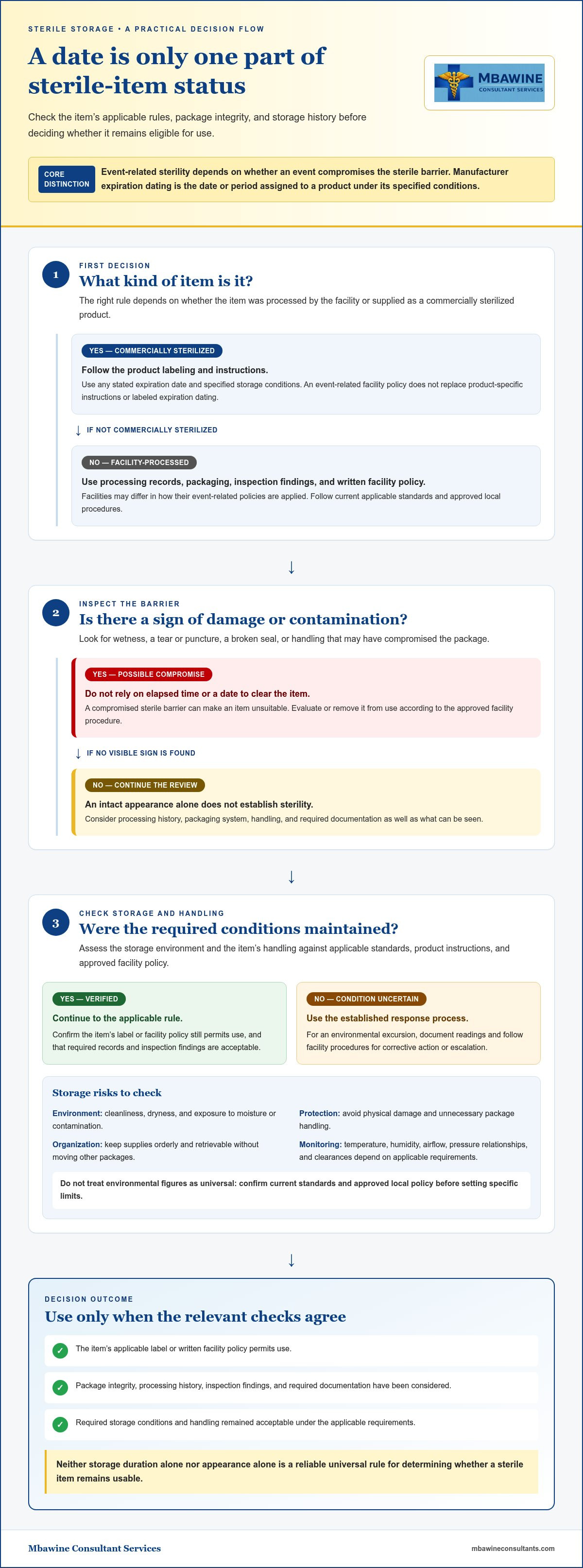
The phrase sterile storage requirements and shelf life can suggest that every item has one countdown beginning on its sterilization date. That is not a reliable universal rule. The relevant approach depends on whether an item was processed by the facility for reuse or supplied as a commercially sterilized product, as well as on its packaging, labeling, and applicable facility policy.
Quotable distinction: Event-related shelf life is governed by whether an event compromises the sterile barrier. Labeled expiration dating is the manufacturer-assigned date or period applicable to a product under its specified conditions. These concepts are not interchangeable. An expiration date printed on a commercial product is not the same as a facility’s policy for an item it has processed and packaged.
Shelf life describes how long an item may remain eligible for use under the conditions and rules that apply to it. For a reusable item processed within a facility, decisions may depend on its packaging and processing records, inspection findings, and written facility policy. For a manufacturer-sterilized product, staff must follow the product labeling and instructions, including any stated expiration date and storage conditions.
Storage duration alone does not establish that a package remains usable, and appearance alone cannot establish that its contents are sterile. A package may look intact while its status still depends on its processing history, packaging system, handling, and required documentation. Conversely, a facility’s event-related policy should not be used to disregard a labeled expiration date or product-specific instructions.
Events that damage or contaminate a sterile barrier can make an item unsuitable before a calendar date would otherwise suggest. Examples include wetness, a tear or puncture, a broken seal, or handling that compromises the package. The practical question is not only how long an item has been stored, but also whether its packaging and required storage conditions have remained acceptable.
Facilities may differ in how their policies operationalize event-related sterility, so staff should not assume one rule applies identically everywhere. Use current applicable standards and approved facility procedures for local decisions, and follow manufacturer labeling for applicable commercial products. Consistent terminology helps teams distinguish a time-based label from an event that requires evaluation or removal from use.
Storage controls should reduce avoidable exposure to contamination, moisture, environmental fluctuation, and physical damage. The practical objective is a clean, dry, orderly area where supplies can be identified and retrieved without unnecessary handling. Facility procedures should address every place sterile items are kept, not just the primary storage room. Temporary holding areas, satellite locations, and transport carts can also affect package protection.
Package integrity depends on controlled environmental conditions and careful handling throughout storage and retrieval. This principle translates sterile storage requirements and shelf life into daily practice without treating one set of environmental limits as universal.
Set a routine for cleaning, checking, and documenting the storage environment. Keep the area orderly, limit access according to facility policy, and separate sterile supplies from activities or materials that could introduce dust, moisture, or contamination. Written procedures should identify responsibilities, inspection frequency, documentation, and the steps to take when an environmental reading falls outside approved limits.
Temperature, humidity, airflow, pressure relationships, and storage clearances may be addressed differently across applicable standards and facility requirements. Confirm the current source and approved local policy before setting or publishing specific parameters. Don’t rely on figures copied from an older procedure or generalized guidance. A useful monitoring record captures readings, when they were taken, any excursion, and the corrective action or escalation that followed.
When reviewing the area, look for practical sources of risk: clutter that blocks cleaning or airflow, supplies placed where they may be splashed, and stock positioned so staff must move other packages to retrieve it. Record and address these conditions through the facility’s established process rather than relying on informal reminders.
Storage design and work habits should prevent packages from being crushed, punctured, exposed to moisture, or handled unnecessarily. Shelving should support orderly placement and retrieval, with enough separation for staff to see package condition and access supplies without dragging, bending, or dislodging neighboring items. Follow package and container instructions for orientation, stacking, and storage. Don’t assume one arrangement suits every product.
Space pressure is a workflow challenge, not a reason to overfill shelves or compromise packaging. If supplies cannot be stored without compression or unsafe handling, follow facility procedures for escalation and inventory management instead of improvising a stacking method. Routine documentation can help identify recurring congestion, environmental excursions, or handling patterns that may require a process change.
Consistent practice depends on shared understanding as well as written controls. Mbawine Consultant Services offers sterile processing classes to support professionals developing the knowledge used to apply facility procedures and current standards in daily work.
These terms describe different controls, and confusing them can lead to incorrect decisions at the point of use. Event-related policies address whether a facility-processed package has remained protected from conditions that could compromise it. Manufacturer expiration dating and product-specific instructions apply to commercial products according to their labeling. Neither approach overrides a recall, applicable standards, or approved facility procedures.
| Control | What it applies to | How to interpret it |
|---|---|---|
| Event-related policy | Items processed and packaged by a facility, where the adopted approach allows it | Assess whether a defined event or condition compromised the package, and follow written facility procedures. |
| Manufacturer expiration dating | Applicable commercially sterilized products | Follow the date and conditions provided in the manufacturer’s labeling and instructions. |
| Product-specific instructions | Products or packaging with particular storage, handling, or use directions | Apply the instructions alongside relevant facility policy; a general event-related rule is not a substitute. |
For facility-processed packages, an event-related approach may be used only as supported by adopted standards and the facility’s written policy. Staff assess whether storage and handling conditions have maintained package integrity, rather than relying solely on a preset number of days after processing. A wet package, puncture, broken seal, or other identified compromise may require removal from usable stock and action under local procedure.
This approach does not establish one universal maximum storage period, nor does it authorize staff to disregard documentation or required controls. The appropriate decision depends on the item, packaging system, adopted standards, and facility policy. If a package is compromised or its status is uncertain, follow the facility’s defined evaluation and disposition process.
For commercially sterilized supplies, the manufacturer’s expiration date and product instructions remain applicable. An intact-looking package does not extend an expiration date, make a recalled product usable, or excuse noncompliance with storage directions. Internal labels, such as a receipt date, stock-rotation mark, or facility tracking label, support inventory management but should not be mistaken for the manufacturer’s expiration date.
Keep the two sources of information distinguishable in the workflow: identify which date comes from the manufacturer and which is an internal processing or tracking record. If a recall notice applies, follow the relevant recall and facility procedures regardless of package appearance or date status. For broader context on standards and sterilization practice, see “Healthcare Sterilization: 2026 Professional Standards.”
In practice, sterile storage requirements and shelf life must be interpreted according to the item’s processing pathway: facility policy governs facility-processed items, while manufacturer labeling governs applicable commercial products. Event-related sterility is not permission to ignore either.
A consistent workflow helps staff preserve traceability and identify concerns before an item reaches the point of use. Incorporate the sequence below into approved facility procedures and adapt it to the products, documentation systems, and responsibilities in each department.
Inspect the whole package, not just one feature. Confirm that it is dry and intact, seals appear undisturbed, required labeling is legible, and applicable expiration information has not passed. Review indicators as directed by facility procedure, but remember that an indicator result does not independently prove package sterility. If an indicator, label, or package condition raises concern, don’t assume the item is usable. Follow the established evaluation process.
Quotable reminder: “Compromised packaging requires action under approved facility procedures, not an assumption that the item remains usable.” If the package has uncertain status, segregate it as directed, document the concern and relevant identifying details, and notify the designated role or department. The facility’s process should determine disposition and any follow-up.
Orderly rotation reduces avoidable searching and handling while helping staff select stock according to the correct dating rules. Maintain traceability information, such as processing details, product identification, relevant dates, and storage location, when facility procedures require those fields. Consistent documentation can also help teams investigate a concern and identify affected items without relying on memory.
Clear procedures work only when personnel understand how to apply them. The “Sterile Processing Classes: Certification Guide” topic provides a relevant framework for structured professional learning, while enrolling in sterile processing classes can support continued development of consistent practice. Education reinforces knowledge; it does not replace current standards or facility policy.
Reliable sterile storage depends on more than a written procedure. Staff need a shared understanding of how that procedure applies to the items they receive, store, inspect, and issue. Supervisors also need a way to identify inconsistent practice. Education helps connect sterile storage requirements and shelf life to routine decisions, but it cannot replace current standards, manufacturer instructions, or facility-approved policy.
Instruction should reflect the tasks each role performs and the procedures staff are expected to follow. Core topics include package integrity, storage conditions, the distinction between event-related shelf life and labeled expiration dating, product labeling, documentation, and escalation when a package or its status is uncertain. For broader standards context, facilities can also refer to “Healthcare Sterilization: 2026 Professional Standards.”
Written procedures give education a consistent reference point. A facility can define which procedures apply to each storage location, how staff document relevant checks, and whom they notify when a condition falls outside policy. Role-appropriate competency processes, documented as required by facility policy, can help establish whether personnel understand and can apply those steps. Short scenario reviews can test practical distinctions, such as whether a date is manufacturer-assigned or an internal tracking label.
Routine review matters because procedures and training materials need to stay aligned with current standards, facility requirements, product instructions, and observed workflow. When a process changes or a recurring issue is identified, leaders can determine whether staff need clarification, a procedure update, or additional competency support. Education should reinforce the approved process, not create a parallel rule.
Formal learning can strengthen foundational knowledge and give teams precise, consistent terminology for discussing sterile barriers, labeling, and storage decisions. That common language supports coordination across receiving, storage, distribution, and point-of-use workflows, where incomplete handoffs or different interpretations can complicate a decision. In-person and online sterile processing classes offer structured learning options for professionals seeking to deepen their knowledge.
Storage practice is part of a wider professional responsibility: personnel must understand how their actions fit into the facility’s system for processing, protecting, tracking, and supplying items. Continuing education can help individuals connect daily tasks to that broader system, while facility leaders retain responsibility for establishing procedures and ensuring staff follow them.
For professionals building on these concepts, sterile processing classes offer a structured next step in professional learning.
Consistent application of sterile storage requirements and shelf life principles depends on professionals who can interpret procedures carefully and recognize when a decision requires escalation. As standards, product instructions, and facility procedures evolve, continued learning helps keep knowledge current and supports sound judgment across daily responsibilities. Education is most effective when applied alongside the approved policies and requirements governing each workplace.
Mbawine Consultant Services provides in-person and online sterile processing classes, including specialized education and certification preparation for sterile processing professionals. Structured learning can help you build a stronger foundation for applying established practices with clarity and consistency.
Take a considered next step in your professional development: explore sterile processing classes.
For facility-processed items, an event-related approach may apply when adopted standards and written facility policy support it. Commercially sterilized products remain subject to their manufacturer’s expiration dating and instructions. The item’s processing pathway matters: an event-related policy doesn’t extend a manufacturer’s date, and a recent processing date doesn’t excuse a compromised package. Apply the relevant procedure and document decisions as facility policy requires.
Don’t assume a commercially sterilized item remains usable after its manufacturer’s expiration date, even if the package appears intact. Follow the product labeling and facility procedure for expired supplies, including how to remove them from active inventory and record their disposition. An internal stock-rotation label or receipt date isn’t a replacement for the manufacturer’s date. If a recall notice applies, follow recall procedures regardless of the printed expiration date.
Moisture, dust, excessive pressure, punctures, and rough handling can threaten packaging integrity. For example, a leak near a storage location or repeated shifting of stock may expose packages to moisture or physical stress. Environmental readings outside the limits established for the facility or product also require attention. Report spills, damage, or excursions through the local process rather than relying on a package’s appearance or assuming conditions were acceptable.
Do not issue a wet, torn, punctured, or otherwise suspect package as though it were intact. Follow facility procedures to segregate or quarantine it, identify the item, and document the observed condition and relevant tracking details. Notify the designated supervisor or department so the item’s status and disposition can be determined under approved policy. Avoid repackaging or returning it to usable stock unless an authorized procedure specifically directs that action.
They can differ according to applicable standards, facility-approved policy, and product-specific instructions. Use the current requirements adopted by the facility rather than transferring a temperature or humidity value from another organization’s procedure. The facility’s monitoring process should also explain what to record and whom to notify when readings fall outside approved limits. Environmental control supports storage practice, but it doesn’t replace package inspection or product labeling.
Stacking is appropriate only when product or container instructions and facility procedures permit the arrangement. Consider whether the weight or movement of items above could compress, bend, or damage packages, and whether staff can retrieve supplies without disturbing adjacent stock. Avoid assuming a universal stack height or configuration. If the designated space cannot accommodate items without creating pressure or handling risks, follow facility inventory and escalation procedures instead of improvising.
Follow the facility’s written inspection procedure, including when checks are required during receipt, storage handling, and issue or point-of-use preparation. A package inspected earlier may be exposed to damage during later movement, so an earlier check shouldn’t automatically substitute for checks required at the next workflow stage. Follow product-specific instructions and document or escalate concerns according to local policy.

Article by
Mba Akuribila
Mba‑Akuribila is a healthcare leader, educator, and founder of Mbawine Consultants, a Bronx‑based institution recognized nationwide for advancing excellence in sterile processing and allied health workforce development. Born in Bongo in Ghana’s Upper East Region, his journey from rural beginnings to national impact reflects a lifelong commitment to service, empowerment, and community advancement.
For over two decades, he has trained sterile processing employees, mentored, and placed thousands of healthcare professionals across the United States. Through Mbawine Consultants, he established one of the country’s most trusted Sterile Processing Certification Test Prep Programs, preparing new Americans and career‑changers for successful entry into the field. The organization, as at 2026, has graduated more than 15,000 sterile processing technicians who now serve in hospitals, ambulatory centers, dental practices, and reprocessing facilities nationwide.
Under his leadership, Mbawine Consultants has expanded into a full Healthcare Staffing Agency, connecting nurses and allied health professionals to meaningful employment opportunities. His team also provides Interim Management Services, supporting hospitals and surgical centers with experienced leaders who stabilize operations, strengthen compliance, and improve workflow efficiency.
As a former surgical technician, sterile processing manager, educator, and system‑wide director, Mba‑Akuribila brings deep expertise to Sterile Processing Consulting, helping healthcare facilities elevate quality, safety, and regulatory readiness.
His work in the United States and Ghana continues to reflect his core philosophy: service above self, opportunity for all, and excellence without compromise.


