

Before choosing a class for sterilization technology certification, confirm what the credential you want requires. The phrase can refer to professional certification, exam preparation, or a training program certificate, and those are not interchangeable. A course may build essential knowledge without awarding a professional credential or meeting every exam eligibility requirement.
If you’re unsure which training route supports your goal, start by identifying the credential you intend to pursue. Choosing coursework before checking the credential’s current requirements can leave important questions unanswered, including whether the class aligns with the examination you plan to take.
This guide explains the difference between education, exam preparation, and professional certification, then offers practical criteria for comparing training options. The credentialing organization’s current materials should guide your eligibility and examination decisions. Mbawine Consultant Services offers in-person and online sterile processing classes designed to help professionals prepare for certification. Compare any class you consider with the requirements published by your chosen credentialing organization.
Professional certification in sterile processing is a credential awarded by an independent certifying organization to people who meet its requirements and successfully complete its assessment process. It recognizes achievement against that organization’s standards. It is different from a certificate issued for completing a class.
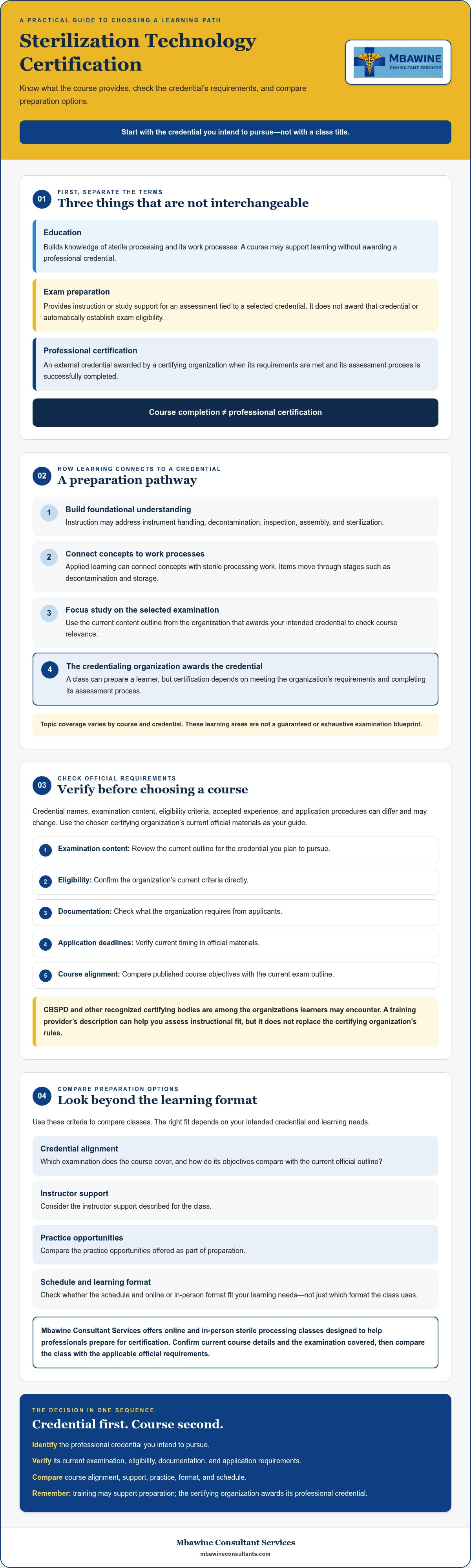
Education builds knowledge, exam preparation supports study, and a professional credential is awarded by the certifying organization when its requirements are met. A course can help you understand sterile processing without conferring certification or automatically establishing eligibility for an examination. The work involves processes within a central sterile services department (CSSD), where items move through stages such as decontamination and storage.
A course certificate documents that a learner completed an educational program offered by a school or training provider. Professional certification, in contrast, is governed and awarded by an external credentialing organization according to its own criteria. Exam preparation is instruction or study support intended to help candidates prepare for an assessment; it does not award the credential.
Before enrolling, check what the program says it provides: course completion, preparation for a named examination, or both. Then compare its curriculum with the current exam outline and eligibility rules published by the organization that awards your intended certification. Don’t assume similar-sounding terms mean the same thing.
The Certification Board for Sterile Processing and Distribution (CBSPD) and other recognized certifying bodies are organizations learners may encounter when researching sterile processing credentials. Credential names, examination content, eligibility criteria, accepted experience, and application procedures can differ and may change. Consult each organization’s current official materials before choosing a preparation route or planning to apply.
Confirm current eligibility and examination information directly with the chosen certifying board rather than relying on a summary. A training provider’s course description can help you assess instructional fit, but it does not replace the certifying organization’s rules.
For additional orientation, review the CRCST information page alongside official credential materials. Mbawine Consultant Services offers online and in-person sterile processing classes designed to prepare professionals for certification. Confirm which examination the current class covers and compare its content with the applicable official requirements. This helps distinguish useful education from the credential itself and identify a sound next step toward sterilization technology certification.
Preparation often moves through related stages: foundational instruction builds understanding, applied learning connects concepts to work processes, and exam preparation focuses study on the assessment for a selected credential. The certifying organization determines its examination content and eligibility rules. Consult its current official materials instead of assuming that a course syllabus or older study guide reflects current requirements.
A class can prepare a learner for an examination, but only the external certifying organization can award its professional credential. Completing instruction may support learning, but it does not by itself confirm exam eligibility or result in certification.
Foundational instruction may cover instrument handling, decontamination, inspection, assembly, and sterilization. These are relevant learning areas, not a guaranteed or exhaustive examination blueprint. Their depth and relevance vary by course and credential. Use the selected organization’s current content outline to check which topics are tested before relying on a course to guide your preparation.
Compare the provider’s published objectives with the certifying organization’s current candidate materials. Look for a clear statement of which credential and examination the instruction supports, then note any areas the course does not cover. If the connection is unclear, ask the provider and verify the answer against the official exam outline.
A practical comparison can include:
For broader context, review relevant healthcare sterilization professional standards alongside the credentialing organization’s exam materials. Standards and exam content serve different purposes, so studying one does not automatically cover the other. The U.S. Bureau of Labor Statistics publishes Medical Equipment Preparer salary and employment data, which can offer occupational context as you consider sterile processing education and career pathways.
Mbawine Consultant Services offers online and in-person sterile processing classes designed to prepare professionals for certification. Before choosing a class, confirm which examination its current instruction covers and whether its format and objectives suit your preparation needs. Review the sterile processing class enrollment information as part of your comparison. This makes sterilization technology certification preparation more purposeful without treating education as a substitute for official eligibility or examination requirements.
Start with the credential you intend to pursue, not a provider’s preferred format or promotional claims. Check whether a course identifies its credential target and provides objectives you can compare with the certifying organization’s current materials. Online and in-person delivery suit different circumstances, but neither format alone demonstrates instructional quality or establishes eligibility for a professional examination.
| Comparison factor | What to check |
|---|---|
| Credential alignment | Does the provider name the credential and examination the course is designed to support? |
| Instructor support | Can you learn about instructor experience, ask questions, and get feedback on your understanding? |
| Learning format | Does the online or in-person setup fit your access, learning preferences, and need for interaction? |
| Practice and materials | Which study resources or practice opportunities are included, and how do they relate to the official exam outline? |
| Schedule and access | What are the current class schedule, delivery details, and arrangements for accessing instruction or support? |
Online learning may offer flexibility in how you fit instruction into your schedule, while in-person classes may allow direct interaction during class. Neither format is automatically more effective. Ask whether the course gives you opportunities to raise questions, clarify difficult concepts, and receive feedback. For a focused discussion of these trade-offs, consult the article Online Versus In-Person Sterile Processing Training.
Request the exact credential target and compare the course objectives with current official candidate materials. Ask which examination the instruction supports, what learning resources are included, who provides instruction, and how learners can access support. Confirm the current schedule and delivery method directly with the provider, since these details may change.
Separate documented information from claims that need confirmation. Don’t assume eligibility, accreditation, exam fees, or outcomes from a general course description. Check those details with the credentialing organization or request supporting documentation from the provider. Mbawine Consultant Services offers online and in-person sterile processing classes intended to prepare professionals for certification. Confirm which examination current classes cover and compare the content with official requirements before deciding whether a course fits your sterilization technology certification preparation needs.
A deliberate preparation process begins with the credential, not a course or study guide. The certifying organization sets eligibility, examination content, application procedures, and deadlines, so verify its current instructions before committing to a preparation plan. These steps can help you organize your path toward sterilization technology certification and keep study decisions tied to official requirements.
If you’ve selected the CRCST pathway, Mbawine Consultant Services’ CRCST information page may provide additional orientation. Confirm current eligibility and examination details with HSPA, which sets the credential’s requirements.
For additional study techniques, consult a sterile processing technician exam tips resource, while treating official candidate materials as the authority on examination requirements. Mbawine Consultant Services offers online and in-person sterile processing classes intended to support certification preparation. Review sterile processing class enrollment information as you consider an educational next step, and confirm which examination current instruction covers before enrolling.
A class is most useful when it addresses a defined learning need and fits the credential you’re considering. Structured instruction can help organize foundational knowledge and direct exam preparation, but the class itself does not award professional certification. Before enrolling, understand what the course covers and which requirements you still need to confirm with the credentialing organization.
A focused sterile processing class may provide a structured way to study core concepts and prepare for a chosen examination, particularly if you prefer guided instruction to studying independently. Compare current course objectives with your credential’s official exam materials, and confirm which examination the class is intended to support. When choosing a class, consider whether its content and learner support meet your preparation needs.
Use this checklist to assess whether an educational option fits your next step:
These checks help separate confirmed course details from assumptions. A class may support learning and examination preparation, but it does not establish your eligibility, guarantee an examination result, confer certification, or assure employment. Those decisions and outcomes depend on the credentialing organization’s requirements and your individual circumstances.
If the class’s credential focus, format, support, and current schedule match your needs, review the sterile processing class enrollment details. Check the available information and confirm any remaining questions before proceeding.
A sound preparation path starts with a clear credential goal. Check the certifying organization’s current eligibility and examination requirements, then compare a course’s objectives, learning format, and support with those official materials. This keeps your choice grounded in the credential you intend to pursue, not a course title alone.
Education, exam preparation, and professional certification serve different purposes. A class can strengthen your knowledge and help organize your study, but the credentialing organization determines eligibility and awards its certification. Confirm which examination current instruction supports and review the class details before deciding whether it fits your sterilization technology certification plan.
Ready to assess an educational option? Explore sterile processing class enrollment. With a defined credential in view and official requirements as your guide, you can take a considered next step toward your professional goal.
Sterilization technology certification generally refers to a professional credential for sterile processing personnel, not one universal certification with that exact title. A credentialing organization sets its eligibility criteria and assessment process, then awards its certification to candidates who meet the requirements. Identify the specific credential you’re considering and verify its current requirements directly with the organization. This helps you choose appropriate education and avoid mistaking a training program’s completion certificate for professional certification.
No. A class certificate typically documents completion of an educational program, while an external credentialing organization awards professional certification under its own rules. A class may teach relevant knowledge or help you prepare for an examination, but completing it does not by itself confer a professional credential. Check the course description to see exactly what completion represents, then consult the certifying organization for its requirements.
Credentials commonly encountered in sterile processing include HSPA’s Certified Registered Central Service Technician (CRCST) and CBSPD’s Certified Sterile Processing and Distribution Technician (CSPDT). The appropriate option depends on your goals and the requirements for the credential you select. Compare current official eligibility criteria, examination information, and application instructions from HSPA or CBSPD. Don’t rely on an older course description or assume the credentials have identical requirements.
Start by choosing your credential and reviewing the certifying organization’s current candidate materials, including its exam content outline and eligibility instructions. Use the outline to organize study topics, compare course objectives against it, and identify areas for further review. Practice activities can reveal knowledge gaps, but they don’t predict or guarantee an exam result. Confirm documentation, application steps, and deadlines directly with the credentialing organization before applying.
An online class can provide education and examination preparation, but completing the class alone does not award professional certification. The credentialing organization sets eligibility and assessment requirements and awards its credential to candidates who satisfy them. Before choosing an online option, verify which examination the class supports and check current course details with the provider.
Check that the course identifies the credential and examination it is intended to support, then compare its objectives with the credentialing organization’s current materials. Consider whether its learning format, schedule, instructor support, and study resources fit your needs. Ask the provider about unclear details, including which exam topics the course addresses. Choose a course as an educational preparation option, not as proof of eligibility or a promise of certification, passing, or employment.

Article by
Mba Akuribila
Mba‑Akuribila is a healthcare leader, educator, and founder of Mbawine Consultants, a Bronx‑based institution recognized nationwide for advancing excellence in sterile processing and allied health workforce development. Born in Bongo in Ghana’s Upper East Region, his journey from rural beginnings to national impact reflects a lifelong commitment to service, empowerment, and community advancement.
For over two decades, he has trained sterile processing employees, mentored, and placed thousands of healthcare professionals across the United States. Through Mbawine Consultants, he established one of the country’s most trusted Sterile Processing Certification Test Prep Programs, preparing new Americans and career‑changers for successful entry into the field. The organization, as at 2026, has graduated more than 15,000 sterile processing technicians who now serve in hospitals, ambulatory centers, dental practices, and reprocessing facilities nationwide.
Under his leadership, Mbawine Consultants has expanded into a full Healthcare Staffing Agency, connecting nurses and allied health professionals to meaningful employment opportunities. His team also provides Interim Management Services, supporting hospitals and surgical centers with experienced leaders who stabilize operations, strengthen compliance, and improve workflow efficiency.
As a former surgical technician, sterile processing manager, educator, and system‑wide director, Mba‑Akuribila brings deep expertise to Sterile Processing Consulting, helping healthcare facilities elevate quality, safety, and regulatory readiness.
His work in the United States and Ghana continues to reflect his core philosophy: service above self, opportunity for all, and excellence without compromise.


