

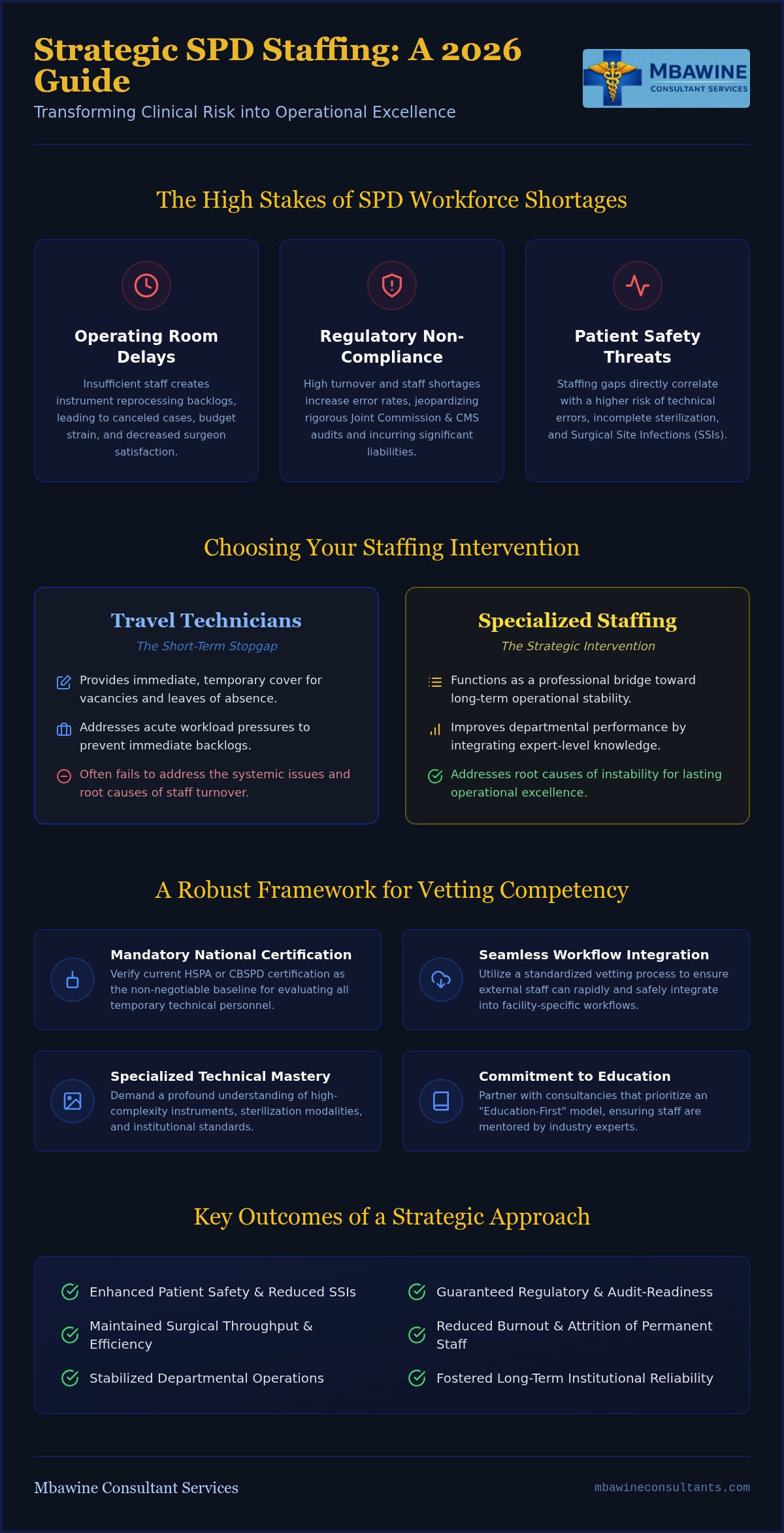
The operational integrity of a surgical suite is fundamentally tethered to the technical precision of the Sterile Processing Department, yet many facilities continue to treat workforce shortages as a peripheral administrative hurdle rather than a critical clinical risk. It's a reality that persistent vacancies and high turnover among permanent staff don't just strain your budget; they directly precipitate Operating Room delays and heighten the risk of regulatory non-compliance during rigorous audits. This 2026 resource guide explores how strategic temporary SPD staffing serves as a sophisticated intervention to stabilize your department, ensuring that every instrument set meets the highest standards of sterilization while maintaining seamless surgical throughput.
By prioritizing the placement of certified and competent external professionals, healthcare leaders can mitigate the anxiety associated with staffing gaps and maintain a steadfast commitment to patient safety. Within this comprehensive guide, we'll detail the systematic processes required to integrate specialized technicians into existing workflows, the necessity of HSPA and CBSPD certification alignment, and the broader role of interim management in optimizing departmental performance. This methodical approach ensures that external support isn't merely a stopgap measure, but a professional bridge toward long-term operational excellence and institutional reliability.
The modern perioperative environment functions as a complex ecosystem where surgical success is inextricably linked to the technical precision of the Central Sterile Services Department (CSSD). Temporary SPD staffing is no longer viewed as a mere administrative contingency but has evolved into a specialized clinical support service. This shift reflects a deeper understanding that the sterile processing technician is a guardian of patient safety whose work directly impacts surgical outcomes. As we navigate the 2026 healthcare landscape, the widening gap between the demand for complex surgical procedures and the availability of certified technicians has reached a critical threshold. Hospitals that fail to recognize this shortage as a strategic risk often face catastrophic disruptions to their operational continuity.
There is a quantifiable correlation between departmental staffing levels and Operating Room (OR) throughput efficiency. When a department lacks sufficient technical personnel, the resulting delays in instrument reprocessing lead to canceled cases and decreased surgeon satisfaction. Consequently, healthcare administrators are moving away from generalist staffing agencies that prioritize volume over technical proficiency. They're instead opting for specialized sterile processing consultancies that provide technicians who possess high-level credentials and a deep understanding of institutional standards. This transition ensures that external staff can integrate seamlessly into high-volume workflows without compromising the rigorous demands of the sterilization cycle.
Certified personnel play a decisive role in mitigating the risk of Surgical Site Infections (SSIs) by adhering to validated reprocessing protocols with absolute fidelity. During periods of high staff turnover, the risk of technical error increases significantly. Utilizing experienced temporary SPD staffing allows a facility to maintain its commitment to patient safety even when its permanent workforce is depleted. These professionals bring a high register of technical mastery that is essential for passing rigorous Joint Commission and CMS audits. They ensure that every reprocessing cycle is documented with the precision required to withstand regulatory scrutiny, protecting the institution from the liabilities associated with compliance failures.
The current recruitment drought in high-complexity medical sterilization requires a proactive approach to human capital management. Implementing sterile processing department staffing as a long-term strategic tool allows facilities to navigate these shortages without exhausting their existing teams. It's a professional necessity. By utilizing specialized temporary support, departments can prevent the cycle of permanent staff burnout that often leads to further attrition. This methodical stabilization of the workforce ensures that the department remains a reliable pillar of the hospital's clinical operations, regardless of the broader labor market's volatility.
The efficacy of any temporary SPD staffing initiative depends entirely on the rigorous verification of technical competency and professional credentials. It's insufficient to source general healthcare travelers who lack specialized training in high-complexity reprocessing. Hospitals must demand technicians who demonstrate a profound understanding of clinical standards and institutional protocols. This specialized focus distinguishes a sterile processing specialist from a generalist agency worker. An "Education-First" staffing model, where technicians are mentored by industry experts, ensures that temporary staff aren't just filling a vacancy but are actively contributing to the department's standard of care.
National certification through the Healthcare Sterile Processing Association (HSPA) or the Certification Board for Sterile Processing and Distribution (CBSPD) represents the non-negotiable baseline for external personnel. These credentials, such as the CRCST or CSPDT, verify that a technician possesses the foundational knowledge required for safe practice. Specialized sterile processing classes provide the academic rigor necessary to achieve these certifications and maintain them through continuing education. This commitment to learning ensures that temporary personnel remain current with evolving AAMI and AORN standards. Professionals seeking to reach this level of mastery may benefit from structured curricula designed for certification readiness.
Competency assessment must extend beyond basic knowledge to include technical proficiency in decontamination and assembly for specialized service lines. Technicians must demonstrate mastery in handling robotic instrumentation and complex orthopedic tray management. They must also possess a clear understanding of low-temperature sterilization versus steam sterilization protocols as outlined in the CDC Sterilizing Practices. Certified competency is the ability to execute reprocessing tasks with zero-defect accuracy under high pressure. This level of precision is essential for maintaining surgical throughput and ensuring that every instrument set is delivered to the Operating Room in a state of absolute sterility.
The financial viability of a surgical center is inextricably linked to the efficiency of its reprocessing cycle. OR delays resulting from unsterile instrument sets or incomplete trays represent a significant loss of potential revenue and a compromise in institutional reputation. When a facility relies on uncertified or inexperienced personnel instead of specialized temporary SPD staffing, the frequency of these disruptions increases. It's essential to recognize that the cost of a traveler isn't just their hourly rate; it's the total cost of ownership, which includes the risk of surgical delays, the potential for regulatory penalties, and the strain on existing surgical staff.
Strategic utilization of temporary SPD staffing to bridge the gap during permanent recruitment allows a facility to maintain its surgical schedule while pursuing long-term stability. This model provides immediate relief to overburdened departments. However, for facilities facing systemic operational failures, the value of specialized interim leadership often outweighs that of frontline technicians alone. This approach ensures that the department isn't merely surviving but is actively being optimized for future performance.
Specialized interim SPD management addresses the root causes of staffing shortages by auditing current workflows and identifying productivity bottlenecks. Unlike travel technicians who focus on daily production, an interim manager implements systemic improvements that transition a department from a crisis state to a sustainable operational model. This high-level intervention ensures that technical processes align with FDA guidance on sterilization and other institutional safety standards. It's a methodical approach to stabilization that prepares the department for the eventual integration of permanent staff while maintaining the highest register of professional reliability.
Hospitals frequently face a choice between specialized sterile processing firms and generalist staffing organizations such as AMN Healthcare or other generalists. While generalist firms possess large labor pools, they often lack the technical oversight necessary to vet technicians for high-complexity environments involving robotic or orthopedic instrumentation. Specialized agencies provide a superior cost-to-value ratio by delivering personnel who require minimal orientation and demonstrate immediate technical proficiency. These specialized partners often provide 24/7 emergency support, which is a critical safeguard for trauma centers and high-volume surgical environments. Choosing a partner with deep industry expertise for temporary SPD staffing ensures that the investment results in measurable clinical and operational improvements that protect both the bottom line and patient safety.
Securing specialized temporary SPD staffing is merely the initial phase of a successful workforce strategy; the subsequent phase requires a systematic onboarding and vetting framework to ensure immediate clinical alignment. Administrators must move beyond basic credential verification to assess how external technicians will function within their specific institutional parameters. This methodical approach minimizes the learning curve and protects the department from the operational friction that often accompanies the introduction of external personnel. It's a professional necessity to ensure that every individual entering the decontamination or assembly area is fully prepared to uphold the facility's specific safety protocols.
A comprehensive vetting process is the primary defense against technical incompetence and operational disruption. It's essential to verify not just the professional background of the technician, but their specific clinical experience in high-volume, high-complexity environments. This verification ensures that the temporary professional can adapt to the rigorous demands of a modern surgical suite without compromising quality.
Facilities that prioritize these standards ensure that their temporary staff can assume their duties with minimal supervision. To maintain this level of technical excellence, institutions should consider partnering with organizations that offer certification-aligned training and professional development.
Once integrated, the performance of temporary personnel must be monitored through specific quality assurance benchmarks, including the rigorous tracking of error rates in tray assembly and the meticulous documentation of biological monitoring cycles. These metrics provide an objective assessment of technical proficiency and ensure that the "zero-defect" standard required for surgical safety is never compromised. Leadership must maintain a steady focus on these data points to validate the efficacy of their staffing choices.
Evaluating the impact of temporary SPD staffing on tray turnaround times (TAT) allows leadership to determine if the initiative is meeting its operational goals for surgical throughput. Consistent communication between SPD leadership and the staffing partner ensures that any performance gaps are addressed immediately through corrective action or additional training. This feedback loop is vital for maintaining a unified standard of care across both permanent and external teams. Seamless cultural integration is achieved when temporary staff are held to the same rigorous accountability standards as the core team, fostering a culture of mutual respect and a shared mission for patient safety.
Mbawine Consultant Services operates at the intersection of technical education and clinical operations, recognizing that the efficacy of a department is fundamentally rooted in the competency of its personnel. Unlike generalist agencies that treat workforce shortages as a logistical hurdle, we approach temporary SPD staffing as a critical clinical intervention. Our methodology ensures that every placement is backed by a foundation of academic rigor and professional mentorship. We leverage an extensive national network of staff and alumni who have been trained under our exacting standards. This ensures that every professional entering your facility is a practitioner who understands the profound impact of their work on patient safety and surgical outcomes.
Our commitment to the sterile processing field extends beyond simple placement. We act as dedicated advocates for the professionalization of the discipline, ensuring that our staff are regarded as vital members of the perioperative team. Through our specialized CRCST preparation, we guarantee that our personnel are industry-leading experts who possess the technical mastery required for zero-defect reprocessing. This academic depth is paired with a 24/7 national emergency response capability. We recognize that critical staffing gaps don't adhere to business hours. Our readiness to deploy certified professionals ensures that surgical volumes remain stable even during the most acute workforce crises.
The requirements of a high-volume Level-1 trauma center differ significantly from those of a specialized ambulatory surgery center. We customize our staffing and sterile processing consulting services to align with the specific instrumentation and throughput demands of each unique facility. Whether managing complex robotic trays or streamlining high-turnover orthopedic sets, our professionals integrate seamlessly into your clinical environment. This versatility positions us as a comprehensive partner for institutions seeking both immediate operational relief and long-term technical excellence.
Facility leadership must take a proactive stance in evaluating departmental health to maintain a safe surgical environment. Conducting a comprehensive staffing needs assessment is the primary step toward achieving long-term operational stability. This assessment should analyze current vacancy rates, turnover trends, and the measurable impact of staffing on surgical delays. We invite administrators to request a formal consultation to discuss how tailored staffing or interim management can address these systemic challenges. Securing a reliable and certified workforce is a clinical imperative that cannot be deferred. Contact Mbawine Consultant Services to secure your SPD staffing solution today.
The evolution of the sterile processing field necessitates a shift from reactive hiring to a methodical, education-based workforce strategy that prioritizes the professionalization of every technician within the department. As surgical complexities increase, the reliance on specialized temporary SPD staffing becomes a pivotal component of institutional success, ensuring that patient safety and regulatory compliance remain uncompromised through the deployment of highly trained personnel. By prioritizing technicians with comprehensive HSPA and CBSPD certification preparation, facilities can bridge the workforce gap with professionals who possess the technical mastery required for high-stakes environments. The integration of expert interim management provides a pathway for department optimization, transitioning operations from a state of crisis to long-term stability.
Mbawine Consultant Services remains a dedicated advocate for excellence, providing the national 24/7 emergency staffing capabilities and expert interim management required to optimize departmental performance during periods of transition. We invite you to Partner with Mbawine for Certified SPD Staffing Solutions to ensure your facility remains a leader in surgical excellence. Proactive leadership today ensures a safer, more efficient clinical environment for every patient tomorrow.
The standard duration for a temporary SPD staffing engagement typically aligns with a thirteen-week cycle. This timeframe allows for technical integration into the facility's specific workflows. While some institutions require shorter emergency coverage, others extend contracts to six months or longer during large-scale department renovations or permanent recruitment initiatives. This temporal flexibility ensures that surgical throughput remains undisturbed while leadership pursues a sustainable long-term staffing solution.
Technical mastery within the sterile processing environment is non-negotiable. Therefore, the highest industry standards mandate that temporary personnel hold national certification through HSPA or CBSPD. While state-level regulations vary, facilities committed to clinical excellence require these credentials. Certification serves as a professional guarantee that the technician possesses the specialized knowledge required to execute complex reprocessing tasks with the precision necessary to ensure patient safety and institutional reliability.
Specialized agencies with national reach can often deploy technical personnel within 24 to 48 hours. This rapid response addresses acute operational crises or sudden workforce vacancies. It's a critical safeguard for trauma centers and high-volume surgical suites that cannot afford even a single day of reprocessing delays. Securing 24/7 emergency staffing ensures that the department maintains its clinical obligations, protecting the facility from the systemic risks associated with unsterilized instrument backlogs.
Travel technicians focus primarily on daily production aspects, such as decontamination and sterilization of instrument sets. In contrast, interim SPD management involves a higher level of professional oversight. A seasoned leader audits existing workflows and addresses the root causes of operational instability. While travel staff fill immediate production gaps, interim managers provide the strategic framework necessary to optimize the department for long-term clinical and financial success.
Utilizing certified temporary professionals strengthens a facility's compliance posture. It ensures that all reprocessing activities adhere to AAMI and AORN standards. Regulatory bodies such as the Joint Commission scrutinize documentation accuracy and sterilization protocols, which often falter under the stress of an understaffed department. Competent temporary SPD staffing provides the technical oversight required to maintain rigorous quality assurance standards, thereby mitigating the risk of audit failures and clinical citations.
Highly experienced temporary technicians often serve as clinical mentors. They share best practices and technical insights with the permanent workforce during their tenure. This knowledge transfer is valuable when a facility introduces new sterilization modalities or complex robotic instrumentation. By integrating these seasoned professionals into the department, leadership can elevate the technical proficiency of the entire team. This fosters a culture of professional excellence and academic rigor.
The gold standard for professional validation in this field includes the CRCST designation from the HSPA and the CSPDT credential from the CBSPD. These certifications require the successful completion of rigorous examinations and documented clinical hours. Maintaining these credentials through continuing education is essential for technicians to remain current with evolving clinical standards. This ongoing commitment ensures they adhere to current FDA guidelines regarding medical device reprocessing.
Calculating the return on investment for specialized staffing requires an analysis of the total cost of ownership. This includes the reduction in canceled surgical cases and the mitigation of Operating Room delays. Facilities should monitor metrics such as tray turnaround times and assembly error rates. When compared to the high cost of surgical downtime and the potential liabilities of non-compliance, the investment in certified temporary personnel often results in significant operational savings.

Article by
Mba Akuribila
Mba‑Akuribila is a healthcare leader, educator, and founder of Mbawine Consultants, a Bronx‑based institution recognized nationwide for advancing excellence in sterile processing and allied health workforce development. Born in Bongo in Ghana’s Upper East Region, his journey from rural beginnings to national impact reflects a lifelong commitment to service, empowerment, and community advancement.
For over two decades, he has trained sterile processing employees, mentored, and placed thousands of healthcare professionals across the United States. Through Mbawine Consultants, he established one of the country’s most trusted Sterile Processing Certification Test Prep Programs, preparing new Americans and career‑changers for successful entry into the field. The organization, as at 2026, has graduated more than 15,000 sterile processing technicians who now serve in hospitals, ambulatory centers, dental practices, and reprocessing facilities nationwide.
Under his leadership, Mbawine Consultants has expanded into a full Healthcare Staffing Agency, connecting nurses and allied health professionals to meaningful employment opportunities. His team also provides Interim Management Services, supporting hospitals and surgical centers with experienced leaders who stabilize operations, strengthen compliance, and improve workflow efficiency.
As a former surgical technician, sterile processing manager, educator, and system‑wide director, Mba‑Akuribila brings deep expertise to Sterile Processing Consulting, helping healthcare facilities elevate quality, safety, and regulatory readiness.
His work in the United States and Ghana continues to reflect his core philosophy: service above self, opportunity for all, and excellence without compromise.


