

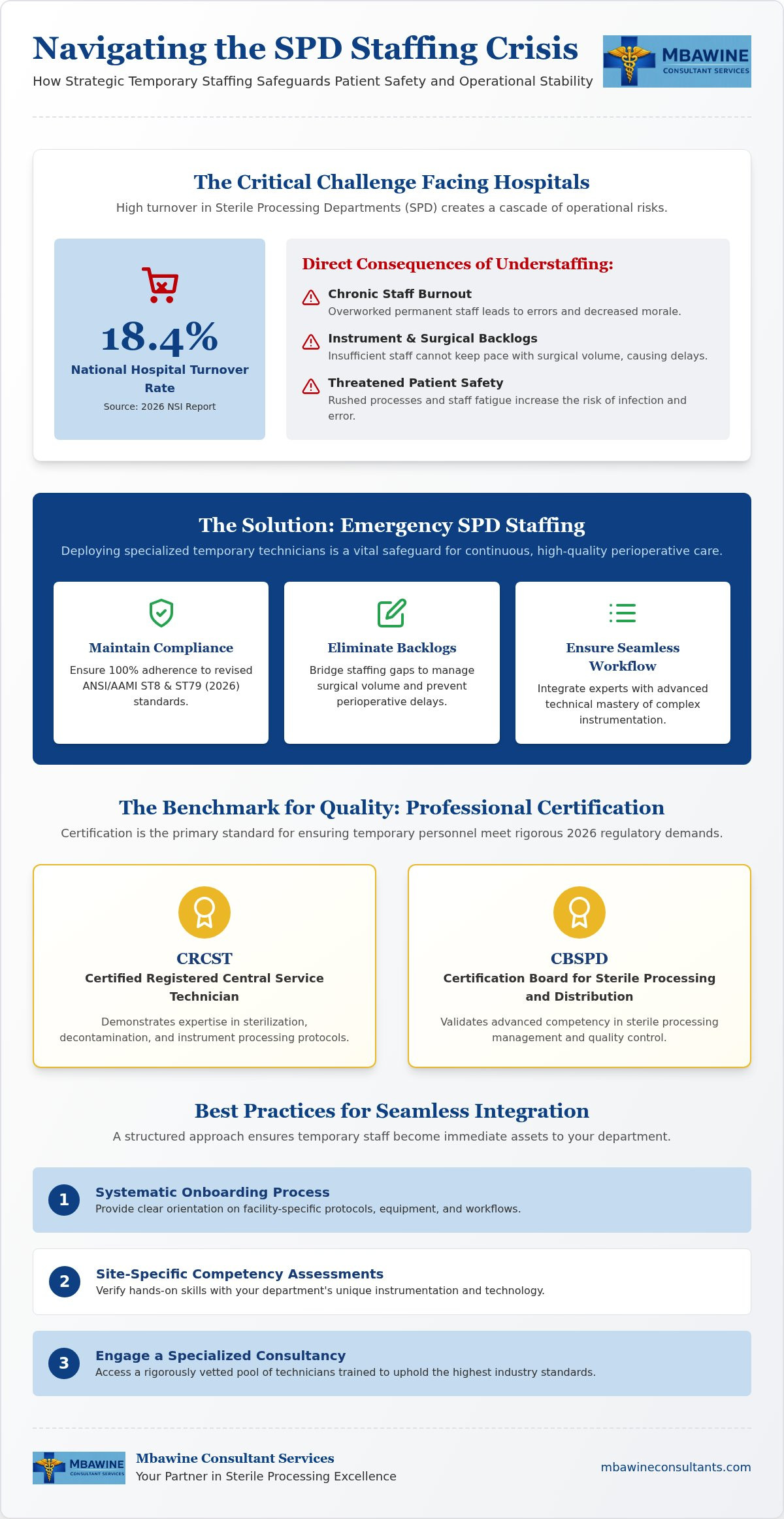
With the 2026 Nursing Solutions Inc. National Health Care Retention Report revealing a hospital turnover rate of 18.4%, the operational stability of the Sterile Processing Department (SPD) has reached a critical inflection point. When permanent staff face chronic burnout and instrument backlogs begin to threaten surgical schedules, it's clear that the immediate deployment of emergency sterile processing staffing becomes more than a temporary fix; it serves as a vital safeguard for patient safety. You understand that maintaining the rigorous pace of a modern operating room requires a department that operates with clinical precision, yet achieving this consistency is increasingly difficult amidst rising labor shortages and specialized technical demands.
This guide explores how the strategic utilization of specialized temporary technicians allows your facility to maintain 100% compliance with the revised ANSI/AAMI ST8:2026 and ST79:2026 standards. By prioritizing professional certification and systematic oversight, healthcare leaders can eliminate backlogs and ensure seamless perioperative workflows. We'll examine the essential role of interim management and advanced technical mastery in meeting the Joint Commission's Accreditation 360 requirements, positioning temporary staffing as a sophisticated asset for institutional excellence and regulatory reliability.
The modern healthcare environment demands a sophisticated approach to infection prevention, where the sterile processing technician is recognized as a specialized clinical professional rather than a general laborer. Within the Central Sterile Services Department (CSSD), these experts manage the critical lifecycle of surgical instrumentation, ensuring that every device meets stringent safety benchmarks before reaching the operating suite. Because surgical throughput is inextricably linked to the efficiency of the sterilization cycle, any disruption in the department's workflow directly impacts a facility's ability to maintain its surgical schedule. As we move through 2026, the industry has seen a decisive shift toward mandatory certification, with updated standards such as AAMI ST79:2026 requiring a level of technical mastery that only certified professionals can provide.
Interim technicians must possess a comprehensive understanding of decontamination, assembly, and sterilization processes to ensure institutional compliance. This role requires high-level technical knowledge of complex surgical instrumentation, ranging from robotic components to delicate microsurgical tools that require specific handling instructions. Professional accountability is paramount; technicians are responsible for executing systematic protocols that prevent cross-contamination and ensure patient safety. The reliance on emergency sterile processing staffing allows facilities to secure this expertise rapidly, bridging the gap when internal resources are stretched thin or when specialized skills are required for new surgical technologies. It's not just about filling a seat; it's about maintaining a standard of excellence that protects the patient and the institution's accreditation status.
Workforce flexibility is a strategic clinical asset that allows healthcare institutions to navigate the volatility of modern labor markets. With the 2026 hospital turnover rate remaining high, temporary staffing solutions provide a buffer against the loss of institutional knowledge and the operational strain caused by permanent staff departures. Facilities often utilize interim technicians during significant transitions, such as department renovations or the implementation of new equipment compliant with the AAMI ST8:2026 steam sterilization standards. These standards introduced new requirements for moisture tension tests and manufacturers' instructions for use, necessitating staff who can adapt quickly to revised protocols.
By integrating flexible staffing models, departments can effectively manage surgical volume fluctuations and significantly reduce perioperative delays. This proactive approach to emergency sterile processing staffing ensures that the department remains a high-functioning engine of the hospital, maintaining 100% compliance even during periods of peak demand or internal transition. When surgical backlogs are eliminated, the entire healthcare system operates with greater financial and clinical efficiency. For healthcare organizations aiming to further enhance their operational performance and scale effectively, 10xdentalpartners.com provides a strategic growth platform designed for long-term success.
To adapt to these labor market shifts, facilities can visit BlueBridge Group Placement Corp to discover how specialized AI-driven employment services streamline the hiring process and support long-term institutional stability.
The fiscal architecture of a Sterile Processing Department (SPD) often reveals that the true cost of labor extends far beyond hourly wages; it encompasses the high price of recruitment, onboarding, and the operational paralysis caused by permanent staff turnover. With the 2026 national hospital turnover rate documented at 18.4%, the financial burden of constant retraining can destabilize departmental budgets. Utilizing specialized temporary personnel provides a controlled cost-benefit model that allows facilities to maintain elite performance without the long-term liability of excessive permanent overhead. This strategic shift is particularly effective in preventing the chronic burnout that plagues understaffed departments, as the introduction of expert support preserves the morale of the existing team and ensures that technical standards don't slip during periods of high surgical volume.
In crisis scenarios, the availability of 24/7 emergency sterile processing staffing serves as a critical fail-safe for institutional continuity. These specialized professionals are trained to integrate into high-pressure environments, ensuring that sterilization protocols remain uncompromised even when internal resources are exhausted. By partnering with agencies that prioritize Sterile Processing Technician Certification, healthcare leaders guarantee that every interim team member possesses the verified competency required to navigate the complexities of modern medical device reprocessing. This commitment to professional standards ensures that the department remains compliant with the Association for the Advancement of Medical Instrumentation (AAMI) and the Joint Commission, even under extreme operational duress.
Maintaining rigorous documentation and procedural standards is exceptionally challenging during leadership transitions or significant staff vacancies. Temporary experts act as guardians of industry standards, ensuring that documentation remains current and that the department is prepared for the Joint Commission's "Accreditation 360" model implemented on January 1, 2026. These interim professionals often function as internal auditors, assessing current workflows against updated AAMI guidelines to identify and rectify potential compliance gaps before they result in survey citations. Their presence ensures that leadership gaps don't translate into a decline in sterility assurance or institutional safety.
Interim technicians often bring a wealth of "best practice" experience acquired from diverse clinical environments, which can be leveraged to refine local processes. This cross-pollination of expertise frequently leads to a measurable reduction in instrument processing lag times, directly supporting the overall health and productivity of the surgical suite. When instrument backlogs are eliminated through targeted staffing, the facility can maximize its surgical revenue and improve patient outcomes simultaneously. To ensure your team remains at the forefront of these evolving standards, you might consider how professional certification pathways can bolster your department's internal expertise and operational resilience.
Professional excellence in the Sterile Processing Department (SPD) begins with a foundation of verified knowledge. Certification through recognized professional organizations, such as the Certification Board for Sterile Processing and Distribution (CBSPD), ensures that technicians have mastered the complex science of infection control. In the context of emergency sterile processing staffing, these credentials act as a universal language of competency. They allow facilities to trust that interim personnel can immediately adhere to CDC Sterilizing Practices without extensive re-education. It's a fundamental requirement for maintaining the safety of the surgical environment.
The mastery of sterilization technology is not a static achievement. It requires ongoing engagement with the latest industry developments and technical updates. High-quality sterile processing classes establish the benchmark for this professional development, providing the structured curriculum necessary to navigate 2026 regulatory shifts. These educational pathways ensure that technicians aren't just following steps but are understanding the underlying principles of microbiology and mechanical processing.
While leading certification bodies, including the CBSPD, verify core competencies, they offer distinct focuses that benefit a comprehensive staffing strategy. For instance, a widely recognized certification program emphasizes a broad range of central service activities, focusing on the lifecycle of the instrument from decontamination to storage. CBSPD certifications often highlight technical distribution and sterilization specifics. Both types of credentials verify that a technician can mitigate risks effectively. As we move through 2026, the trend toward national standardization has intensified, making these credentials non-negotiable for any facility committed to excellence. Certified technicians are statistically less likely to commit processing errors that lead to surgical delays.
Rigorous education is the most effective tool for reducing Surgical Site Infections (SSIs). Modern surgical suites rely on robotic and minimally invasive tools that require specialized training to decontaminate correctly. Without this specific knowledge, even a diligent technician might leave bioburden on complex instruments. Utilizing thorough preparation for industry-standard certifications ensures that temporary staff are ready for immediate deployment into high-stakes environments. This level of readiness is essential when emergency sterile processing staffing is required to address sudden volume spikes. It ensures that the speed of staffing doesn't come at the cost of clinical precision or patient safety. Professional mastery is the only acceptable standard when lives are on the line.
Integrating temporary personnel into a high-stakes clinical environment requires a methodical onboarding framework that prioritizes patient safety over mere operational speed. While the deployment of emergency sterile processing staffing addresses immediate labor deficits, the success of this intervention hinges on a systematic approach to facility-specific competency assessments. These assessments must verify that interim technicians are proficient in the local equipment configurations and specific sterilization modalities used within the institution. This verification process ensures that the high standards established by the permanent team remain uncompromised during periods of transition, as it's essential that departmental protocols are followed with absolute precision.
A seamless integration depends on the existence of clear, comprehensive Standard Operating Procedures (SOPs) that are accessible to all personnel. By assigning temporary staff to standardized, high-volume tasks, such as the processing of basic orthopedic or general surgery sets, facilities can free up their permanent lead technicians to manage more complex instrumentation or departmental oversight. Peer mentorship serves as an additional layer of quality assurance, where a seasoned permanent staff member provides guidance on institutional nuances. This collaborative model fosters professional synergy and maintains a steady communication flow between permanent and interim teams, ensuring that productivity doesn't falter during peak surgical hours.
The presence of sterile processing interim leadership is instrumental in ensuring that temporary personnel are utilized effectively and held to the highest performance standards. Management must actively monitor productivity metrics, such as instrument tray accuracy and processing turnaround times, to identify any training gaps or workflow bottlenecks. This level of oversight is particularly critical when managing the complexities of emergency sterile processing staffing during peak demand. A structured transition plan is also necessary to facilitate the eventual return to a fully permanent workforce, ensuring that all departmental knowledge gained during the interim period is documented and retained for future institutional stability.
To standardize communication between teams, departments should implement a daily shift-report checklist:
Facilities seeking to elevate their departmental standards can enroll in professional certification programs to ensure their teams possess the advanced technical mastery required for modern healthcare excellence.
Mbawine Consultant Services operates with a distinct mission that transcends the traditional role of a staffing agency, positioning itself as a specialized consultancy dedicated to the preservation of institutional integrity and patient safety. We function as a guardian of industry standards, ensuring that every technician within our national network is prepared for the demands of emergency sterile processing staffing through a rigorous vetting process that exceeds standard requirements. This process verifies not only the necessary HSPA or CBSPD certifications but also the clinical maturity required to thrive in high-pressure environments. Our commitment to excellence is rooted in our dual role as educators and staffing providers, where our deep understanding of the sterile processing lifecycle informs every placement and consulting engagement.
Our approach to workforce management is inherently methodical, beginning with a comprehensive assessment of a facility's unique operational needs and technical requirements. Whether a department is facing a sudden surge in surgical volume, a complex equipment upgrade, or a chronic labor deficit, we provide tailored emergency sterile processing staffing solutions that integrate seamlessly with existing institutional workflows. This service is uniquely enhanced by our specialized consultant services, which offer a high-level analysis of departmental efficiency, resource allocation, and regulatory compliance. Facilities benefit from 24/7 emergency support, ensuring that critical staffing shortages never translate into compromised patient care or costly surgical delays. Partnering with a mission-driven consultancy provides the long-term benefit of a stable, compliant, and highly efficient sterile processing environment that can withstand the volatility of the modern healthcare market.
The superior caliber of our interim professionals is a direct result of our pedagogical foundation and our unwavering focus on the professionalization of the field. By maintaining a focus on rigorous training and continuous improvement, we ensure that our staff and alumni are prepared to meet the most demanding 2026 healthcare standards and accreditation requirements. We invite healthcare leaders to explore our full range of services, which include interim management and specialized consulting designed to oversee complex departmental transitions with clinical precision. Our alumni consistently demonstrate the technical mastery and leadership qualities required to maintain 100% compliance with sterilization protocols across diverse surgical specialties. To secure the future of your department and ensure the highest levels of professional mastery, we encourage you to enroll in professional development and staffing solutions that reflect the gravity and importance of the medical field.
The strategic integration of certified temporary technicians has evolved into a fundamental requirement for healthcare facilities seeking to navigate the rigorous complexities of the 2026 regulatory landscape. By prioritizing professional credentials and systematic onboarding; departments can effectively eliminate instrument backlogs and maintain unwavering compliance with the latest AAMI standards. The utilization of specialized emergency sterile processing staffing ensures that surgical throughput remains uninterrupted even during periods of extreme operational volatility or leadership transitions. This proactive approach transforms the Sterile Processing Department into a resilient engine of clinical excellence that safeguards both patient safety and institutional accreditation.
Mbawine Consultant Services remains a dedicated advocate for this professional standard; serving as an authorized provider of CRCST certification preparation with a national reach that includes specialized interim leadership options. Our 24/7 emergency staffing response capabilities provide the institutional stability required to uphold the highest benchmarks of public safety. We invite you to Enroll in Certified Sterile Processing Solutions to secure the technical mastery your facility demands. Elevating your departmental standards is an essential step toward ensuring long-term operational success and clinical reliability.
Typical qualifications for temporary sterile processing technicians in 2026 include current certification through HSPA or CBSPD and a demonstrated mastery of the revised ANSI/AAMI ST79:2026 guidelines. Professionals must be proficient in managing complex surgical instrumentation, including robotic and minimally invasive tools. Additionally, technicians must understand the moisture tension test requirements established in ST8:2026. These technical benchmarks ensure that interim staff can integrate into high-stakes environments without compromising established departmental safety protocols or institutional standards.
A healthcare facility can typically secure emergency sterile processing staffing within a highly accelerated timeframe, often through 24/7 response protocols designed for critical labor shortages. Specialized consultancies maintain a national network of pre-vetted, certified professionals who are ready for immediate deployment. This rapid response capability is essential for managing sudden surgical volume spikes or addressing unexpected staff turnover. It allows the sterile processing department to maintain continuous operations and avoid the financial repercussions of surgical schedule delays.
While state-level licensing varies, the 2026 healthcare landscape increasingly mandates certification for all sterile processing personnel to ensure compliance with the Joint Commission's Accreditation 360 model. Most reputable institutions require temporary staff to hold CRCST or CBSPD credentials as a prerequisite for employment. Certification serves as a verified benchmark of technical competency, ensuring that technicians are equipped to mitigate the risks associated with complex medical device reprocessing. It's a fundamental requirement for maintaining departmental excellence and patient safety.
A general staffing agency primarily focuses on the transaction of filling labor vacancies, whereas a sterile processing consultancy provides comprehensive technical oversight and departmental auditing. Consultancies like Mbawine Consultant Services integrate interim leadership and educational resources with staffing solutions. This model ensures that temporary personnel aren't just filling roles but are also upholding rigorous industry standards. A consultancy acts as a strategic partner, providing specialized knowledge to optimize departmental workflows and ensure long-term regulatory compliance.
Utilizing certified temporary staffing has a direct, positive impact on a hospital's infection control metrics by reducing the incidence of processing errors. Expert technicians ensure that bioburden is thoroughly removed from complex instruments, which significantly lowers the risk of Surgical Site Infections (SSIs). Because the 2026 accreditation standards emphasize outcomes-based performance, maintaining a high caliber of technical expertise in the SPD is critical. Professional staffing ensures that every instrument tray meets the highest sterility assurance levels.
Temporary technicians and interim managers frequently assist with department optimization by introducing "best practice" workflows observed across diverse clinical settings. Their external perspective allows them to identify bottlenecks in the decontamination or assembly areas that permanent staff might overlook. By implementing systematic improvements, these professionals help eliminate instrument backlogs and improve overall tray accuracy. This optimization process enhances the efficiency of the entire surgical suite and ensures that the department meets modern productivity benchmarks.
The onboarding process for interim SPD technicians should include facility-specific competency assessments and a thorough orientation to local equipment and sterilization modalities. It's essential to review the institution's specific Standard Operating Procedures (SOPs) and documentation requirements. A structured communication checklist should also be provided to ensure seamless shift handoffs between permanent and interim teams. This systematic approach ensures that temporary staff can function with the same level of precision and accountability as the resident clinical team.
Professionals stay current with evolving sterilization standards by participating in specialized sterile processing classes and meeting the continuing education requirements for certification renewal. These educational pathways ensure that technicians understand the latest regulatory changes, such as the 2026 updates to AAMI steam sterilization guidelines. Ongoing professional development is necessary to master new surgical technologies and infection prevention protocols. Dedicated technicians prioritize these educational opportunities to maintain their status as elite clinical experts in the field of healthcare sterilization.

Article by
Mba Akuribila
Mba‑Akuribila is a healthcare leader, educator, and founder of Mbawine Consultants, a Bronx‑based institution recognized nationwide for advancing excellence in sterile processing and allied health workforce development. Born in Bongo in Ghana’s Upper East Region, his journey from rural beginnings to national impact reflects a lifelong commitment to service, empowerment, and community advancement.
For over two decades, he has trained sterile processing employees, mentored, and placed thousands of healthcare professionals across the United States. Through Mbawine Consultants, he established one of the country’s most trusted Sterile Processing Certification Test Prep Programs, preparing new Americans and career‑changers for successful entry into the field. The organization, as at 2026, has graduated more than 15,000 sterile processing technicians who now serve in hospitals, ambulatory centers, dental practices, and reprocessing facilities nationwide.
Under his leadership, Mbawine Consultants has expanded into a full Healthcare Staffing Agency, connecting nurses and allied health professionals to meaningful employment opportunities. His team also provides Interim Management Services, supporting hospitals and surgical centers with experienced leaders who stabilize operations, strengthen compliance, and improve workflow efficiency.
As a former surgical technician, sterile processing manager, educator, and system‑wide director, Mba‑Akuribila brings deep expertise to Sterile Processing Consulting, helping healthcare facilities elevate quality, safety, and regulatory readiness.
His work in the United States and Ghana continues to reflect his core philosophy: service above self, opportunity for all, and excellence without compromise.


