

Last Updated: August 10, 2026
Surgical facility sterile processing support services encompass the full operational infrastructure that keeps an OR running safely, from the moment an instrument leaves the surgical field to the moment it returns as a verified sterile unit. Facilities that treat sterile processing as a back-office function rather than a clinical one pay for that assumption in surgical delays, compliance citations, and preventable infection risk.
Sterile processing support is the coordinated set of services, staffing, education, and workflow systems that ensure surgical instrumentation meets sterilization standards before every case. It spans decontamination, inspection, assembly, sterilization, sterile storage, and distribution.
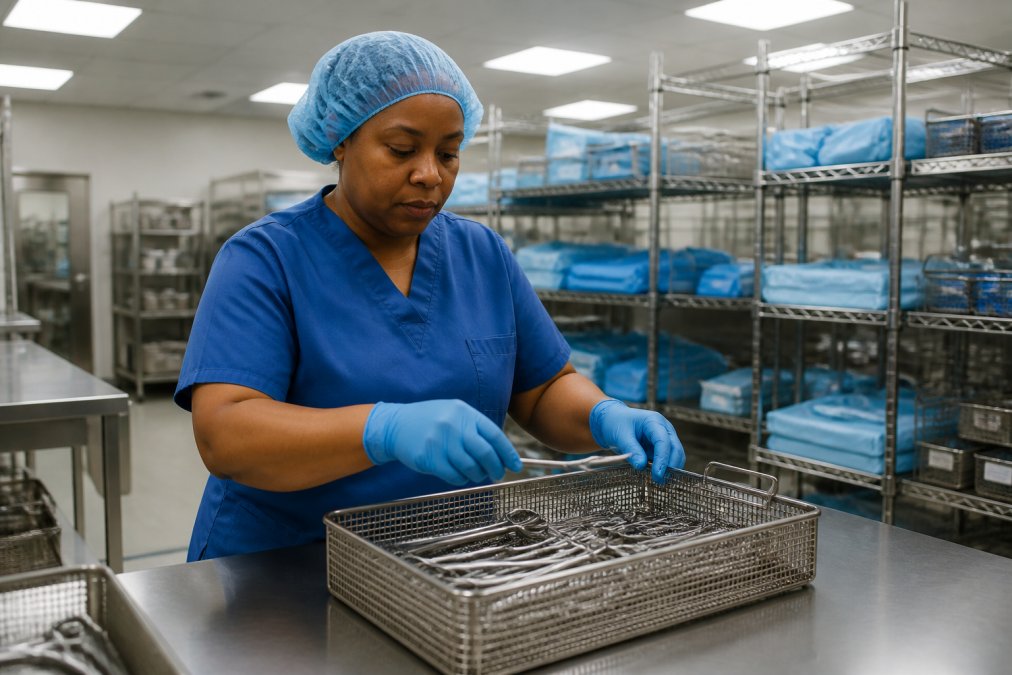
A well-run sterile processing support program touches instrument tracking, point-of-use cleaning protocols, autoclave validation, sterile barrier system integrity, surgical tray assembly accuracy, and staff competency verification. A failure at point-of-use cleaning elevates bioburden, which compromises sterilization efficacy downstream, where patient safety breaks down.
The sterile processing workflow follows a defined sequence that cannot be shortcut without consequence. Point-of-use cleaning begins in the OR, where scrub techs remove gross soil and keep instruments moist before transport. Instruments then move to the decontamination zone, where technicians use enzymatic detergents, ultrasonic cleaners, and automated washers to reduce bioburden. After cleaning, instruments move through inspection and assembly, where each piece is examined for damage, functionality, and completeness. Packaging follows using an appropriate sterile barrier system. Sterilization, most commonly via steam autoclave, completes the cycle. Sterile storage and distribution close the loop.
As documented in AAMI's sterilization standards for healthcare facilities, each phase requires documented validation, not just execution. That distinction matters enormously during accreditation audits.
The sterile processing technician is responsible for instrument inspection, tray assembly, sterilization validation, and maintaining the aseptic technique standards that protect patients from surgical site infection.
Certification through the IAHCSMM CRCST credential or the CBSPD validates that a technician has demonstrated competency across the full reprocessing workflow. Many facilities still employ uncertified staff, creating both compliance risk and quality inconsistency. The trend toward mandatory certification in states like New York, New Jersey, and California reflects growing recognition that this role requires formal credentialing.
Most sterile processing department workflow optimization conversations start with equipment. That's the wrong starting point. Equipment is rarely the constraint. The real bottlenecks are tray turnaround time, instrument tracking gaps, and staffing instability.
Instrument tracking is where sterile processing intersects directly with OR scheduling. When the scheduling system and the central sterile supply department operate as separate silos, the result is predictable: trays go missing, sets are incomplete, and cases get delayed or canceled.
Modern instrument tracking systems use barcodes, RFID, or laser-etched identifiers to document each step of an instrument's lifecycle. The operational advantage comes when that tracking data connects to surgical scheduling software. When a surgeon schedules a complex orthopedic case, the scheduling system can automatically flag whether the required instrument sets are available, in reprocessing, or flagged for repair.
According to The Joint Commission's sentinel event data on surgical complications, retained surgical instruments and incorrect procedure events remain among the most serious patient safety concerns in operating rooms. Real-time instrument tracking directly reduces that risk by creating an auditable chain of custody from decontamination through delivery.
Tray turnaround time is the metric that connects sterile processing performance to OR throughput. When a facility runs consecutive cases, the speed and accuracy with which used instruments are reprocessed and returned directly determines whether the next case starts on time.
Staffing instability destroys turnaround time. High turnover forces facilities into a continuous cycle of onboarding, which slows throughput and introduces reprocessing errors from undertrained staff. Temporary staffing solutions can bridge gaps, but only when the placed technicians already understand sterile processing protocols. A common mistake is accepting general healthcare temps into SPD roles.
| Workflow Factor | Common Problem | Operational Fix |
|---|---|---|
| Tray turnaround time | Incomplete tray assembly slows OR starts | Tray card audits + competency checks |
| Instrument tracking | Missing sets cause case cancellations | Barcode/RFID integration with scheduling |
| Staffing gaps | Untrained temps increase reprocessing errors | SPD-specific credentialed placements |
| Preventative maintenance | Autoclave downtime halts sterilization | Scheduled validation and service contracts |
| Point-of-use cleaning | Elevated bioburden compromises sterilization | OR team training on pre-cleaning protocols |
Compliance in sterile processing is not a checkbox exercise. It is a continuous quality management discipline, and facilities that treat it otherwise tend to discover the difference during an unannounced survey.
The Joint Commission (TJC) surveys sterile processing as part of its hospital accreditation standards, with particular focus on infection control, instrument reprocessing protocols, and staff competency documentation.
AAMI (Association for the Advancement of Medical Instrumentation) publishes the technical standards that define how reprocessing should be performed. AAMI ST79 is the comprehensive guide for steam sterilization and sterility assurance. AAMI TIR30 covers the decontamination of reusable medical devices.
The FDA regulates the reprocessing of single-use devices and oversees sterilization validation requirements. For third-party reprocessing units, FDA registration and compliance with 21 CFR Part 820 quality system regulations are mandatory.
DNV Healthcare offers an Advanced Sterile Processing Certification that provides external validation of a facility's reprocessing standards through a formal survey process.
Accreditation standards require documented compliance auditing, sterilization validation records, biological indicator logs, and staff competency files. Gaps in any of these areas create citation risk.
Instrument damage is expensive and preventable. The most common causes are mechanical stress during decontamination, improper disassembly before cleaning, incorrect autoclave loading, and inadequate inspection before tray assembly.
A structured risk mitigation approach addresses three layers. First, instrument inspection protocols must be standardized: every technician uses the same criteria for evaluating functionality, surface integrity, and sharpness. Second, reprocessing protocols must match the manufacturer's instructions for use (IFU). Third, damage tracking should feed back into purchasing and repair decisions.
Quality assurance in sterile processing is only as useful as the metrics driving it. The goal is a short list of actionable indicators that surface problems before they reach the OR.
The most operationally significant sterile processing quality assurance metrics fall into five categories:
As outlined in CDC guidelines on infection prevention in surgical settings, surgical site infection prevention depends heavily on the reliability of instrument sterilization processes.
Outsourced sterile processing for ASCs is a decision that deserves rigorous financial and operational analysis. Ambulatory surgical centers operate under tighter margin constraints than hospital systems. The question of whether to manage sterile processing in-house or contract it to an external provider comes down to four variables: case volume, instrument complexity, staffing availability, and compliance burden.

Low-volume ASCs performing straightforward procedures with standardized instrument sets often find that outsourcing reduces overhead without sacrificing quality. High-volume centers with complex surgical specialties face a different calculus: instrument turnaround time becomes critical, and dependence on an external provider introduces scheduling risk.
The hidden costs of in-house management include staff turnover and recruitment, ongoing competency training, equipment maintenance and replacement, and compliance audit preparation. Outsourcing converts those variable costs into a contractual service fee.
The provider selection process should go beyond pricing. Key questions include:
Mbawine Consultants approaches surgical facility sterile processing support services from both the operational and educational dimensions, building sustainable internal capability rather than just filling an immediate gap.
On the staffing side, Mbawine Consultants provides temporary and permanent staffing solutions specifically for sterile processing departments. Placed staff understand the full reprocessing workflow and can integrate into a facility's existing protocols without extended onboarding.
On the education side, Mbawine Consultants offers fast-track CRCST and CIS certification preparation through audio, video, and web conferencing, accessible from home. The firm also prepares professionals for the Certified Healthcare Leader credential, supporting career advancement into administrative and management roles.
Interim management solutions address department manager vacancies during compliance-sensitive periods, maintaining sterile processing quality assurance and accreditation readiness while a permanent hire is secured.
Financing options include no payment for the first 30 days, which reduces the barrier for facilities evaluating the program before committing budget. For a complete picture of current service options and pricing, contact Mbawine Consultants directly at mbawineconsultants.com.
Surgical facilities face a consistent challenge: sterile processing departments are held to exacting compliance standards while being chronically under-resourced in staffing, training, and operational infrastructure. Mbawine Consultants exists to close that gap, offering credentialed interim management, SPD-specific staffing, and flexible certification preparation that builds the internal expertise facilities need to sustain quality assurance independently. Enroll with Mbawine Consultants and build a sterile processing program that holds up under survey, supports surgical efficiency, and protects patients.
Outsourcing sterile processing support gives surgical facilities immediate access to credentialed technicians, standardized reprocessing protocols, and built-in compliance auditing without the cost of building that expertise internally. For smaller hospitals and ambulatory surgical centers, it eliminates chronic staffing gaps, reduces surgical delays caused by unavailable or improperly processed instrument trays, and shifts the compliance burden to a specialized provider. The operational result is more consistent turnaround times and lower risk of surgical site infection from reprocessing failures.
Sterile processing departments in the US must comply with standards set by the Association for the Advancement of Medical Instrumentation (AAMI), The Joint Commission (TJC), and the Centers for Medicare and Medicaid Services (CMS) Conditions of Participation. The FDA also regulates sterilization validation for reusable medical devices. Facilities seeking advanced recognition can pursue DNV Advanced Sterile Processing Certification. Any support services provider working in your department must operate within all applicable federal and state requirements, as well as your facility's own accreditation standards.
Sterile processing support directly affects how quickly an operating room can turn over between cases. When instrument trays are decontaminated, inspected, assembled, and sterilized on schedule, the surgical supply chain runs without interruption. Staffing gaps, missing instruments, or failed sterilization loads are among the most common causes of preventable surgical delays. A dedicated support services provider with experienced technicians and optimized workflow protocols reduces these bottlenecks, which translates to more cases completed per day and lower per-case costs for the facility.
Start by confirming that the provider's technicians hold current CRCST or equivalent certifications and that the firm has direct experience with ambulatory surgical center volumes and case mix. Ask specifically how they onboard to your facility's instrument sets and tray configurations, and how quickly they can place staff during an urgent gap. Review their quality assurance metrics, including reprocessing error rates and compliance audit history. Providers should also demonstrate familiarity with AAMI standards, Joint Commission requirements, and your state's applicable health department regulations before any contract is signed.
This article was written using GrandRanker


