

Last Updated: August 22, 2026
Surgical departments across the country face a persistent challenge: maintaining full sterile processing capacity while managing unpredictable demand and staffing gaps. Even a single technician absence can cascade into delayed surgeries and compromised patient safety protocols.
Temporary sterile processing staffing solutions address this operational vulnerability directly. Rather than scrambling to cover shifts or pushing existing staff into overtime, hospitals can access trained professionals on-demand to maintain compliance standards and surgical schedules. This approach has become essential for facilities managing surge capacity, seasonal demand fluctuations, or permanent staff shortages.
The decision to bring in temporary sterile processing staffing often stems from immediate operational pressure: a technician leaves unexpectedly, a facility undergoes renovation, or a new surgical service launches. What makes this different from simply hiring permanent staff is flexibility. Temporary staffing allows administrators to respond to real demand without long-term financial commitment. For small facilities especially, this flexibility can mean the difference between maintaining accreditation standards and facing compliance violations. Mbawine Consultants has worked with hospitals of all sizes to bridge these gaps through interim management and staffing solutions that align with facility-specific protocols and regulatory requirements.
Operational Continuity and Compliance
Surgical schedules depend on sterile processing capacity. When that capacity is compromised, surgery delays follow immediately. Temporary staffing maintains the instrument pipeline that keeps operating rooms supplied with properly decontaminated, sterilized, and tracked surgical instruments. This continuity directly supports patient safety and accreditation compliance, since regulatory bodies assess whether facilities maintain consistent sterilization protocols and instrument traceability.
Cost Flexibility and Budget Control
Permanent staffing creates fixed labor costs regardless of demand fluctuations. Temporary staffing inverts this dynamic: administrators pay only for capacity they actually use, when they use it. During slower periods, temporary assignments scale back; during surge periods, they scale up. This flexibility protects budget margins and allows capital reallocation to other operational priorities.
Small facilities benefit most from this cost structure. A 10-person sterile processing department cannot absorb the fixed cost of hiring a permanent technician for seasonal demand spikes. Temporary staffing transforms that seasonal spike into a manageable expense.
Reduced Turnover and Training Burden
Permanent hiring creates perpetual recruitment and onboarding demands. Temporary staffing arrangements sidestep this entirely. There's no lengthy hiring process, no extended training period for someone who may leave in six months, no gap between when a position opens and when it's filled. The facility accesses experienced professionals who understand sterile processing protocols immediately.
This is particularly valuable for small facilities with limited administrative capacity, allowing managers to focus on core operations and compliance rather than recruitment.
Surge Capacity for Planned and Unplanned Demand
Surgical volumes fluctuate due to seasonal demand swings, new surgical services, or equipment failures. Temporary sterile processing staffing solutions provide immediate surge capacity for these scenarios. Rather than turning away elective procedures or extending surgical schedules into evenings, facilities maintain their surgical calendar.
Small facilities face unique constraints that make sterile processing staffing particularly challenging. A 5-person or 10-person department cannot absorb a single absence without compromising patient safety or schedule integrity. Hiring a permanent replacement for one missing technician creates permanent overhead that the facility's surgical volume cannot justify.
Small facilities also lack the administrative infrastructure that large hospital systems maintain. When a technician leaves, the department manager must personally handle recruitment, screening, background checks, credentialing verification, and training. This diverts clinical leadership from operational priorities.
A sterile processing staffing agency for small facilities must provide pre-screened, credentialed professionals who can integrate into smaller teams without requiring extensive facility-specific training. The staffing arrangement should be flexible enough to accommodate the irregular, unpredictable demand patterns that characterize small surgical services.
An agency that primarily serves large hospital systems may not understand the operational reality of a small facility. Large systems have standardized protocols and formal training programs. Small facilities operate with less formal structure but equally rigorous safety standards. The temporary staff member must adapt quickly to a less formal environment while maintaining the same compliance rigor.
Mbawine Consultants brings expertise in working with facilities of all sizes, including the specific operational challenges that small sterile processing departments face. Rather than applying a one-size-fits-all staffing model, the approach accounts for facility size, surgical volume, and existing staff expertise.
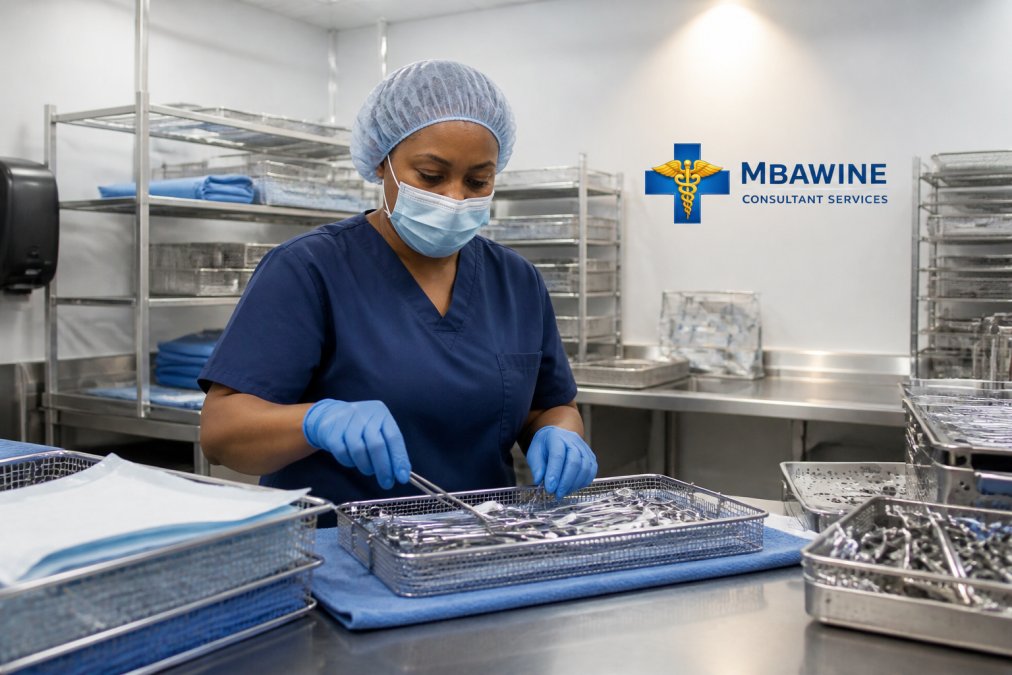
Beyond temporary technician staffing, some facilities require interim management support. This might involve a temporary department manager who oversees operations during a leadership transition, implements new protocols, or addresses compliance gaps. Interim management differs fundamentally from temporary technician staffing because it addresses operational leadership rather than processing capacity.
Interim management is particularly valuable during periods of organizational change: a department manager leaves, a new surgical service launches, or a facility undergoes accreditation preparation. An interim manager provides experienced leadership continuity while the facility recruits a permanent replacement or completes its transition.
The interim manager's role encompasses protocol development, staff training, compliance documentation, equipment maintenance oversight, and regulatory liaison. Effective interim management requires deep knowledge of sterile processing standards, regulatory requirements, and operational best practices. The interim manager must earn credibility quickly with existing staff, implement changes without disrupting operations, and document improvements for the permanent leadership transition.
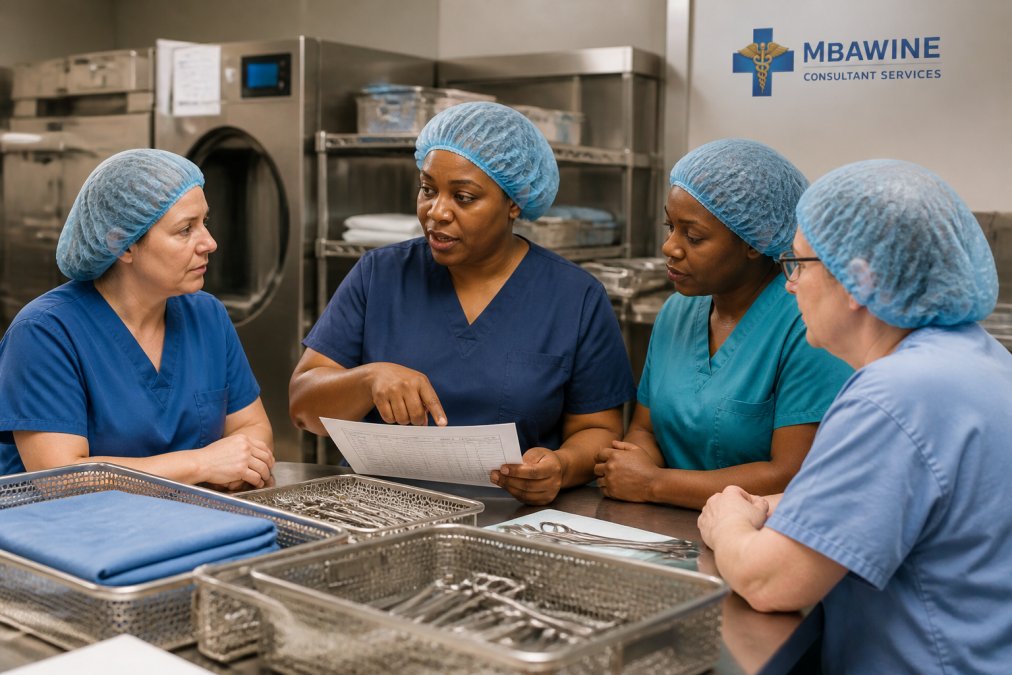
Mbawine Consultants provides interim management services that combine operational expertise with sensitivity to facility culture. Rather than imposing external practices, the interim manager assesses existing operations, identifies gaps, and develops solutions that align with facility resources and regulatory requirements.
Credentialing and certification verification form the foundation of responsible temporary staffing. A temporary sterile processing technician must hold current CRCST (Certified Registered Central Service Technician) certification or equivalent credential. This is a regulatory and safety requirement.
The CRCST certification demonstrates that a technician has met standardized competency requirements established by the International Association of Healthcare Central Service Material Management Professionals (IAHCSMM) (iahcsmm.org). The certification requires passing an examination covering instrument identification, decontamination processes, sterilization principles, safety protocols, and regulatory compliance.
Temporary staffing arrangements must verify current CRCST certification before assignment through independent verification with IAHCSMM, confirming that the credential is current and in good standing. Facilities should never accept a temporary technician who claims certification without independent verification.
Some temporary staff members hold Certified Instrument Specialist (CIS) credentials instead of or in addition to CRCST, indicating advanced expertise in surgical instrument management. A CIS-credentialed technician brings higher-level expertise, particularly valuable for complex surgical services or specialized instrument management.
Temporary staff credentialing also includes verification of state licensing where applicable, background checks, and confirmation of continuing education requirements. Beyond initial credentialing, temporary staff should participate in facility-specific competency assessments to demonstrate competency with that facility's specific instruments, protocols, and equipment.
Successfully integrating temporary staff requires deliberate strategy. The temporary technician arrives with CRCST certification and general sterile processing knowledge, but lacks familiarity with this specific facility's instruments, protocols, equipment, and staff dynamics.
Effective integration begins before the temporary staff member's first day. The department manager should prepare existing staff for the temporary assignment, clarifying the reason for the temporary staffing and setting expectations for collaboration. On the first day, the temporary technician needs a structured orientation covering facility-specific protocols, equipment location and operation, instrument sets and their uses, sterilization parameters, and documentation systems.
Pairing the temporary technician with an experienced permanent staff member during the first few days accelerates integration and builds confidence. This peer mentoring approach is far more effective than formal classroom training.
Compliance considerations during temporary staffing integration center on maintaining protocol consistency. Temporary staff must follow the same decontamination procedures, sterilization parameters, and documentation requirements as permanent staff. Documentation becomes particularly important with temporary staff, creating an audit trail that demonstrates compliance and provides evidence of proper sterilization for any instrument traceability questions.
Temporary staff should also participate in facility compliance programs, including incident reporting, near-miss identification, and protocol feedback. Rather than being passive observers, temporary technicians should feel empowered to identify gaps or concerns and report them through proper channels.
The decision between temporary and permanent staffing requires clear-eyed financial analysis. Permanent staffing creates fixed labor costs, benefits obligations, and long-term financial commitment. Temporary staffing creates variable costs aligned with actual demand.
Permanent Staffing Costs
A permanent full-time sterile processing technician earning 50,000 dollars annually costs the facility roughly 65,000-70,000 dollars in total annual compensation when payroll taxes, health insurance, retirement contributions, workers' compensation, and paid time off are included (bls.gov). Recruitment and training costs typically equal 15-25% of annual salary. If the technician leaves after two years, the facility has invested 130,000-140,000 dollars in compensation plus recruitment and training costs, only to restart the cycle.
Temporary Staffing Costs
Temporary staffing typically costs more per hour than permanent staffing but requires no benefits, no long-term commitment, and no training investment. The facility pays for hours worked and nothing more. An hourly rate for temporary staffing might be 25-40% higher than the equivalent permanent technician's hourly rate.
Decision Framework
Temporary staffing makes financial sense when demand is predictable and temporary (seasonal surge, planned renovation, new service launch with uncertain volume), the facility cannot justify permanent headcount for the demand level, the temporary need is less than 6-12 months, or budget flexibility is more valuable than cost minimization.
Permanent staffing makes financial sense when demand is consistent and long-term, the facility has sufficient surgical volume to justify permanent headcount, the facility has capacity to absorb recruitment and training costs, or staff retention is strong and turnover is low.
Many facilities use hybrid approaches: core permanent staff provide baseline capacity, while temporary staff provide surge capacity during peak demand. This hybrid model optimizes cost while maintaining operational reliability.
Mbawine Consultants helps facilities analyze their specific staffing needs and develop models that balance cost, compliance, and operational continuity.
Temporary sterile processing staffing solutions address a critical operational need for hospitals and surgical facilities managing demand fluctuations, staffing gaps, or leadership transitions. The decision to use temporary staffing should be grounded in clear analysis of facility needs, compliance requirements, and financial circumstances. Mbawine Consultants combines expertise in sterile processing operations, regulatory compliance, and staffing strategy to help facilities implement temporary staffing arrangements that maintain patient safety, operational continuity, and compliance standards. With highly credentialed experts leading interim management and staffing solutions, facilities gain access to experienced professionals who understand both the technical requirements of sterile processing and the operational realities of surgical services departments. Whether your facility needs temporary technician staffing, interim management support, or strategic staffing planning, Mbawine Consultants provides comprehensive surgical support services designed for your specific circumstances. Enroll today to explore how temporary sterile processing staffing solutions can strengthen your department's operational capacity and compliance posture.
A: Temporary sterile processing staff should hold current CRCST (Certified Registered Central Service Technician) or CIS (Certified Instrument Specialist) certification. Beyond credentials, look for technicians with hands-on experience in instrument decontamination, sterilization protocols, and surgical instrument tracking. Ask prospective providers how they validate credentials and whether technicians have experience with your facility's specific equipment and surgical services.
A: Temporary staffing provides surge capacity without permanent payroll commitments. When surgical schedules spike or staff call out, temporary technicians can scale your department's output immediately. This prevents instrument shortages, reduces turnaround times, and maintains patient safety standards. Temporary staff also allows your permanent team to focus on complex tasks while temps handle routine instrument tray assembly and decontamination, improving overall operational efficiency.
A: Effective onboarding includes facility orientation, review of your specific sterilization protocols, equipment training, and credentialing verification. Most temporary staff should spend their first shift shadowing experienced technicians to learn your facility's instrument tracking systems and surgical services workflows. The goal is operational readiness while maintaining compliance standards.
A: Compliance verification starts before hire: confirm current certifications, accreditation status, and background clearance. During onboarding, provide written protocols covering your facility's sterilization standards and audit procedures. Regular check-ins and clear communication about expectations reduce compliance risks and protect your facility's accreditation standing.
This article was written using GrandRanker


