

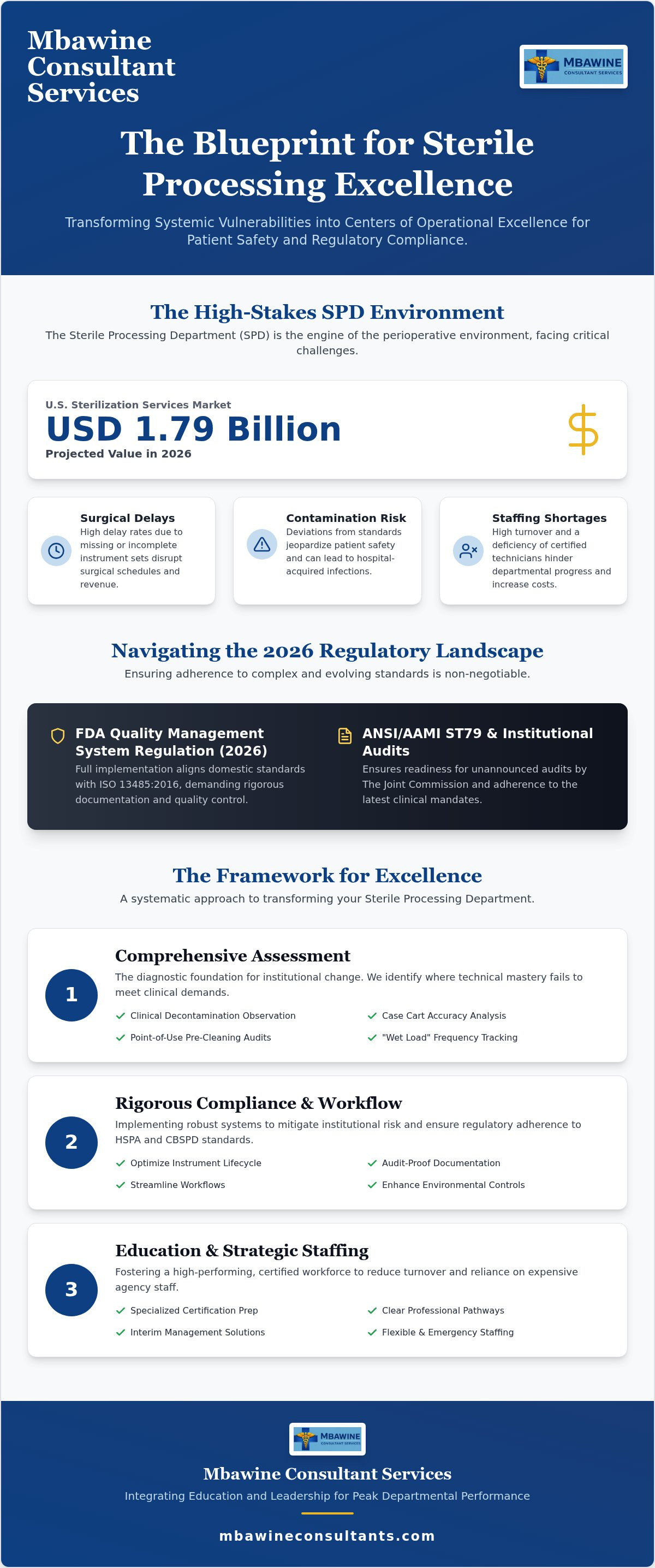
The U.S. sterilization services market is projected to reach USD 1.79 billion in 2026, yet many healthcare facilities continue to struggle with high surgical delay rates and the persistent threat of contaminated instrumentation. You understand that the Sterile Processing Department (SPD) serves as the critical engine of the perioperative environment, where even a minor deviation from ANSI/AAMI ST79 standards can jeopardize patient safety and institutional accreditation. Professional sterile processing consultant services provide the rigorous clinical oversight required to transform these high-stakes environments from points of systemic vulnerability into centers of operational excellence. By engaging with seasoned experts, hospital leadership can systematically address the root causes of staff turnover and the deficiency of certified technicians that frequently hinder departmental progress.
This comprehensive guide explores how specialized consulting identifies critical operational gaps, ensures adherence to the 2026 FDA Quality Management System Regulation, and establishes sustainable educational frameworks for long-term success. You'll discover a strategic roadmap for achieving a high-performing, compliant SPD staffed by competent professionals who are fully prepared for the complexities of modern surgical demands. We will examine the methodologies used to eliminate missing instruments and provide the foundation for a department that prioritizes both regulatory precision and patient outcomes.
Professional sterile processing consultant services represent a critical intervention for healthcare institutions seeking to align their central service operations with the rigorous demands of modern perioperative medicine. These services function as a comprehensive audit and optimization vehicle, moving beyond surface-level checklists to evaluate the fundamental integrity of sterilization processes within the facility. There's a direct, measurable correlation between the performance of the Sterile Processing Department (SPD) and the hospital's primary revenue stream: the operating room. When instrument sets are missing, incomplete, or contaminated, surgical schedules collapse. This leads to substantial financial losses and compromised patient safety. By engaging external experts, facilities can bridge the gap between entry-level technical requirements and advanced institutional mastery.
The regulatory environment in 2026 has become increasingly complex, particularly following the full implementation of the FDA's Quality Management System Regulation. This shift aligns domestic standards with ISO 13485:2016, placing unprecedented emphasis on documentation and quality control for any outsourced or in-house sterilization activity. Specialized third-party assessments are no longer optional; they're essential for maintaining institutional readiness for unannounced audits by The Joint Commission. Consultants analyze evolving expectations for documentation accuracy and the impact of AAMI ST79:2017 (reaffirmed 2022) updates on departmental workflows. They ensure that every environmental parameter, from humidity to air quality, meets the most current clinical mandates, effectively shielding the organization from the risk of non-compliance.
Beyond compliance, the economic incentives for optimization are profound. Quantifying the cost of surgical delays reveals that even a brief setback due to instrument bioburden can erode the profitability of a surgical case. Professional consultants assist leadership in reducing capital expenditure by implementing superior instrument lifecycle management protocols, preventing the premature degradation of expensive surgical assets. This precision extends to human capital. By establishing clear professional pathways and providing specialized certification preparation, facilities can mitigate the national staffing crisis. This strategy reduces reliance on expensive agency spend and fosters a culture of long-term staff retention. It transforms the SPD into a high-performing unit that supports the hospital's fiscal and clinical objectives. Through interim management and 24/7 emergency staffing support, consultants provide a critical safety net during these essential departmental transitions.
A comprehensive Sterile Processing Department (SPD) assessment serves as the diagnostic foundation for institutional change, beginning with a meticulous initial tour and clinical observation of both the decontamination and assembly areas. During this phase, it's essential to evaluate the adherence to point-of-use pre-cleaning protocols and the efficacy of manual cleaning processes, as these initial steps dictate the microbial safety of the entire sterilization cycle. It's through this meticulous lens that sterile processing consultant services identify where the department's technical mastery fails to meet the institution's clinical demands. Beyond visual inspection, the assessment incorporates a quantitative analysis of case cart accuracy and the frequency of "wet loads," which provide objective data regarding the reliability of the department's output and the functionality of its equipment.
Interviews with Operating Room (OR) leadership are conducted to identify systemic communication breakdowns that frequently lead to surgical delays and physician frustration. Simultaneously, a thorough review of existing training protocols and certification percentages is performed to determine if the workforce aligns with HSPA or CBSPD standards. This audit of human capital is as critical as the audit of physical assets, as it reveals the underlying causes of staff turnover and technical errors. By synthesizing these diverse data points, consultants can construct a roadmap that addresses both the immediate clinical risks and the long-term educational needs of the facility.
This phase identifies operational gaps by assessing workflow bottlenecks that impede the sterilization cycle, particularly in the transition from the decontamination area to the clean assembly side. It evaluates whether current equipment and technology support are adequate for the facility's specific surgical volume and device complexity. Hidden inefficiencies in materials management, such as disorganized inventory or inadequate par levels for critical consumables, are often exposed during this rigorous inquiry. These findings allow the consultant to propose targeted re-engineering strategies that improve the overall throughput and reliability of the department.
Establishing benchmarks for instrument set accuracy is paramount for measuring the success of sterile processing workflow consulting. These metrics link departmental performance directly to patient safety outcomes by reducing the risk of surgical site infections and ensuring that every tray delivered to the surgical suite is functionally perfect. By measuring the effectiveness of current sterilization monitoring and biological testing protocols, sterile processing consultant services provide the clarity needed for sustained improvement. For departments seeking to elevate their internal standards and achieve long-term stability, exploring professional certification pathways through accredited classes remains a primary recommendation for establishing a permanent baseline of technical competence.
Sustainable excellence in the Sterile Processing Department (SPD) is not achieved through isolated interventions but through the simultaneous optimization of workflow, compliance, and education. Comprehensive sterile processing consultant services treat these elements as interdependent variables rather than separate silos. By re-engineering workflows to mirror industry best practices and conducting rigorous compliance auditing against HSPA and CBSPD standards, facilities can create a resilient operational environment. The integration of sterile processing compliance consulting serves as a primary vehicle for risk mitigation, ensuring that every protocol is defensible and clinically sound. This holistic approach transforms the department from a reactive support unit into a proactive center of excellence that can withstand the pressures of high surgical volumes.
Optimizing the reprocessing cycle requires the implementation of Lean principles within the decontamination room to eliminate wasted movement and reduce instrument dwell times. This modernization focuses on the assembly and sterilization sequence, particularly for high-turnover trays that are critical to maintaining the surgical schedule. Effective workflow design also necessitates enhancing communication between the SPD and the Operating Room, fostering a collaborative atmosphere that reduces friction and improves instrument availability. These systematic changes ensure that the department can handle increasing surgical volumes without compromising quality or safety. Consultants analyze these interactions to remove bottlenecks that frequently lead to missing instruments or delayed starts. It's through this methodical re-engineering that departments achieve the throughput necessary for institutional growth.
The most sophisticated workflow will eventually fail without a workforce grounded in technical mastery. Mandatory certification is no longer a luxury but the new standard for SPD excellence, providing technicians with the theoretical knowledge required to manage complex instrumentation. Integrating sterile processing classes directly into the consulting roadmap ensures that staff members don't just follow instructions but understand the underlying microbiology and regulatory requirements. This educational focus facilitates the development of internal mentorship programs, creating a sustainable framework for long-term departmental health and professional growth. It bridges the gap between basic job performance and professional expertise. By fostering a culture of continuous learning, facilities can significantly reduce turnover and ensure that the department remains compliant with the evolving 2026 regulatory landscape. Education is the catalyst for permanent operational change.
Selecting a partner for sterile processing consultant services requires a rigorous evaluation of their capacity to lead through organizational transition, rather than merely providing a passive assessment of existing conditions. Leadership in this high-stakes environment demands a proven track record in improving certification pass rates for departmental staff, as technical competency serves as the primary safeguard against surgical site infections. A viable consulting partner must demonstrate absolute transparency in their reporting structures and implementation timelines, ensuring that hospital administration remains fully informed of progress and potential obstacles. It's the ability to provide flexible staffing solutions during the optimization phase that distinguishes a truly comprehensive service provider from a standard auditing firm.
Interim leadership serves as a critical bridge during periods of crisis or leadership vacancies, stabilizing the department's daily operations while simultaneously implementing the consultant's strategic recommendations. These interim leaders provide the necessary clinical oversight to prevent operational regression, ensuring that the momentum gained during the initial audit is maintained until a permanent leadership placement is secured. The strategic advantage of a partner who can provide immediate emergency sterile processing staffing can't be overstated, as it offers a vital safety net that allows the department to continue meeting surgical demands without compromising safety standards. This dual capacity for management and staffing ensures a seamless transition toward institutional excellence.
When assessing the methodology of sterile processing consultant services, leadership must differentiate between firms that offer generic reports and those that provide highly customized solutions tailored to the facility's unique surgical profile. A seasoned consultant possesses the interpersonal and professional expertise to handle staff resistance to change, transforming skepticism into engagement through clear communication of the benefits of professionalization. This transformation requires a profound depth of knowledge in healthcare sterilization training, as the consultant must act as both a mentor and an authoritative expert. By prioritizing these criteria, institutions ensure they're investing in a partnership that delivers permanent improvements rather than temporary compliance. To begin the process of professionalizing your departmental workforce through accredited education, your staff can enroll in specialized certification classes designed to meet the highest industry standards.
Mbawine Consultant Services operates on the fundamental principle that sustainable institutional change is impossible without a foundation of technical mastery. While traditional sterile processing consultant services often focus exclusively on equipment or architectural layout, our philosophy positions education as the primary catalyst for operational transformation. We provide a dual-track solution that combines high-level sterile processing department optimization strategies with the immediate provision of certified, competent talent. This approach ensures that the strategic roadmap we establish isn't merely a theoretical document but a living framework executed by professionals who understand the clinical gravity of their work. We don't just identify gaps. We provide the people to close them. Institutional leadership can schedule a consultation to begin the process of aligning their department with the highest standards of safety and efficiency.
Our organization maintains a distinguished track record in preparing technical staff for the rigorous requirements of HSPA and CBSPD certification. We believe that empowering the existing workforce through advanced technical mastery is the most effective way to reduce staff turnover and improve patient safety outcomes. Our CRCST-focused educational programs are designed to bridge the gap between entry-level performance and professional expertise. This ensures that every technician is equipped to handle the complexities of modern surgical instrumentation. By fostering a culture of academic and professional reliability, we help facilities meet the evolving regulatory expectations of 2026. Mastery is essential. Patient safety is non-negotiable. Our classes are available in both in-person and online formats to accommodate the diverse needs of your facility.
During periods of departmental transition or crisis, our staffing and alumni network provides a critical safety net for healthcare facilities. We offer interim management services that focus on establishing a culture of compliance while stabilizing daily operations. This ensures that the momentum of optimization isn't lost during leadership vacancies. Our 24/7 emergency staffing capabilities allow departments to maintain surgical throughput without compromising the integrity of the sterilization cycle. We act as a seasoned mentor. We act as an authoritative expert. Enrolling your team in our professional development pathways represents a definitive commitment to institutional excellence and public safety. This integrated model of sterile processing consultant services and education provides the foundation for a resilient and high-performing department. By uniting high-level institutional strategy with grassroots professional training, we ensure your facility is prepared for the challenges of the modern healthcare environment.
The path toward a high-performing Sterile Processing Department requires a deliberate synthesis of clinical workflow re-engineering and a commitment to workforce professionalization. You've seen how professional sterile processing consultant services serve as the vital link between identifying systemic vulnerabilities and implementing sustainable, certification-focused frameworks. By prioritizing adherence to AAMI and Joint Commission standards, healthcare facilities don't just achieve regulatory compliance; they establish a culture where patient safety is the primary metric of success.
This transformation is supported by a dual-track approach that combines high-level institutional strategy with the immediate provision of certified technical talent. As an authoritative expert in HSPA and CBSPD certification standards, our organization provides the interim management and 24/7 staffing options necessary to stabilize your operations during these critical periods of growth. We maintain a national reach dedicated to fostering excellence across the central service landscape. Mastery changes everything. It's time to bridge the gap between entry-level requirements and advanced technical mastery to ensure your facility's long-term operational resilience. Explore Our Comprehensive Sterile Processing Consulting and Management Services to begin your journey toward departmental excellence.
Sterile processing consultant services encompass a multi-dimensional assessment of departmental operations, including a rigorous audit of sterilization cycles, decontamination protocols, and environmental parameters. These services facilitate the identification of systemic vulnerabilities and provide a strategic roadmap for aligning workflows with the latest ANSI/AAMI ST79 standards. Beyond clinical oversight, they include the implementation of sustainable educational frameworks that prepare technical staff for professional certification while ensuring that all documentation meets the most current regulatory expectations.
The duration of a departmental optimization project varies significantly based on the initial assessment findings and the specific institutional goals, though most comprehensive transformations require several months to achieve sustainable cultural change. This timeline allows for the systematic re-engineering of workflows, the delivery of specialized certification prep classes, and the stabilization of leadership through interim management. A methodical pace ensures that operational improvements are deeply integrated into the department's daily routines rather than serving as temporary fixes.
Specialized sterile processing consultant services prioritize the professionalization of the workforce by offering comprehensive preparation for HSPA and CBSPD certification examinations. These programs move beyond basic technical instruction to provide a deep understanding of the microbiological and regulatory principles required for the CRCST and other professional credentials. By integrating these classes into the consulting roadmap, institutions ensure that their staff members possess the technical mastery necessary to maintain long-term departmental excellence and patient safety.
Consultants provide essential clinical oversight to ensure that every aspect of the sterilization process aligns with the evolving expectations of The Joint Commission and the 2026 FDA Quality Management System Regulation. This assistance includes a thorough review of documentation accuracy, environmental monitoring protocols, and the efficacy of biological testing cycles. By conducting pre-audit assessments, consultants identify and rectify non-compliance issues before they result in institutional findings, effectively shielding the organization from regulatory risk and accreditation challenges.
An SPD audit serves as a diagnostic tool that identifies specific operational gaps and regulatory deficiencies, whereas professional consulting involves the active implementation of strategic solutions and long-term mentorship. While an audit provides the necessary data for institutional change, specialized consulting bridges the gap between diagnosis and excellence by providing the leadership, training, and workflow re-engineering required for permanent optimization. Consulting represents a comprehensive commitment to departmental health that extends far beyond the initial identification of problems.
Mbawine Consultant Services provides experienced interim management professionals who specialize in stabilizing departmental operations during periods of leadership transition or organizational crisis. These interim leaders act as seasoned mentors who implement the strategic recommendations identified during the initial assessment while maintaining the integrity of daily sterilization cycles. This service ensures that the department continues to meet surgical demands while the institution identifies and places permanent leadership, preventing any regression in operational or clinical standards.
Consulting services improve operating room efficiency by systematically reducing the frequency of surgical delays caused by missing instrumentation, incomplete case carts, or bioburden contamination. By optimizing the reprocessing cycle and enhancing communication between the SPD and perioperative leadership, consultants ensure that every surgical suite receives the necessary assets on schedule. This precision directly correlates to improved surgical revenue and patient outcomes, as the operating room can maintain a predictable and high-volume schedule without departmental interruptions.
Facilities can secure 24/7 emergency staffing support to maintain operational continuity while their departmental workflows are being reorganized or during periods of critical technician shortages. This staffing solution acts as a vital safety net, providing certified and competent professionals who can execute the updated protocols immediately. It allows the institution to pursue long-term optimization goals without compromising the immediate needs of the surgical department, ensuring that patient safety remains the primary institutional focus throughout the transition.

Article by
Mba Akuribila
Mba‑Akuribila is a healthcare leader, educator, and founder of Mbawine Consultants, a Bronx‑based institution recognized nationwide for advancing excellence in sterile processing and allied health workforce development. Born in Bongo in Ghana’s Upper East Region, his journey from rural beginnings to national impact reflects a lifelong commitment to service, empowerment, and community advancement.
For over two decades, he has trained sterile processing employees, mentored, and placed thousands of healthcare professionals across the United States. Through Mbawine Consultants, he established one of the country’s most trusted Sterile Processing Certification Test Prep Programs, preparing new Americans and career‑changers for successful entry into the field. The organization, as at 2026, has graduated more than 15,000 sterile processing technicians who now serve in hospitals, ambulatory centers, dental practices, and reprocessing facilities nationwide.
Under his leadership, Mbawine Consultants has expanded into a full Healthcare Staffing Agency, connecting nurses and allied health professionals to meaningful employment opportunities. His team also provides Interim Management Services, supporting hospitals and surgical centers with experienced leaders who stabilize operations, strengthen compliance, and improve workflow efficiency.
As a former surgical technician, sterile processing manager, educator, and system‑wide director, Mba‑Akuribila brings deep expertise to Sterile Processing Consulting, helping healthcare facilities elevate quality, safety, and regulatory readiness.
His work in the United States and Ghana continues to reflect his core philosophy: service above self, opportunity for all, and excellence without compromise.


