

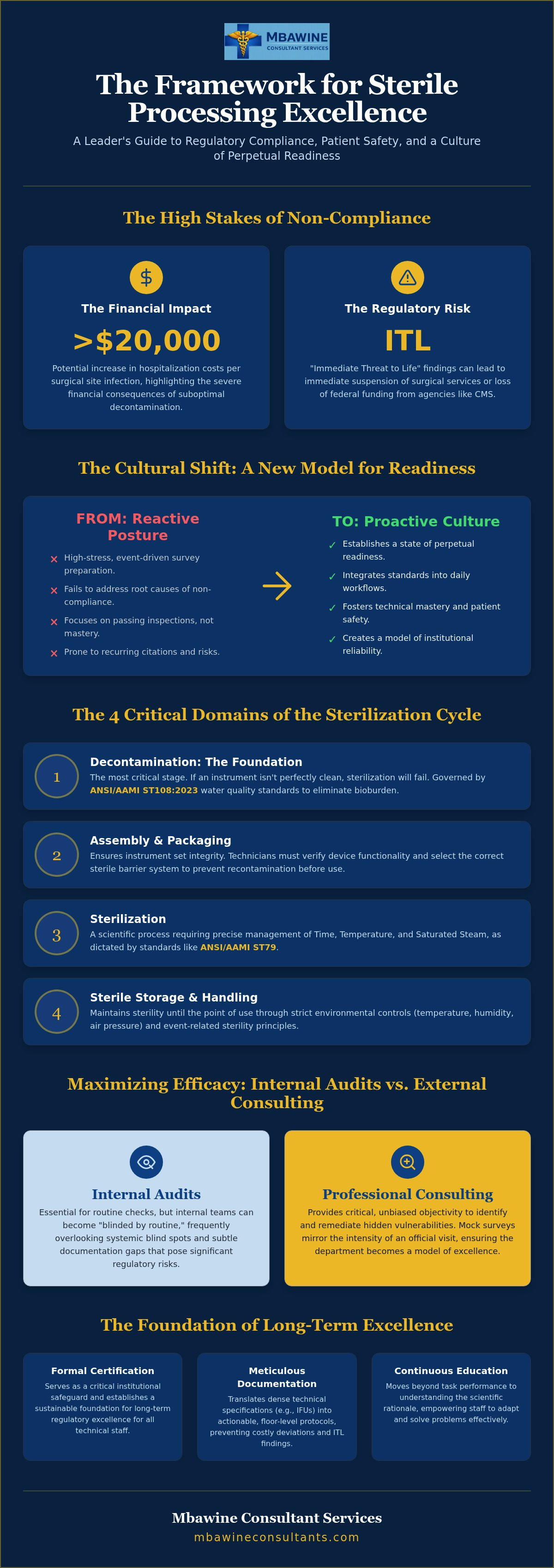
With surgical site infections potentially increasing hospitalization costs by more than $20,000 per occurrence, the financial and clinical consequences of a suboptimal decontamination cycle are far too severe for any modern healthcare institution to ignore. You likely recognize that maintaining a constant state of survey readiness is not merely about passing a periodic Joint Commission or DNV inspection but is instead about establishing a durable culture of technical mastery and patient safety. This guide serves as an authoritative framework for sterile processing compliance consulting, offering healthcare leaders a systematic method to assess, remediate, and sustain regulatory excellence within the Sterile Processing Department.
We'll explore the critical 2026 updates to ANSI/AAMI ST108 regarding water quality and the ongoing revisions to ST79 that dictate stringent environmental controls. By standardizing workflows to eliminate bioburden and the persistent issue of "wet loads," your institution can finally bridge the chronic communication gap between the operating room and the sterile processing team. This comprehensive audit checklist provides the necessary technical depth to transform your department from a site of regulatory risk into a model of institutional reliability and continuous professional development.
The regulatory architecture for medical device reprocessing isn't a static set of suggestions but a mandatory framework where ANSI/AAMI provides the technical methodology, CMS establishes federal expectations for patient safety, and The Joint Commission verifies institutional implementation. Standards aren't suggestions. For healthcare leadership, the traditional model of survey readiness often functions as a reactive, high-stress event that fails to address the root causes of non-compliance. A superior approach involves transitioning to a proactive institutional culture where every technician views their role through the lens of a perpetual audit. Professional sterile processing compliance consulting operates as a critical risk-mitigation tool within this environment, providing the specialized oversight necessary to identify vulnerabilities before they escalate into regulatory citations or patient harm. The 2026 updates from AORN and the ongoing revisions to foundational AAMI standards have placed a renewed emphasis on high-level disinfection (HLD) and the necessity of borescope inspections for complex endoscopes, reflecting a zero-tolerance policy toward residual bioburden.
As the definitive guide for steam sterilization and sterility assurance, ANSI/AAMI ST79:2017 (reaffirmed in 2022) remains the technical cornerstone of the Central Sterile Services Department (CSSD). It's not enough for a facility to simply possess the manual. Departments must translate these dense technical specifications into actionable, floor-level protocols that technicians can execute with absolute precision. Expert consultants assist in this translation by developing robust, documented competency assessments. These ensure every staff member isn't just performing a task but understands the scientific rationale behind each step of the sterilization loop. This level of technical literacy is the only way to ensure that sterile processing compliance consulting leads to sustainable, long-term improvements rather than temporary fixes.
The stakes of a regulatory visit are exceptionally high. Immediate Threat to Life (ITL) findings can lead to the immediate suspension of surgical services or the loss of federal funding. Many of these findings stem from failures in meticulous documentation or deviations from the manufacturer's Instructions for Use (IFU). By utilizing professional consulting services, facilities can conduct unbiased mock surveys that mirror the intensity of an official accreditation visit. These assessments provide an objective perspective on the entire sterilization cycle. They identify the subtle documentation gaps that internal teams, often blinded by routine, might overlook. This rigorous external review process ensures that when the official surveyors arrive, the department isn't just ready; it's a model of institutional excellence.
A resilient sterilization cycle depends on the meticulous execution of four distinct yet interdependent domains. Decontamination remains the most critical and often overlooked stage. If an instrument isn't physically clean, subsequent sterilization processes will fail because residual bioburden acts as a shield for microorganisms. Sterile processing compliance consulting emphasizes that decontamination isn't merely a preliminary step; it's a rigorous chemical and mechanical process now governed by ANSI/AAMI ST108:2023 water quality standards. Following cleaning, the assembly and packaging phase ensures instrument set integrity. Technicians must verify the functionality of each device and select the appropriate barrier system to prevent recontamination. The sterilization phase itself requires precise management of time, temperature, and saturated steam. Finally, sterile storage maintains these results through strict environmental controls and the principles of event-related sterility, ensuring that the package remains a barrier until the point of use.
Facility infrastructure must align with AAMI and ASHRAE standards to mitigate the risk of airborne contaminants. In sterile storage areas, the temperature must remain between 68°F and 73°F, with relative humidity maintained between 30% and 60%. A minimum of four total air changes per hour with positive pressure is required to protect processed goods. Institutional leaders often benefit from sterile processing workflow consulting to ensure a physical separation between "clean" and "dirty" zones. This structural divide is essential for preventing cross-contamination. Storage clearances are equally vital; items must be kept 8 inches off the floor, 18 inches below sprinkler heads, and 2 inches from outside walls to ensure adequate airflow and fire safety compliance. For departments struggling with these physical constraints, pursuing advanced technical certification for leadership can provide the expertise needed to manage complex facility requirements.
A robust quality assurance program relies on consistent biological and chemical monitoring to validate the efficacy of every sterilization cycle. Load documentation and lot control systems are mandatory for effective recall management. These records provide a traceable history that confirms every item in a specific load met the necessary parameters. Sterility Assurance Level (SAL) is defined as the probability of a single viable microorganism remaining on an item after sterilization. Achieving an SAL of 10⁻⁶ is the industry standard for critical medical devices. Maintaining this level of precision requires sterile processing compliance consulting that focuses on the integration of technical data and administrative oversight to ensure that no compromised set ever reaches a patient.
Internal assessments are frequently compromised by the 'blind spot' phenomenon, where familiar operational shortcuts become normalized over time and eventually accepted as standard practice. External sterile processing compliance consulting introduces the clinical objectivity necessary to dissect these systemic failures before they result in regulatory citations. While an internal audit might verify that a sterilization log is signed, an external consultant evaluates whether the technical parameters recorded actually align with the specific manufacturer's Instructions for Use (IFU). The financial justification for this level of scrutiny is absolute. Each surgical site infection (SSI) can increase hospitalization costs by $20,000 or more, meaning the cost of a single preventable infection often exceeds the entire investment in a comprehensive compliance audit. This rigorous external review is the essential catalyst for strategic sterile processing department optimization, shifting the department from a reactive state of survival to a model of institutional excellence.
Recognizing when a department has reached a critical threshold of risk is a primary leadership responsibility. Indicators such as high 'wet pack' rates, frequent delays in the operating room, and escalating physician dissatisfaction are clear signals that internal processes are no longer sufficient to ensure patient safety. In these high-stakes environments, interim management often becomes a prerequisite for stabilization. These seasoned leaders provide the steady hand needed during institutional transitions, ensuring that compliance reforms are not just suggested but actively implemented on the floor. This interim oversight bridges leadership gaps and prevents the degradation of standards while a permanent leadership strategy is finalized.
True compliance isn't found in a 'binder on the shelf' that technicians only consult when a surveyor enters the building. It's a living practice that requires consistent reinforcement. Effective sterile processing compliance consulting recommendations must be paired with hands-on staff training and rigorous competency verification. Measuring the efficacy of an engagement requires tracking data-driven Key Performance Indicators (KPIs), such as biological indicator failure rates, tray accuracy percentages, and water quality metrics as defined by the new ST108 standards. By developing a partnership with a specialized educational consultancy, institutions move beyond the temporary fixes of 'embedded' models. They instead build a foundation of technical mastery and long-term self-sufficiency that can withstand the rigors of any regulatory audit.
Executing a technical audit requires more than a cursory observation of departmental activities; it demands a systematic verification of every variable within the sterilization loop. Professional sterile processing compliance consulting provides the rigorous framework necessary to transform these observations into actionable data. This 2026 audit checklist serves as a technical instrument to identify operational deviations before they manifest as clinical failures or regulatory citations. Institutional leaders must move beyond the assumption of compliance and instead demand documented proof of adherence to the following critical checkpoints.
The integrity of a department's record-keeping system is the primary evidence used by surveyors to determine institutional reliability. Every sterilization load must have a corresponding record that includes physical parameters, chemical indicator results, and biological monitoring data where applicable. It's essential to verify that sterilizer maintenance logs are current and include detailed third-party service reports that correlate with internal testing results. Furthermore, staff training records must transcend simple attendance logs; they should include specific, documented competency assessments for complex instrumentation and high-level disinfection processes. Maintaining this level of administrative precision is a core component of sterile processing compliance consulting, as it ensures that the department's technical performance is legally and professionally defensible.
A high-functioning department must maintain a seamless communication loop with the Operating Room to ensure instrument sets are complete and sterile at the point of use. Regular audits of case carts are necessary to identify missing or substituted instruments, which frequently lead to surgical delays and physician dissatisfaction. In the sterile storage area, auditors must inspect for compromised packaging, improper stacking, or expired event-related sterility indicators. A critical metric for 2026 is the documented reduction of immediate-use steam sterilization (IUSS), which should only occur in strictly defined emergency scenarios. To establish a culture that prioritizes these advanced technical standards, healthcare leaders should encourage their teams to enroll in specialized certification programs that provide the foundational knowledge required for modern compliance.
The technical integrity of a department is fundamentally limited by the clinical knowledge of its workforce. While equipment and workflow optimization are essential, the human element remains the primary variable in achieving long-term regulatory stability. Research consistently demonstrates a direct correlation between the presence of certified technicians and a measurable reduction in surgical site infections. Clinical mastery is non-negotiable. This is precisely why mandatory certification is rapidly becoming the national standard for institutional excellence. Professional sterile processing compliance consulting must therefore include a robust educational component that transcends basic orientation. By leveraging specialized sterile processing classes, healthcare leaders can build a workforce that doesn't just follow instructions but understands the underlying microbiology and physics of sterilization. Mbawine Consultant Services bridges the critical gap between entry-level training and advanced mastery, acting as a guardian of industry standards through rigorous academic preparation.
Establishing a baseline of clinical knowledge through CRCST certification is an essential risk-mitigation strategy. Structured education programs reduce the dangerous variability in technician performance that often leads to inconsistent compliance outcomes. When every member of the team is trained to the same high standard, the likelihood of errors in the decontamination or assembly phases decreases significantly. Competency is the foundation of safety. This educational foundation encourages a culture of lifelong learning and professional advocacy within the department. Technicians who are professionally certified are more likely to identify and report potential breaches in protocol; they serve as a critical internal audit mechanism. Transforming the staff into a proactive defense force is the ultimate goal of high-level sterile processing compliance consulting.
Achieving a state of perpetual survey readiness requires a holistic approach that integrates technical audits, workflow optimization, and continuous professional development. It's no longer sufficient to treat compliance as a periodic event. It must be an institutional value woven into the daily operations of the department. Standards must be lived. Empowering your team to act as the first line of defense secures the future of your department and the well-being of every patient who enters your facility. To begin this transformation, institutional leaders should enroll in a professional development program to elevate your department's standards and establish a sustainable framework for clinical excellence.
Transitioning a department from a state of reactive survey preparation to a model of proactive institutional excellence requires a synthesis of technical precision, administrative oversight, and continuous professional development. This framework has detailed the critical necessity of adhering to the 2026 ANSI/AAMI ST108 water quality standards and the foundational role of documented competency assessments in mitigating clinical risk. By integrating professional sterile processing compliance consulting into your institutional strategy, you ensure that your department possesses the external objectivity required to identify systemic vulnerabilities before they compromise patient safety or regulatory standing.
Mbawine Consultant Services stands as a guardian of these industry standards, offering national expertise in interim SPD management and specialized CRCST certification preparation designed for first-time success. Whether your facility requires comprehensive 24/7 emergency staffing solutions or a structured pathway toward technical mastery, our programs provide the stability needed to navigate the evolving regulatory landscape. We invite you to Enroll in Mbawine's Professional Certification and Consulting Programs to secure the future of your department. Elevating your standards today establishes the durable foundation necessary for the safety and success of your clinical operations tomorrow.
A consultant provides an objective technical evaluation of departmental workflows, documentation, and equipment performance to ensure alignment with ANSI/AAMI and CMS requirements. They identify specific regulatory vulnerabilities and develop actionable remediation strategies. This process often includes a thorough review of sterilization logs and physical environment controls. By utilizing sterile processing compliance consulting, institutional leaders gain a clear roadmap for achieving a state of perpetual survey readiness while minimizing clinical risk.
Healthcare institutions should ideally schedule a professional compliance audit once per calendar year to ensure adherence to evolving standards like ANSI/AAMI ST79 and ST108. Facilities experiencing high technician turnover or frequent "wet load" events should consider bi-annual assessments. These regular reviews prevent the normalization of deviance within the department. Consistency is key. Annual audits establish a reliable baseline for performance and demonstrate a commitment to patient safety during accreditation surveys.
The most frequent citations involve failures in documenting sterilizer cycles, deviations from manufacturer Instructions for Use (IFU), and improper environmental monitoring of temperature or humidity. Surveyors also prioritize the physical separation of clean and dirty zones. Many departments struggle with maintaining current staff competency records. These common pitfalls highlight why sterile processing compliance consulting is essential for identifying documentation gaps before an official inspection occurs and leads to potential citations.
Professional certification establishes a standardized baseline of technical and clinical knowledge that significantly reduces the probability of reprocessing errors. Certified technicians demonstrate a deeper understanding of microbiology and the scientific principles behind decontamination. This expertise leads to more consistent adherence to technical protocols. Institutions that prioritize certification often report lower rates of bioburden and higher tray accuracy, which directly contributes to the overall regulatory excellence of the facility.
Interim management provides the necessary leadership stability to enforce compliance standards during periods of institutional transition or leadership vacancies. These seasoned professionals implement rigorous oversight and bridge communication gaps between the SPD and the Operating Room. They ensure that departmental protocols don't degrade while the facility searches for permanent leadership. This specialized oversight is a critical component of a broader risk management strategy during high-stakes organizational shifts.
Achieving total compliance is exceptionally difficult without external oversight because internal teams often develop "blind spots" to routine procedural shortcuts. While internal audits are valuable, they lack the technical objectivity of an external specialist. A consultant brings national perspective and up-to-date knowledge of the latest AAMI revisions. External validation is the most reliable method for ensuring that every technical variable meets the most current federal and accreditation standards.
The primary distinction lies in the level of objectivity and technical depth provided by an external specialist. Internal teams may unintentionally overlook systemic issues because they've become accustomed to specific departmental constraints. A professional assessment utilizes a rigorous, evidence-based methodology to evaluate technical performance against national benchmarks. This external review identifies subtle documentation and workflow errors that internal "mock surveys" frequently fail to capture during routine assessments.
The 2026 AORN guidelines have strengthened recommendations for the use of borescopes to inspect the internal channels of complex instruments. There's also an increased emphasis on enhanced PPE in the decontamination area, including fluid-resistant gowns with thumb loops. These updates reflect a zero-tolerance policy toward residual bioburden and staff exposure. Staying current with these specific technical requirements is a primary focus of modern compliance consulting to ensure patient safety.

Article by
Mba Akuribila
Mba‑Akuribila is a healthcare leader, educator, and founder of Mbawine Consultants, a Bronx‑based institution recognized nationwide for advancing excellence in sterile processing and allied health workforce development. Born in Bongo in Ghana’s Upper East Region, his journey from rural beginnings to national impact reflects a lifelong commitment to service, empowerment, and community advancement.
For over two decades, he has trained sterile processing employees, mentored, and placed thousands of healthcare professionals across the United States. Through Mbawine Consultants, he established one of the country’s most trusted Sterile Processing Certification Test Prep Programs, preparing new Americans and career‑changers for successful entry into the field. The organization, as at 2026, has graduated more than 15,000 sterile processing technicians who now serve in hospitals, ambulatory centers, dental practices, and reprocessing facilities nationwide.
Under his leadership, Mbawine Consultants has expanded into a full Healthcare Staffing Agency, connecting nurses and allied health professionals to meaningful employment opportunities. His team also provides Interim Management Services, supporting hospitals and surgical centers with experienced leaders who stabilize operations, strengthen compliance, and improve workflow efficiency.
As a former surgical technician, sterile processing manager, educator, and system‑wide director, Mba‑Akuribila brings deep expertise to Sterile Processing Consulting, helping healthcare facilities elevate quality, safety, and regulatory readiness.
His work in the United States and Ghana continues to reflect his core philosophy: service above self, opportunity for all, and excellence without compromise.


