

The efficacy of a surgical intervention is fundamentally dependent on the meticulous, invisible labor performed within the decontamination suite. Obtaining a sterile processing tech certification in 2026 represents more than a personal achievement; it's a professional mandate for those serving as the primary guardians of patient advocacy and surgical excellence. Many candidates feel paralyzed by the technical rigor of the national examinations or the logistical challenge of securing 400 hours of mandatory clinical experience. You likely find yourself caught between the divergent requirements of the HSPA and CBSPD pathways, wondering which credential best serves your long-term career objectives.
We recognize that navigating these institutional standards requires a level of precision that mirrors the technical work itself. This guide provides a definitive, professional roadmap to mastering the certification process and ensuring first-attempt success. By following this structured approach, you'll gain a comprehensive understanding of the 2026 professional standards and the strategic steps necessary to unlock higher earning potential. We'll examine the specific clinical requirements, examination preparation techniques, and the professional benchmarks that define excellence in the field today.
The acquisition of a sterile processing tech certification has evolved from a recommended credential into the definitive benchmark for professional competence within the contemporary surgical support environment. As we progress through 2026, the standards governing infection prevention have become increasingly stringent, reflecting a global awareness of the risks associated with improper instrument handling. This professional mandate ensures that every individual operating within the Central Sterile Services Department (CSSD) possesses a verified understanding of the physiological and chemical processes required to achieve total sterility. Regulatory bodies across numerous jurisdictions are transitioning toward mandatory certification requirements. They acknowledge that the technical proficiency of the technician is directly correlated with the reduction of perioperative risks. This shift prioritizes patient safety while establishing a clear professional identity for those dedicated to the sterilization arts.
Patient safety is inextricably linked to the efficacy of the sterilization cycle. Surgical site infections (SSIs) remain a primary concern for healthcare institutions, often resulting in prolonged hospitalization and increased morbidity. The technician carries a profound professional responsibility to interrupt the chain of infection. This duty involves more than a cursory cleaning process; it requires a systematic, evidence-based approach to instrument decontamination and high-level disinfection. Every tool must be treated with the gravity its future use in a human body demands. When technicians adhere to rigorous, certified standards, they provide a critical layer of defense that protects vulnerable patients from preventable harm. It's a mission-driven role that requires absolute precision.
The introduction of sophisticated medical technology, such as robotic-assisted surgical systems and instruments with microscopic lumens, has fundamentally altered the requirements for sterile processing tech certification. These innovations demand specialized knowledge that exceeds traditional cleaning methods. Technicians must now master intricate disassembly protocols and validated drying techniques to ensure no bioburden remains in hidden recesses. Continuous education is no longer optional. It's a necessity for those who wish to remain relevant in a field defined by rapid technological advancement. Achieving these recognized credentials doesn't just satisfy a regulatory hurdle. It also establishes a foundation for professional growth, allowing dedicated specialists to transition into leadership roles or specialized consultancy positions within the healthcare infrastructure.
The pursuit of professional excellence within the sterile processing department necessitates a deliberate selection of credentialing pathways. Candidates typically evaluate two primary certifying bodies: the Healthcare Sterile Processing Association (HSPA) and the Certification Board for Sterile Processing and Distribution (CBSPD). Both organizations maintain rigorous standards accredited by the American National Standards Institute (ANSI), yet they offer distinct administrative structures and examination philosophies. Selecting a sterile processing tech certification requires an understanding of how these pathways align with your long-term career trajectory and the specific requirements of your prospective employer. In 2026, the industry continues to prioritize certifications that demonstrate a deep mastery of complex instrumentation and validated sterilization processes.
The Certified Registered Central Service Technician (CRCST) designation, issued by HSPA, remains the most widely recognized entry-level benchmark in the field. It establishes a baseline of professional competence that's respected by major healthcare systems. While both HSPA and CBSPD credentials facilitate national reciprocity, subtle differences in their renewal cycles and continuing education (CE) requirements may influence your decision. HSPA requires an annual renewal process accompanied by 12 CE credits, whereas CBSPD operates on a five-year recertification cycle necessitating 50 to 100 points depending on the specific credential held.
HSPA's curriculum focuses intensely on the technical nuances of central service and advanced instrumentation. This organization provides a tiered professional development ladder that allows technicians to specialize after achieving their initial sterile processing tech certification. These specializations include the Certified Instrument Specialist (CIS) and the Certified Endoscope Reprocessor (CER). These specialized roles are increasingly critical as surgical technology becomes more intricate. Many successful candidates utilize Mbawine CRCST preparation to ensure they possess the specialized guidance required to navigate these dense technical domains and institutional standards.
The CBSPD examination methodology often integrates broader aspects of distribution and material management alongside sterilization protocols. This body offers a diverse range of certifications, including technician, supervisor, and management levels, which may appeal to those focused on the logistics of the surgical supply chain. While HSPA is often the preferred choice for large acute care hospitals, CBSPD maintains a strong presence in ambulatory surgery centers and specialized clinics. Aspiring technicians who are ready to begin their professional journey may enroll in professional training to ensure they meet these rigorous 2026 standards regardless of the specific pathway they choose. Ultimately, the choice between HSPA and CBSPD should reflect your commitment to maintaining the highest level of professional reliability and patient safety.
Establishing a career in surgical support begins with a clear understanding of the eligibility criteria mandated by national credentialing bodies. Candidates must first secure a high school diploma or its equivalent before they can initiate the formal application process for a sterile processing tech certification. This academic baseline serves as the foundation for the complex technical knowledge required to manage modern medical instrumentation. Once this prerequisite is met, the candidate's focus shifts to the dual requirements of theoretical knowledge and practical application. Most professionals choose to pursue the Healthcare Sterile Processing Association's CRCST status, which necessitates a rigorous 400-hour clinical internship. It's possible to sit for the examination prior to completing these hours, resulting in a 'provisional' certification status. This provisional designation provides a six-month window for the technician to document their hands-on experience under the supervision of a department manager.
The clinical experience requirement is structured to ensure comprehensive exposure to the six core functional areas of the department. These include decontamination, preparation and packaging, sterilization and disinfection, storage and distribution, equipment management, and quality assurance. Securing a clinical placement requires a proactive approach, often involving direct engagement with local hospital administrators or volunteer departments. During this period, professional conduct is paramount. Technicians must demonstrate absolute precision in their tasks and a steadfast commitment to institutional safety protocols. A successful internship is defined by several key performance indicators:
Choosing the correct educational path is a critical decision that influences examination performance and long-term technical mastery. While some individuals attempt self-study using industry textbooks, the inherent complexity of high-level disinfection and sterilization chemistry often necessitates a more structured approach. Enrolling in professional sterile processing classes provides access to expert instructors who can clarify difficult concepts and offer real-world context that textbooks alone cannot provide. This instructor-led training is particularly beneficial for those seeking a sterile processing tech certification, as it specifically addresses the 2026 standards for endoscope reprocessing and robotic instrument care. Professional consultancy services further bridge the gap by offering tailored educational programs that align with current institutional standards and public safety mandates.
The final phase in achieving professional recognition is the successful completion of the national board examination. This assessment isn't merely a test of rote memorization; it's a comprehensive evaluation of a candidate's ability to apply rigorous technical standards within high-pressure clinical scenarios. Achieving a sterile processing tech certification requires a deep understanding of the core domains established by the certifying bodies, specifically focusing on decontamination, sterilization, and equipment management. Many candidates mistakenly believe the exam is a hurdle of basic knowledge, yet the technical depth required to differentiate between sterilization parameters and chemical indicators often proves challenging. We recommend a methodical study schedule spanning 8 to 12 weeks. This timeframe facilitates the transition from superficial recognition to a foundational mastery that ensures long-term professional reliability.
Preparation must include the utilization of practice examinations that precisely mirror the Prometric testing environment. Familiarity with the digital interface and the pacing required to address 150 complex questions is as critical as the technical content itself. Candidates who engage in simulated testing scenarios often report lower levels of anxiety and higher rates of first-attempt success. It's essential to treat these practice sessions with the same gravity as the actual examination, adhering to strict time limits and eliminating external distractions to build the necessary mental endurance.
Success on the examination is predicated on a candidate's fluency in the language of the sterile processing department. This involves developing a systematic approach to memorizing surgical instrumentation and the specific sterilization parameters required for various materials. A central pillar of this knowledge base is the ANSI/AAMI standards, which provide the evidence-based guidelines that the examination questions are built upon. Understanding these institutional standards is vital for the decontamination section, where technical concepts are tested with extreme precision. For instance, bioburden refers to the number of microorganisms on a contaminated object before sterilization or disinfection. Mastering these definitions allows the technician to navigate the dense technical language found in the examination's most challenging segments.
Optimizing performance on the day of the examination requires a clear understanding of the logistics involved in the Prometric testing process. Candidates must arrive at the testing center at least 30 minutes prior to their scheduled appointment and possess the required forms of government-issued identification. During the three-hour examination period, effective time management is paramount. It's advisable to move steadily through the questions, marking complex scenarios for later review rather than allowing a single difficult item to disrupt your momentum. If you find that your current study methods aren't yielding the desired confidence, you should schedule professional consultation to develop a personalized preparation strategy. To ensure you have access to the most comprehensive training resources available, you may enroll in our certification prep courses today.
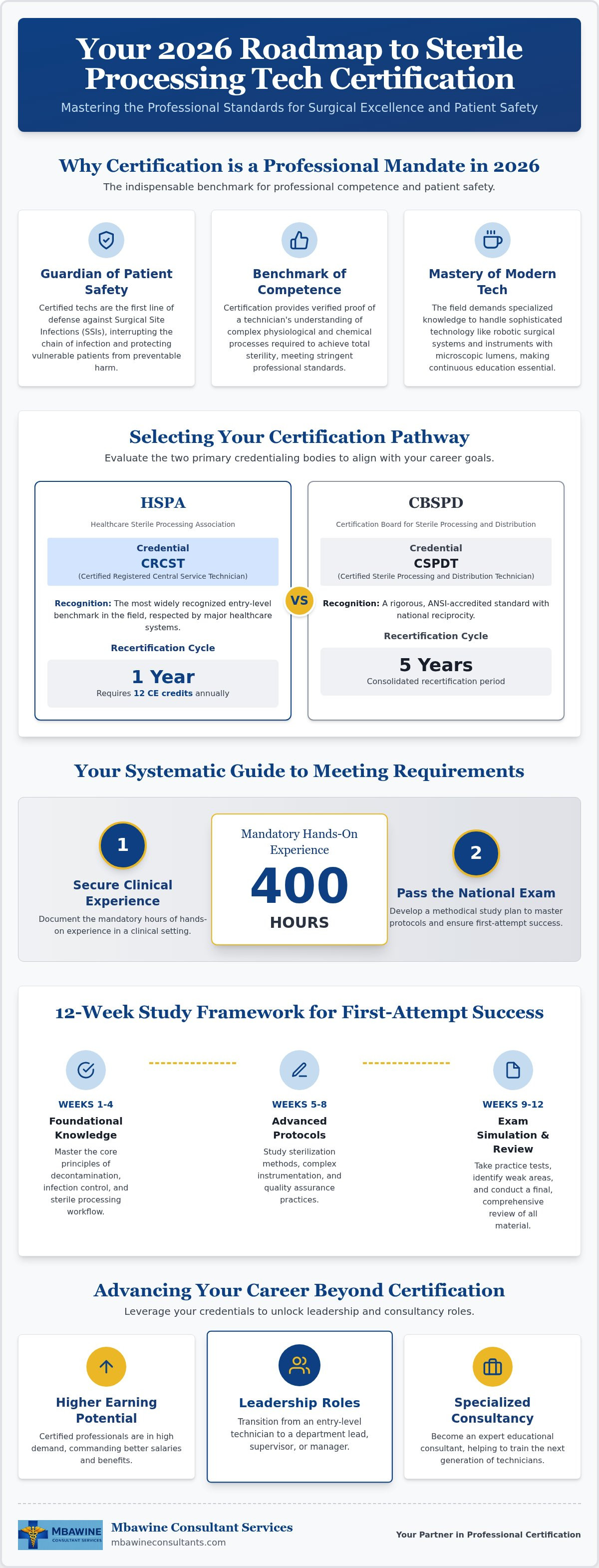
Achieving a sterile processing tech certification is the foundational step in a career defined by technical mastery and patient advocacy. However, the professional lifecycle of a technician doesn't conclude with initial credentialing. For those committed to excellence, the trajectory extends into leadership roles, such as lead technician or department manager, where the focus shifts from individual execution to institutional oversight. Specialized credentials, including the Certified Instrument Specialist (CIS) designation, significantly enhance your professional value by demonstrating a verified expertise in complex surgical trays and delicate micro-instruments. Leveraging Mbawine staffing solutions allows certified professionals to identify high-level career opportunities that align with their advanced skill sets and professional ambitions.
Transitioning from technical execution to departmental management requires a strategic shift in perspective. The Certified Healthcare Leader (CHL) designation is specifically designed for those seeking to oversee complex sterile processing operations. This credential requires technicians to master budgetary management, personnel development, and the implementation of quality assurance programs. It's a role that demands both technical knowledge and administrative precision. Professionals looking to bridge the gap between entry-level service and senior management often find that enrolling in advanced classes provides the structured educational framework necessary for this evolution. Leadership in this field isn't just about authority; it's about safeguarding the standards that protect every patient who enters the operating theater.
The pinnacle of a sterile processing career often involves transitioning into interim management or professional consultancy. These roles provide the flexibility of temporary staffing assignments while allowing experienced technicians to apply their expertise to optimize hospital workflows and ensure strict regulatory compliance. Consultants serve as essential auditors, identifying gaps in decontamination protocols and implementing validated sterilization processes that meet the highest industry standards. These high-stakes positions are critical for maintaining department continuity during leadership transitions or facility expansions. If you're prepared to elevate your professional standing and explore the full potential of your sterile processing tech certification, we invite you to contact us for personalized guidance on your professional development journey.
Managing the intricate requirements of infection prevention in 2026 demands a steadfast commitment to the highest institutional standards. Mastering the technical nuances of the HSPA or CBSPD pathways and meticulously documenting the mandatory clinical experience are the vital steps required to establish yourself as a guardian of public safety. Obtaining your sterile processing tech certification isn't merely a regulatory milestone; it's a profound professional mandate that validates your expertise in managing the sophisticated medical instrumentation of the modern surgical suite. This definitive roadmap ensures you're prepared to meet the technical rigor of the national examinations while positioning yourself for long-term career advancement.
We're dedicated to acting as a bridge between your current aspirations and advanced technical mastery through our expert-led curriculum and comprehensive support for the CRCST and CBSPD pathways. Our organization offers specialized training and unique access to national staffing and interim management opportunities for those who demonstrate excellence in the field. You're invited to enroll in professional sterile processing classes to begin your certification journey today. Your dedication to this specialized field ensures the continued integrity of surgical outcomes and the safety of every patient under your care.
Certification isn't mandated by federal law in every state, but a growing number of jurisdictions have enacted specific legislation requiring technicians to be certified. Regardless of state-level mandates, most acute care hospitals and surgical centers require a sterile processing tech certification as a condition of employment. This institutional requirement ensures that all staff members possess a verified understanding of the complex protocols necessary to maintain patient safety and surgical excellence.
The duration of the certification process generally ranges from four to eight months. This timeline includes approximately 8 to 12 weeks of intensive academic preparation followed by the completion of 400 hours of mandatory clinical experience. The speed of completion often depends on the technician's ability to secure a clinical placement and the frequency of their scheduled hours within the decontamination and sterilization suites.
HSPA and CBSPD examinations must be completed in person at a proctored Prometric testing center. This requirement ensures a secure and standardized testing environment that protects the integrity of the professional credential. Candidates are required to follow strict identification and arrival protocols to participate in the assessment. Online testing is currently not an option for these high-stakes technical certifications to ensure the highest security standards.
If you pass the examination before completing your clinical requirements, you're granted a provisional certification. This status allows you to work in the field while you finish the 400 hours of hands-on experience required for full status. You must submit the completed documentation, signed by a department manager, within six months of passing the exam to avoid the expiration of your provisional credential and the requirement to retest.
Candidates must consult the official HSPA or CBSPD portals to verify current examination fees for 2026. These administrative costs are determined by the certifying bodies and cover the processing of the application and the technical seat at the testing facility. It's advisable to review these costs early in your preparation phase to ensure all financial requirements are met before scheduling your examination date to avoid administrative delays.
The HSPA CRCST examination utilizes a scaled scoring system where a score of 700 is the minimum threshold for passing. This system ensures that the technical rigor remains consistent across different versions of the test. A passing result indicates that the candidate has demonstrated the foundational knowledge and technical proficiency required to operate safely within a modern sterile processing environment, reflecting a mastery of complex decontamination and sterilization protocols.
Renewal cycles depend on which certifying body issued your sterile processing tech certification. HSPA requires an annual renewal process accompanied by 12 continuing education credits to ensure technicians stay current with evolving technology. In contrast, CBSPD operates on a five-year recertification cycle that requires a higher volume of points. Consistent renewal is a professional obligation that signals your commitment to industry excellence and the safety of the surgical patients you serve.
You can often secure employment as a technician-in-training or an intern before achieving full certification. Many healthcare institutions provide pathways for entry-level staff to gain their required 400 hours of clinical experience on the job. These positions are typically contingent upon the employee successfully passing their national board examination within a predetermined window, usually between six and twelve months of their start date, ensuring they meet professional standards.

Article by
Mba Akuribila
Mba‑Akuribila is a healthcare leader, educator, and founder of Mbawine Consultants, a Bronx‑based institution recognized nationwide for advancing excellence in sterile processing and allied health workforce development. Born in Bongo in Ghana’s Upper East Region, his journey from rural beginnings to national impact reflects a lifelong commitment to service, empowerment, and community advancement.
For over two decades, he has trained sterile processing employees, mentored, and placed thousands of healthcare professionals across the United States. Through Mbawine Consultants, he established one of the country’s most trusted Sterile Processing Certification Test Prep Programs, preparing new Americans and career‑changers for successful entry into the field. The organization, as at 2026, has graduated more than 15,000 sterile processing technicians who now serve in hospitals, ambulatory centers, dental practices, and reprocessing facilities nationwide.
Under his leadership, Mbawine Consultants has expanded into a full Healthcare Staffing Agency, connecting nurses and allied health professionals to meaningful employment opportunities. His team also provides Interim Management Services, supporting hospitals and surgical centers with experienced leaders who stabilize operations, strengthen compliance, and improve workflow efficiency.
As a former surgical technician, sterile processing manager, educator, and system‑wide director, Mba‑Akuribila brings deep expertise to Sterile Processing Consulting, helping healthcare facilities elevate quality, safety, and regulatory readiness.
His work in the United States and Ghana continues to reflect his core philosophy: service above self, opportunity for all, and excellence without compromise.


