

What if the financial impact of a sterilization-related surgical site infection extends well beyond the cost of treating the infection? The cost of a surgical site infection due to sterilization error can include additional care, a longer hospital stay, and disruption to clinical operations, but no single estimate captures every consequence. The CDC reports that an SSI can extend a patient’s hospital stay by an average of 9.7 days. That figure describes SSIs broadly, not costs proven to result from a sterilization error.
Healthcare leaders need clear figures, yet published estimates vary according to the patient population, infection severity, and costs included. A suspected sterilization failure also doesn’t, by itself, establish that it caused an infection. This article explains the main direct and indirect cost categories, how to distinguish an observed association from a defensible causal finding, and why investigation matters before assigning financial responsibility.
You’ll also learn how organizations can review sterile processing workflows, identify workforce and process risks, and strengthen staff capability through education and operational support. The goal is a careful, evidence-informed assessment that recognizes the systems-level burden without overstating what the available evidence can prove.
A surgical site infection (SSI) affects the incision, deeper tissues, or an organ or space involved in a surgical procedure. The Surgical Site Infection overview describes these categories and the range of factors involved. A sterilization deviation may prompt an investigation, but it does not establish that an instrument caused a patient’s infection. Establishing that connection requires evidence about the specific event, exposure, clinical course, and other plausible sources of infection.
Attributable cost is the additional resource use or expense reasonably linked to an SSI, compared with what would likely have occurred without it. This is an analytical definition, not a ready-made invoice. The result depends on the comparison and the costs included. A facility should distinguish costs associated with treating an SSI from costs defensibly attributed to a sterilization error. The first relationship may be clinically evident; the second requires investigation and evidence.
Estimates vary because SSIs are not uniform events. Procedure type, a patient’s clinical circumstances, infection depth, pathogen, treatment pathway, and length of care can all affect resource use. The accounting method matters too. Billed charges are amounts submitted for payment, not necessarily the resources a facility consumed or the expense it ultimately incurred. Patient-level, episode-level, and facility-level calculations therefore answer different questions and shouldn’t be presented as interchangeable measures.
Direct clinical costs can include diagnostic evaluation, medication, wound management, additional procedures, and inpatient treatment. Readmission may add costs if the patient needs care after discharge, while some infections can be managed without it. Requirements depend on the infection’s depth and severity, the organism involved, the patient’s health, and the original procedure. For a useful estimate, identify which services were additional to the expected course of care rather than treating every charge in the episode as infection-related.
Operational effects may include additional bed use, staff time for treatment and coordination, postponed procedures, and work to investigate a possible processing breakdown. Facilities can track these effects through capacity records, scheduling data, staffing time, and investigation documentation, although they may not appear on the patient’s bill. Their scale depends on the event and the facility’s response; none should be assumed for every SSI.
Potential longer-term consequences also require careful interpretation. A confirmed event may lead to further review, corrective work, or process changes, each requiring organizational resources. Reputational effects, legal exposure, or broader financial consequences are possible in some circumstances, but they are not automatic costs of an SSI and shouldn’t be recorded as realized losses without supporting evidence. Keeping direct care, operational disruption, and context-dependent downstream effects in separate categories gives leaders a clearer basis for analysis and communication.
A sterilization-related SSI is possible through a chain of events, not simply because a process record contains a deviation. A breakdown could leave a device inadequately processed or compromise its sterile state before use. If a contaminated instrument then exposes a patient during surgery, infection may follow. Each link requires examination. A deviation can warrant prompt review without proving that contamination occurred, that exposure took place, or that it caused a specific infection.
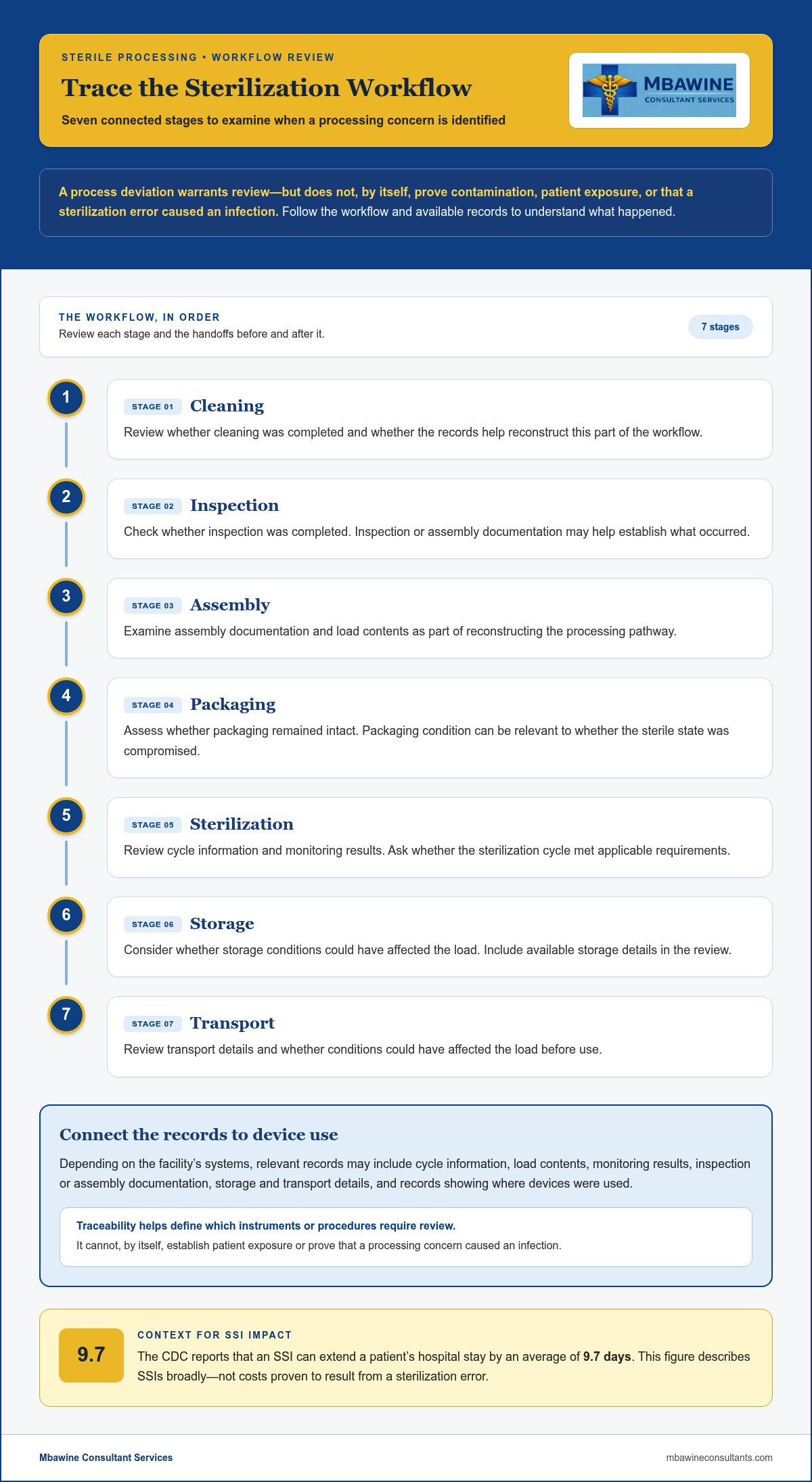
Sterile processing depends on connected stages: cleaning, inspection, assembly, packaging, sterilization, storage, and transport. A concern at one point can prompt questions about the preceding and following steps. For example, investigators may examine whether cleaning and inspection were completed, whether packaging remained intact, whether the sterilization cycle met applicable requirements, and whether storage or transport conditions could have affected the load.
Documentation helps reconstruct that pathway. Depending on the facility’s systems, relevant records may include cycle information, load contents, monitoring results, inspection or assembly documentation, storage and transport details, and records identifying where devices were used. Traceability can help define which instruments or procedures require review, but it cannot, by itself, establish patient exposure or causation. Facilities should assess current authoritative standards and their own approved procedures rather than rely on an outdated version or generalized summary.
An identified process deviation is evidence of a workflow concern, not proof that it caused an individual patient’s infection. A temporal association, such as an infection diagnosed after surgery involving a device from a questioned load, may justify investigation. A plausible contamination pathway adds context. Demonstrating patient-level causation requires a stronger assessment of clinical and process evidence together.
Infection risk is multifactorial. Patient health and other clinical circumstances, the procedure itself, environmental conditions, and post-operative care may all be relevant. Infection prevention, sterile processing, surgical and other clinical teams, and risk management should assess the available evidence together. This helps avoid assigning responsibility to one department before evaluating the facts across the full care pathway. The CDC Guidelines for Surgical Site Infection Prevention provide broader SSI prevention context, but an investigation still needs to address the specific event and facility records.
This distinction also shapes financial analysis. The cost of a surgical site infection due to sterilization error should not be calculated by treating every expense associated with an SSI as attributable to a processing deviation. First establish what clinical and operational resources were used. Then document which, if any, can reasonably be linked to the suspected failure. A careful review can identify process weaknesses even when causation remains undetermined. Role-appropriate sterile processing education can reinforce consistent understanding of workflow responsibilities as one part of a broader quality system.
A credible estimate begins by defining what is being measured. A patient-level estimate examines additional resources used by one patient; an episode-level estimate aggregates costs across a defined course of care; a facility-level estimate may assess broader effects, such as staff time or disrupted capacity. These measures answer different questions. A national estimate, even when useful for describing overall burden, cannot be applied directly as the cost of a particular patient’s SSI or a single sterilization event.
For each reported figure, state the population, timeframe, included cost categories, and source. Explain whether the amount reflects actual resource costs, billed charges, or another financial measure. Present the cost of a surgical site infection due to sterilization error as an attributable estimate only when the clinical and process review supports that connection. If attribution or financial data remain unresolved, label the figure provisional and describe what is still under review.
Build the estimate from records that can be reconciled: relevant clinical documentation, utilization data, sterile processing and department logs, and finance definitions for the costs being counted. Compare observed use with a documented baseline or an appropriate comparator, using consistent inclusion criteria. For example, specify whether the estimate includes additional treatment only or also investigation time and operational disruption. If records are incomplete, disclose the limitation rather than implying precision.
| Cost category | Evidence to review | Attribution limitation |
|---|---|---|
| Additional clinical care | Clinical records, treatment, medication, readmission, and utilization data | Separate resources associated with the infection from care expected for the original procedure. |
| Processing investigation | Department logs, cycle and load records, staff time, and review documentation | An investigation’s expense does not establish that a process deviation caused the infection. |
| Operational disruption | Scheduling, capacity, staffing, and postponed-procedure records | Record documented effects; don’t assume every SSI disrupts facility operations. |
Use language that reflects the strength of the evidence. “An SSI occurred after a procedure involving a questioned load” describes timing. “The review identified a possible pathway” describes a hypothesis. Neither statement alone confirms causation. Reserve definitive attribution for conclusions supported by the relevant clinical and process evidence. Clinical investigation findings, legal conclusions, and finance estimates serve different purposes and should be reported separately.
Leaders can make uncertainty useful by documenting what is known, what remains under review, and when the estimate will be revisited. A finance figure may be reasonably calculated even while patient-level causation is undetermined, but it should not be represented as a proven loss caused by sterilization error. For process context, teams can also consult current healthcare sterilization standards and verify that the guidance they use applies to the specific process under review.
A disciplined response protects patient care while giving leaders a defensible basis for operational and financial decisions. The review should follow a clear sequence, with infection prevention, sterile processing, clinical teams, quality, risk, and finance participating according to their responsibilities. The aim is to establish what happened, identify process weaknesses, and distinguish documented costs from those that remain uncertain.
Include the people who can interpret the evidence, not only those who maintain the records. Depending on the event, this may include sterile processing leaders, infection prevention, operating room staff, clinical teams, quality, risk, and finance. Handle patient information and incident documentation according to facility privacy, reporting, and disclosure policies. Legal questions depend on jurisdiction and circumstances; refer them to qualified counsel rather than treating a quality review as legal advice.
Use findings to assess competency, workflow, supervision, staffing, and adherence to facility procedures without presuming that one factor explains the event. A gap may call for role-appropriate education, clearer process controls, or operational support. Sterile processing consulting and interim management can support facilities reviewing department processes and workforce needs. Education and operational changes are components of a broader quality system, not guarantees against infection.
Facilities seeking to strengthen staff knowledge as part of that system can explore sterile processing education and support. A careful, documented review helps leaders assess the cost of a surgical site infection due to sterilization error without treating association as proof of causation.
Education and operational support can help facilities build consistent sterile processing practices, but neither guarantees that an SSI will be prevented. They are most useful as components of a facility-wide quality system that also includes clear procedures, appropriate oversight, reliable workflows, and ongoing evaluation. Reviewing a process concern or financial estimate can help leaders identify where staff knowledge, departmental capacity, or workflow support may need attention.
Role-appropriate learning can support onboarding, reinforce competencies, and address knowledge gaps identified through supervision, process reviews, or changes in assigned responsibilities. Certification preparation can provide a structured learning pathway for professionals pursuing certification. Facilities can align education with the tasks staff perform and reinforce learning through established procedures and competency processes. CRCST certification preparation is one educational resource, and sterile processing certification education can fit within broader staff development.
Training is most useful when it responds to an identified need rather than serving as a stand-alone corrective action. If a review identifies inconsistent understanding of a processing step, for example, education can reinforce the relevant knowledge while leaders also assess whether procedures, supervision, workload, and workflow support consistent practice. This keeps responsibility at the system level and avoids assuming that an individual knowledge gap explains every process deviation.
Consulting and interim management can support a facility’s assessment of department workflows, operational priorities, and management needs. Temporary staffing can help address workforce capacity needs. Consider these forms of support in relation to the facility’s assessment and objectives; they do not establish that a particular cause has been identified or guarantee a clinical outcome. Information about sterile processing consulting and interim management can help leaders consider operational support alongside internal improvement planning.
For a structured assessment, facilities can connect findings to specific actions: clarify process ownership, identify where staff need additional instruction, review how work is supervised, and define measures for follow-up. Leaders should document responsibilities and revisit whether changes are being applied consistently. The cost of a surgical site infection due to sterilization error cannot be reduced to a training decision; sound improvement planning considers clinical, procedural, and workforce factors together.
For readers assessing staff development needs, sterile processing education and support can be one part of strengthening workforce capability within a broader quality system.
A facility’s response to a suspected sterilization-related infection can become an opportunity to strengthen the systems that support safe, consistent work. Consider which staff capabilities and operational resources best support your next improvement priority, then make workforce development part of that plan. A careful approach to the cost of a surgical site infection due to sterilization error depends not only on sound analysis, but also on sustained attention to the people and processes involved.
Mbawine Consultant Services offers online and in-person sterile processing classes, certification preparation for sterile processing professionals, and operational support through consulting, interim management, and temporary staffing. These services can contribute to a broader quality effort, while clinical outcomes remain dependent on the facility’s full system of care and controls.
Explore sterile processing classes and certification preparation as a practical next step in supporting staff knowledge and professional development. With deliberate planning and ongoing learning, healthcare organizations can continue strengthening the practices that protect patients and support reliable sterile processing.
There is no single universal amount for the cost of a surgical site infection due to sterilization error. A hospital’s estimate depends on the procedure, the patient’s condition, infection severity, additional care, and how finance defines cost. Published research may describe different populations or cost categories, so it provides context rather than a substitute for reviewing a particular case. An SSI-related expense also isn’t automatically attributable to a sterilization issue.
A sterilization error can be investigated as a possible contributor, but a process deviation alone can’t prove it caused an SSI in a particular patient. Reviewers need to connect records about the device and processing pathway with clinical findings and other relevant exposures. Timing can justify questions, but it doesn’t establish causation. The conclusion should come from multidisciplinary evidence review, not an isolated cycle record or an assumption about preventability.
An estimate may include additional diagnostics, medication, procedures, or inpatient care when needed, as well as utilization such as added bed days. Facility analyses may separately record staff time spent coordinating care, reviewing an event, or adjusting schedules. These categories shouldn’t be collapsed: patient damages, a facility’s resource expense, and broader societal costs measure different things. State the categories and timeframe so readers can interpret the estimate.
No. An SSI may reflect a combination of patient-related, procedural, environmental, and post-operative factors; sterile processing is one element of infection prevention. An infection alone therefore doesn’t demonstrate that instruments were improperly processed. Facilities should compare clinical findings with relevant processing and use records, considering other possible explanations before drawing a conclusion. The review should identify what evidence supports or weakens a possible link rather than presume a single cause.
A hospital can assess a possible link by bringing together infection prevention, sterile processing, relevant clinical teams, quality, risk, and finance as appropriate. Compare device traceability and cycle documentation with the patient’s procedure, clinical course, and other pertinent information. Record the evidence, gaps, and uncertainty, then assign follow-up actions. No single indicator, such as a cycle record or diagnosis timing, should determine the conclusion by itself.
Training can support staff knowledge and consistent practice, particularly when it addresses an identified competency gap or onboarding need. Its content should align with facility procedures and staff responsibilities; instruction alone can’t address every factor, including equipment condition, workload, supervision, or monitoring. Facilities can pair learning with observation and competency review, then address identified process barriers. Education is one part of a quality system, not a promise of fewer infections or errors.
Follow facility procedures for coordinating patient-care review, escalating the concern, documenting the event, and preserving relevant records. Notify appropriate stakeholders, which may include sterile processing, infection prevention, clinical leadership, quality, and risk. Keep documentation factual and distinguish confirmed findings from hypotheses. The facility should follow its own policies and seek qualified professional guidance for questions specific to the circumstances; jurisdiction-specific legal questions should be directed to qualified counsel.

Article by
Mba Akuribila
Mba‑Akuribila is a healthcare leader, educator, and founder of Mbawine Consultants, a Bronx‑based institution recognized nationwide for advancing excellence in sterile processing and allied health workforce development. Born in Bongo in Ghana’s Upper East Region, his journey from rural beginnings to national impact reflects a lifelong commitment to service, empowerment, and community advancement.
For over two decades, he has trained sterile processing employees, mentored, and placed thousands of healthcare professionals across the United States. Through Mbawine Consultants, he established one of the country’s most trusted Sterile Processing Certification Test Prep Programs, preparing new Americans and career‑changers for successful entry into the field. The organization, as at 2026, has graduated more than 15,000 sterile processing technicians who now serve in hospitals, ambulatory centers, dental practices, and reprocessing facilities nationwide.
Under his leadership, Mbawine Consultants has expanded into a full Healthcare Staffing Agency, connecting nurses and allied health professionals to meaningful employment opportunities. His team also provides Interim Management Services, supporting hospitals and surgical centers with experienced leaders who stabilize operations, strengthen compliance, and improve workflow efficiency.
As a former surgical technician, sterile processing manager, educator, and system‑wide director, Mba‑Akuribila brings deep expertise to Sterile Processing Consulting, helping healthcare facilities elevate quality, safety, and regulatory readiness.
His work in the United States and Ghana continues to reflect his core philosophy: service above self, opportunity for all, and excellence without compromise.


