

The difference between a successful surgical outcome and a catastrophic healthcare-associated infection often rests entirely upon the technical precision and ethical rigor of the sterile processing department. Achieving a high level of expertise in hspa sterile processing requires more than just manual dexterity, as it demands a comprehensive mastery of complex decontamination, sterilization, and distribution protocols that safeguard patient health. Many dedicated professionals find the path to formal certification daunting, particularly when they must reconcile the rigorous 400-hour clinical requirement with the high failure rates historically associated with the CRCST examination. You likely understand that balancing a demanding full-time career with the intensive academic preparation needed to meet these national standards presents a significant obstacle to your professional growth.
This guide provides the structured, authoritative framework necessary to overcome these institutional hurdles and secure your professional standing within the healthcare ecosystem. We will examine the critical distinctions between HSPA and CBSPD credentials, detail the systematic steps for attaining the CRCST designation, and outline the strategic pathways for advancing into leadership and specialized management roles.
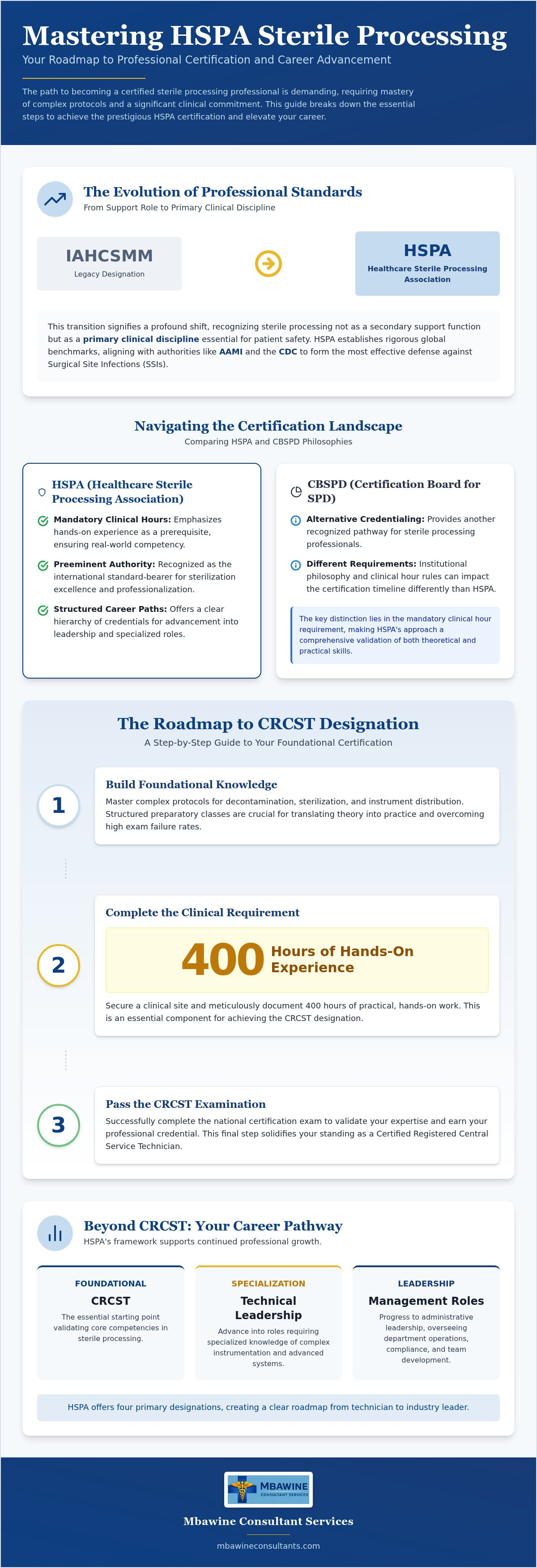
The Healthcare Sterile Processing Association (HSPA) functions as the preeminent international authority regarding the systematic sterilization and decontamination of medical instrumentation. This organization provides the foundational standards that govern the critical workflows within central service departments. The transition from the legacy designation of IAHCSMM to HSPA signifies a profound ideological shift toward the professionalization of the field. It represents a move away from viewing the department as a secondary support function of "materiel management" and toward recognizing it as a primary clinical discipline. By establishing rigorous benchmarks for hspa sterile processing, the association ensures that technicians possess the specialized knowledge required to operate in increasingly complex surgical environments. This evolution reflects an industry-wide acknowledgement that the technical mastery of reprocessing is as vital to patient outcomes as the surgical procedure itself.
The expertise of certified professionals remains the most effective defense against the proliferation of Surgical Site Infections (SSIs), which continue to pose significant risks to patient safety and institutional stability. As we move through 2026, the updated standards emphasize the necessity of integrated technology and automated reprocessing systems. These advancements are designed to mitigate human error while ensuring that every instrument meets the stringent parameters for high-level disinfection or sterilization. Failure to adhere to these evolving standards can lead to catastrophic clinical failures and severe regulatory consequences for healthcare facilities.
Historically, sterile processing was frequently relegated to secondary operations with limited institutional visibility; however, the modern healthcare environment has transformed these departments into high-stakes clinical environments. Mandatory certification has become a cornerstone of this evolution, directly impacting patient safety and substantially reducing hospital liability by ensuring a standardized level of competency. HSPA serves as a guardian of these industry standards through its commitment to professional advocacy and institutional governance. This ensures that technicians aren't merely laborers but are recognized as essential guardians of public health. For those seeking to meet these high standards, specialized CRCST preparation is often the critical first step toward professional recognition.
The efficacy of HSPA standards is reinforced by their close alignment with guidelines established by the Association for the Advancement of Medical Instrumentation (AAMI) and the Centers for Disease Control and Prevention (CDC). This harmonization of protocols creates a unified front in the battle against pathogenic transmission. The global footprint of HSPA certification continues to expand, with international healthcare facilities increasingly adopting these rigorous credentialing requirements to ensure cross-border clinical excellence. HSPA stands as the definitive standard-bearer for sterilization excellence in 2026, providing the technical and ethical framework necessary for the safe delivery of surgical care.
The HSPA credentialing framework establishes a clear hierarchy of professional competence, ensuring that every level of the department operates with verified technical proficiency. This tiered system allows for a logical progression from entry-level technical roles to specialized clinical mastery and eventually to administrative leadership. By categorizing these designations, the association provides a roadmap for career advancement that aligns with the increasing complexity of modern surgical environments. Each credential serves as a formal validation of a professional's ability to maintain the integrity of the reprocessing lifecycle.
The Certified Registered Central Service Technician (CRCST) designation serves as the foundational entry point for anyone pursuing a career in hspa sterile processing. This certification validates a technician's mastery over core competencies, including decontamination, high-level disinfection, sterilization, and complex inventory management. The "Registered" status is particularly significant, as it signifies that the professional has not only passed a rigorous theoretical examination but has also completed the mandatory 400 hours of hands-on clinical experience. You can review the full CRCST Certification Requirements to understand the specific documentation needed for this status. This foundational step is essential for establishing professional credibility within any healthcare institution.
Beyond the foundational level, HSPA offers advanced certifications designed for those seeking to refine their technical focus or transition into department management. These paths allow for specialization that meets the specific operational needs of diverse medical facilities. The strategic selection of these certifications should be based on your long-term career trajectory and the specific technical challenges you wish to master within the field of hspa sterile processing.
Selecting the appropriate certification requires a strategic assessment of your professional goals. Whether you aim to become a technical subject matter expert or a department director, each path demands a methodical approach to academic and clinical preparation. To ensure you are positioned for success in these high-stakes examinations, consider enrolling in professional sterile processing classes that provide the didactic depth required for national credentialing.
The choice between the Healthcare Sterile Processing Association (HSPA) and the Certification Board for Sterile Processing and Distribution (CBSPD) represents a pivotal decision for any technician aiming for professional longevity. While both bodies are accredited by the National Commission for Certifying Agencies (NCCA), they diverge significantly in their institutional philosophies and eligibility criteria. HSPA maintains a rigorous clinical immersion model, whereas CBSPD provides a more flexible framework that accommodates various educational and professional backgrounds. Many Tier-1 trauma centers and high-volume surgical facilities prioritize hspa sterile processing credentials because the mandatory clinical hours ensure a baseline of operational competency that theoretical study alone cannot replicate. This employer preference reflects a broader industry belief that the hands-on mastery of complex instrumentation is the most reliable predictor of success in high-pressure clinical environments.
The most prominent distinction lies in HSPA's mandatory 400-hour clinical requirement, which many prospective technicians view as a formidable barrier to entry. This requirement isn't an arbitrary hurdle; it's a badge of quality that signifies a candidate has successfully performed decontamination, sterilization, and assembly tasks under direct supervision. In contrast, CBSPD offers multiple eligibility paths, including those based on the completion of an intensive sterile processing training program or 12 months of full-time employment. Documenting these hours for HSPA requires a methodical approach to verification, as each hour must be signed off by a supervisor or manager to ensure the integrity of the professional's training record. This rigorous verification process protects the industry's standards and ensures that only those with proven technical ability achieve full certification.
A comparative analysis of the exam blueprints reveals subtle but critical differences in how each body weights technical competencies. HSPA examinations typically place a heavy emphasis on the systematic application of standards, specifically focusing on the intersection of decontamination protocols and patient safety outcomes. CBSPD exams often distribute weight across the entire lifecycle of a medical device, including distribution and storage logistics. Understanding these nuances is essential for technicians who wish to align their preparation with the specific demands of their current or future employers. For facilities seeking to optimize their departmental performance, utilizing professional sterile processing services can help bridge the gap between individual certification and institutional excellence. Both organizations require a longitudinal commitment to recertification, though HSPA's annual cycle demands a more frequent engagement with continuing education compared to CBSPD's five-year window.
The path toward professional validation in hspa sterile processing is a methodical undertaking that requires a dual commitment to academic excellence and clinical mastery. It's not a journey that can be successfully completed through casual observation; instead, it demands a structured approach that aligns with the rigorous standards of the Healthcare Sterile Processing Association. Candidates must first establish a didactic foundation through formal education before transitioning into the intensive 400-hour clinical phase. This sequence ensures that the technician possesses the theoretical framework necessary to understand the "why" behind every decontamination and sterilization protocol they perform. After completing the preparation, candidates must apply for the exam through HSPA and schedule their testing session through Prometric, the designated proctoring partner. Finally, maintaining the credential requires a lifelong commitment to annual continuing education credits to ensure the professional's knowledge remains current with evolving industry standards.
Relying solely on self-study often proves insufficient given the technical depth required by the HSPA Technical Manual, which serves as the primary source of truth for the CRCST exam. Formal instruction provides the necessary context for complex subjects such as microbiology, surgical instrumentation, and human anatomy, ensuring that candidates don't merely memorize facts but understand their clinical applications. Utilizing systematic practice exams allows for the precise identification of knowledge gaps, enabling a targeted review of the curriculum before the high-stakes examination date. This academic rigor is essential for overcoming the high failure rates often associated with the national certification exam. To ensure you meet these rigorous institutional benchmarks and achieve first-time exam success, you should enroll in professional sterile processing classes that bridge the gap between theoretical knowledge and practical application.
Successfully navigating the 400-hour requirement involves a strategic rotation through diverse areas of the central service department, including decontamination, preparation and packaging, and sterile storage. This clinical immersion must be meticulously documented and verified by a department manager who can attest to the candidate's adherence to professional standards and safety protocols. Securing a clinical site requires a proactive approach, often involving networking or formal partnerships between educational institutions and healthcare facilities. For those who choose to sit for the examination prior to completing their hours, HSPA grants a "Provisional" status, which allows the professional six months to finalize and submit their clinical documentation. This status is a critical bridge for those entering the field of hspa sterile processing, though it carries a strict expiration that demands disciplined follow-through.
Mbawine Consultant Services operates as a critical bridge between the theoretical requirements of hspa sterile processing and the practical realities of institutional healthcare. We recognize that the path to certification is often obscured by complex regulatory standards and the pressure of clinical expectations. Our methodology integrates interim management expertise with didactic instruction to ensure that every student understands the operational impact of their technical mastery. By providing healthcare temp staffing and specialized consulting, we maintain a direct pulse on the evolving needs of modern surgical environments. This ensures that our candidates are prepared for the high-stakes nature of the field. Our approach transforms the certification process from a hurdle into a foundation for professional excellence.
Our staffing solutions and interim management services ensure that healthcare facilities remain fully compliant with HSPA standards even during periods of leadership transition or personnel shortages. We don't merely teach the standards; we implement them within the most demanding clinical settings. This real-world involvement allows us to provide a level of context that traditional educational programs cannot match. It's this integration of theory and practice that defines our commitment to the professionalization of sterile processing.
Our curriculum is meticulously aligned with the latest 2026 HSPA exam blueprints, focusing on the specific technical hurdles found in sterilization science and decontamination protocols. Personalized coaching sessions allow for a targeted analysis of complex topics, moving beyond the surface-level information found in standard workbooks. This comprehensive approach is foundational to our Sterile Processing Classes, which are engineered to facilitate first-time exam success for the CRCST designation. We prioritize the mastery of microbiology, anatomy, and infection control to ensure our students are prepared for the technical rigor of the national examination. For a deeper understanding of our educational framework, you may consult our Comprehensive Guide to Sterile Processing Classes.
Professional growth within the sterile processing department doesn't conclude with initial certification. We provide specialized consulting services designed to help technicians transition into administrative oversight and technical leadership roles. Through Professional Schedule Planning, we assist individuals and departments in optimizing their operational workflows while prioritizing long-term career development. Our interim leadership teams serve as mentors, providing the real-world guidance necessary to cultivate the next generation of sterile processing experts. For facilities facing immediate operational challenges, our Emergency Sterile Processing Staffing Solutions ensure that patient safety and hspa sterile processing compliance remain uncompromised during periods of crisis or transition.
The pursuit of formal validation represents a definitive commitment to the highest standards of patient safety and technical precision. This guide has detailed the critical importance of professionalization within the field, highlighting how rigorous hspa sterile processing benchmarks ensure that technicians are recognized as essential clinical partners. Success in this specialized discipline requires a methodical mastery of complex decontamination protocols and a disciplined approach to the mandatory 400-hour clinical requirement. Mbawine Consultant Services supports this professional evolution through an expert-led curriculum specifically engineered for CRCST success. Our national staffing and interim management expertise provide a unique clinical context that bridges the gap between theoretical knowledge and institutional application. We maintain a dedicated mentor-guardian approach to professional standards, ensuring that you're prepared for both the national examination and the high-stakes demands of the modern operating room.
Your path toward leadership and specialized technical roles begins with a structured educational foundation. Enroll in our HSPA Certification Preparation Classes to secure the expertise necessary for a distinguished career in healthcare sterile processing. It's time to transform your professional potential into a verified standard of clinical excellence.
HSPA is the current institutional name for the organization formerly known as IAHCSMM, a change that signifies the global professionalization of the sterile processing field. This transition reflects a shift in focus from materiel management to a mission-driven approach centered on clinical excellence and patient safety. While the name has evolved, the association remains the definitive standard-bearer for sterilization protocols within the modern healthcare ecosystem.
Achieving the CRCST designation requires the completion of 400 hours of hands-on clinical experience within a central service department. These hours must be meticulously distributed across core competencies such as decontamination, sterilization, and sterile storage to ensure a comprehensive mastery of the technical lifecycle. Every hour must be documented and verified by a department supervisor or manager to meet the rigorous institutional standards of the association.
In 2026, the HSPA certification exams continue to be administered through proctored sessions at designated Prometric testing facilities rather than through unmonitored online platforms. This protocol ensures the security and technical integrity of the credentialing process, which is essential for maintaining the high-stakes standards of the medical field. Candidates should schedule their appointments well in advance to accommodate the specific test development cycles and facility availability.
Individuals who don't achieve a passing score must wait for a specific period, typically 45 days, before they're eligible to retake the examination. This mandatory interval is designed to provide candidates with sufficient time for intensive remediation and a thorough review of the HSPA Technical Manual. Each attempt requires a new application and the associated fee, emphasizing the importance of rigorous didactic preparation prior to the initial test date.
Annual renewal of your certification is a mandatory requirement that involves the submission of 12 continuing education credits and a processing fee. These credits ensure that certified professionals remain current with evolving sterilization technologies and regulatory updates that impact patient outcomes. Failure to complete this process within the designated timeframe will result in the expiration of the credential, requiring the individual to sit for the examination again.
Certification requirements vary by jurisdiction, as several states have already enacted mandatory credentialing laws for sterile processing technicians to enhance public safety. Even in states without specific legislation, the majority of healthcare institutions require hspa sterile processing certification as a condition of employment. This industry-wide preference reflects the high-stakes nature of surgical care and the necessity of verified technical proficiency in reducing surgical site infections.
Provisional CRCST status is an entry-level designation for those who've passed the theoretical examination but haven't yet finalized their 400 clinical hours. To achieve full certification, the technician must submit their verified clinical documentation to HSPA within six months of passing the exam. If this documentation isn't provided within the strict six-month window, the provisional status is revoked, and the candidate must repeat the testing process.
Mbawine Consultant Services utilizes its extensive network in interim management and healthcare staffing to provide candidates with strategic guidance on navigating the clinical hour requirement. We assist professionals in identifying facilities that recognize the value of certified expertise, helping to bridge the gap between academic study and institutional practice. Our consultants ensure that technicians understand how to document their 400 hours of hspa sterile processing experience with the precision required for national verification.

Article by
Mba Akuribila
Mba‑Akuribila is a healthcare leader, educator, and founder of Mbawine Consultants, a Bronx‑based institution recognized nationwide for advancing excellence in sterile processing and allied health workforce development. Born in Bongo in Ghana’s Upper East Region, his journey from rural beginnings to national impact reflects a lifelong commitment to service, empowerment, and community advancement.
For over two decades, he has trained sterile processing employees, mentored, and placed thousands of healthcare professionals across the United States. Through Mbawine Consultants, he established one of the country’s most trusted Sterile Processing Certification Test Prep Programs, preparing new Americans and career‑changers for successful entry into the field. The organization, as at 2026, has graduated more than 15,000 sterile processing technicians who now serve in hospitals, ambulatory centers, dental practices, and reprocessing facilities nationwide.
Under his leadership, Mbawine Consultants has expanded into a full Healthcare Staffing Agency, connecting nurses and allied health professionals to meaningful employment opportunities. His team also provides Interim Management Services, supporting hospitals and surgical centers with experienced leaders who stabilize operations, strengthen compliance, and improve workflow efficiency.
As a former surgical technician, sterile processing manager, educator, and system‑wide director, Mba‑Akuribila brings deep expertise to Sterile Processing Consulting, helping healthcare facilities elevate quality, safety, and regulatory readiness.
His work in the United States and Ghana continues to reflect his core philosophy: service above self, opportunity for all, and excellence without compromise.


