

In the high-stakes environment of the modern operating suite, the difference between a successful surgical outcome and a catastrophic healthcare-acquired infection often rests not in the surgeon's hand, but in the systematic rigor of sterile processing quality assurance training. It's a sobering reality that even a minor lapse in sterilization can lead to profound clinical consequences. Many department leaders currently struggle with the persistent ambiguity of evolving regulatory standards and the frustrating recurrence of instrument tray errors that compromise patient safety. You've likely experienced the difficulty of maintaining consistent staff education amidst shifting compliance requirements and high-pressure throughput demands.
This definitive guide provides the comprehensive framework required to implement elite-level quality assurance protocols; it ensures your facility meets the stringent ANSI/AAMI ST79 updates projected for 2026. By mastering these systematic frameworks and rigorous educational standards, you'll be equipped to transform compliance from a simple checklist into a robust culture of institutional excellence. We'll explore the essential components of standardized documentation, the integration of advanced technical mastery into daily workflows, and the strategic pathways toward successful institutional accreditation. Through this methodical approach, your department can achieve the ultimate goal of reducing surgical site infections and safeguarding public health.
Quality assurance within the sterile processing department (SPD) isn't merely a retrospective review of completed tasks; it's a proactive, systematic framework designed to ensure that every instrument, tray, and piece of equipment meets rigorous clinical standards before it reaches the surgical field. While basic technical competency is necessary, specialized sterile processing quality assurance training represents the transition from rudimentary task execution to a sophisticated level of institutional oversight. This training ensures that the department operates as a reliable engine of patient safety, where every step of the decontamination, assembly, and sterilization process is validated through objective, data-driven protocols.
The correlation between rigorous quality control and the mitigation of surgical site infections (SSIs) is absolute. When a sterile processing department fails to adhere to established benchmarks, the clinical and ethical consequences are profound. While organizations like the Healthcare Sterile Processing Association (HSPA) provide the foundational certification and educational standards necessary for entry-level professionals, institutional excellence requires a commitment to ongoing, high-register training. This professional imperative transcends simple compliance; it's a moral obligation to protect patients from avoidable harm through the consistent application of scientific sterilization principles.
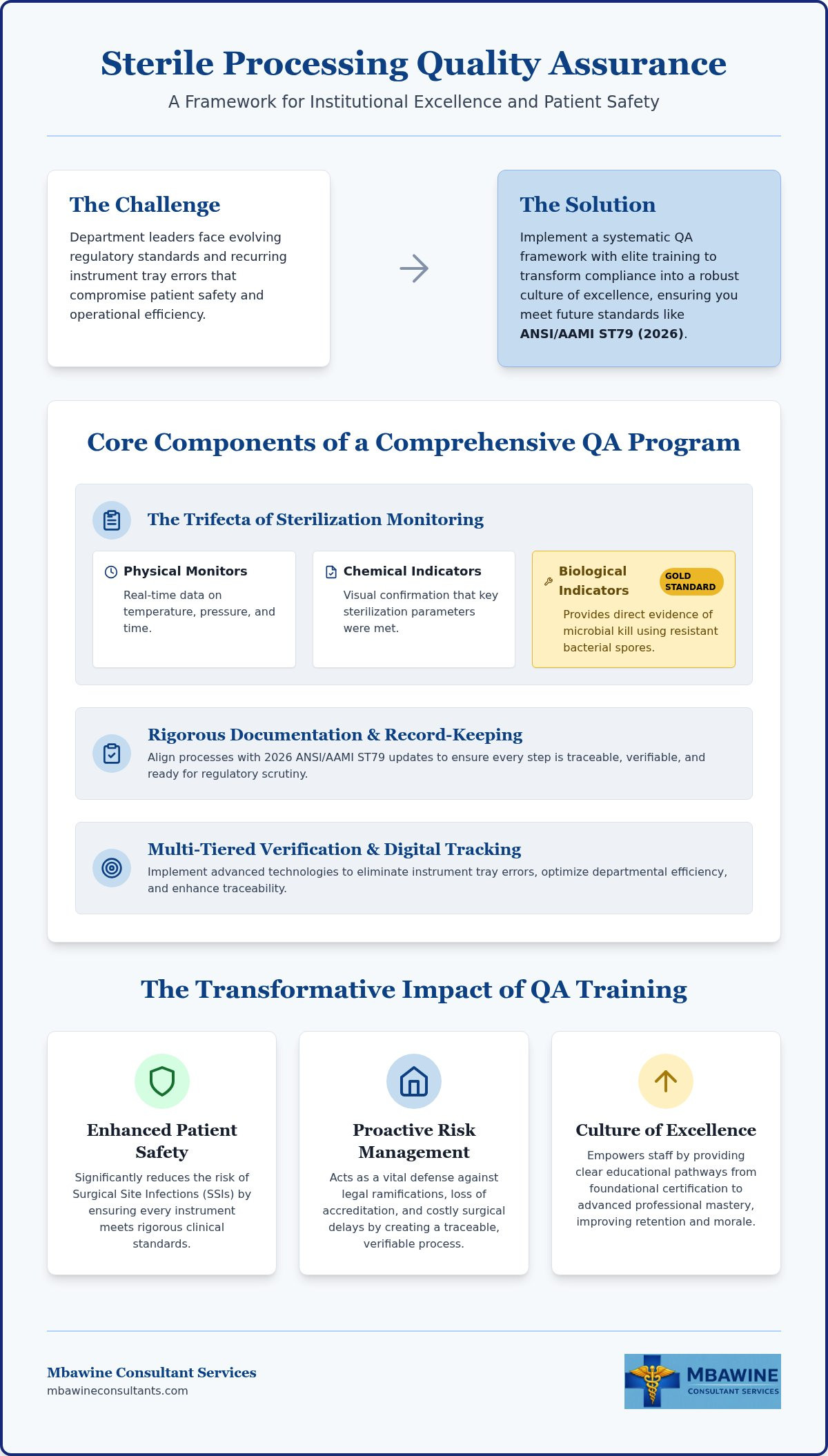
Creating a culture of safety requires a shift from individual accountability to collective, systematic vigilance. Leadership must advocate for specialized education that empowers staff to view themselves as guardians of public health rather than mere technicians. By investing in professional consulting, facilities foster an environment where quality is the primary metric of success. This investment doesn't just improve outcomes; it enhances staff retention by providing clear pathways for career advancement and professional mastery.
From a risk management perspective, inadequate quality control represents a significant liability for any healthcare institution. Comprehensive sterile processing quality assurance training serves as a vital defense against the high-stakes consequences of sterilization failures, including legal ramifications and loss of accreditation. Educated QA oversight ensures that errors are identified and corrected before they leave the SPD, providing a clear financial benefit by reducing the need for costly surgical delays or re-processing. Implementing documented, expert-led protocols ensures that every process is traceable, verifiable, and capable of withstanding the scrutiny of regulatory surveys.
A robust sterile processing quality assurance training program serves as the bedrock of departmental reliability; it moves beyond basic technical skills to instill a deep understanding of empirical validation. The curriculum must prioritize the trifecta of sterilization monitoring, which includes physical, chemical, and biological indicators. Each of these components provides a unique layer of data that, when synthesized, confirms the efficacy of the sterilization cycle. Physical monitors provide real-time data on temperature, pressure, and time, while chemical indicators offer a visual confirmation that specific parameters were achieved. However, the biological indicator remains the gold standard, as it provides the only direct evidence of microbial kill through the use of highly resistant bacterial spores.
Adherence to the CDC Sterilizing Practices Guidelines is foundational to this educational framework. These guidelines emphasize that quality control isn't a singular event but a continuous cycle of monitoring and documentation. For the 2026 regulatory environment, training must also encompass the meticulous interpretation of Manufacturer’s Instructions for Use (IFU). Technicians shouldn't just read these documents; they must possess the analytical skills to translate complex technical requirements into standardized, repeatable workflows. This mastery is especially critical during decontamination and high-level disinfection (HLD) processes, where chemical concentrations and contact times are non-negotiable variables.
Staff must be trained to understand the specific science of biological monitoring, including the necessary incubation requirements and the biochemical markers of a failed cycle. It isn't enough to simply record a result. Technicians must be empowered to recognize subtle deviations and initiate immediate corrective actions, such as load recalls or equipment troubleshooting. Integrating multi-parameter chemical indicators into daily quality logs ensures that every tray is verified at the point of use, providing an additional safeguard against mechanical malfunctions that might go undetected by physical monitors alone.
Standardizing the assembly of complex surgical instrument sets requires a systematic approach to IFU mastery. Training modules should focus on the nuances of multi-step decontamination, ensuring that every lumen is flushed and every surface is brushed according to the manufacturer's precise specifications. By aligning these internal processes with the Healthcare Sterilization: 2026 Professional Standards, departments can eliminate the variability that often leads to instrument tray errors. Professionals seeking to lead these high-level initiatives can enroll in specialized classes to deepen their technical expertise and ensure their facility remains at the forefront of clinical safety.
Continuous education is the most effective tool for maintaining survey readiness and institutional reliability. Conducting structured mock audits allows staff to identify and remediate compliance gaps in documentation or instrument processing before they become critical failures during a formal inspection. These simulated inspections should mirror the intensity of a real survey, focusing specifically on the traceability of sterilized loads and the minute accuracy of biological indicator logs. Many departments find that engaging sterile processing consultant services provides an objective assessment of their current state, offering a detailed roadmap for optimizing operations and ensuring that every technician is prepared to articulate the clinical rationale behind their quality control measures.
The legal environment surrounding sterile processing is undergoing a significant transformation as more states move toward mandating professional certification for all technicians. This shift reflects a broader recognition of the sterile processing department's critical role in public safety and the necessity of standardized, high-register education. Advanced sterile processing quality assurance training protects healthcare facilities by establishing a documented, defensible record of staff competency that can be vital during regulatory inspections or legal inquiries. Maintaining an updated educational syllabus that reflects the 2026 standards ensures that the department remains compliant with new legislation while fostering a culture of professional responsibility that extends far beyond the basic requirements of entry-level certification. This commitment to excellence serves as a bridge between foundational knowledge and the mastery required to lead a modern sterilization unit.
Establishing a systematic quality assurance protocol requires a departure from subjective inspections in favor of a methodological, multi-tiered framework. This structure ensures that every surgical tray undergoes a series of redundant verifications, significantly reducing the probability of human error reaching the sterile field. A comprehensive sterile processing quality assurance training program teaches staff to integrate high-tech digital tracking software with traditional manual documentation, creating a dual-layered audit trail that's both resilient and transparent. By establishing clear Key Performance Indicators (KPIs), such as tray assembly accuracy rates and biological indicator pass percentages, departmental leaders can move from reactive troubleshooting to proactive excellence. When these protocols are applied consistently, they provide the empirical evidence required to validate the department's role in institutional risk management.
Implementing a peer-review system transforms the assembly area into a collaborative environment where technicians validate each other's work against standardized checklists. These checklists must be derived directly from the Manufacturer’s Instructions for Use (IFU) and updated in real-time within the department’s digital tracking system. Training staff to utilize these tools for real-time monitoring allows for immediate intervention when a deviation's detected, ensuring that only validated products proceed to the sterilization phase. This rigorous check system serves as the final barrier against the distribution of compromised instruments, safeguarding both the patient and the surgical team.
Data-driven improvement relies on the rigorous application of Root Cause Analysis (RCA) following any sterilization failure or near-miss event. Instead of focusing on individual culpability, a professional sterile processing quality assurance training curriculum emphasizes a "no-blame" culture that scrutinizes the system rather than the person. Analyzing error trends through this lens provides the objective evidence needed to justify departmental resource allocation and staffing adjustments to hospital administration. It's this commitment to systematic scrutiny that allows a department to evolve from meeting basic standards to achieving industry-leading performance. When quality data identifies a specific procedural trend, it informs the targeted educational interventions that sustain institutional safety. To build these advanced systems within your own department, enroll in our professional sterile processing classes to master the frameworks of elite quality oversight.
Mbawine Consultant Services functions as a dedicated advocate for excellence; it positions itself not merely as a provider of educational materials but as a guardian of industry standards. While many programs focus solely on the minimum requirements for entry-level roles, our approach to sterile processing quality assurance training emphasizes a systematic transition from technical proficiency to institutional leadership. By integrating advanced pedagogical methods with real-world clinical applications, we ensure that professionals don't just memorize protocols but deeply understand the scientific rationale behind every quality check. This methodology is particularly evident in our Mbawine sterile processing classes, which are meticulously designed to facilitate first-time exam success while building a foundation for long-term career mastery.
The integration of consulting and education allows for a holistic approach to departmental optimization. Instead of treating training as an isolated event, we view it as a continuous component of a broader quality management system. This perspective is essential for departments aiming to achieve and maintain the elite-level standards required in the 2026 healthcare landscape. By aligning staff education with institutional goals, we help facilities transform their sterile processing departments into centers of clinical excellence that prioritize patient safety above all else.
Institutional reliability depends on the identification and remediation of specific operational gaps that vary between facilities. Through Mbawine Consultant Services, healthcare organizations can access customizable in-person and online curricula tailored to their unique departmental needs. On-site, expert-led training sessions provide an invaluable opportunity for staff to receive direct mentorship within their own environment; this fosters a culture of accountability and precision. For facilities currently utilizing healthcare temp staffing, this educational pathway offers a strategic transition toward long-term institutional excellence by elevating the existing workforce to meet the highest professional benchmarks.
For healthcare organizations navigating broader structural transitions, you can discover MAS Management Services to find interim and fractional executive leadership that ensures stability and professional oversight during periods of change.
The path toward CRCST certification and advanced quality credentials requires a methodical preparation strategy that encompasses both technical knowledge and analytical reasoning. Our professional syllabus provides a comprehensive roadmap for candidates, ensuring they're equipped to navigate the complexities of modern sterilization standards with confidence. Beyond the examination, we offer ongoing mentorship to bridge the gap between classroom theory and departmental optimization. Taking the next step toward professionalization is a critical investment in patient safety and institutional integrity. You're encouraged to Schedule your departmental assessment or enroll in a course to begin the process of systematic improvement.
The landscape of surgical safety in 2026 demands a transition from rudimentary task execution to a sophisticated culture of systematic oversight. It's clear that the implementation of rigorous sterile processing quality assurance training is the primary mechanism for mitigating risk and ensuring uncompromising clinical standards. By integrating advanced sterilization indicators and mastering the nuances of manufacturer’s instructions for use, your department can achieve the institutional reliability necessary for successful accreditation. Mbawine Consultant Services provides the specialized expertise required to bridge the gap between foundational certification and professional mastery through expert-led training programs and comprehensive consulting for SPD optimization. We also offer 24/7 support and flexible staffing solutions to ensure your operations remain resilient during periods of high demand. Our mission is to empower your team with the analytical skills and technical precision needed to excel in high-stakes environments. We invite you to enroll in professional sterile processing classes to master quality assurance standards and secure the future of your facility. Your commitment to these rigorous standards ensures that every instrument processed is a testament to your dedication to public safety and clinical excellence.
Foundational certification, such as the CRCST, establishes the baseline technical competency required for entry level roles within the department. In contrast, specialized quality assurance training focuses on the systematic oversight, validation protocols, and data driven monitoring required to maintain departmental excellence. While certification proves a technician possesses the knowledge to perform sterilization tasks, quality assurance education ensures the entire institutional process is verifiable, traceable, and compliant with 2026 standards.
Rigorous sterile processing quality assurance training directly correlates with the mitigation of healthcare acquired infections, specifically surgical site infections. By ensuring that every instrument set meets precise biological and chemical validation benchmarks, this training prevents the introduction of pathogens into the sterile field. This systematic rigor safeguards patient health and reduces the incidence of post operative complications related to contaminated equipment, thereby protecting the institution from clinical failures and ethical lapses.
Both online and in person formats are highly effective when they utilize a structured, expert led syllabus that emphasizes analytical reasoning. Online classes offer necessary flexibility for working professionals while maintaining rigorous academic standards through digital tracking and interactive modules. In person sessions provide a valuable opportunity for the hands on validation of technical skills within the clinical environment. Mbawine Consultant Services delivers both options to ensure healthcare facilities can access specialized education regardless of scheduling constraints.
Common gaps often include the inconsistent documentation of biological indicator results, the improper interpretation of Manufacturer’s Instructions for Use, and a lack of standardized peer review checks during instrument assembly. Many departments also struggle with maintaining a traceable audit trail for high level disinfection processes. Identifying these vulnerabilities through systematic assessment is the first step toward implementing a robust quality management framework that withstands the scrutiny of regulatory bodies and external auditors.
Sterile processing staff should undergo updated quality assurance training at least annually or whenever significant regulatory changes occur, such as the 2026 ANSI/AAMI ST79 updates. Continuous education ensures that technicians remain proficient in evolving sterilization technologies and complex documentation requirements. Regular training intervals prevent the erosion of clinical standards and ensure that the department’s quality protocols remain aligned with current national benchmarks, which is essential for maintaining institutional reliability and safety.
Comprehensive quality assurance training is the most effective preparation for a Joint Commission or CMS survey because these inspections focus heavily on process validation and staff competency. A well trained department can provide a documented, defensible record of compliance that proves every load was processed according to rigorous safety standards. This level of readiness transforms the survey from a stressful event into a professional validation of excellence, ensuring the facility maintains its critical accreditation.
While the CRCST provides the necessary baseline, advanced credentials such as the Certified Instrument Specialist and Certified Healthcare Leader focus more heavily on quality oversight and management. Professionals often pursue sterile processing quality assurance training to bridge the gap between these certifications and the practical implementation of elite level quality frameworks. These educational pathways prepare leaders to oversee complex sterilization processes and maintain institutional compliance at the highest register of professional mastery.
Mbawine Consultant Services specializes in developing custom curricula that address the specific institutional quality gaps of individual healthcare facilities. Our consulting services involve a comprehensive assessment of departmental operations to identify areas where targeted training can optimize performance. By tailoring our expert led education to your facility's unique instrument sets and workflows, we ensure that your team achieves total departmental optimization and long term educational excellence while adhering to the most current industry standards.

Article by
Mba Akuribila
Mba‑Akuribila is a healthcare leader, educator, and founder of Mbawine Consultants, a Bronx‑based institution recognized nationwide for advancing excellence in sterile processing and allied health workforce development. Born in Bongo in Ghana’s Upper East Region, his journey from rural beginnings to national impact reflects a lifelong commitment to service, empowerment, and community advancement.
For over two decades, he has trained sterile processing employees, mentored, and placed thousands of healthcare professionals across the United States. Through Mbawine Consultants, he established one of the country’s most trusted Sterile Processing Certification Test Prep Programs, preparing new Americans and career‑changers for successful entry into the field. The organization, as at 2026, has graduated more than 15,000 sterile processing technicians who now serve in hospitals, ambulatory centers, dental practices, and reprocessing facilities nationwide.
Under his leadership, Mbawine Consultants has expanded into a full Healthcare Staffing Agency, connecting nurses and allied health professionals to meaningful employment opportunities. His team also provides Interim Management Services, supporting hospitals and surgical centers with experienced leaders who stabilize operations, strengthen compliance, and improve workflow efficiency.
As a former surgical technician, sterile processing manager, educator, and system‑wide director, Mba‑Akuribila brings deep expertise to Sterile Processing Consulting, helping healthcare facilities elevate quality, safety, and regulatory readiness.
His work in the United States and Ghana continues to reflect his core philosophy: service above self, opportunity for all, and excellence without compromise.


