

The clinical integrity of a surgical suite is only as robust as the sterile processing department that supports it, yet many healthcare institutions continue to treat instrument reprocessing as a secondary logistical concern rather than a critical clinical safeguard. This systemic undervaluation often results in a sterile processing management agency becoming a necessary intervention for facilities facing persistent staffing shortages and high error rates in tray assembly. You've likely felt the mounting pressure that occurs when qualified leadership is absent and the threat of an upcoming regulatory audit looms over your daily operations. It's clear that maintaining a fully certified workforce while optimizing surgical volume requires a level of specialized expertise that transcends basic departmental management.
Discover how a specialized management agency optimizes Sterile Processing Department operations through integrated education, interim leadership, and rigorous compliance oversight. By aligning departmental protocols with the highest industry standards, these agencies serve as guardians of public safety and institutional reliability. This article provides a comprehensive overview of how professionalized management structures reduce healthcare-associated infections and establish a foundation for long-term operational excellence.
A sterile processing management agency functions as a specialized consultancy dedicated to the structural and clinical optimization of the Central Sterile Services Department (CSSD). It's far more than a simple labor provider; it represents a comprehensive partner that bridges the gap between basic departmental functions and elite regulatory performance. While general healthcare staffing firms often focus on filling broad vacancies across various clinical disciplines, a specialized agency provides a deep, technical immersion into the specific workflows of sterilization and decontamination. This focus is essential because the SPD serves as the heart of the hospital, where any failure in the sterilization chain can result in catastrophic outcomes for patient safety and surgical throughput. By integrating professional education, interim leadership, and rigorous operational oversight, these agencies ensure that every instrument tray is a testament to institutional excellence.
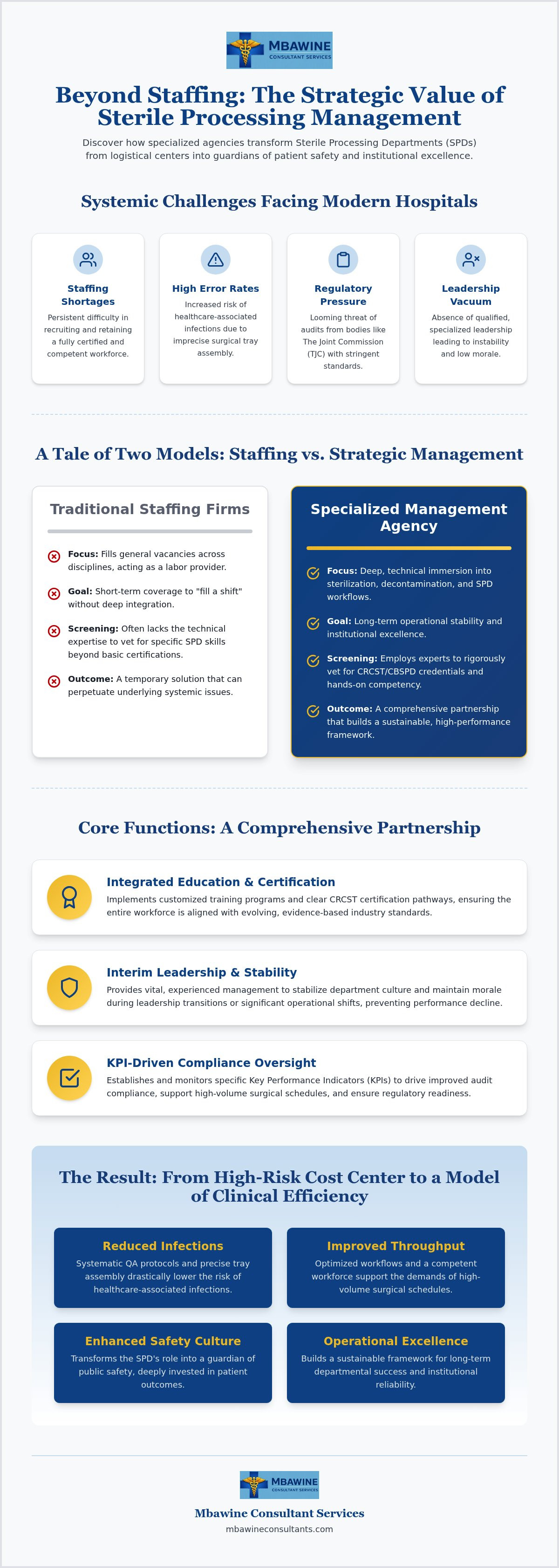
The role of such an agency is multisectoral, addressing the immediate needs of the facility while building a sustainable framework for the future. It's not enough to simply place a technician in a role. A true sterile processing management agency evaluates the entire ecosystem of the department, from the efficacy of the pre-cleaning protocols to the accuracy of the final biological indicators. This holistic approach ensures that the department doesn't just function, but excels as a guardian of industry standards. Through this partnership, healthcare facilities can transform their reprocessing units from high-risk cost centers into models of clinical efficiency and safety.
Historically, sterile processing was viewed as a basic utility department, often relegated to hospital basements with minimal technical oversight. However, the modern healthcare environment has seen the SPD evolve into a high-tech clinical hub, driven by complex robotic instrumentation and increasingly stringent regulatory requirements. Organizations like The Joint Commission (TJC) now apply the same level of scrutiny to reprocessing protocols as they do to direct patient care. This shift has created a gap that traditional Human Resources departments often struggle to bridge, as they may lack the technical expertise required to evaluate the nuances of microbial lethality cycles or complex tray assembly requirements.
The primary distinction between a specialized agency and a traditional staffing model lies in the depth of technical screening and clinical oversight. A dedicated agency employs experts who vet candidates specifically for CRCST and CBSPD credentials, ensuring that every technician possesses the fundamental knowledge required for high-stakes environments. Beyond mere certification, these agencies provide a layer of clinical leadership that stabilizes departmental culture. Instead of offering short-term coverage that merely fills a schedule, a specialized agency focuses on long-term operational stability by aligning staffing with established industry standards and institutional goals. It's about finding the right professional fit, not just a warm body to fill a shift.
While many facilities view external partnerships solely through the lens of labor acquisition, a sterile processing management agency provides a much more profound level of institutional support by embedding professional education directly into the department's daily operational rhythm. This integration ensures that every technician, whether a new hire or a seasoned veteran, remains aligned with evolving industry standards and evidence-based practices. By implementing customized training programs that address the unique challenges of a specific facility, these agencies move beyond the generic "one-size-fits-all" approach that often characterizes traditional staffing models. This methodical focus on professionalization creates a workforce that's not only competent but is also deeply invested in the clinical outcomes of the patients they serve.
The implementation of systematic quality assurance (QA) protocols represents another pillar of this consultative relationship. It's not enough to simply process instruments; a department must possess the documented evidence that every cycle meets established biological and chemical parameters. A specialized agency assists in the development of these rigorous oversight structures, ensuring that the department operates with a level of transparency that satisfies both internal safety committees and external regulatory bodies. This comprehensive approach transforms the sterile processing unit from a reactive cost center into a proactive guardian of surgical safety.
Achieving departmental excellence is fundamentally dependent on the technical proficiency of the staff, which is why CRCST certification serves as a non-negotiable benchmark for modern reprocessing units. A specialized agency facilitates this by offering structured sterile processing classes that cater to the diverse needs of hospital personnel. Some facilities benefit from the immediate, hands-on feedback provided by in-person instruction, while others require the flexibility of online modules to accommodate complex scheduling demands. Regardless of the delivery method, the objective remains the same: bridging the knowledge gap between entry-level procedural understanding and the advanced technical mastery required to manage complex surgical instrumentation. For departments seeking to elevate their internal standards, exploring these advanced educational pathways is a critical first step.
Beyond the human element, a sterile processing management agency conducts exhaustive consultative analyses to identify and rectify bottlenecks within the decontamination and sterilization cycles. This often involves a granular review of tray assembly error rates, where systematic failures are addressed through targeted corrective training rather than punitive measures. By optimizing the "dirty-to-clean" workflow, agencies ensure that the department can meet the escalating demands of high-volume surgical schedules without compromising safety protocols. These professional consulting services also include the implementation of rigorous quality assurance (QA) protocols, which provide the documented evidence of compliance required during high-stakes regulatory inspections. It's this level of detail that ensures long-term operational growth and sustainability.
A leadership vacuum in the Sterile Processing Department (SPD) often precipitates a rapid decline in operational standards and staff morale. When a director or manager departs unexpectedly, the resulting instability can jeopardize surgical schedules and compromise the rigorous patient safety protocols that the facility worked hard to establish. A sterile processing management agency addresses this critical vulnerability by deploying seasoned interim leaders who possess the technical acumen and administrative experience required to stabilize the unit. These professionals don't simply act as placeholders; they serve as strategic catalysts for structural improvement, executing necessary change management strategies without the interpersonal friction that often accompanies permanent personnel shifts. By aligning departmental goals with institutional requirements, they ensure that the sterilization unit continues to function as a reliable clinical partner.
The presence of an interim manager allows a facility to conduct a thorough search for a permanent director without the pressure of a deteriorating department. This strategic bridge ensures that the transition is marked by growth rather than regression. These leaders bring an objective perspective to the department, identifying systemic inefficiencies that internal staff may have overlooked. Through this consultative lens, the agency provides a roadmap for long-term success, ensuring that the department is not only stabilized but is also better equipped for future challenges. For facilities facing such transitions, securing interim leadership services is a vital step in maintaining operational continuity.
During periods of leadership failure or critical staffing shortages, an agency provides immediate clinical intervention that is essential for restoring the fractured trust between the Operating Room (OR) and the SPD. This rapid response ensures that surgical teams have absolute confidence in the integrity of their processed instrument sets, thereby reducing the likelihood of intraoperative delays. By providing 24/7 leadership during emergency transitions, interim managers prevent the operational bottlenecks that lead to increased healthcare-associated infections and surgical cancellations. They implement immediate corrective actions to address high error rates in tray assembly, ensuring the department remains compliant with stringent regulatory requirements during the transitional phase.
Beyond immediate stabilization, interim leaders function as mentors for the existing supervisory staff, providing high-level guidance that bridges the gap between daily tasks and advanced technical mastery. They conduct formal assessments to evaluate current staff competencies, identifying specific areas where specialized education or CRCST certification preparation may be required. By standardizing protocols and reinforcing evidence-based practices, these leaders ensure a consistent level of performance that persists regardless of future personnel changes. This methodical approach prepares the department for the eventual arrival of a permanent director, establishing a foundation of clinical excellence that simplifies the long-term onboarding process and fosters a culture of professional accountability.
Defining departmental success requires a transition from anecdotal observations to rigorous, data-driven benchmarks that reflect the clinical complexity of modern sterilization workflows. A sterile processing management agency establishes these essential Key Performance Indicators (KPIs) to provide a transparent view of departmental health for hospital C-suite executives. By quantifying metrics such as sterilization cycle failures and tray assembly errors, the agency transforms the SPD from an overlooked utility into a high-functioning clinical asset. This level of oversight ensures that the facility remains in constant alignment with AAMI and AORN standards, which serve as the definitive blueprints for patient safety and instrument integrity. When success is measured through the lens of microbial lethality and tray accuracy, the department's value to the broader surgical ecosystem becomes undeniable.
The role of a sterile processing management agency extends into the realm of financial stewardship by providing comprehensive reporting on instrument loss and damage. These reports allow hospital administrators to see the direct correlation between technician proficiency and the reduction of unnecessary capital expenditures. By maintaining a steady focus on these metrics, the agency ensures that the department doesn't just meet the minimum requirements for operation but consistently exceeds the benchmarks for institutional excellence. This methodical approach to data-driven management creates a foundation of trust that supports the high-stakes demands of modern perioperative services.
This commitment to technical oversight and equipment maintenance is a principle that extends beyond the SPD; for example, facilities managing large-scale waste or fluid processing often look to Industrial Centrifugal Separation Solutions and Refurbishment from Sacor Engineering to ensure their critical systems remain reliable and cost-effective.
Continuous audit readiness is a hallmark of professionalized management, ensuring that a facility is prepared for the arrival of TJC, CMS, or DNV inspectors at any moment. An agency implements "mock audits" to identify latent vulnerabilities in the decontamination and sterilization chain before they become liabilities. This process includes a meticulous review of Instructions for Use (IFU) accessibility and the rigorous documentation of biological monitoring results. Ensuring that every chemical indicator is correctly logged and every IFU is followed to the letter creates a culture of perpetual compliance. This proactive stance eliminates the anxiety of upcoming inspections and reinforces the department's role as a guardian of public safety.
Balancing the need for rapid instrument turnover with the meticulous requirements of sterilization is a constant challenge for SPD leadership. Accuracy in tray assembly is a primary metric, as even a single missing or improperly cleaned instrument can lead to significant surgical delays and increased anesthesia time for the patient. By tracking these errors, a sterile processing management agency identifies specific training gaps and implements targeted interventions to improve technician performance. To establish these high standards within your own team and ensure every technician operates with technical mastery, you should consider enrolling your staff in specialized sterile processing classes today. This investment in human capital is the most effective way to balance productivity with the uncompromising demands of patient safety.
Mbawine Consultant Services operates under a mission-driven mandate to act as a guardian of professional industry standards and public safety. Unlike generalist healthcare management firms that apply broad administrative principles to specialized clinical areas, a dedicated sterile processing management agency provides the technical depth required to navigate the complexities of instrument reprocessing. The core of the Mbawine approach lies in the powerful synergy between comprehensive education and hands-on operational management. This dual focus ensures that departmental improvements aren't merely cosmetic but are rooted in the advanced technical mastery of the workforce. By offering flexible staffing models that address the specific needs of national healthcare facilities, the agency provides a scalable solution for institutions facing chronic leadership or personnel shortages.
Specialized expertise is the only viable path to mitigating the risks associated with modern surgical volumes. Generalist management often overlooks the granular details of microbial lethality and tray integrity, yet these are the very factors that determine a facility's clinical success. Mbawine bridges this gap by functioning as a bridge between entry-level procedural requirements and the highest levels of professional certification. This commitment to excellence ensures that every departmental intervention is guided by the most current evidence-based practices and regulatory mandates. It's a partnership that prioritizes institutional integrity over short-term fixes.
The process of engaging with a sterile processing management agency begins with an exhaustive assessment of the department's current state, identifying specific vulnerabilities in workflow and compliance. Following this evaluation, a customized professionalization plan is implemented, which often includes integrating online training modules for existing staff to boost internal certification rates. This methodical approach allows facilities to cultivate a highly trained, certified workforce without disrupting daily operations. Over the long term, this managed transition results in a stable departmental culture where professional accountability and technical precision are the standard rather than the exception.
There is a direct, documented link between sterile processing excellence and the reduction of healthcare-associated infections (HAIs), making the SPD a primary front in the battle for patient safety. When a department operates at peak efficiency with a certified workforce, the risk of surgical site infections is significantly minimized, protecting both the patient and the institution's reputation. To begin the process of transforming your reprocessing unit into a model of clinical reliability, you're encouraged to schedule a consultation to evaluate your department's specific needs. Mbawine Consultant Services remains steadfast in its authoritative commitment to upholding the highest healthcare sterilization standards for the protection of the public and the advancement of the medical field.
The transition from a basic utility department to a high-tech clinical hub requires more than just additional staffing; it demands a fundamental shift toward professional technical mastery. By integrating interim leadership with systematic quality oversight, a sterile processing management agency provides the necessary framework to ensure that every instrument tray meets the highest clinical standards. This strategic partnership stabilizes departmental culture and ensures that your facility remains prepared for the most rigorous regulatory inspections.
Mbawine Consultant Services stands as a dedicated advocate for these industry standards, offering national interim leadership expertise and specialized CRCST certification preparation to elevate your workforce. Our commitment to AAMI and TJC standards ensures that your department functions as a reliable guardian of patient safety and surgical throughput. It's time to transform your reprocessing unit into a model of professional excellence. Partner with Mbawine Consultant Services for Comprehensive SPD Solutions and secure a future defined by clinical precision. Your department's journey toward technical mastery begins with a single step toward professionalization.
A sterile processing management agency provides an integrated framework for departmental excellence by combining technical education, interim leadership, and operational oversight. It serves as a specialized partner that goes beyond labor placement to evaluate the entire sterilization ecosystem. This approach includes conducting workflow analyses to identify bottlenecks in decontamination and implementing quality assurance protocols that align with AAMI standards. By focusing on the structural health of the department, the agency ensures long-term clinical integrity.
An interim SPD manager is a specialized consultant deployed to stabilize operations and implement strategic change management during transitional periods. While a permanent hire focuses on long-term departmental maintenance, the interim leader identifies systemic inefficiencies and prepares the department for future leadership. These professionals bring an objective perspective that's essential for restoring trust between the Operating Room and the SPD. They ensure that clinical standards remain high while the facility conducts a thorough search for a permanent director.
Hospitals should choose a specialized sterile processing management agency because these organizations provide technical vetting and clinical oversight that generalist staffing firms cannot match. Standard firms often focus on filling broad vacancies across multiple disciplines without understanding the nuances of microbial lethality or complex tray assembly. A specialized agency ensures that every technician possesses verified CRCST or CBSPD credentials. This focus on technical mastery reduces the risk of surgical delays and healthcare-associated infections.
Yes, a management agency provides structured educational pathways, including specialized prep classes and competency assessments, to help staff achieve CRCST certification. This professionalization of the workforce is a core pillar of their service model, as it ensures that all technicians possess the advanced technical mastery required for high-stakes environments. By bridging the gap between entry-level hires and certified professionals, the agency creates a more reliable and clinically competent workforce that is deeply invested in patient safety.
Success is typically measured through specific Key Performance Indicators such as tray assembly accuracy, sterilization cycle success rates, and instrument loss reduction. These metrics provide a transparent view of departmental performance and help communicate the value of the SPD to hospital C-suite executives. By tracking these data points, an agency identifies specific training gaps and implements corrective actions. This data-driven approach ensures that the department consistently meets the high-volume demands of modern surgical schedules.
Engagement lengths vary based on the specific needs of the facility but typically range from three to six months. This duration provides enough time to stabilize departmental culture, implement necessary protocol changes, and conduct a thorough search for a permanent leader. Some engagements may be extended if the department requires more extensive structural optimization or if the facility faces a prolonged leadership transition. The goal is always to ensure a seamless handoff to permanent management once the department is stabilized.
Yes, these agencies conduct mock audits and implement rigorous documentation protocols to ensure continuous readiness for TJC, CMS, and DNV inspections. This proactive approach identifies vulnerabilities in the sterilization chain before they result in audit citations or safety failures. By standardizing Instructions for Use (IFU) accessibility and ensuring meticulous biological monitoring logs, the agency creates a culture of perpetual compliance. This eliminates the anxiety typically associated with upcoming regulatory surveys and reinforces institutional reliability.
Online training is a core offering for agencies that prioritize flexibility and accessibility for hospital staff. These digital classes allow technicians to pursue certification and advanced technical mastery without the constraints of traditional classroom schedules. By offering both in-person and online educational pathways, an agency ensures that the entire workforce remains aligned with evolving industry standards. This flexible model is essential for maintaining high certification rates in departments with complex, 24/7 operational requirements.

Article by
Mba Akuribila
Mba‑Akuribila is a healthcare leader, educator, and founder of Mbawine Consultants, a Bronx‑based institution recognized nationwide for advancing excellence in sterile processing and allied health workforce development. Born in Bongo in Ghana’s Upper East Region, his journey from rural beginnings to national impact reflects a lifelong commitment to service, empowerment, and community advancement.
For over two decades, he has trained sterile processing employees, mentored, and placed thousands of healthcare professionals across the United States. Through Mbawine Consultants, he established one of the country’s most trusted Sterile Processing Certification Test Prep Programs, preparing new Americans and career‑changers for successful entry into the field. The organization, as at 2026, has graduated more than 15,000 sterile processing technicians who now serve in hospitals, ambulatory centers, dental practices, and reprocessing facilities nationwide.
Under his leadership, Mbawine Consultants has expanded into a full Healthcare Staffing Agency, connecting nurses and allied health professionals to meaningful employment opportunities. His team also provides Interim Management Services, supporting hospitals and surgical centers with experienced leaders who stabilize operations, strengthen compliance, and improve workflow efficiency.
As a former surgical technician, sterile processing manager, educator, and system‑wide director, Mba‑Akuribila brings deep expertise to Sterile Processing Consulting, helping healthcare facilities elevate quality, safety, and regulatory readiness.
His work in the United States and Ghana continues to reflect his core philosophy: service above self, opportunity for all, and excellence without compromise.


