

The modern sterile processing department serves as the operational heart of the healthcare institution, yet it remains one of the most vulnerable points of failure during periods of management instability. Most facility administrators recognize that high staff turnover and mounting friction between the Sterile Processing Department and the Operating Room represent significant risks to patient safety and regulatory standing. This is why sterile processing interim leadership has evolved into a strategic necessity rather than a simple placeholder. It's a critical intervention that secures institutional integrity and operational continuity during high-stakes leadership transitions.
By integrating specialized management, organizations can move beyond temporary fixes to achieve a comprehensive transformation that aligns departmental workflows with the rigorous 2026 FDA Quality Management System Regulation and updated ANSI/AAMI ST79 standards. This article examines how specialized interim management facilitates a seamless leadership transition, reduces tray error rates, and prioritizes the professional development required for HSPA and CBSPD certification success. You'll discover how a strategic interim placement serves as a guardian of industry standards, ensuring your facility is prepared for imminent Joint Commission or CMS surveys while fostering a culture of technical mastery and institutional excellence.
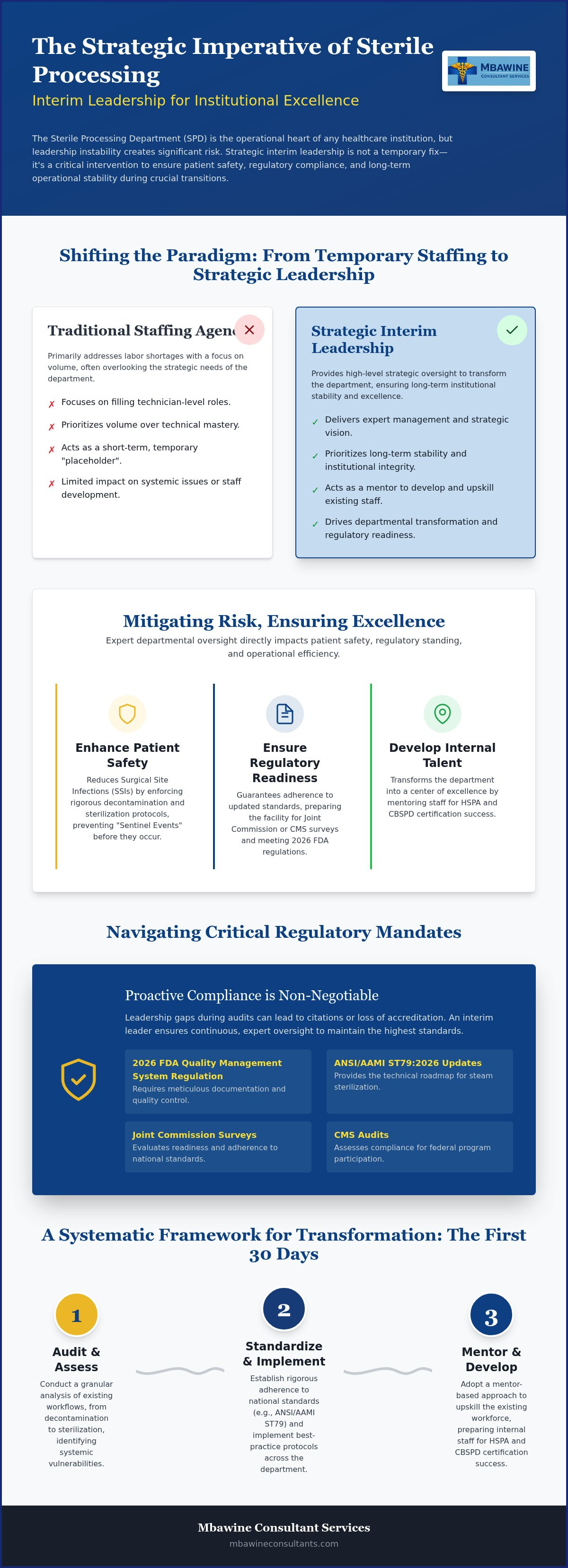
The implementation of sterile processing interim leadership represents a sophisticated management intervention designed to stabilize the operational core of a healthcare facility. Unlike traditional temporary staffing, which primarily addresses labor shortages at the technician level, interim leadership provides high-level strategic oversight within the central sterile services department (CSSD). This distinction is critical; a leader doesn't just fill a seat but acts as the primary guardian of the sterilization lifecycle. This industry-wide shift toward professionalized management is a direct response to increasing regulatory scrutiny and the complex technical requirements of modern surgical environments. It's no longer sufficient to maintain a status quo; excellence requires specialized management solutions from a dedicated expert who can navigate the intersection of clinical safety and administrative efficiency.
Filling a leadership vacancy requires a credentialing profile that far exceeds standard technician requirements. Standard staffing models often prioritize volume over technical mastery, but the administrative gravity of instrument processing demands a leader who understands the nuanced interplay between decontamination workflows and high-level disinfection (HLD) protocols. An interim leader manages the department's technical assets while simultaneously navigating the human elements of staff morale and inter-departmental communication. It's a role that requires an expert understanding of how a single error in the prep and pack area can cascade into a catastrophic event in the operating suite. This specialized focus ensures that the department remains a center of excellence rather than a point of institutional risk. By positioning the interim leader as a mentor, facilities can bridge the gap between entry-level requirements and advanced technical mastery, effectively professionalizing the existing workforce during the transition.
Institutional readiness for Joint Commission and CMS surveys is perhaps the most significant driver for sterile processing interim leadership in the current fiscal year. With the 2026 FDA Quality Management System Regulation now in full effect, healthcare facilities face unprecedented pressure to maintain meticulous documentation and quality control for all sterilization activities. Leadership gaps during an audit can lead to immediate citations or loss of accreditation, which carries severe financial and reputational consequences. An interim leader ensures the department adheres to the updated ANSI/AAMI ST79:2026 standards, which provide the technical roadmap for steam sterilization and environmental controls. By maintaining continuous, expert oversight, the interim manager bridges the gap between daily operations and the high-level compliance required by national governing bodies. This proactive approach doesn't just prepare a facility for an audit; it establishes a sustainable framework for long-term regulatory success.
The reduction of iatrogenic risks, specifically Surgical Site Infections (SSIs), remains the most significant metric for evaluating the efficacy of sterile processing interim leadership. A leader's ability to enforce rigorous decontamination and sterilization protocols directly impacts patient morbidity and mortality rates. By implementing "Sentinel Event" prevention strategies, an interim manager identifies systemic vulnerabilities before they manifest as clinical failures. This involves a granular analysis of the sterilization workflow, ensuring that every cycle is validated according to the highest industry standards. These leaders establish a culture of accountability where bioburden removal is treated with the same clinical gravity as the surgical procedure itself.
The quality of instrument kits delivered to the Operating Room serves as a tangible indicator of departmental health. Standardized leadership ensures that every tray is complete, functional, and sterile, thereby reducing surgical delays and perioperative complications. Effective communication between the Sterile Processing Department (SPD) and surgical teams is essential; the interim leader acts as a technical liaison to bridge these often-siloed areas. Adherence to the AORN Guidelines for Perioperative Practice provides a validated framework for these interactions, ensuring that sterilization practices align with the latest clinical evidence. For a deeper analysis of these dynamics, institutions should review Sterile Processing Leadership Consulting: A Case Study in Institutional Transformation.
Expert management is indispensable for protecting the facility's capital investments in surgical instrumentation. Without specialized oversight, expensive assets often suffer from improper handling, inadequate lubrication, or aggressive cleaning methods that lead to premature degradation. Interim leaders implement systematic inventory tracking and comprehensive audits to mitigate the high costs associated with lost or damaged instruments. The return on investment (ROI) for hiring specialized leadership is realized through the drastic reduction of unmanaged departmental inefficiencies and the prevention of costly surgical delays. This financial stewardship extends to the optimization of detergent usage and utility consumption, aligning departmental spending with broader institutional goals.
Aligning departmental Standard Operating Procedures (SOPs) with current HSPA and CBSPD guidelines is a non-negotiable requirement during any leadership transition. An interim manager conducts a thorough gap analysis to identify discrepancies between current practices and the rigorous 2026 certification standards. This process ensures that the department remains compliant with national benchmarks while simultaneously preparing the technical staff for professional advancement. Facilities seeking to strengthen their internal expertise and ensure long-term operational excellence should encourage their teams to enroll in professional certification preparation. This proactive approach transforms a temporary leadership gap into a strategic opportunity for institutional growth and enhanced patient safety.
The selection of a leadership partner represents a critical pivot point for a healthcare facility's operational integrity and regulatory standing. Many institutions default to a "commodity staffing" model, which treats leadership as a high-volume vacancy to be filled by any candidate possessing a general management title. In contrast, an educational consultancy model views sterile processing interim leadership as a strategic opportunity to rebuild departmental foundations through technical mastery and mentorship. Choosing a partner that provides comprehensive Sterile Processing Management Solutions ensures the interim period is utilized for systematic improvement rather than mere maintenance. This approach distinguishes between generalist healthcare staffing and firms that specialize exclusively in sterilization and decontamination standards.
Generalist healthcare staffing agencies often lack the specialized infrastructure required to vet candidates for deep technical proficiency. These firms frequently place "traveler" managers who, while experienced in hospital administration, may lack an intimate understanding of the 2026 ANSI/AAMI ST79 standards. This creates a significant risk of culture mismatch and operational stagnation. A leader who isn't deeply rooted in SPD-specific compliance can't effectively advocate for the department during high-stakes institutional audits. They often fail to recognize subtle workflow inefficiencies that lead to instrument degradation or tray errors, ultimately compromising surgical outcomes.
Specialized firms operate from a position of technical authority, often integrating staff education directly into the leadership term. A partner providing Sterile Processing Manager Training brings a level of expertise that generalist agencies cannot replicate. This model prioritizes the professionalization of the existing team, utilizing the interim term to prepare technicians for CRCST, HSPA, or CBSPD certification. By acting as mentors, these leaders bridge the gap between entry-level performance and advanced technical mastery. They ensure that sterile processing interim leadership serves as a catalyst for long-term departmental excellence.
This specialized approach is particularly vital for high-volume level-one trauma centers where operational downtime isn't an option. The availability of 24/7 emergency staffing acts as a critical safety net. It ensures that leadership transitions don't compromise the department's ability to support life-saving surgical procedures. Facilities benefit from a national network of specialized alumni. This allows for the rapid deployment of leaders who possess the specific technical credentials required to maintain institutional excellence. For those seeking long-term stability and professional growth, it's essential to contact a specialized consultancy that understands the gravity of the sterilization lifecycle.
The deployment of sterile processing interim leadership must follow a methodical, phased approach to ensure institutional stability and long-term technical mastery. This framework begins with a rigorous 30-day assessment designed to identify systemic weaknesses and establish a baseline for operational excellence. Rather than merely reacting to daily departmental crises, the interim leader implements a structured roadmap that transitions the department from a state of reactive survival to one of professionalized, clinical reliability. This systematic intervention secures the sterilization lifecycle while preparing the facility for the eventual integration of permanent management.
The initial audit phase focuses on identifying critical gaps in decontamination and sterilization documentation, which frequently serve as primary points of failure during regulatory surveys. Mechanical, chemical, and biological monitoring records are scrutinized for absolute compliance with 2026 ANSI/AAMI ST79 benchmarks. Simultaneously, the interim leader conducts a granular assessment of staff competency and certification status. This evaluation informs a professional development roadmap, identifying specific technicians who require specialized instruction to meet national standards. By addressing these foundational documentation and competency gaps early, the interim leader mitigates institutional risk and establishes a culture of clinical accountability.
Following the audit, the focus shifts to the implementation of Healthcare Sterilization Training to elevate the technical proficiency of the entire team. Workflow patterns are refined to minimize cross-contamination risks and optimize the movement of instruments from the decontamination suite to the prep and pack area. By utilizing a combination of online and in-person classes, the interim leader ensures that every technician understands the clinical gravity of their role and the technical requirements of the sterilization process. This phase is essential for aligning departmental practices with the high-level standards expected by modern surgical teams.
Objective Key Performance Indicators (KPIs) are established to provide empirical evidence of departmental improvement throughout the interim term. Metrics such as tray accuracy rates and turnover times are monitored daily to ensure that the department meets the demands of the Operating Room without compromising safety. Finally, the interim leader facilitates a comprehensive succession plan. This process involves documenting stabilized protocols and improved workflows to ensure that the permanent successor inherits a department characterized by regulatory compliance and professional excellence. To begin this transformation within your facility, we invite you to enroll in our professional certification preparation programs to empower your existing technical team.
Mbawine Consultant Services addresses the fundamental deficiencies of the "seat-filler" staffing model by providing a sophisticated hybrid of interim management and professional education. This approach ensures that sterile processing interim leadership functions as a catalyst for institutional transformation rather than a temporary administrative patch. By positioning our leaders as seasoned mentors, we bridge the critical gap between current staffing crises and long-term departmental excellence. This model prioritizes the professionalization of the technical workforce, ensuring that every decontamination and sterilization process adheres to the highest national standards of public safety and clinical reliability.
Our interim managers are distinguished by their dual capacity as operational experts and pedagogical leaders. They possess the unique ability to deliver on-site CRCST certification preparation, effectively transforming the department into an active learning environment while simultaneously managing complex daily workflows. Enrolling your current staff in our specialized Sterile Processing Classes under the direct guidance of an interim leader ensures that technical mastery becomes a permanent institutional asset. For a comprehensive analysis of our management capabilities, facilities should review our full suite of interim management and consulting services. This integrated approach doesn't just stabilize the department; it elevates the entire technical team to meet the rigorous demands of modern perioperative care.
Institutional safety is further reinforced by our 24/7 emergency staffing capability, which serves as a vital safety net during critical leadership transitions or unexpected surgical volume surges. Our commitment to national US coverage ensures that high-level expertise is available to facilities across the country, maintaining a steady focus on HSPA and CBSPD certification requirements. We advocate for the professionalization of the field, acting as a bridge between entry-level technical requirements and advanced technical mastery. Facilities facing imminent regulatory surveys or significant leadership gaps are encouraged to schedule a formal consultation to discuss their specific institutional needs and long-term safety goals.
Securing expert sterile processing interim leadership is a strategic investment in the safety and efficiency of your surgical services. You shouldn't leave your department's regulatory standing to chance during a management vacancy. Contact us today to secure interim SPD leadership that transforms your department and establishes a foundation of professional excellence for your permanent successor.
The transformation of a sterile processing department from a point of operational vulnerability to a center of technical mastery requires more than a temporary manager. It demands a commitment to the rigorous 2026 standards of patient safety and regulatory compliance. By prioritizing expert sterile processing interim leadership, healthcare facilities can mitigate the high costs of surgical delays and instrument degradation while simultaneously fostering a culture of professional excellence. This strategic intervention ensures that your department remains prepared for imminent audits and serves as a reliable partner to the surgical suite.
Mbawine Consultant Services stands as a national consultancy dedicated to institutional safety. We provide specialized CRCST certification preparation experts who act as mentors to your technical team, bridging the gap between current staffing needs and advanced technical mastery. With 24/7 emergency staffing availability, we offer a critical safety net that maintains departmental continuity during periods of transition. We invite you to Secure Professional Interim SPD Leadership Today to ensure your facility achieves the highest standards of sterilization and clinical reliability. Your department's journey toward professional excellence begins with a foundation of expert leadership.
The primary responsibilities of a sterile processing interim manager involve high-level strategic oversight of departmental operations, including the rigorous enforcement of decontamination and sterilization protocols. These leaders focus on optimizing workflow efficiencies, managing technical assets, and ensuring that all documentation aligns with the latest regulatory mandates. They also serve as a technical liaison between the department and surgical teams, facilitating better communication and reducing the risk of perioperative complications through systematic quality control.
A typical sterile processing interim leadership engagement usually spans between three and six months, providing sufficient time to stabilize operations and implement necessary technical improvements. This duration allows the facility to conduct a thorough search for a permanent successor without compromising departmental safety or regulatory compliance. Some engagements may extend longer if complex institutional transformations or extensive staff certification initiatives are required to meet long-term excellence goals.
An interim leader plays a pivotal role in preparing the department for Joint Commission or CMS surveys by conducting comprehensive gap analyses. They identify vulnerabilities in sterilization records and environmental controls, ensuring that all practices adhere to the 2026 ANSI/AAMI ST79 benchmarks. By standardizing documentation and enforcing consistent quality assurance protocols, the interim manager establishes the institutional readiness required to navigate high-stakes audits without the risk of citations.
A strategic interim leader acts as a technical mentor, directly assisting staff with preparation for HSPA and CBSPD certifications. This involves integrating educational roadmaps into the daily workflow and identifying specific technical competencies that require advancement. By professionalizing the existing team, the interim leader ensures that the department achieves a higher level of technical mastery, which remains a permanent institutional asset long after the leadership transition is complete.
When evaluating candidates for sterile processing interim leadership, facilities should prioritize individuals with advanced certifications such as the CRCST and CHL. It's essential to select leaders with proven experience in high-volume surgical environments and a deep understanding of current AAMI and AORN standards. The ideal candidate possesses strong administrative skills, including budget management and compliance auditing, alongside the clinical expertise required to oversee complex sterilization lifecycles.
Interim leadership differs from hiring a travel SPD supervisor by focusing on strategic transformation rather than basic shift coverage. While a travel supervisor primarily manages daily tasks, an interim leader is tasked with systemic improvement, workflow refinement, and long-term succession planning. They don't just fill a vacancy; they rebuild the department's foundational standards to ensure that sterile processing interim leadership serves as a bridge to institutional excellence.
The cost structure for sterile processing management services is generally determined by the specific scope of the departmental assessment and the anticipated duration of the leadership contract. Factors such as the size of the facility, the volume of surgical procedures, and the complexity of regulatory remediation needs influence the final investment. Facilities should view these costs as a strategic reallocation of resources intended to prevent expensive tray errors and infections.
Deployment speed depends on the specialization of the leadership partner, though specialized consultancies often provide rapid placement to prevent leadership gaps. In situations requiring immediate intervention, some firms offer 24/7 emergency staffing capabilities that allow a leader to be on-site within a few days. This rapid response is critical for maintaining institutional safety and operational continuity during unexpected vacancies or when a facility doesn't have a current succession plan.

Article by
Mba Akuribila
Mba‑Akuribila is a healthcare leader, educator, and founder of Mbawine Consultants, a Bronx‑based institution recognized nationwide for advancing excellence in sterile processing and allied health workforce development. Born in Bongo in Ghana’s Upper East Region, his journey from rural beginnings to national impact reflects a lifelong commitment to service, empowerment, and community advancement.
For over two decades, he has trained sterile processing employees, mentored, and placed thousands of healthcare professionals across the United States. Through Mbawine Consultants, he established one of the country’s most trusted Sterile Processing Certification Test Prep Programs, preparing new Americans and career‑changers for successful entry into the field. The organization, as at 2026, has graduated more than 15,000 sterile processing technicians who now serve in hospitals, ambulatory centers, dental practices, and reprocessing facilities nationwide.
Under his leadership, Mbawine Consultants has expanded into a full Healthcare Staffing Agency, connecting nurses and allied health professionals to meaningful employment opportunities. His team also provides Interim Management Services, supporting hospitals and surgical centers with experienced leaders who stabilize operations, strengthen compliance, and improve workflow efficiency.
As a former surgical technician, sterile processing manager, educator, and system‑wide director, Mba‑Akuribila brings deep expertise to Sterile Processing Consulting, helping healthcare facilities elevate quality, safety, and regulatory readiness.
His work in the United States and Ghana continues to reflect his core philosophy: service above self, opportunity for all, and excellence without compromise.


