

In 2026, the traditional paradigm where departmental longevity served as the primary catalyst for promotion has been superseded by a rigorous, credential-centric framework where specialized expertise and strategic education dictate the sterile processing career path. You likely understand the stagnation that accompanies entry-level roles when there isn't a clear mechanism for advancement, especially as the industry grapples with the complexities of the Sustainable Hospitals Act and the latest ANSI/AAMI ST79:2026 standards. It's common to feel a sense of professional ambiguity when navigating the disparate requirements of HSPA and CBSPD tracks without a seasoned mentor to illuminate the route toward high-level leadership.
This comprehensive analysis serves as a definitive roadmap for professional development, offering a systematic approach to transitioning from foundational certification into executive management and specialized consulting. We'll explore how you can leverage advanced credentials to command salaries reaching the 90th percentile of $81,000 annually and secure interim leadership positions that demand institutional mastery. By understanding the evolving regulatory landscape and the shift toward mandatory certification, you'll gain the clarity necessary to transform a technical role into a sophisticated professional legacy characterized by clinical excellence and administrative authority.
The historical perception of the Central Sterile Services Department (CSSD) as a secondary, behind-the-scenes labor unit has undergone a profound transformation into a highly regulated clinical discipline. This shift isn't merely cultural; it's institutional, driven by a growing recognition that sterile processing technicians are the primary guardians of patient safety and infection prevention. Consequently, the sterile processing career path is no longer viewed as a static job but as a multi-tiered professional journey that encompasses technical proficiency, supervisory leadership, and specialized consulting phases. The introduction of the Sustainable Hospitals Act in August 2026 represents a pivotal moment in this evolution, as federal oversight now mandates a study into the reprocessing of single-use devices, specifically requiring the consultation of sterile processing experts to ensure public safety.
Institutional standards are the primary catalysts driving this demand for specialized professional development. As healthcare facilities face increasing scrutiny from regulatory bodies, the need for a systematic approach to instrument management has become paramount. This environment requires professionals who don't just perform tasks but understand the complex physiological and microbiological principles that underpin every sterilization cycle. The transition toward a credentialed workforce ensures that every stage of the surgical support process meets the highest clinical benchmarks.
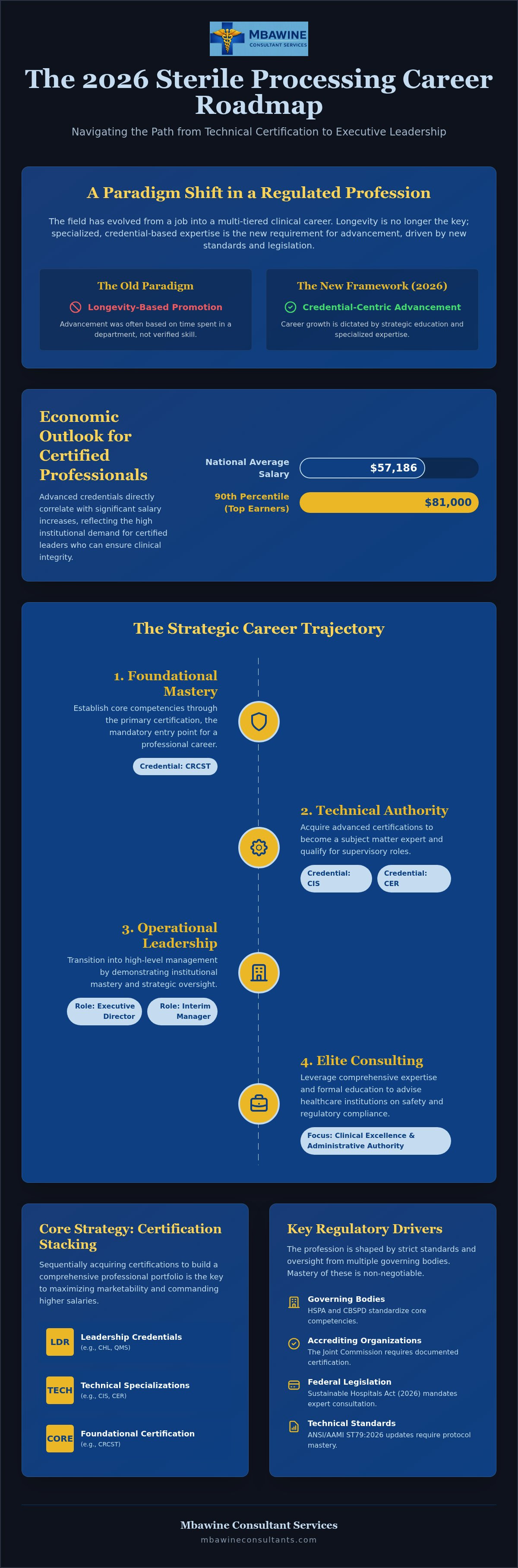
The industry has reached a tipping point where on-the-job training's increasingly insufficient to meet rigorous regulatory demands. Governing bodies such as the Healthcare Sterile Processing Association (HSPA) and the Certification Board for Sterile Processing and Distribution (CBSPD) have standardized the core competencies required for entry and advancement. The Joint Commission and other accrediting organizations now look for documented certification as a baseline for departmental compliance. This regulatory environment ensures that the sterile processing career path is predicated on formal academic achievement rather than simple seniority. The release of the ANSI/AAMI ST79:2026 updates further underscores the necessity for professionals who can interpret complex technical standards and implement standardized protocols for decontamination and sterilization across diverse healthcare settings.
The professionalization of the field has yielded significant economic dividends for those who pursue advanced credentials. Data from August 2026 indicates that the national average annual salary for a technician has reached $57,186, with top-tier earners in the 90th percentile commanding up to $81,000 annually. These figures reflect a direct correlation between specialized education and compensation levels. As healthcare systems expand their reliance on complex surgical instrumentation, the demand for certified leaders who can manage high-volume throughput while maintaining clinical integrity remains robust. Professionals who invest in comprehensive sterile processing classes are better positioned to secure these high-tier institutional roles. This economic trajectory suggests that the field will continue to outpace many other allied health roles in both stability and wage growth.
The modern sterile processing career path relies on a multi-tiered credentialing strategy known as "certification stacking." This methodology involves the sequential acquisition of technical and leadership certifications to differentiate one's professional profile in a competitive, highly regulated market. While a single certification was once sufficient for employment, institutional standards in 2026 demand a broader portfolio of verified competencies to ensure patient safety and operational efficiency. By stacking specialized credentials, professionals demonstrate a commitment to clinical excellence that transcends basic entry-level requirements.
The Certified Registered Central Service Technician (CRCST) serves as the primary entry point into the profession, requiring 400 hours of documented clinical experience and a comprehensive understanding of decontamination, sterilization, and storage protocols. Successfully navigating this initial milestone often necessitates structured support, as the HSPA exam demands high technical proficiency. Candidates who utilize formal CRCST certification preparation programs generally demonstrate higher first-time pass rates compared to those who rely solely on self-directed study. This foundational step is corroborated by the Sterile Processing Career Pathway, which outlines the rigorous academic and clinical prerequisites necessary for institutional compliance across the United States.
Once foundational mastery is achieved, professionals can pursue specialized designations like the Certified Instrument Specialist (CIS) or Certified Endoscope Reprocessor (CER). These certifications aren't just titles. The CIS credential elevates a technician to the status of a subject matter expert in complex surgical instrumentation, while the CER addresses the high-risk requirements of flexible endoscope reprocessing. For those targeting administrative roles, the Certified Healthcare Leader (CHL) is indispensable. It bridges the gap between clinical execution and departmental oversight, covering personnel management, budget allocation, and regulatory adherence. The ROI for these advanced credentials is substantial; top-tier earners often leverage these designations to reach the $81,000 annual salary threshold. Investing in your future by enrolling in specialized classes ensures you're prepared for these advanced examinations and the leadership responsibilities that follow.
The traditional sterile processing career path has historically followed a linear progression from technician to supervisor; however, the contemporary landscape has diversified into specialized streams that prioritize either advanced clinical technicality or high-level administrative oversight. Professionals who demonstrate exceptional technical proficiency often find significant opportunities within the traveling technician trajectory, where they leverage their CRCST and specialized credentials to fulfill high-demand temporary staffing assignments across national healthcare networks. This path offers a unique blend of clinical variety and competitive compensation, and it's frequently a bridge for those who prefer technical execution over permanent institutional management. Conversely, the executive track demands a transition from manual instrument processing to the strategic management of perioperative services, requiring a different set of competencies rooted in organizational theory and fiscal responsibility.
The transition from a clinical technician to a Lead Technician represents the first critical juncture in the management hierarchy. In this role, the professional must balance active instrument processing with peer supervision and quality assurance monitoring. As one advances to the position of SPD Manager, the focus shifts decisively toward operational administration, including the oversight of departmental budgets, human resources, and strict adherence to regulatory compliance standards. For those targeting the executive tier, the role of Director of Sterile Processing in large healthcare systems requires a comprehensive understanding of perioperative leadership, ensuring that the department's strategic goals align with the broader objectives of the medical institution. These roles often command the higher end of the salary spectrum, especially for those who've attained the Certified Healthcare Leader (CHL) designation.
For seasoned professionals who have mastered both technical and administrative domains, the transition into sterile processing consultant services represents the pinnacle of professional achievement. These experts are frequently called upon to conduct comprehensive departmental assessments, identify operational inefficiencies, and implement corrective action plans that align with the latest AAMI standards. Closely related is the role of interim management, which provides essential stability to departments during leadership transitions or organizational restructures. By assuming these high-stakes responsibilities, consultants and interim leaders ensure operational continuity and patient safety, demonstrating the sophisticated level of mastery that defines the upper echelons of the modern sterile processing career path. This trajectory allows professionals to apply their expertise across diverse institutional settings, acting as a guardian of industry standards on a national scale.
Advancing through the sterile processing career path requires a methodical transition from clinical execution to strategic oversight. This progression isn't a byproduct of time. It's the result of a deliberate, five-step framework designed to establish institutional authority and professional marketability. By following a structured roadmap, you can shift from manual processing to high-level departmental management.
Mastering the administrative aspects of sterile processing involves more than supervising personnel. It requires an acute understanding of fiscal management and departmental budgeting. You must ensure the department operates efficiently within the hospital's broader economic ecosystem. Leaders must also excel at conflict resolution and team building to maintain morale in high-stress medical environments. Effective leadership is defined by the seamless integration of ANSI/AAMI ST79:2026 standards into daily operational workflows, transforming complex regulatory requirements into actionable clinical practices. This technical-administrative hybrid skill set is what distinguishes a manager from a technician.
Professional growth is rarely achieved in isolation. Identifying mentors within the Mbawine Staff and Alumni network provides access to a wealth of institutional knowledge and career guidance that isn't available in textbooks. Engaging with professional associations increases your visibility and provides opportunities for networking with industry leaders on a national scale. You should maintain a professional portfolio that documents your specific contributions to process improvements and successful compliance audits. This record of achievement is essential when applying for high-level consultative roles. To begin your journey toward leadership and secure your place in the next generation of industry experts, you can enroll in our advanced certification programs today.
Relying on self-study for high-level professional advancement often proves insufficient when navigating the high-stakes environment of modern perioperative support. The sterile processing career path requires a depth of understanding that extends beyond memorizing technical manuals; it demands an ability to apply clinical logic to complex sterilization challenges and regulatory requirements. Engaging in comprehensive sterile processing classes provides the necessary institutional framework to master these competencies, ensuring that technicians don't just pass exams but internalize the standards of practice. Mbawine Consultant Services acts as a critical bridge in this professional journey, transforming entry-level technicians into sophisticated leaders through a combination of rigorous CRCST preparation and strategic leadership mentorship. This vocation is ultimately mission-driven, where every processed instrument represents a non-negotiable commitment to patient safety and the preservation of human life.
Selecting an educational institution requires a careful evaluation of clinical depth and historical certification pass rates. Programs that offer instructor-led training provide a significant advantage, as they allow for real-time clarification of complex technical and regulatory topics that are often glossed over in self-directed modules. This structured approach to learning is essential for mastering the nuances of the ANSI/AAMI ST79:2026 standards and the implications of the Sustainable Hospitals Act. Ambitious professionals often find that specialized education significantly reduces their time-to-promotion, as they enter the workforce with a level of technical authority that commands institutional respect. By prioritizing programs that emphasize comprehensive assessment and clinical proficiency, you ensure your career is built on a foundation of professional reliability and expertise.
The long-term benefits of a structured career path extend far beyond individual salary growth; they are fundamental to the health of the entire healthcare ecosystem. When departments are led by professionals who have pursued formal development, patient safety outcomes improve and institutional compliance risks are mitigated. A commitment to continuous education ensures that the sterile processing department remains a guardian of industry standards rather than a bottleneck for surgical services. We advocate for every professional in the field to recognize the gravity of their role and take the next step in their professional evolution. Your journey toward technical mastery and leadership begins with a commitment to excellence. You can secure your future and contribute to the professionalization of the industry by accessing enrollment for upcoming professional development sessions to establish your roadmap for 2026 and beyond.
The transition from a technical operative to a strategic leader is a deliberate journey defined by the acquisition of high-level credentials and institutional mastery. By embracing the multi-tiered framework of certification stacking, you ensure your sterile processing career path remains resilient against evolving regulatory standards and the complexities of modern surgical support. Success in this field requires more than departmental longevity; it demands a commitment to formal professional development that aligns with national benchmarks for patient safety.
Mbawine Consultant Services provides the essential framework for this advancement through a comprehensive leadership and technical curriculum. Our programs are led by nationally recognized sterile processing consultants and boast industry-leading CRCST exam pass rates, ensuring you're prepared for the clinical and administrative challenges of 2026. Enroll in professional sterile processing development classes today to establish your authority as a guardian of industry standards. Your dedication to clinical excellence is the foundation of institutional safety and professional success.
Entry-level technicians typically earn around $41,500, while the national average has reached $57,186 as of August 2026. As you advance along the sterile processing career path, specialized certifications like the CIS or CER allow for salary increases into the 75th percentile of $69,000. Management and executive director roles represent the upper tier of compensation, with top earners in the 90th percentile reaching $81,000 annually through institutional leadership.
While a college degree isn't universally mandated for all management positions, many large healthcare systems now require an Associate's or Bachelor's degree in healthcare administration or business for Director-level roles. Foundational leadership is often accessible through HSPA's Certified Healthcare Leader (CHL) designation. However, as the profession becomes more institutionalized, a degree combined with advanced certification significantly enhances your competitiveness for executive perioperative leadership positions.
The transition from an entry-level technician to a supervisory role typically requires three to five years of clinical experience, depending on your rate of credential acquisition. Professionals who prioritize certification stacking and demonstrate mastery of AAMI standards often accelerate this timeline. By obtaining the CHL credential early and maintaining a record of high clinical proficiency, ambitious individuals can secure Lead Technician or Supervisor positions more rapidly than through seniority alone.
Both HSPA and CBSPD certifications are widely recognized, but HSPA's multi-tiered framework is often preferred for long-term career growth due to its specialized leadership and technical tracks. The HSPA CRCST, CIS, and CHL certifications provide a structured ladder that aligns closely with the modern sterile processing career path in large hospital systems. CBSPD remains a robust alternative, particularly in facilities that prioritize a broad, integrated approach to sterile processing and distribution.
Becoming a sterile processing consultant requires a combination of extensive departmental leadership experience and advanced technical certifications. Most consultants have served as SPD Managers or Directors for several years and possess a deep mastery of Joint Commission and AAMI ST79:2026 standards. You must demonstrate a proven ability to conduct departmental audits, implement process improvements, and provide data-driven solutions that enhance patient safety and operational efficiency across diverse healthcare environments.
The skills acquired in sterile processing, such as quality assurance, regulatory compliance, and personnel management, are highly transferable to broader healthcare management roles. Many professionals move into perioperative services management, infection prevention, or materials management. The analytical nature of the profession prepares individuals to oversee complex logistical and clinical workflows, making them excellent candidates for administrative positions within hospital operations or risk management departments.
Interim leadership differs from traditional management primarily in its focus on departmental stabilization and short-term operational improvement during transitional periods. While a traditional manager focuses on long-term institutional growth, an interim leader is often an external expert brought in to address specific compliance gaps or leadership vacancies. This role requires immediate technical authority and the ability to implement corrective actions quickly, often serving as a bridge to permanent leadership.
The Certified Healthcare Leader (CHL) and Certified Instrument Specialist (CIS) are often considered the most challenging certifications due to their specialized focus. The CHL requires a sophisticated understanding of human resources, budgeting, and strategic planning; meanwhile, the CIS demands expert-level knowledge of complex surgical instrumentation. Successfully obtaining these credentials requires rigorous study and clinical experience, as they represent the highest levels of technical and administrative mastery in the field.

Article by
Mba Akuribila
Mba‑Akuribila is a healthcare leader, educator, and founder of Mbawine Consultants, a Bronx‑based institution recognized nationwide for advancing excellence in sterile processing and allied health workforce development. Born in Bongo in Ghana’s Upper East Region, his journey from rural beginnings to national impact reflects a lifelong commitment to service, empowerment, and community advancement.
For over two decades, he has trained sterile processing employees, mentored, and placed thousands of healthcare professionals across the United States. Through Mbawine Consultants, he established one of the country’s most trusted Sterile Processing Certification Test Prep Programs, preparing new Americans and career‑changers for successful entry into the field. The organization, as at 2026, has graduated more than 15,000 sterile processing technicians who now serve in hospitals, ambulatory centers, dental practices, and reprocessing facilities nationwide.
Under his leadership, Mbawine Consultants has expanded into a full Healthcare Staffing Agency, connecting nurses and allied health professionals to meaningful employment opportunities. His team also provides Interim Management Services, supporting hospitals and surgical centers with experienced leaders who stabilize operations, strengthen compliance, and improve workflow efficiency.
As a former surgical technician, sterile processing manager, educator, and system‑wide director, Mba‑Akuribila brings deep expertise to Sterile Processing Consulting, helping healthcare facilities elevate quality, safety, and regulatory readiness.
His work in the United States and Ghana continues to reflect his core philosophy: service above self, opportunity for all, and excellence without compromise.


