

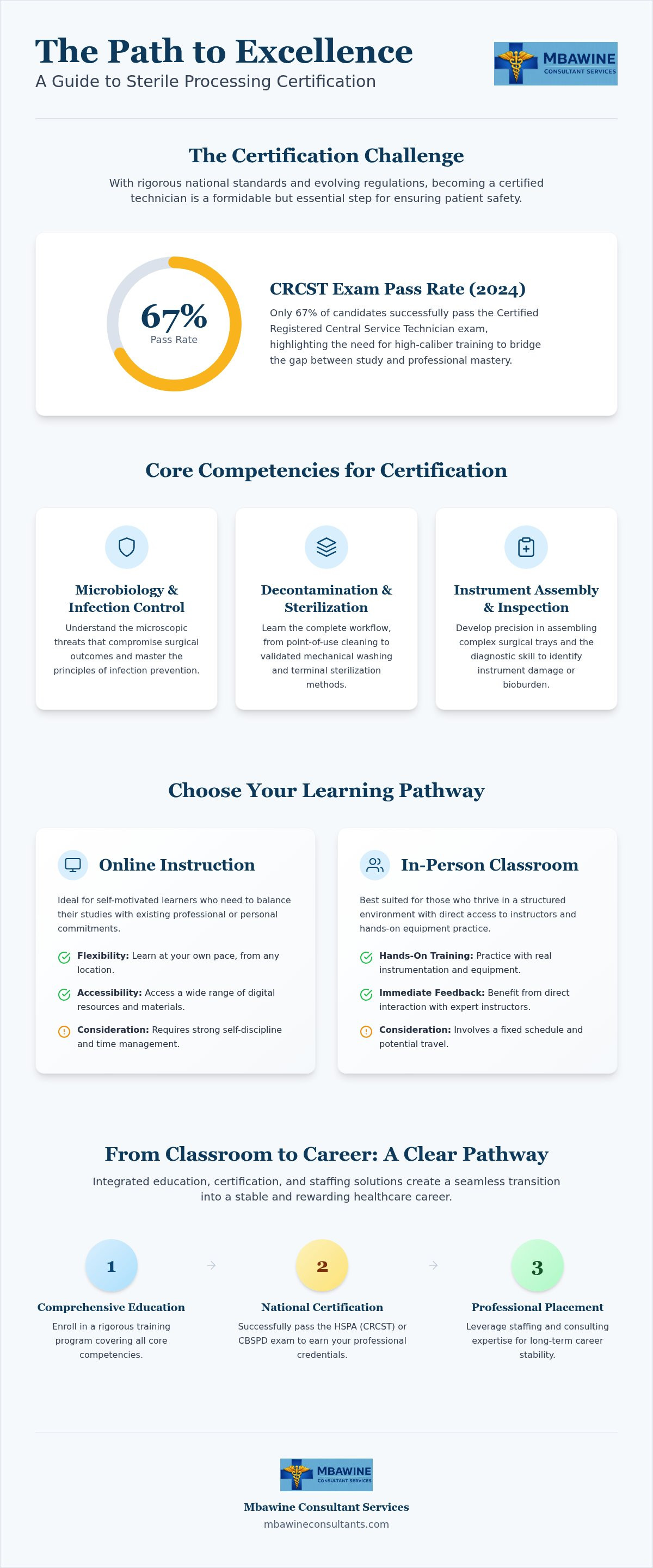
With only 67 percent of candidates successfully passing the Certified Registered Central Service Technician exam in 2024, the path to professional credentialing remains a formidable hurdle for many aspiring healthcare professionals. You recognize that the integrity of perioperative safety rests upon the technical mastery of decontamination and sterilization protocols; yet, identifying a high-caliber sterile processing certification class often involves navigating a landscape of ambiguous curricula and varying institutional standards. It's common to feel a sense of trepidation regarding the transition from academic study to the high-stakes environment of a modern sterile processing department where public safety is the primary mandate.
This article serves as a definitive guide to the most rigorous educational pathways available, offering a thorough analysis of how specialized training programs prepare personnel for national certification excellence. We'll explore the critical distinctions between virtual and classroom-based instruction, the systematic requirements for attaining CRCST or CBSPD credentials, and the strategic integration of education with professional staffing solutions. By the conclusion of this prospectus, you'll possess a clear, authoritative roadmap to achieving both professional certification and long-term career stability within the healthcare sector. This comprehensive evaluation ensures that your educational investment aligns with the highest industry standards for patient care and technical proficiency.
The Central Sterile Services Department (CSSD) serves as the vital engine of the modern healthcare infrastructure, ensuring that every surgical instrument is free from microbial contamination before it enters the sterile field. This department's performance directly impacts clinical outcomes, making the technical proficiency of its staff a matter of institutional survival and public safety. As surgical techniques become increasingly complex, the professional mandate for standardized training has shifted from a preference to a requirement. A sterile processing certification class is a structured pedagogical program aligned with national healthcare standards. This educational rigor ensures that technicians don't just follow a checklist but understand the scientific principles governing sterilization. Facilities that invest in certified personnel effectively bridge the gap between basic operational tasks and advanced clinical mastery.
State-level mandates are rapidly evolving, with an increasing number of jurisdictions now requiring mandatory certification for all technicians operating within an SPD. This shift reflects a broader national trend where institutional accreditation often depends on the presence of a certified workforce. By 2026, the industry expects even tighter scrutiny from regulatory bodies like The Joint Commission, which introduced specialized certifications in 2024 to address sterilization oversight. Professional education directly mitigates the risk of surgical site infections (SSIs) by grounding technicians in the benchmarks set by the Healthcare Sterile Processing Association (HSPA) and the Certification Board for Sterile Processing and Distribution (CBSPD). These standards provide the clinical framework necessary to maintain departmental compliance and protect patient health.
Technicians function as the primary guardians of the sterile field, acting as a final barrier against potential pathogens. When a facility employs personnel who have completed a recognized sterile processing certification class, it significantly reduces institutional liability and enhances operational efficiency. Certified professionals possess the diagnostic skills to identify instrument damage or bioburden that uncertified staff might overlook. Healthcare facilities increasingly prioritize candidates from established educational consultancies because these individuals represent a commitment to excellence rather than mere compliance. This dedication to mastery fosters a culture of safety that extends from the decontamination sink to the operating room table. Ultimately, the transition to a fully certified workforce is an essential step in professionalizing the field and ensuring the highest standards of care.
A professional sterile processing certification class must transcend basic rote memorization, focusing instead on the deep integration of microbiology and technical precision. Professional mastery begins with an exhaustive understanding of infection control principles, where technicians learn to identify the microscopic threats that compromise surgical outcomes. This knowledge is applied throughout the decontamination process, which commences at the point-of-use in the operating room and concludes with the validated results of a mechanical washer. According to the Bureau of Labor Statistics, these specialists are essential for maintaining the integrity of medical environments, a role that demands absolute accuracy in instrumentation assembly. Every surgical tray requires a rigorous inspection and testing protocol to ensure that moving parts function correctly and that no residual bioburden remains. Technicians who master these domains are prepared to handle the increasing complexity of modern surgical tools.
Rigorous educational frameworks must incorporate the standards established by the American National Standards Institute (ANSI) and the Association for the Advancement of Medical Instrumentation (AAMI). Specifically, a high-level sterile processing certification class prioritizes the ST79 and ST91 guidelines, which serve as the definitive benchmarks for steam sterilization and flexible endoscope processing. Students explore the complex science behind various sterilization modalities, including saturated steam, ethylene oxide (ETO), and low-temperature hydrogen peroxide gas plasma. This technical training emphasizes that sterilization is a validated process, requiring meticulous quality assurance documentation to verify that every cycle meets the necessary biological and chemical parameters. For those seeking to master these institutional standards, choosing to enroll in a professional program ensures alignment with current regulatory expectations.
Beyond technical execution, the curriculum must address the analytical skills required for complex surgical tray assembly, where a single missing component can delay a life-saving procedure. Technicians must develop clear communication protocols with the Operating Room (OR) to ensure that clinical needs are met with precision and urgency. This professional synergy is grounded in a strong ethical framework, as technicians operate in a high-stakes medical environment where their decisions directly influence patient safety. Professionalism in the SPD involves a commitment to continuous learning and an unwavering adherence to the ethical standards of the healthcare field. It's this combination of technical expertise and professional conduct that defines a truly prepared sterile processing technician.
The selection of a sterile processing certification class involves a strategic assessment of one's professional objectives and learning style. Distance learning has emerged as a highly effective pedagogical tool for the acquisition of complex theoretical knowledge, such as the chemical properties of detergents and the biological principles of pathogen destruction. However, the high-stakes nature of surgical instrument handling often necessitates the in-person mentorship and hands-on laboratory experience found in physical classrooms. While online modalities offer unparalleled flexibility for the acquisition of theoretical knowledge, they cannot fully replicate the institutional benefits and tactile mastery gained within a traditional classroom environment. Hybrid models frequently provide a balanced approach, integrating digital flexibility with the technical rigor required for the clinical setting.
Online education provides essential accessibility for working professionals who are managing a career transition without the limitations of geographic constraints. These programs utilize digital resources and virtual simulations that act as modern educational aids, allowing students to visualize the internal components of complex medical devices. It's a modality that is often highly cost-effective and grants students the ability to review dense sterilization theories at a personal pace, which is particularly beneficial for mastering the intricate standards discussed in previous chapters. By leveraging these digital platforms, students can achieve a high level of theoretical proficiency before they ever step into a decontamination suite.
Theoretical knowledge is only one component of professional readiness; the Certification Board for Sterile Processing and Distribution (CBSPD) and other national bodies emphasize that 400 hours of hands-on experience are mandatory for full certification. In-person classes often facilitate the procurement of these clinical hours through established institutional partnerships, providing a streamlined pathway that online-only students might find difficult to navigate independently. This practical application allows students to bridge the gap between a sterile processing certification class and a professional resume, ensuring they enter the workforce as seasoned technicians rather than mere theorists. By engaging in these clinical externships, candidates demonstrate a commitment to the high-level technical mastery that healthcare facilities demand. It's this integration of study and practice that ultimately secures long-term career stability in the medical field.
Transitioning from theoretical foundations to the rigorous requirements of the Certified Registered Central Service Technician (CRCST) examination requires a methodical pedagogical strategy. Successful candidates prioritize a systematic review of the Healthcare Sterile Processing Association (HSPA) Technical Manual, which serves as the primary repository of industry standards and validated processes. Understanding the exam weighting is essential for efficient study; specific domains such as decontamination and sterilization parameters receive significantly higher point values, necessitating a more intensive focus than administrative or inventory functions. Integrating CRCST certification preparation into a daily routine through repetitive practice examinations allows for the identification of specific knowledge gaps well before the testing date. This disciplined approach ensures that the technician doesn't just memorize facts but understands the clinical rationale behind every protocol.
Candidates must navigate a precise administrative process to document their 400 hours of hands-on clinical experience, a requirement that remains a cornerstone of professional eligibility. If these hours aren't completed prior to the examination, the individual is granted a provisional certification status, which must be converted to full certification through the completion and submission of hours within six months. Managing this timeline is critical for maintaining professional momentum. The application requires verified documentation of clinical competencies, typically signed by a departmental manager or an authorized instructor from your sterile processing certification class. Ensuring that all credentials are submitted correctly prevents unnecessary delays in the credentialing cycle.
Mastering the complex terminology and technical parameters of modern sterilization requires the development of high-level critical thinking skills. Situational exam questions often present clinical scenarios where technicians must determine the appropriate course of action based strictly on ANSI/AAMI standards rather than departmental shortcuts. Professional mentorship plays a pivotal role in managing examination anxiety, as seasoned experts provide the contextual insight necessary to interpret complex regulatory language. Comprehensive preparation ensures that the technician enters the testing center with the professional confidence required for first-attempt success. To secure your place in a program that prioritizes these high standards, you're encouraged to enroll in a specialized training program that offers structured exam support.
Mbawine Consultant Services operates at the intersection of professional education and institutional management, providing a pedagogical model that transcends the limitations of generic trade schools. By integrating clinical rigor with real-world operational insights, our specialized training programs prepare healthcare personnel to meet the high-stakes demands of modern surgical environments. We're deeply committed to the professionalization of the field, acting as a dedicated advocate for excellence and a reliable source of high-level knowledge. To begin your journey toward technical mastery, you may enroll in professional sterile processing classes that are specifically designed to align with national certification standards. Choosing the right sterile processing certification class is the foundational step in a career dedicated to surgical excellence and patient safety.
Learning from a consultancy rather than a traditional academic institution offers students a unique advantage because they gain direct exposure to the actual operational needs of hospitals and surgical centers. Mbawine Consultant Services provides more than just a sterile processing certification class; it offers entry into a national professional ecosystem. This network includes access to healthcare staffing solutions and interim management opportunities that bridge the gap between initial certification and long-term employment. Our commitment to the field ensures that we remain advocates for industry standards, providing ongoing professional development and advocacy for our alumni as they progress into leadership roles within the department. This relationship doesn't end at graduation; it continues as we support the next generation of sterile processing leaders through constant engagement with industry benchmarks.
Our extensive staffing expertise directly informs our educational curriculum, ensuring that every module remains relevant to the evolving needs of the healthcare market. This technical synergy allows us to identify the specific skills that hospital administrators prioritize when hiring new technicians, making our graduates highly competitive candidates in a demanding field. Our interim leadership services place seasoned experts within departments to provide direct mentorship to newly certified personnel, fostering a culture of technical excellence and institutional reliability. You can explore our sterile processing consultant services to understand how our institutional oversight supports both departmental efficiency and individual career growth. This holistic approach ensures that our graduates are not only prepared for a certification examination but are equipped to lead within a high-stakes medical environment where public safety is the primary mandate.
The transition from an aspiring technician to a certified professional requires more than basic instruction; it demands a rigorous pedagogical foundation aligned with the highest institutional standards. Achieving success on national examinations depends on a comprehensive mastery of microbiology, decontamination protocols, and the complex regulatory frameworks established by HSPA. By selecting a specialized sterile processing certification class, you're not merely preparing for an exam but are establishing yourself as a vital guardian of the sterile field and public safety. This professional journey represents a serious commitment to the integrity of surgical outcomes and the welfare of every patient under your care.
Mbawine Consultant Services provides an expert-led curriculum that directly mirrors current HSPA standards while offering comprehensive support for the mandatory 400-hour clinical experience requirement. Our unique position as a national staffing and consulting firm ensures that our alumni transition seamlessly from the classroom to stable healthcare employment through our integrated staffing solutions. We invite you to Enroll in Mbawine Consultant Services' Sterile Processing Classes Today to secure your future in this essential medical field. Your dedication to technical mastery is the foundation of a successful and impactful career.
While no federal mandate currently exists, certification is rapidly becoming a national standard due to evolving state-level legislation and institutional safety protocols. Most healthcare facilities prioritize or exclusively hire certified technicians to mitigate surgical site infections and ensure regulatory compliance. Enrolling in a sterile processing certification class ensures that candidates are prepared to meet the rigorous benchmarks established by national credentialing bodies like the HSPA or CBSPD.
The duration of a professional program generally ranges from three to four months for the didactic component. This timeframe accounts for the comprehensive study of microbiology, infection control, and sterilization science. Following the classroom portion, candidates must complete 400 hours of hands-on clinical experience. Depending on the technician's weekly commitment to their externship, the entire process from initial enrollment to full certification typically spans six to nine months.
The primary distinction lies in the eligibility requirements and the specific credentialing body. The Healthcare Sterile Processing Association (HSPA) grants the CRCST credential and mandates 400 hours of clinical experience. Conversely, the Certification Board for Sterile Processing and Distribution (CBSPD) offers the CSPDT credential, which accepts either one year of employment or the completion of a recognized training program. Both pathways are accredited and widely accepted across the United States.
Entry-level candidates without prior medical experience can certainly succeed in online programs. These curricula are structured to introduce foundational concepts such as anatomy, physiology, and the principles of thermal and chemical sterilization. While the theoretical knowledge is acquired through digital platforms, students must eventually secure a clinical placement to fulfill their practical requirements. This hybrid approach allows for geographic flexibility while maintaining the technical rigor required for professional excellence.
The clinical externship requires 400 hours of documented experience across several critical domains of the Central Sterile Services Department. Technicians must perform tasks in decontamination, instrument assembly, sterilization, and sterile storage. These hours must be verified and signed by a department manager or supervisor to satisfy the requirements for full certification. This practical application ensures that the technician can safely translate classroom theory into the high-stakes environment of a hospital.
Tuition for a professional sterile processing certification class varies depending on whether the student selects a virtual or in-person modality. Industry data from 2026 indicates that virtual instruction typically costs approximately $1,850, while in-person programs average around $2,500. Candidates should also account for additional expenses such as the $140 CRCST examination fee. These investments reflect the specialized nature of the training and the high-level technical expertise required for the role.
If a candidate doesn't pass the national certification exam on their first attempt, they must observe a mandatory waiting period before scheduling a re-test. The re-examination fee for the CRCST is $140, mirroring the initial application cost. Reputable programs provide their students with detailed score analysis and remediation support to address specific technical weaknesses. This structured review process is essential for ensuring success on the subsequent attempt and maintaining professional momentum.
Mbawine Consultant Services offers unique advantages by integrating its educational programs with a national staffing and interim management network. Certified alumni gain access to temporary staffing solutions and interim management opportunities that facilitate a smooth transition into the workforce. This comprehensive professional ecosystem is designed to bridge the gap between initial certification and long-term career stability. By leveraging these consultancy services, technicians can secure placements in high-performing departments across the country.

Article by
Mba Akuribila
Mba‑Akuribila is a healthcare leader, educator, and founder of Mbawine Consultants, a Bronx‑based institution recognized nationwide for advancing excellence in sterile processing and allied health workforce development. Born in Bongo in Ghana’s Upper East Region, his journey from rural beginnings to national impact reflects a lifelong commitment to service, empowerment, and community advancement.
For over two decades, he has trained sterile processing employees, mentored, and placed thousands of healthcare professionals across the United States. Through Mbawine Consultants, he established one of the country’s most trusted Sterile Processing Certification Test Prep Programs, preparing new Americans and career‑changers for successful entry into the field. The organization, as at 2026, has graduated more than 15,000 sterile processing technicians who now serve in hospitals, ambulatory centers, dental practices, and reprocessing facilities nationwide.
Under his leadership, Mbawine Consultants has expanded into a full Healthcare Staffing Agency, connecting nurses and allied health professionals to meaningful employment opportunities. His team also provides Interim Management Services, supporting hospitals and surgical centers with experienced leaders who stabilize operations, strengthen compliance, and improve workflow efficiency.
As a former surgical technician, sterile processing manager, educator, and system‑wide director, Mba‑Akuribila brings deep expertise to Sterile Processing Consulting, helping healthcare facilities elevate quality, safety, and regulatory readiness.
His work in the United States and Ghana continues to reflect his core philosophy: service above self, opportunity for all, and excellence without compromise.


