

The integrity of modern surgical outcomes rests not merely upon the skill of the surgeon, but upon the rigorous adherence to aseptic protocols maintained within the sterile processing department by highly trained technicians. Many prospective candidates face significant anxiety regarding the complexities of the CRCST examination or the logistical challenges of fulfilling the mandatory 400-hour clinical requirement. It's common to feel a sense of professional uncertainty when evaluating the nuanced differences between HSPA and CBSPD certification pathways. This article serves as a definitive resource for those seeking top-tier sterile processing classes, offering a structured approach to mastering the technical and regulatory frameworks essential for patient safety.
By engaging with curriculum designed for academic rigor, you'll gain the specialized knowledge required to achieve successful certification and secure long-term placement in reputable healthcare facilities. We'll provide a methodical overview of current industry standards, including the latest ANSI/AAMI ST79 updates, and detail the specific educational milestones necessary to transition from an entry-level applicant to a seasoned professional guardian of public health. Through this comprehensive assessment, you'll understand how professional education acts as the critical bridge between basic vocational requirements and the advanced technical mastery demanded by the nation's leading medical institutions.
Sterile processing serves as the fundamental cornerstone of modern surgical safety, acting as the primary barrier against healthcare-associated infections. While some vocational programs categorize this role as a secondary support function, the clinical reality in 2026 is that the Central Sterile Services Department (CSSD) operates as a high-stakes clinical environment. Enrollment in professional sterile processing classes is no longer an optional career enhancement; it's a mandatory prerequisite for those assuming the responsibility of protecting patient lives from microbial threats. This educational evolution reflects a broader industry shift where technical proficiency directly correlates with the measurable reduction of Surgical Site Infections (SSIs). Precision is the standard.
A Sterile Processing Technician is a specialized clinical professional who possesses the technical mastery required to manage the lifecycle of surgical instrumentation. Their role is defined by a deep expertise in the scientific principles of sterilization and the mechanical nuances of modern surgical tools. The scope of practice is comprehensive and includes several critical phases:
This role carries a profound ethical obligation to patient safety. Technicians serve as the silent advocates for patients who are under anesthesia, ensuring that every device used during an invasive procedure meets the highest standards of clinical purity. It's a mission-driven profession that demands unwavering attention to detail. Every tray processed represents a human life.
Navigating the complex regulatory environment of 2026 requires a level of systematic training that traditional on-the-job models can't provide. Modern hospitals face intense scrutiny from The Joint Commission and must adhere to the latest ANSI/AAMI ST79 standards to maintain accreditation and ensure patient safety. Formal sterile processing classes provide the theoretical foundation and practical frameworks necessary to maintain institutional compliance in an era of increasing surgical complexity. Compliance is not negotiable.
By choosing a program backed by Mbawine Consultant Services, students align themselves with a brand committed to institutional excellence and the highest tiers of professional advocacy. This training prepares technicians to operate within the high-pressure environment of the modern operating suite, where regulatory adherence is as critical as technical execution. The transition from a vocational job to a recognized clinical discipline has been driven by the emergence of drug-resistant pathogens and the sophisticated requirements of robotic surgical systems. Formal education ensures that technicians are prepared for these challenges from day one.
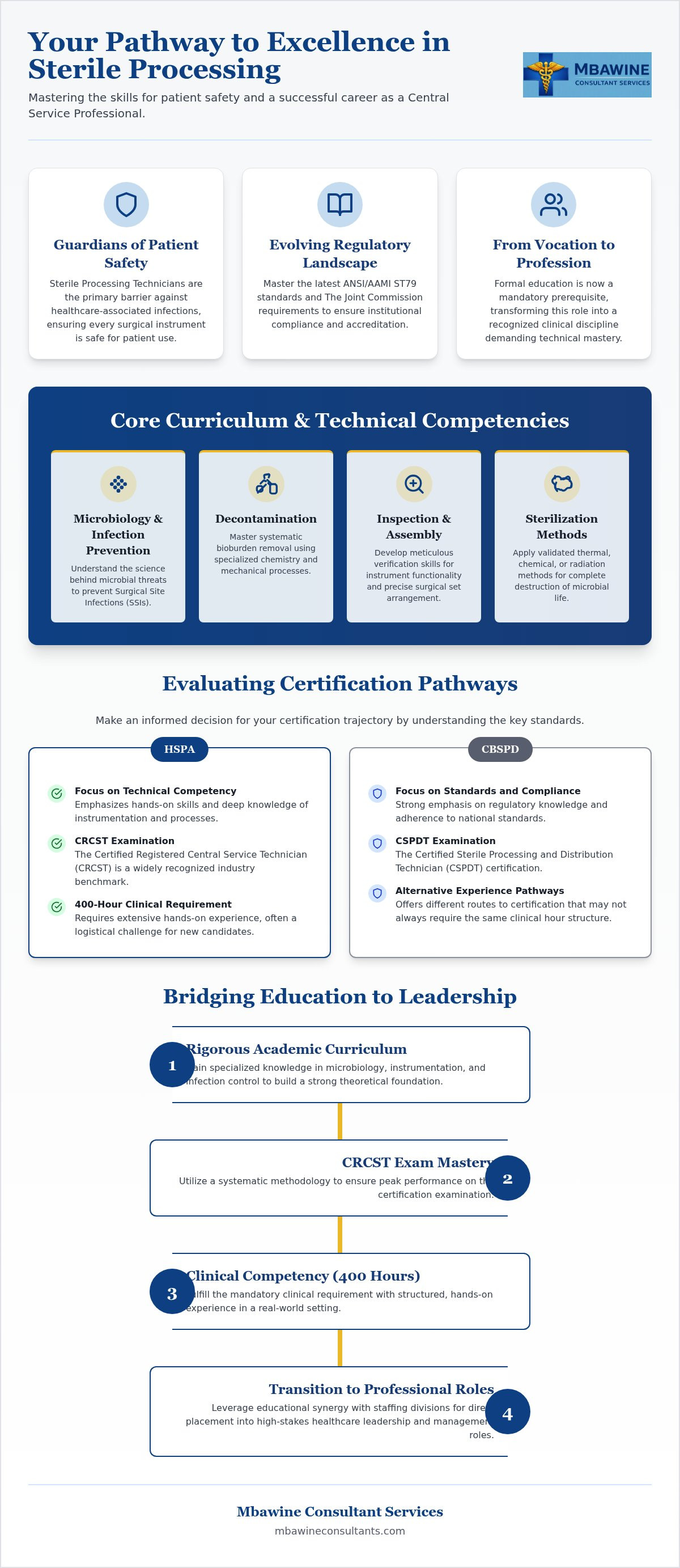
The transition from manual labor to a specialized clinical discipline requires a curriculum rooted in the biological sciences and mechanical engineering. High-quality sterile processing classes move beyond basic medical terminology to provide a comprehensive analysis of the environmental and physiological factors that influence instrument safety. This educational foundation ensures that every technician understands the "why" behind the "how," fostering a culture of professional accountability and technical precision. Mastery of these core competencies is the only path to ensuring that surgical assets are safe for patient use.
Technicians must achieve a high level of proficiency in microbiology to effectively combat the microscopic threats present in the clinical environment. Professional education focuses heavily on the lifecycle of pathogens and the formation of biofilms, which are complex microbial communities that adhere to instrument surfaces. Understanding how to disrupt these biofilms during the decontamination process is critical, as decontamination represents the first line of defense in the sterilization chain. Classes teach the principles of aseptic technique and the specific parameters required for microbial destruction, ensuring that no pathogen survives the reprocessing cycle. This scientific approach is what differentiates a certified professional from an untrained laborer.
The modern surgical suite utilizes a vast array of sophisticated tools, ranging from traditional stainless steel retractors to high-tech robotic components and lumened devices. Professional training provides the technical framework for handling these complex assets, emphasizing the necessity of meticulous functional testing and assembly protocols. Technicians learn to identify subtle signs of wear or damage that could compromise a surgical procedure. This level of detail is a core component of CRCST certification preparation, as it aligns with the rigorous standards established by leading industry bodies. Proper identification and care for these assets ensure longevity and, more importantly, patient safety during invasive procedures.
A comprehensive syllabus also examines the various sterilization modalities utilized in 2026. While saturated steam remains the gold standard for many items, the rise of heat-sensitive robotic tools has increased the reliance on low-temperature sterilization methods, such as vaporized hydrogen peroxide and ethylene oxide. Classes detail the specific validation requirements for each modality to ensure that the process is consistently effective. Additionally, students are introduced to the complexities of inventory management and supply chain logistics. Efficiently managing the flow of sterile goods is essential for maintaining the operational rhythm of the operating room. For those ready to begin this rigorous professional journey, you can enroll in our upcoming sessions to gain these vital skills.
The Certification Board for Sterile Processing and Distribution (CBSPD) and other governing entities emphasize that technical competence must be paired with an understanding of institutional standards. By mastering these competencies, technicians become integral members of the healthcare team, capable of navigating the high-stakes environment of modern medicine with confidence and authority.
Achieving professional validation requires a strategic choice between two primary credentialing bodies: the Healthcare Sterile Processing Association (HSPA) and the Certification Board for Sterile Processing and Distribution (CBSPD). Both organizations provide nationally recognized certifications that are essential for career mobility and institutional compliance. As outlined in the O*NET occupational profile for Medical Equipment Preparers, the technical demands of this role necessitate a formal assessment of knowledge. Selecting the appropriate sterile processing classes is a critical decision that dictates a candidate's preparation for these rigorous examinations. In 2026, certification is increasingly a legal mandate, with several states already requiring these credentials for employment as part of a nationwide movement toward standardized clinical oversight.
The HSPA offers the Certified Registered Central Service Technician (CRCST) credential, which is widely regarded for its emphasis on comprehensive clinical experience. A defining feature of this pathway is the mandatory 400-hour hands-on experience requirement, which ensures that candidates have practical exposure to decontamination, assembly, and sterilization processes. For individuals new to the field, HSPA provides a provisional certification option. This allows candidates to sit for the examination first and complete their clinical hours within six months of passing. This pathway is particularly beneficial for those seeking entry-level roles in facilities that prioritize institutional leadership and standardized management practices. Candidates often utilize specialized CRCST certification preparation to navigate the high-stakes exam environment successfully.
The CBSPD offers the Certified Sterile Processing and Distribution Technician (CSPDT) designation. This body provides multiple eligibility pathways, allowing candidates to qualify through twelve months of full-time work experience or the successful completion of professional sterile processing classes. The CBSPD curriculum often focuses on a broad understanding of the distribution chain and inventory management alongside core sterilization principles. Choosing between HSPA and CBSPD should depend on a candidate's specific career goals and the requirements of their target healthcare facility. While both credentials demonstrate professional mastery, the CBSPD path is frequently selected by those who prefer a pathway that acknowledges educational completion as a direct route to exam eligibility.
Maintaining professional status requires a commitment to lifelong learning. HSPA, for instance, requires an annual renewal fee of $50 and the completion of 12 continuing education (CE) credits. These requirements ensure that technicians remain current with evolving technologies, such as AI-powered borescopes and advanced instrument tracking software. Whether a technician chooses the HSPA or CBSPD route, the resulting credential serves as a testament to their expertise and their dedication to the high standards of patient safety. Professional portability is a significant advantage of these certifications, allowing technicians to seek employment across the nation in an environment where the demand for certified professionals continues to rise.
Mastering the Certified Registered Central Service Technician (CRCST) examination requires more than a cursory review of vocational materials; it demands a systematic, multi-phase approach that integrates academic study with clinical application. Successful candidates typically follow a five-step methodology that begins with enrollment in comprehensive sterile processing classes to establish a rigorous theoretical baseline. This is followed by a deep analysis of the HSPA Technical Manual and the latest ANSI/AAMI ST79 standards, the completion of verified practice assessments to identify specific knowledge gaps, and direct engagement with professional mentors to clarify complex sterilization modalities. The final step involves a structured review focusing on the seven core domain areas to ensure the candidate has internalized the clinical gravity of the role. This methodical preparation is essential because the CRCST exam fee is $140 for a single attempt, necessitating a high level of readiness to avoid the logistical and financial burdens of retakes.
Securing a clinical internship or a volunteer position is often the most significant hurdle for prospective technicians, yet it's a mandatory component for full certification. Candidates should proactively target healthcare facilities by highlighting their commitment to institutional excellence and their understanding of current regulatory frameworks. It's critical to document hours across the various functional areas of the department, including decontamination, preparation and packaging, and sterile storage, to ensure a well-rounded professional foundation. By enrolling in structured classes, students often benefit from institutional networks that facilitate clinical placements, effectively bridging the divide between academic theory and the high-stakes environment of the sterile processing department.
The CRCST examination evaluates competency across seven distinct domains, each weighted to reflect its importance in the sterilization lifecycle. Effective time management during the assessment is paramount, as candidates must navigate complex, scenario-based questions that require both technical knowledge and critical thinking. We encourage a mission-driven mindset where every question is analyzed through the lens of patient safety, as this focus helps to reduce exam-related anxiety and aligns the candidate's choices with professional best practices. Precision is the goal. Success on examination day is the culmination of a deliberate educational process that prioritizes technical mastery and a deep commitment to the ethical obligations of the central service professional.
Mbawine Consultant Services functions as a specialized bridge between rigorous academic preparation and elite professional execution. Our sterile processing classes aren't merely preparatory courses for an examination; they are the entry point into a professional ecosystem designed for sustained career excellence. Because our instructors are active industry consultants, they bring a level of institutional insight that vocational programs cannot replicate. This ensures that every student is trained not just to pass a test, but to lead within the high-stakes environment of a modern surgical suite. We view our students as future colleagues. Precision and reliability are our foundational values.
The integration of our educational division with our comprehensive staffing agency creates a direct pipeline for professional advancement. We recognize that the transition from a newly certified technician to a functioning member of a clinical team requires more than just technical knowledge. It requires a network of support. Our temporary staffing solutions provide alumni with immediate opportunities to apply their skills in diverse healthcare settings, fostering the adaptability required for long-term success. Becoming part of this elite alumni network offers a distinct competitive advantage in a field where institutional trust is paramount. We invite prospective candidates to schedule a consultation to discuss how our integrated model can accelerate their specific career trajectory.
The modern healthcare landscape faces a critical demand for interim leadership and specialized management within the sterile processing department. As facilities navigate complex regulatory audits and technological shifts, the need for seasoned professionals who can provide interim management has never been greater. Our professional education serves as the foundational bedrock for those aspiring to move into advanced roles such as:
We don't just train technicians; we cultivate the next generation of departmental directors and industry consultants. By maintaining these high academic and professional standards, Mbawine Consultant Services remains a dedicated guardian of public safety and a reliable advocate for the professionalization of the field. This commitment ensures that our graduates are prepared to meet the challenges of 2026 and beyond with technical mastery and ethical authority. Your career deserves a foundation of excellence.
The transition of the central service department into a highly specialized clinical discipline necessitates a profound commitment to academic rigor and technical mastery. By mastering microbiology, infection control, and complex instrumentation through professional sterile processing classes, candidates establish themselves as essential guardians of patient safety within the modern surgical environment. We've analyzed the specific requirements of the HSPA and CBSPD pathways, and it's clear that a structured educational foundation is the most reliable method for navigating the complexities of the CRCST examination and fulfilling mandatory clinical hours.
Mbawine Consultant Services offers a unique professional ecosystem where a consultant-led curriculum is paired with a national staffing network for our alumni. This comprehensive approach ensures that our CRCST exam preparation translates directly into immediate career opportunities and long-term leadership potential. We remain deeply committed to the professionalization of this field and invite you to Enroll in Professional Sterile Processing Classes Today to secure your professional trajectory. Your dedication to these high-stakes standards represents the pinnacle of clinical responsibility and the beginning of a distinguished career path.
Prerequisites involve a high school diploma or equivalent and a demonstrated aptitude for technical precision. Candidates must be prepared for the rigorous academic demands of microbiology and regulatory compliance. While prior healthcare experience is advantageous, it isn't strictly required for enrollment. The primary requirement is a commitment to the ethical obligations of patient safety, as technicians operate as the primary barrier against healthcare-associated infections in high-stakes clinical environments.
Completion of a sterile processing technician program typically requires between four and twelve months of dedicated study. This timeline fluctuates based on the student's ability to navigate complex clinical concepts and the logistics of securing a clinical internship. Beyond the classroom hours, candidates must account for the 400-hour hands-on requirement necessary for full CRCST certification. Choosing a program with an integrated professional network can significantly streamline this transition into the workforce.
Online sterile processing classes are exceptionally effective when they utilize a curriculum led by active industry consultants. These programs provide the theoretical depth needed to master infection control and sterilization modalities without the constraints of a physical classroom. However, technical mastery also requires the practical application of these concepts in a clinical setting. A hybrid approach, combining digital academic rigor with on-site clinical experience, remains the gold standard for achieving professional competence.
Candidates are eligible to sit for the CRCST examination prior to the completion of their 400 clinical hours. Upon successful completion of the assessment, the individual is awarded Provisional status. This designation provides a six-month window to fulfill the hands-on requirements within a sterile processing department. This provision allows prospective technicians to demonstrate their theoretical expertise to potential employers while they finalize the practical components of their professional certification.
The standard fee for the Certified Registered Central Service Technician (CRCST) examination is $140 for each attempt. For those pursuing the CBSPD pathway, the Certified Sterile Processing and Distribution Technician (CSPDT) exam fee is $135. These costs are administrative requirements for credentialing and don't include the investment in professional education. Candidates should also anticipate an annual renewal fee of $50 to maintain their certified status and demonstrate ongoing professional development.
The examination provides a comprehensive assessment across seven primary domain areas, including decontamination, preparation, and packaging. Technical questions focus on the mechanical nuances of surgical instrumentation, various sterilization modalities, and the principles of sterile storage. Additionally, candidates must demonstrate proficiency in inventory management and the regulatory frameworks governing patient care equipment. This broad scope ensures that certified technicians possess the technical mastery required to manage sophisticated surgical assets safely.
While certification is not yet a federal requirement, an increasing number of states have enacted legislation mandating professional credentials for sterile processing technicians. Even in jurisdictions without specific legal mandates, most reputable healthcare facilities require certification to ensure institutional compliance and patient safety. Enrolling in sterile processing classes prepares technicians for this evolving regulatory landscape, ensuring they remain competitive in a national market that increasingly prioritizes formal validation and technical expertise.
Maintaining certification requires an annual renewal process that emphasizes the importance of lifelong learning. Technicians must pay a standard renewal fee and document 12 continuing education (CE) credits annually. These credits must be earned through verified educational activities that address the latest technological advancements and regulatory updates, such as changes to ANSI/AAMI standards. This process ensures that the professional remains a reliable source of high-level knowledge throughout their career in the medical field.

Article by
Mba Akuribila
Mba‑Akuribila is a healthcare leader, educator, and founder of Mbawine Consultants, a Bronx‑based institution recognized nationwide for advancing excellence in sterile processing and allied health workforce development. Born in Bongo in Ghana’s Upper East Region, his journey from rural beginnings to national impact reflects a lifelong commitment to service, empowerment, and community advancement.
For over two decades, he has trained sterile processing employees, mentored, and placed thousands of healthcare professionals across the United States. Through Mbawine Consultants, he established one of the country’s most trusted Sterile Processing Certification Test Prep Programs, preparing new Americans and career‑changers for successful entry into the field. The organization, as at 2026, has graduated more than 15,000 sterile processing technicians who now serve in hospitals, ambulatory centers, dental practices, and reprocessing facilities nationwide.
Under his leadership, Mbawine Consultants has expanded into a full Healthcare Staffing Agency, connecting nurses and allied health professionals to meaningful employment opportunities. His team also provides Interim Management Services, supporting hospitals and surgical centers with experienced leaders who stabilize operations, strengthen compliance, and improve workflow efficiency.
As a former surgical technician, sterile processing manager, educator, and system‑wide director, Mba‑Akuribila brings deep expertise to Sterile Processing Consulting, helping healthcare facilities elevate quality, safety, and regulatory readiness.
His work in the United States and Ghana continues to reflect his core philosophy: service above self, opportunity for all, and excellence without compromise.


