

What if the foundational safety of a healthcare institution is determined not by the visibility of its clinical outcomes, but by the invisible precision of its sterilization protocols? You likely recognize that achieving professional certification in this high-stakes field requires more than just basic knowledge; it demands a rigorous commitment to mastering complex regulatory standards and technical processes that define modern surgical environments. Enrolling in a high-caliber sterile processing class is the essential first step toward overcoming the ambiguity of national requirements and the daunting technical depth of the CRCST and CBSPD examinations.
This article provides a comprehensive educational framework designed to help you master these technical demands, ensuring you possess the expertise required to navigate the certification process successfully. By focusing on authoritative standards and clinical validity, we'll help you bridge the gap between initial training and advanced technical mastery. With the 2024 introduction of facility-level Centralized Sterilization Services certification increasing institutional oversight, the demand for verified expertise has never been more critical. We will explore the critical standards of instrument decontamination, the nuances of national certification requirements, and the strategic steps necessary to transition from entry-level technical roles into interim management and departmental leadership positions.
The sterile processing professional serves as the primary guardian of the surgical environment, occupying a role that transcends simple equipment maintenance to ensure the integrity of patient care. This discipline functions as the critical nexus where technical precision meets clinical excellence. Modern healthcare standards for 2026 demand a professionalized Central Sterile Services Department (CSSD), moving away from legacy models of task-based cleaning toward a comprehensive understanding of microbiological control and regulatory compliance. Transitioning from basic technical execution to professional mastery requires an authoritative educational framework that establishes a foundation in safety and systematic reliability.
Rigorous technician education directly correlates with reduced Surgical Site Infections (SSIs), as standardized protocols minimize the risk of bioburden retention on complex instrumentation. As healthcare systems face increased scrutiny from governing bodies, various jurisdictions across the United States have moved toward mandatory certification to safeguard public health. The Sterile Processing Technician represents the essential foundation of modern perioperative safety. Formalizing this expertise through a dedicated sterile processing class New York ensures that practitioners possess the theoretical knowledge to justify every clinical action they take within the decontamination and sterilization cycles. Without this standardized education, the risk of technical error increases, potentially compromising patient outcomes and institutional standing.
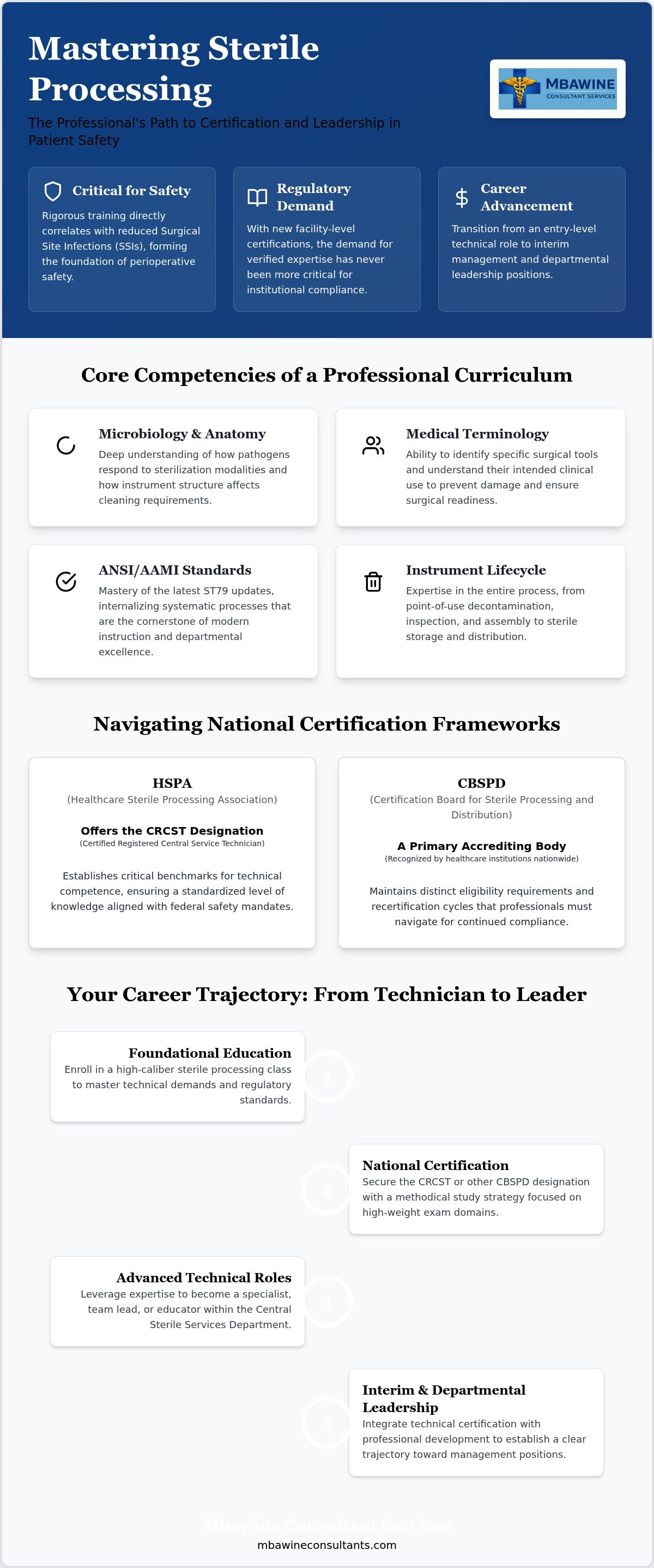
A professional curriculum must prioritize a deep examination of microbiology, anatomy, and medical terminology, as these subjects provide the necessary context for effective sterilization. Technicians must understand how specific pathogens respond to different sterilization modalities and how the physiological structure of an instrument affects its cleaning requirements. This involves mastering the lifecycle of a surgical instrument, starting from the point of use in the operating room through decontamination, inspection, assembly, and eventual sterile storage. A technician's ability to identify specific surgical tools and understand their intended clinical use is vital for preventing instrument damage and ensuring surgical readiness.
Adherence to ANSI/AAMI standards, particularly the latest ST79 updates, remains the cornerstone of modern instruction. These institutional guidelines shape the frameworks used in a high-level sterile processing class New York, ensuring that students aren't just memorizing steps but are internalizing the systematic processes required for departmental excellence. By focusing on these core competencies, aspiring professionals can prepare for the CRCST designation and establish themselves as reliable experts in the field. This level of preparation is vital for those seeking to transition from entry-level roles into advanced technical or management positions within the healthcare ecosystem.
Professional accreditation in the field of instrument reprocessing is governed by two primary bodies: the Healthcare Sterile Processing Association (HSPA) and the Certification Board for Sterile Processing and Distribution (CBSPD). These organizations establish the benchmarks for technical competence, ensuring that every technician possesses a standardized level of knowledge that aligns with FDA Good Manufacturing Practice and other federal safety mandates. While both boards are recognized by healthcare institutions, they maintain distinct eligibility requirements and recertification cycles that professionals must navigate with precision. A high-quality sterile processing class New York acts as a bridge, synthesizing the vast didactic material found in industry manuals into actionable knowledge that prepares candidates for the rigorous nature of these national examinations.
The Certified Registered Central Service Technician (CRCST) designation offered by HSPA is widely regarded as the premier credential for professionals within the Central Service environment. Full certification requires the successful completion of a 150-question examination and the documentation of 400 hours of hands-on experience in a sterile processing department. This experiential requirement ensures that the technician has moved beyond theoretical concepts to master the tactile complexities of instrument decontamination and sterilization. It's essential to select a curriculum that mirrors the HSPA eighth edition manual to ensure all exam domains are thoroughly covered. Candidates often begin their journey by seeking CRCST certification preparation to master the high-weight domains of the exam, such as sterilization and equipment management, before attempting the provisional or full certification process.
The CBSPD provides an alternative pathway for certification, offering the Certified Sterile Processing and Distribution Technician (CSPDT) designation. Eligibility for the CBSPD technician exam can be met through several avenues, including twelve months of full-time employment or the successful completion of a training course with a grade of 70 or higher. A significant distinction between the two boards lies in their maintenance requirements; while HSPA requires annual renewal with 12 continuing education credits, CBSPD operates on a five-year recertification cycle necessitating 100 contact hours. A comprehensive sterile processing class New York should ideally address the core competencies required by both boards, allowing students the flexibility to pursue the credential that best fits their career trajectory. Aspiring technicians who wish to secure their professional standing should enroll in a structured program that provides both the technical depth and the clinical context required for long-term success in the field.
The pedagogical landscape of healthcare technical training has undergone a significant transformation, necessitating a sophisticated evaluation of how complex sterilization concepts are transmitted to aspiring professionals. While traditional classroom settings provide immediate tactile feedback, modern digital platforms have evolved to offer high-fidelity simulations that mirror the high-stakes environment of a decontamination suite. Selecting a sterile processing class New York requires a critical assessment of whether the instructional format aligns with both the student's learning style and the rigorous institutional standards of modern healthcare facilities. In-person instruction remains highly effective for tactile learners who require manual instrument handling practice to master the complexities of tray assembly; however, the contemporary workforce increasingly utilizes hybrid models that provide the flexibility necessary for those already balancing clinical responsibilities.
Modern digital learning platforms have moved beyond static text, leveraging interactive modules and virtual simulations to help students master decontamination protocols and microbiological control. These programs allow for a level of self-paced mastery that is particularly advantageous for career-changers or current healthcare employees seeking to formalize their expertise without disrupting their existing professional commitments. By utilizing high-resolution visual aids and step-by-step digital walkthroughs, students can visualize the microscopic reality of bioburden and the specific chemical reactions involved in high-level disinfection. Those seeking to advance their technical proficiency should evaluate various professional training options to ensure their chosen curriculum maintains the technical rigor required for national certification.
Access to seasoned consultants and educators represents a superior educational advantage over automated learning software, as human mentors provide the clinical context that software cannot replicate. Live Q&A sessions and consultative feedback loops are essential for clarifying the nuanced regulatory and technical standards that define the field. An authoritative instructor acts as a bridge between theoretical knowledge and the situational challenges encountered in a high-volume Central Service department. This mentorship is vital for developing the critical thinking skills required to manage departmental emergencies or complex instrumentation sets. For a deeper understanding of how high-level expertise optimizes departmental outcomes, professionals should consult the 2026 Guide to Sterile Processing Consultant Services, which details the role of specialized knowledge in achieving institutional excellence. A sterile processing class New York that prioritizes this expert-led approach ensures that students are not just memorizing facts, but are preparing for the realities of clinical leadership.
Establishing a methodical study schedule is the cornerstone of professional certification, as the breadth of material requires a disciplined, domain-specific approach that prioritizes high-weight exam components. Candidates must allocate their preparation time according to the statistical significance of each domain, focusing heavily on the technical processes that occur within the decontamination and sterilization phases. Mock assessments and practice examinations serve as essential diagnostic tools, allowing students to identify knowledge gaps before they impact their performance on the national stage. Successful candidates develop a deep understanding of technical terminology and instrumentation categories, ensuring they can distinguish between complex surgical sets and identify the appropriate reprocessing modality for each. This level of preparation is necessary to navigate the high-stakes environment of the modern surgical suite where precision is the only acceptable standard.
Preparation should focus on the high-priority areas of cleaning, disinfection, and sterilization, which collectively account for approximately 40% of the certification examination. Beyond these technical tasks, a professional curriculum must address the administrative and risk management aspects of the Central Service department, including documentation requirements and safety protocols. Technicians who understand the regulatory reasoning behind every action are better equipped to navigate the situational questions that test clinical judgment rather than simple recall. This comprehensive approach ensures that the technician is prepared for the diverse challenges of a high-volume department. Exam success is a byproduct of clinical mastery, not just rote memorization.
Utilizing structured resources is vital for maintaining the momentum required to achieve a first-time pass rate on national exams. Students should enroll in professional preparatory classes to gain access to expert-led instruction that clarifies complex concepts. Engaging with professional forums and study groups further enhances conceptual understanding by allowing for the peer-to-peer exchange of technical insights and practical experiences. For the most current industry benchmarks, professionals should refer to the Healthcare Sterilization: 2026 Professional Standards, which details the evolving requirements for institutional compliance. Integrating these resources into a sterile processing class New York ensures that every student is prepared not just for an exam, but for a career defined by excellence and patient safety. By mastering these standards, you position yourself as a reliable guardian of public health within the healthcare ecosystem.
Completion of a sterile processing class New York is not a terminal achievement; it is the entry point into a specialized professional ecosystem. True career advancement requires integrating this foundational education with strategic placement and ongoing leadership development. Mbawine Consultant Services functions as a bridge, connecting certified professionals with high-stakes healthcare environments that demand technical excellence. This integrated approach ensures that education doesn't exist in a vacuum but serves as a direct pathway to institutional influence. By maintaining a robust network of staff and alumni, the organization provides a continuous framework for professional growth, moving beyond entry-level roles into specialized consulting and departmental oversight.
High-performance departments require technicians who understand the clinical gravity of their work and can execute protocols with absolute precision. Standard staffing agencies often lack the technical depth to evaluate a sterile processing professional's true capability, which can lead to misalignment between technician skill sets and departmental needs. By focusing on specialized staffing solutions, certified individuals can access opportunities that align perfectly with their technical proficiency and career goals. Exploring staff and alumni opportunities allows professionals to leverage a network of high-level experts who have navigated similar career trajectories. This connection is particularly vital during crisis or surge management, where departments require immediate, expert-level intervention to maintain institutional standards and patient safety.
The transition from a technical role to a management position represents a strategic evolution in a professional's career. Advanced certification and extensive clinical experience prepare technicians for the complexities of departmental oversight, including budgeting, regulatory compliance, and staff development. Many facilities now rely on sterile processing interim leadership to navigate regulatory transitions or optimize operational workflows during periods of institutional change. Positioning yourself as a consultant involves more than just technical knowledge; it requires a deep understanding of risk management and human resource optimization. This career path allows you to leverage your sterile processing class New York experience to solve systemic challenges and elevate the standards of the entire Central Service department. As the healthcare landscape becomes increasingly regulated, the demand for certified professionals who can provide authoritative guidance continues to expand, offering a clear trajectory toward specialized consulting roles.
Professional mastery in the field of sterilization represents a rigorous commitment to patient safety and institutional integrity that extends far beyond the initial attainment of credentials. By navigating the complexities of HSPA and CBSPD frameworks and adopting a methodical approach to exam preparation, you establish a technical foundation that is essential for the high-stakes surgical environments of 2026. Enrolling in a sterile processing class New York provides the clinical context and technical depth required to transition from basic technical execution into roles of interim leadership and specialized consulting. This educational journey is the critical first step in positioning yourself as an authoritative guardian of industry standards and a reliable expert within the healthcare ecosystem.
Mbawine Consultant Services offers an authoritative educational framework designed to facilitate your successful attainment of national CRCST certification through direct mentorship from industry-leading sterile processing consultants. Our mission-driven approach ensures comprehensive support from your initial enrollment through to professional placement in high-performance departments. Secure your professional future by enrolling in our expert-led sterile processing classes today. The path toward technical mastery is a significant undertaking, but your dedication to excellence will ensure a career defined by professional reliability and a profound impact on public health.
Most comprehensive sterile processing programs require approximately four to six months of dedicated study to master the technical and regulatory requirements. This duration ensures that students can thoroughly internalize complex concepts such as microbiological control and instrumentation assembly before attempting national examinations. The timeline may vary based on whether the curriculum is delivered through an accelerated format or a standard academic semester.
Certification is not currently mandated by federal law; however, it is required by legislation in several states across the country. Even in jurisdictions where it is not a legal requirement, most high-performance healthcare facilities demand national certification to ensure institutional compliance and patient safety. This reflects a broader national trend toward the professionalization of the sterile processing field to mitigate surgical risks and improve clinical outcomes.
The HSPA Certified Registered Central Service Technician (CRCST) designation requires 400 hours of hands-on experience and annual recertification with 12 continuing education credits. Conversely, the CBSPD Certified Sterile Processing and Distribution Technician (CSPDT) credential offers eligibility based on a training course grade of 70 or higher and operates on a five-year recertification cycle. Both certifications are widely recognized by institutional leadership as valid evidence of technical proficiency.
Aspiring technicians can successfully complete a sterile processing class New York through online learning platforms that offer the flexibility required for full-time employees. These digital programs utilize virtual simulations and high-fidelity modules to deliver the same technical rigor found in traditional classroom settings. This modality allows professionals to advance their expertise without interrupting their current clinical or administrative responsibilities.
Enrolling in a professional sterile processing program typically requires a high school diploma or an equivalent General Education Development (GED) credential. Some institutions may also require candidates to undergo background checks or health screenings to ensure eligibility for clinical rotations within a Central Sterile Services Department. These standards maintain the professional integrity of the field and ensure that all students are prepared for the high-stakes nature of surgical support.
The Healthcare Sterile Processing Association (HSPA) requires exactly 400 hours of documented hands-on experience to achieve full CRCST status. Candidates may pursue provisional certification by passing the exam first, after which they have six months to complete and submit their hours. This experiential requirement ensures that every certified technician has demonstrated tactile mastery of decontamination, inspection, and sterilization processes in a live clinical environment.
As of September 2026, the examination fee for the HSPA CRCST certification is $140, which includes a non-refundable $25 application fee. The CBSPD CSPDT technician exam is priced at $128 for candidates seeking entry-level technical certification. It's important to note that these costs are separate from the tuition for a sterile processing class New York and are paid directly to the respective national certifying bodies.
Candidates who do not achieve a passing score on their first attempt are permitted to retest after a designated waiting period. For the HSPA examination, individuals must wait six weeks before submitting a new application and paying the full exam fee again. This interval provides an opportunity for a methodical review of knowledge gaps identified during the initial assessment to ensure success on the subsequent attempt.

Article by
Mba Akuribila
Mba‑Akuribila is a healthcare leader, educator, and founder of Mbawine Consultants, a Bronx‑based institution recognized nationwide for advancing excellence in sterile processing and allied health workforce development. Born in Bongo in Ghana’s Upper East Region, his journey from rural beginnings to national impact reflects a lifelong commitment to service, empowerment, and community advancement.
For over two decades, he has trained sterile processing employees, mentored, and placed thousands of healthcare professionals across the United States. Through Mbawine Consultants, he established one of the country’s most trusted Sterile Processing Certification Test Prep Programs, preparing new Americans and career‑changers for successful entry into the field. The organization, as at 2026, has graduated more than 15,000 sterile processing technicians who now serve in hospitals, ambulatory centers, dental practices, and reprocessing facilities nationwide.
Under his leadership, Mbawine Consultants has expanded into a full Healthcare Staffing Agency, connecting nurses and allied health professionals to meaningful employment opportunities. His team also provides Interim Management Services, supporting hospitals and surgical centers with experienced leaders who stabilize operations, strengthen compliance, and improve workflow efficiency.
As a former surgical technician, sterile processing manager, educator, and system‑wide director, Mba‑Akuribila brings deep expertise to Sterile Processing Consulting, helping healthcare facilities elevate quality, safety, and regulatory readiness.
His work in the United States and Ghana continues to reflect his core philosophy: service above self, opportunity for all, and excellence without compromise.


