

When a sterilizer displays an error code, treat it as a signal to pause and assess the cycle, not as a repair instruction. During troubleshooting common sterilizer error codes, that distinction matters: alerts vary by model, and the same message should not be treated as a universal diagnosis. If a cycle stops or its outcome is uncertain, the need to restore instrument availability must not override steps to protect the load, equipment, and patient safety.
A systematic response is safer than a guess. This guide explains how to respond to an alert without bypassing safety controls or assuming a load is acceptable, where to find the model-specific meaning in the operator manual, and which details to document for follow-up. It also explains when to escalate an issue to qualified technical support instead of relying on routine operator checks. Strong sterile processing education can help build the judgment these situations require, while facility procedures and equipment instructions remain central to each decision.
A sterilizer error code is a machine-generated indication that a monitored condition needs attention. It may appear when the control system detects a condition outside the parameters for the selected cycle. The message is a starting point for investigation, not a complete explanation of what happened. A sterilizer, also known as an autoclave, uses controlled conditions to process items, which is why its alerts need careful interpretation.
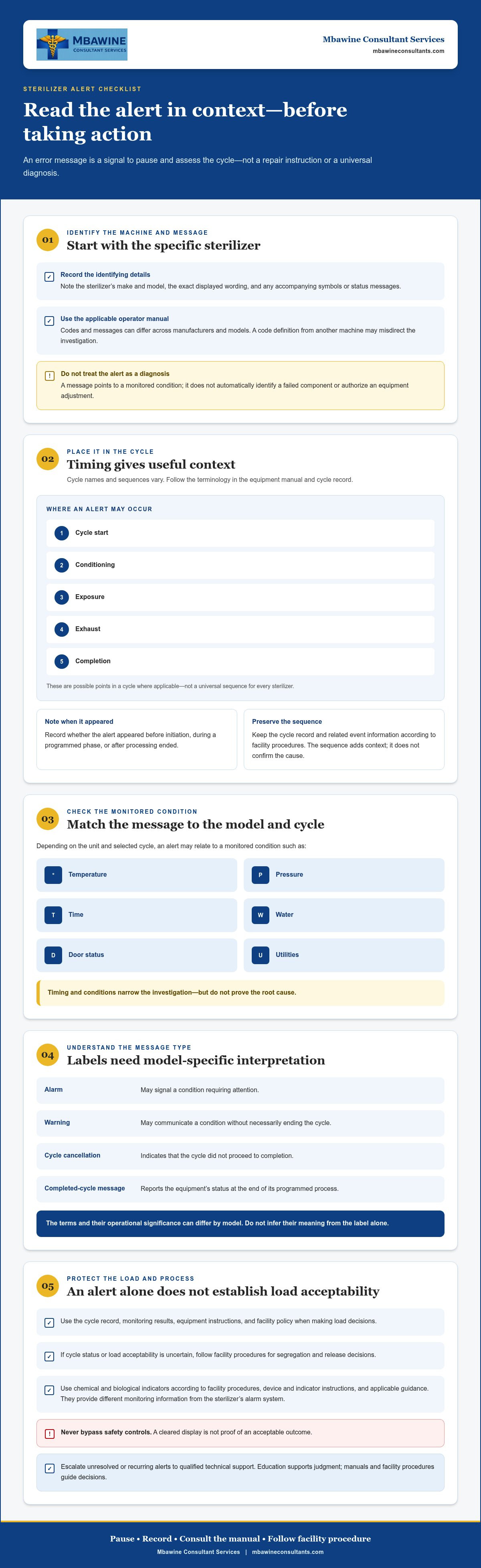
The manufacturer’s operator manual governs how to interpret a code displayed by that specific sterilizer model. Codes and messages are not universal. The same number or wording can refer to different conditions on equipment from different manufacturers, or even across models from one manufacturer. Control systems, cycle parameters, and display conventions vary. A code definition found online for another machine can therefore misdirect troubleshooting common sterilizer error codes. Record the sterilizer’s make and model, the exact displayed wording, and any accompanying symbols or status messages.
Each sterilizer monitors conditions according to its design and programmed cycles. An alert’s meaning and the appropriate operator response may depend on the specific unit, selected cycle, and point in the process when the message appeared. Do not apply a code from a different model as a diagnosis. Use the manual for the equipment in question, and follow facility procedures if the alert’s meaning or next step remains unclear.
Alerts point to monitored conditions, but they do not automatically diagnose failed components. Depending on the manual’s instructions, a message may direct an operator to check a correctable condition, or it may indicate a fault requiring qualified technical assessment. Do not assume the message identifies the underlying cause or authorizes an equipment adjustment.
Use the manual’s terminology to distinguish message types. An alarm may signal a condition requiring attention; a warning may communicate a condition without necessarily ending the cycle. A cycle cancellation indicates that the cycle did not proceed to completion, while a completed-cycle message reports the equipment’s status at the end of its programmed process. These terms and their operational significance can differ by model, so do not infer their meaning from the label alone.
An error message by itself does not establish whether a load is sterile or may be released. That decision depends on the cycle record, monitoring results, equipment instructions, and facility policy. If cycle status or load acceptability is uncertain, follow facility procedures for segregation and release decisions. A cleared display is not proof of an acceptable outcome.
An alert’s timing helps place it within the sterilization process, but cycle names and sequences differ among equipment. Use the terminology in the sterilizer’s operator manual and cycle record rather than assuming every machine follows the same sequence. Where applicable, alerts may occur at cycle start, during conditioning, exposure, exhaust, or completion. The display may relate to monitored temperature, pressure, time, water, door status, or utilities. Check the alert’s meaning against the specific model and selected cycle.
An alert before a cycle starts has a different context from one that appears during exposure or after processing ends. Note the stage shown by the machine, the exact message, and the order of events recorded before and after it. For example, recording whether a door-status alert appeared before initiation or during a programmed phase gives technical reviewers useful context, but does not prove what caused it. The cycle phase and exact message narrow the investigation, but they do not confirm the root cause.
Preserve the cycle record and related event information according to facility procedures. A sequence of messages can help distinguish the initial alert from later notifications and provide more useful context for technical assessment than a remembered code alone. Do not infer a universal cause from timing. Consult the manual for the unit’s interpretation and response instructions.
The sterilizer’s alarm system reports conditions monitored by the equipment, while chemical and biological indicators provide different process-monitoring information. Neither substitutes for the other. Use indicators and interpret their results according to facility procedures, the device and indicator instructions, and applicable guidance. The FDA’s information on recognized sterilization standards provides regulatory context; it does not replace the operating instructions for a particular sterilizer or the facility’s process controls.
In practical terms, troubleshooting common sterilizer error codes means reading the alert alongside the cycle stage, machine record, and required monitoring results. For broader context on professional expectations, review the sterile processing classes, which support learning about procedures and process monitoring. Education can strengthen understanding, while model-specific instructions and facility policy guide decisions about an alert or load.
Alert categories can help organize an initial review, but they are not universal diagnoses. During troubleshooting common sterilizer error codes, use the manual for the specific make and model. Treat the checks below as prompts to consult its instructions and facility procedures, not as repair steps.
Before a cycle starts, an alert may relate to setup or a monitored utility condition, but its timing alone does not establish the cause. Check only externally visible conditions that the operator manual and facility procedure identify as appropriate for the operator. A correctable setup issue is not the same as a confirmed equipment fault. Do not bypass an interlock, remove panels, or perform electrical work.
A visible check never authorizes opening a pressurized chamber or overriding a safeguard. If a safe, permitted check does not resolve the alert, stop and follow the facility’s escalation process. The CDC guidelines on sterilizing practices provide context for operating practices, including loading and monitoring.
Keep the cycle record and follow facility procedures for load segregation, release decisions, and any repeat processing. Do not assume that running another cycle automatically resolves a failed or interrupted process. Escalate an alert that returns, conflicts with recorded parameters, or leaves process acceptance uncertain. Qualified technical support can assess equipment concerns using the complete event information.
A safety-first response preserves the information needed to assess an alert and keeps load decisions within facility controls. During troubleshooting common sterilizer error codes, take only actions authorized by the operator manual and facility procedures. Do not treat a generic online explanation as authority to adjust equipment, release a load, or repeat processing.
Accurate details support review. A paraphrased alert or missing cycle phase can make the event harder to assess. Include related cycle-record information and note whether the alert appeared before, during, or after processing. Follow facility policy to identify, hold, or otherwise manage the load while its status is assessed. Decisions about release or repeat processing belong to the established facility process, not an online code list.
Stop operator-level checks if the alert recurs, its meaning remains unclear, or the next step would exceed the manual’s instructions or your role. Keep the equipment out of service when required by the manual or facility policy. Preserve records and document actions taken for technical review. Do not assume that restarting or repeating a cycle resolves a fault or establishes load acceptability.
Sterile processing education can strengthen procedural understanding and judgment in these situations. Sterile processing classes can help build broader knowledge of safe practices, documentation, and escalation.
Reliable troubleshooting depends on more than recognizing an alert. Staff need a sound understanding of sterile processing procedures, documentation, monitoring, and their role in escalating concerns. That foundation supports a consistent response: capture the message accurately, follow facility policy, and distinguish an authorized operator check from a situation requiring technical review. It also helps staff use better judgment when a cycle record or monitoring result raises questions about process acceptance.
Education strengthens this knowledge, but it does not replace the sterilizer’s model-specific operator manual, facility procedures, or qualified technical service. No course or general troubleshooting guide should be used to override a safeguard or decide that an uncertain load is acceptable. Professional learning helps staff understand why established steps matter and how to apply them within their responsibilities.
Foundational sterile processing education can help staff connect equipment alerts with broader process requirements instead of treating each message as an isolated code. A consistent understanding supports complete records, appropriate use of monitoring information, and timely escalation when an alert remains unresolved. For a broader learning context, read the sterile processing classes certification guide.
Certification preparation and equipment-specific instruction serve different purposes. Certification preparation builds broader professional knowledge; the applicable sterilizer manual and qualified technical support guide responses to a particular model or equipment fault. Mbawine Consultant Services provides in-person and online sterile processing classes, along with CRCST certification preparation for learners seeking focused credential-related study.
As you build confidence in troubleshooting common sterilizer error codes, keep the same boundaries in view: apply training to strengthen your understanding, follow facility policy, and use the appropriate technical escalation pathway when required. To continue developing your sterile processing knowledge, explore sterile processing classes.
Effective troubleshooting starts by treating an error as a model-specific signal, not a universal diagnosis. Use the applicable operator manual and facility procedures to interpret the message, record its timing and cycle context, and protect the affected load while its status is assessed. If an alert persists, recurs, or raises questions about process acceptance, follow the designated escalation pathway instead of relying on assumptions or automatically repeating a cycle.
Consistent practice depends on sound sterile processing knowledge, including documentation, monitoring, and clear escalation roles. Structured education can strengthen that foundation, while manuals, facility policy, and qualified technical service remain essential for equipment-specific decisions. Mbawine Consultant Services offers in-person and online sterile processing classes, certification preparation, and specialized professional education.
Build on what you’ve learned about troubleshooting common sterilizer error codes and strengthen your procedural knowledge. Explore sterile processing classes and take a confident next step in your professional development.
A sterilizer error code is a machine-generated message indicating that a monitored condition needs attention. It may relate to a cycle stage or a condition such as temperature, pressure, water supply, or door status, but it does not automatically identify a failed component or confirm the cause. Check the operator manual for the specific sterilizer model, then follow facility procedures to investigate the alert and manage any affected load.
No. Codes, wording, and alert responses can differ across manufacturers and models, so an explanation for one machine may not apply to another. For safe troubleshooting common sterilizer error codes, record the make and model and the exact message shown, then consult the applicable operator manual. Avoid relying on an unverified code list or interpreting a number without confirming that it matches the equipment in use.
Restart only if the sterilizer’s operator manual and your facility’s procedures authorize that action in the specific situation. First capture the alert and relevant cycle information, then follow facility policy to hold or manage the affected load. Do not assume a restart or repeat cycle corrects an interruption, resolves an equipment concern, or makes the original load acceptable. Escalate if the alert persists, recurs, or remains unclear.
An error message alone cannot establish whether a load is sterile or releasable. The decision requires review under facility procedures, taking into account cycle records, required monitoring results, equipment instructions, and the alert’s significance for that model and cycle. Keep the affected load managed according to facility policy while its status is assessed. Do not release or reprocess it based only on an online explanation or a cleared display.
Document the sterilizer make and model, exact alert wording or code, time, selected cycle, and the cycle phase when the message appeared. Preserve the available cycle record and related event sequence, and note relevant observations and actions taken according to facility documentation procedures. Accurate details help technical reviewers assess the event and distinguish the original alert from subsequent messages. Do not alter or discard records needed for review.
Escalate through the facility’s designated technical pathway when an alert persists or recurs, appears safety-related, has no clear operator-level response in the manual, or conflicts with recorded cycle information. Stop routine troubleshooting if the next step exceeds your role or requires access beyond authorized checks. Follow instructions for taking equipment out of service when required, and preserve cycle records and documentation for qualified technical review.
No. A biological indicator provides process-monitoring information when used and interpreted according to its instructions and facility procedures, but it does not diagnose the cause of an equipment alert. Review indicator results alongside the cycle record and other required monitoring information, following applicable guidance. If an error raises questions about cycle performance or load status, use facility policy to manage the load and escalate equipment concerns through the designated pathway.
Sterile processing technicians can build procedural knowledge through structured education, facility training, and careful review of applicable equipment manuals and policies. Mbawine Consultant Services provides in-person and online sterile processing classes, certification preparation, and specialized professional education. These learning options can strengthen understanding of procedures, documentation, and monitoring. They do not replace model-specific instructions, facility requirements, or qualified technical service when equipment concerns arise.

Article by
Mba Akuribila
Mba‑Akuribila is a healthcare leader, educator, and founder of Mbawine Consultants, a Bronx‑based institution recognized nationwide for advancing excellence in sterile processing and allied health workforce development. Born in Bongo in Ghana’s Upper East Region, his journey from rural beginnings to national impact reflects a lifelong commitment to service, empowerment, and community advancement.
For over two decades, he has trained sterile processing employees, mentored, and placed thousands of healthcare professionals across the United States. Through Mbawine Consultants, he established one of the country’s most trusted Sterile Processing Certification Test Prep Programs, preparing new Americans and career‑changers for successful entry into the field. The organization, as at 2026, has graduated more than 15,000 sterile processing technicians who now serve in hospitals, ambulatory centers, dental practices, and reprocessing facilities nationwide.
Under his leadership, Mbawine Consultants has expanded into a full Healthcare Staffing Agency, connecting nurses and allied health professionals to meaningful employment opportunities. His team also provides Interim Management Services, supporting hospitals and surgical centers with experienced leaders who stabilize operations, strengthen compliance, and improve workflow efficiency.
As a former surgical technician, sterile processing manager, educator, and system‑wide director, Mba‑Akuribila brings deep expertise to Sterile Processing Consulting, helping healthcare facilities elevate quality, safety, and regulatory readiness.
His work in the United States and Ghana continues to reflect his core philosophy: service above self, opportunity for all, and excellence without compromise.


